Atoms, nuclei and nuclear change
Học bằng cách chơi
Trả lời những câu hỏi này để kiếm năng lượng, rồi câu cá và khám phá. Không cần tài khoản.
Ghi chú bài học
Big idea: atoms, nuclei and nuclear change
- Key concept: Systems. A tiny, positively charged nucleus accounts for large deflections of a few incident α particles. Most particles pass through because an atom is mostly empty space.
- Related concepts: Models and evidence. Use a scientific explanation to make predictions, then test it against observations.
- Global context: Scientific and technical innovation. Scattering evidence lets scientists test models of structures too small to observe directly.
Atomic Structure
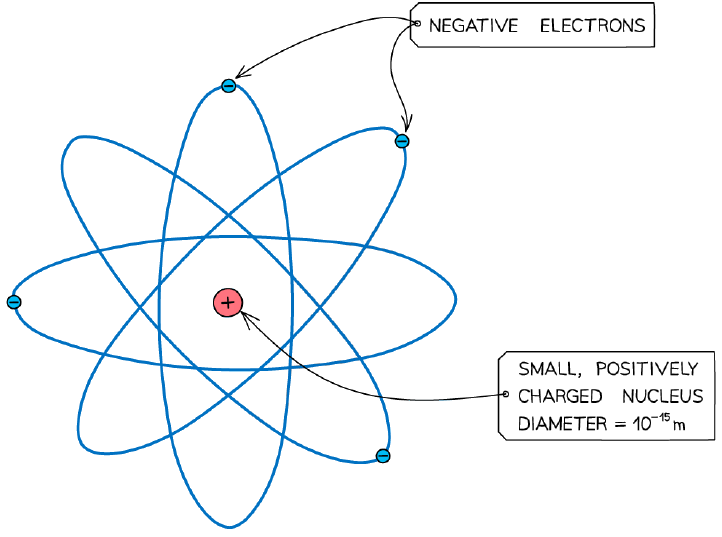
- Atoms consist of a small, dense, positively charged nucleus surrounded by negatively charged electrons in orbit.
- Atom radius ≈ 1 × 10⁻¹⁰ m; nucleus radius is over 10,000 times smaller but contains almost all the mass.
- A neutral atom has equal numbers of protons and electrons.
- Ions are formed when an atom loses or gains electrons: losing electrons → positive ion; gaining electrons → negative ion.
Diagram of an atom with a positively charged nucleus and negatively charged electrons orbiting it.
Rutherford's Alpha Scattering Experiment
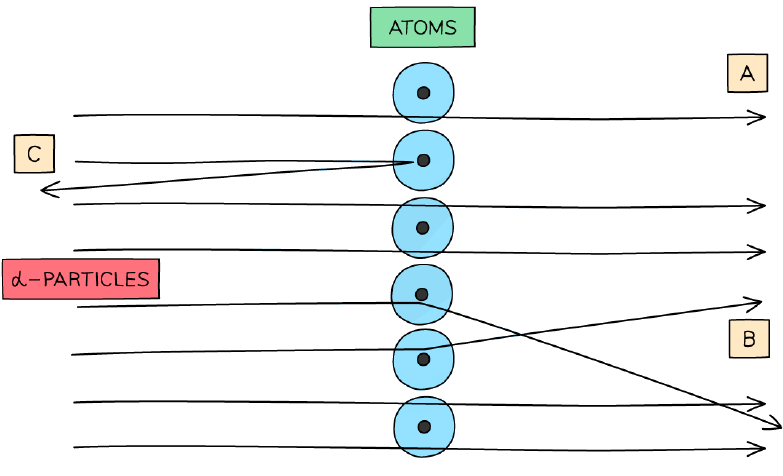
- In 1909, Rutherford, Geiger and Marsden fired α-particles at thin gold foil.
- Most α-particles passed straight through → atom is mostly empty space.
- Some were deflected → repelled by a small, positively charged nucleus.
- A very few bounced back → nucleus is tiny and contains most of the mass.
- This disproved the Plum Pudding model and provided evidence for the nuclear model.
Rutherford's Alpha Scattering Experiment
The Nucleus
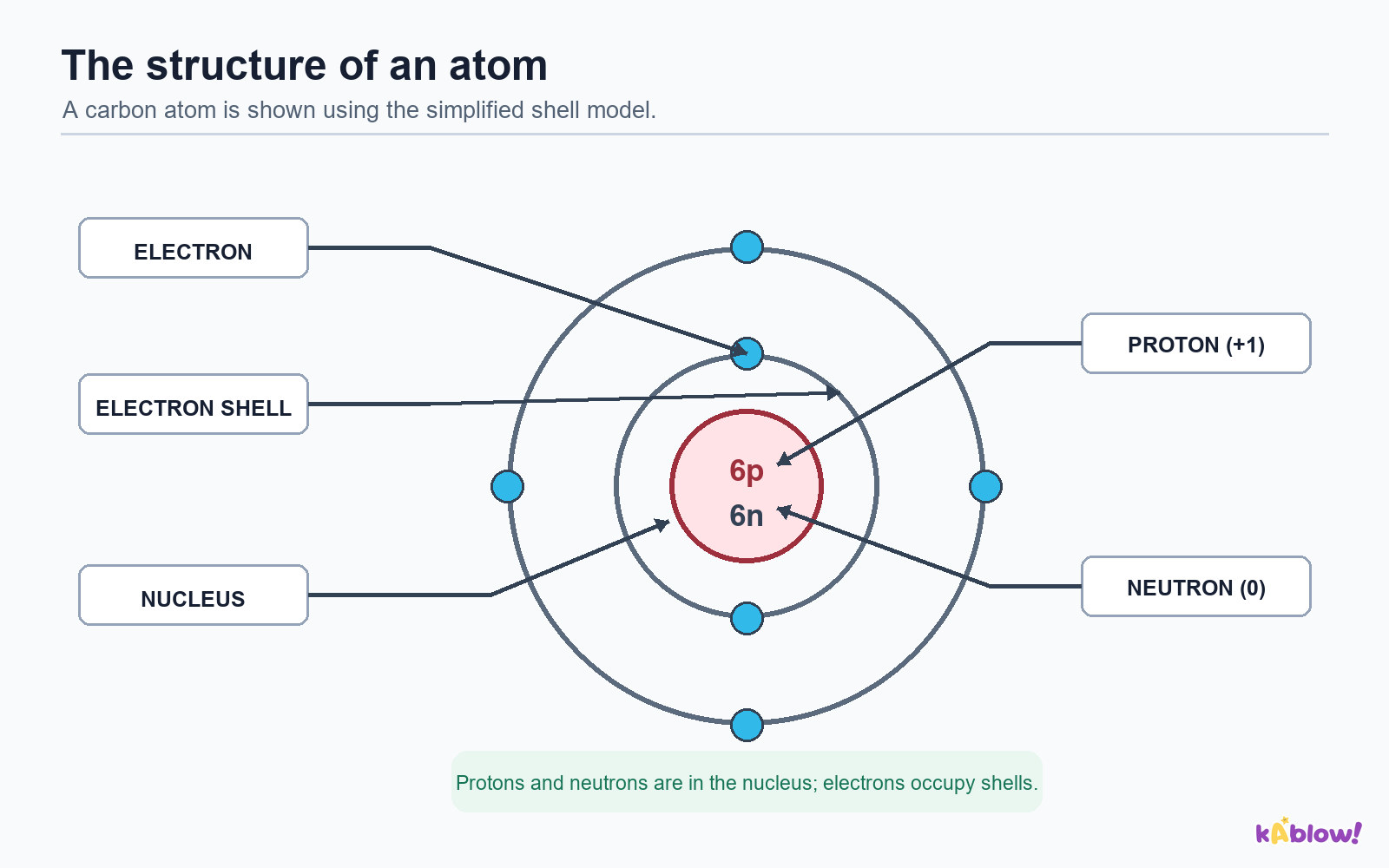
- The nucleus contains protons (positive charge) and neutrons (no charge); overall positive charge.
- Proton number (Z) = number of protons = atomic number; determines the element.
- Nucleon number (A) = total number of protons and neutrons (mass number).
- Number of neutrons = nucleon number − proton number.
Structure of the atom
Nuclide Notation
- Nuclide notation: \ce{AZX} where X = element symbol, A = nucleon number, Z = proton number.
- Example: \ce{19779Au} has 79 protons, 118 neutrons (197−79), and 79 electrons.
- A nuclide is a group of atoms with the same number of protons and neutrons.
Isotopes
- Isotopes are atoms of the same element with the same number of protons but different numbers of neutrons.
- They have the same Z but different A.
- Example: \ce{23592U} and \ce{23892U} are isotopes of uranium.
- Some isotopes are stable and others are radioactive. Nuclear stability depends on the balance of protons and neutrons and other nuclear properties; being an isotope does not itself mean being unstable.
Protons, Neutrons & Electrons
- Relative charges: proton = +1, neutron = 0, electron = −1.
- Relative masses: proton = 1, neutron = 1, electron = negligible (≈1/2000).
- Nuclear charge = number of protons × (+1).
- Relative mass of atom ≈ nucleon number (mass of electrons negligible).
Nuclear Fission
- Nuclear fission is the splitting of a heavy nucleus into smaller nuclei, often with neutrons and energy released; neutron absorption can trigger it.
- A neutron collides with the nucleus, which splits into daughter nuclei and 2–3 neutrons, releasing energy and gamma rays.
- Example: \ce{23592U + 10n → 9236Kr + 14156Ba + 310n + energy}.
- The total nucleon and proton numbers are conserved; mass decreases slightly as mass is converted to energy.
- Used in nuclear power stations with fuels like uranium-235 and plutonium.
Nuclear Fusion
- Nuclear fusion is the joining of two light nuclei to form a heavier nucleus.
- Occurs in stars (e.g., hydrogen fusing to helium) and requires extremely high temperature and pressure.
- Example: \ce{21H + 11H → 32He + energy}.
- Mass of product is slightly less than reactants; mass converted to energy releases huge amounts (1 kg hydrogen ≈ 10 million kg coal).
Think like a scientist
- Analyse a teacher-provided scattering simulation to compare particle deflections at different approach distances from a nucleus.
- Comparison: the approach distance from the nucleus. Outcome: the scattering angle.
- Control: keep particle energy and nuclear charge constant. Explain why this makes the comparison fairer.
- Evidence: Use a consistent method, repeated observations where appropriate and a table with labelled quantities and units. Keep unexpected results and investigate their cause.
- Safety: Practical activities need teacher supervision and an appropriate risk assessment. Use the provided data or simulation where the investigation specifies it.
- Inquiry task: State a testable question, predict the outcome using the science, then explain how your observations would support or challenge the prediction.
Evaluate the science
- Scattering evidence lets scientists test models of structures too small to observe directly.
- A model is judged by predictions and evidence; an attractive drawing alone does not establish its accuracy.
- Evaluation task: Link your conclusion to evidence, identify a limitation and suggest a specific improvement. Distinguish a measured result from an explanation of its cause.
Slide
Sign up free to view the lesson slides
Step through every slide for this topic — plus flashcards and revision notes — with a free account.
Câu hỏi luyện tập
Xem trước miễn phí — 8 trên 52 câu hỏi. Đăng ký để xem tất cả.
1.Which statement about the three isotopes of hydrogen is correct?
Easy- AThey must have different numbers of electrons orbiting their nucleus.
- BThey must all have one proton in their nuclei.
- CThey must all have one neutron in their nuclei.
- DThey must all have the same number of nucleons in their nucleus.
2.An atom consists of electrons orbiting a nucleus. The nucleus contains protons and neutrons. For the atom to be neutral, which statement must be correct?
Easy- AThe number of electrons is equal to the number of protons.
- BThe number of protons is equal to the number of neutrons.
- CThe number of electrons, protons and neutrons are all different.
- DThe number of electrons is equal to the number of neutrons.
3.The charge on an electron is -e. Which answer correctly describes the charge of a proton and the charge on a neutron?
Easy- AProton: 0, Neutron: +e
- BProton: +e, Neutron: -e
- CProton: +e, Neutron: 0
- DProton: -e, Neutron: +e
4.An isotope of uranium is represented by the symbol 92235U. Which of the answers below could be a different isotope of uranium?
Medium- A91235U
- B92238U
- C23592U
- D90235U
5.Atom X loses an electron to form an ion. Atom Y gains an electron to form an ion. Which row in the table is correct?
Easy- Acharge on ion of X: positive, charge on ion of Y: positive
- Bcharge on ion of X: positive, charge on ion of Y: negative
- Ccharge on ion of X: negative, charge on ion of Y: positive
- Dcharge on ion of X: negative, charge on ion of Y: negative
6.Where is the positive charge in an atom?
Easy- Aon the orbiting particles
- Bin the nucleus
- Cin the space between the nucleus and the orbiting particles
- Dspread throughout the atom
7.Which row correctly identifies the relative charges of the three types of particle in an atom?
Easy- Aproton: +1, neutron: -1, electron: 0
- Bproton: +1, neutron: 0, electron: -1
- Cproton: -1, neutron: +1, electron: 0
- Dproton: -1, neutron: 0, electron: +1
8.How many neutrons are in a nucleus of aluminium? The chemical symbol is 1327Al.
Easy- A13
- B27
- C14
- D40
Unlock all 52 questions, flashcards & more
Tạo tài khoản miễn phí để xem mọi câu hỏi, slide, thẻ ghi nhớ và ghi chú ôn tập cho chủ đề này.