Measurement, uncertainty and investigations
Học bằng cách chơi
Trả lời những câu hỏi này để kiếm năng lượng, rồi câu cá và khám phá. Không cần tài khoản.
Ghi chú bài học
Big idea: measurement, uncertainty and investigations
- Key concept: Relationships. Repeated measurements reveal random variation. Timing several cycles can reduce the fractional effect of reaction-time uncertainty on the estimated period.
- Related concepts: Models and evidence. Use a scientific explanation to make predictions, then test it against observations.
- Global context: Scientific and technical innovation. Uncertainty estimates help judge whether measured differences support a claim.
Measuring Length
- Use a ruler for small distances (cm), accurate to nearest millimetre (mm).
- Use a tape measure for lengths of tens of centimetres.
- Use a trundle wheel for lengths of tens of metres.
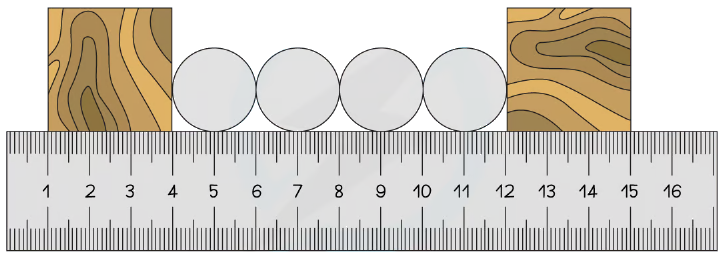
- For small objects, measure multiple (e.g., 4 ball-bearings) and divide by the number to find one diameter.
Measuring the diameter of small objects using a ruler
Measuring Volume
- Measuring cylinders measure liquid volume; read from bottom of meniscus at eye level.
- Volume of an irregular solid is found by displacement: record initial and final water levels, subtract.
- For small objects, use a smaller cylinder for greater accuracy.
Measuring Time
- Use stop-clocks or stopwatches for time intervals.
- Human reaction time (~0.25 s) affects short measurements.
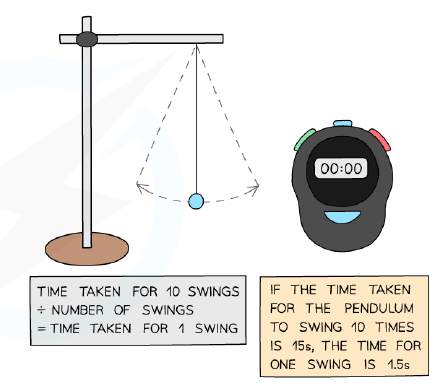
- Take multiple readings (e.g., time for 10 pendulum swings) and divide to reduce uncertainty.
- Use a fiducial marker (e.g., a dot at equilibrium) to improve timing accuracy.
Measuring time with a stopwatch and a swinging pendulum
Scalars & Vectors
- Scalars have only magnitude (e.g., mass, distance, speed, energy).
- Vectors have both magnitude and direction (e.g., weight, displacement, velocity, force).
- Distance is total path length (scalar); displacement is straight line from start to finish (vector).
- Speed is distance per time (scalar); velocity is displacement per time (vector).
Calculating with Vectors
- Vectors are drawn as arrows: length = magnitude, direction = arrow direction.
- To combine two perpendicular vectors, draw a vector diagram (scale drawing) or use Pythagoras and trigonometry.
- Resultant vector = diagonal of rectangle formed by components.
- Use soh-cah-toa to find angles; Pythagoras for magnitude.
Think like a scientist
- Compare repeated timings of one pendulum swing with timings of ten swings divided by ten, using a small-amplitude school pendulum.
- Comparison: the number of swings timed in each measurement. Outcome: the spread of estimated periods.
- Control: keep pendulum length and release angle constant. Explain why this makes the comparison fairer.
- Evidence: Use a consistent method, repeated observations where appropriate and a table with labelled quantities and units. Keep unexpected results and investigate their cause.
- Safety: Practical activities need teacher supervision and an appropriate risk assessment. Use the provided data or simulation where the investigation specifies it.
- Inquiry task: State a testable question, predict the outcome using the science, then explain how your observations would support or challenge the prediction.
Evaluate the science
- Uncertainty estimates help judge whether measured differences support a claim.
- Repeating a method does not correct a systematic offset such as a miscalibrated instrument.
- Evaluation task: Link your conclusion to evidence, identify a limitation and suggest a specific improvement. Distinguish a measured result from an explanation of its cause.
Slide
Sign up free to view the lesson slides
Step through every slide for this topic — plus flashcards and revision notes — with a free account.
Câu hỏi luyện tập
Xem trước miễn phí — 8 trên 52 câu hỏi. Đăng ký để xem tất cả.
1.Which of the following is a scalar quantity?
Easy- Adistance
- Bdisplacement
- Cvelocity
- Dacceleration
2.Which instrument is most suitable for measuring the thickness of aluminium foil?
Easy- Aruler
- Btape measure
- Cmicrometer screw gauge
- Dmeasuring cylinder
3.A student measures the time for 20 oscillations of a pendulum as 30.0 s. What is the period of the pendulum?
Easy- A0.67 s
- B1.5 s
- C10.0 s
- D20.0 s
4.A geologist uses a measuring cylinder containing water to find the volume of an irregular pebble. The water level rises from 40 cm³ to 57 cm³. What is the volume of the pebble?
Medium- A17 cm³
- B23 cm³
- C40 cm³
- D57 cm³
5.A student wants to measure the volume of a liquid as accurately as possible. Which procedure would make the measurement less accurate?
Medium- AAligning her eye level with the height of the liquid
- BReading the liquid level from the bottom of the meniscus
- CUsing the largest measuring cylinder she could find
- DUsing a set-square to make sure the cylinder is vertical
6.A boat travels 30 km east then 40 km north. What is the magnitude of its displacement?
Medium- A50 km
- B70 km
- C10 km
- D1400 km
7.A student uses a stopwatch to time 40 complete swings of a pendulum. The total time is 1 minute 52 seconds. What is the period of the pendulum?
Hard- A2.8 s
- B1.4 s
- C5.6 s
- D1.9 s
8.Three blocks X, Y, Z are placed in separate measuring cylinders. The water level rises by 10 cm³ for X, 15 cm³ for Y, and 8 cm³ for Z. Which shows the blocks in order of increasing volume?
Hard- AZ, X, Y
- BX, Y, Z
- CY, X, Z
- DZ, Y, X
Unlock all 52 questions, flashcards & more
Tạo tài khoản miễn phí để xem mọi câu hỏi, slide, thẻ ghi nhớ và ghi chú ôn tập cho chủ đề này.