Moments, balance and structural design
Học bằng cách chơi
Trả lời những câu hỏi này để kiếm năng lượng, rồi câu cá và khám phá. Không cần tài khoản.
Ghi chú bài học
Big idea: moments, balance and structural design
- Key concept: Systems. Moment equals force times perpendicular distance from the pivot. Rotational equilibrium requires total clockwise moment to equal total anticlockwise moment.
- Related concepts: Models and evidence. Use a scientific explanation to make predictions, then test it against observations.
- Global context: Scientific and technical innovation. Moment calculations help design balanced structures and lifting systems.
Moments
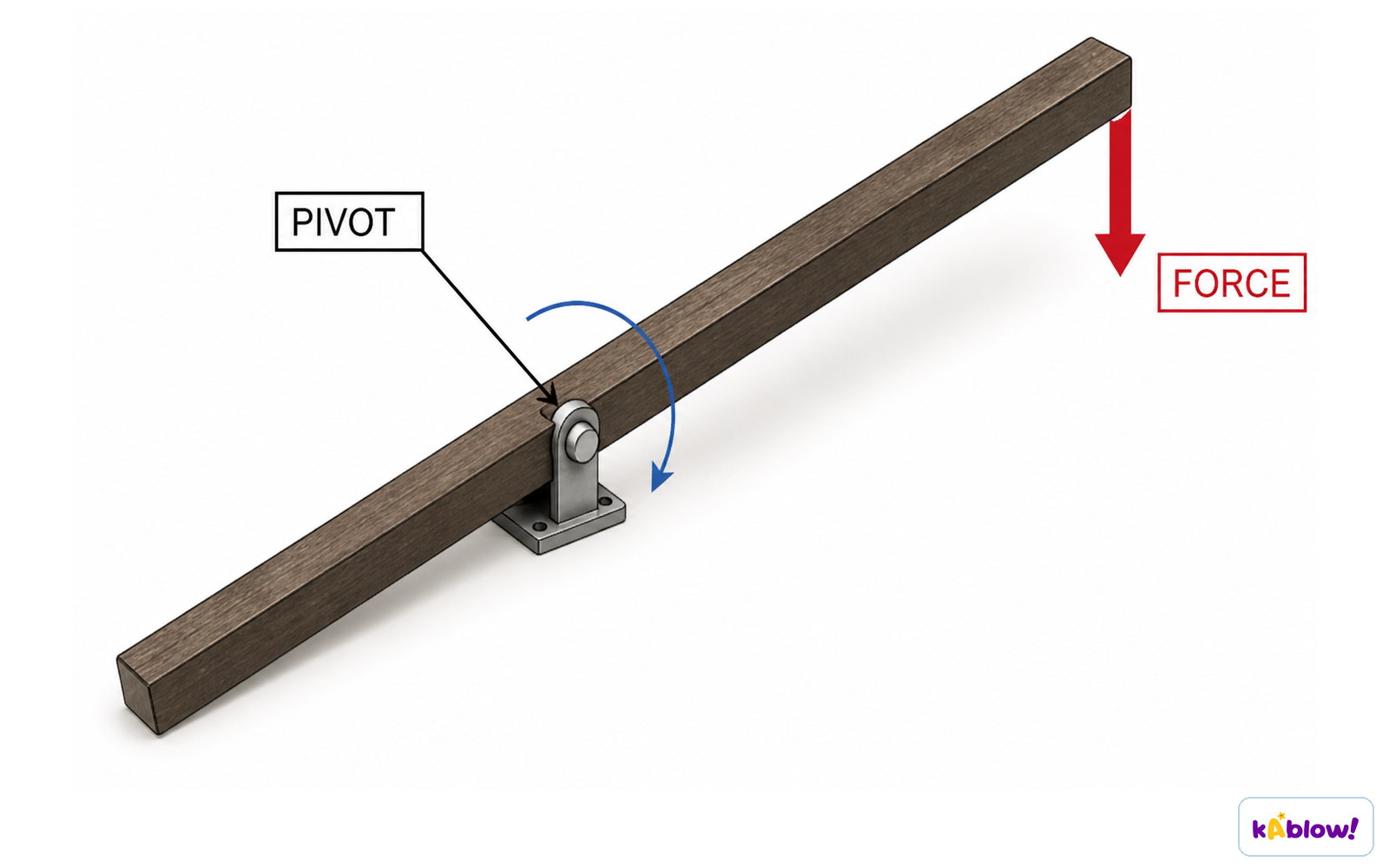
- A moment is the turning effect of a force about a pivot.
- Examples: see-saw, spanner, door, crane, screwdriver, tap, wheelbarrow, scissors.
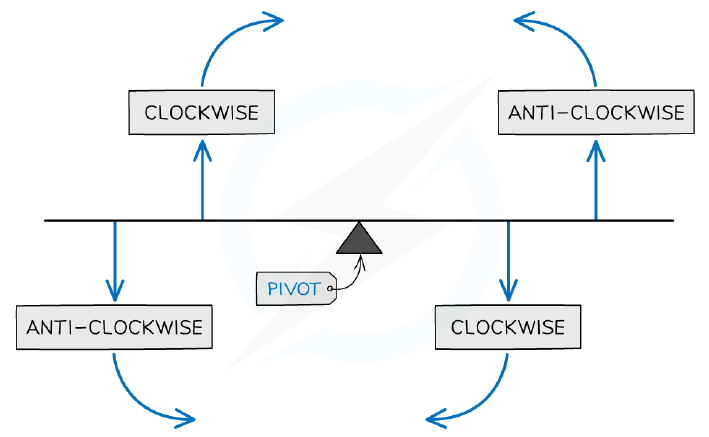
- Rotation can be clockwise or anticlockwise (use clock hands as reference).
- Equation: moment = force × perpendicular distance from pivot (M = F × d).
- Units: newton metre (N m) or newton centimetre (N cm).
- Increasing distance from pivot reduces the force needed for the same moment.
Illustration of a pivot and a force acting on a lever, demonstrating a moment.
Principle of Moments
- Principle of moments: For a balanced object, total clockwise moment equals total anticlockwise moment.
- Clockwise moment = anticlockwise moment.
- Used to solve for unknown forces or distances when the system is in equilibrium.
- Always convert distances to metres unless question specifies N cm.
Principle of moments: a beam balanced on a pivot, with the clockwise and anticlockwise turning directions labelled on each side.
Principle of Moments
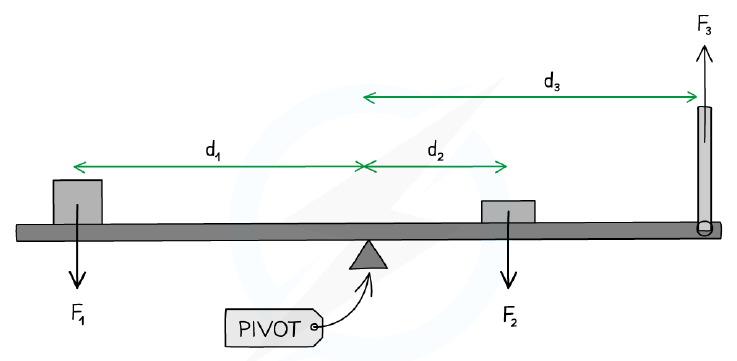
- Extended tier: multiple forces on each side of the pivot.
- Sum of clockwise moments = sum of anticlockwise moments.
- Example: F2 × d2 = (F1 × d1) + (F3 × d3).
- Ensure all distances are in the same units and directions are correctly identified.
Three forces on a beam about a pivot, with each force's perpendicular distance from the pivot labelled (d1, d2, d3).
Equilibrium
- Equilibrium means a state of balance or stability – no resultant force and no resultant moment.
- Conditions: (1) forces balanced (resultant force = 0), (2) clockwise moments = anticlockwise moments (resultant moment = 0).
- If either condition fails, the object will accelerate or rotate.
Centre of Gravity
- Centre of gravity is the point through which the weight of an object acts.
- For symmetrical objects of uniform density, it lies at the centre of symmetry.
- The centre of gravity can lie inside or outside the object.
- In force diagrams, always draw weight from the centre of gravity.
Stability
- An object is stable when its centre of gravity lies above its base.
- If the line of action of weight falls outside the base, the object topples.
- Stability increases with a low centre of gravity and a wide base.
- Tall, narrow objects (e.g., buses) are less stable and topple more easily.
Investigating Centre of Gravity (Suspension Method)
- Aim: find the centre of gravity of an irregularly shaped plane lamina.
- Method: punch 3 holes near edges, hang lamina from a clamp, use a plumb line to mark vertical line of weight.
- Repeat for each hole – the intersection of the three lines is the centre of gravity.
- When suspended, the object settles with its centre of gravity directly below the point of suspension.
- Avoid parallax error by viewing plumb line straight on; allow lamina to settle before marking.
Demonstrating Equilibrium (Extended Experiment)
- Aim: show no resultant moment for an object in equilibrium.
- Use a metre ruler pivoted at its centre, hang unequal masses on cotton loops at different distances.
- Adjust distances until ruler is horizontal and balanced.
- Calculate anticlockwise moment (m1 × g × d1) and clockwise moment (m2 × g × d2).
- Results should show anticlockwise moment = clockwise moment for equilibrium.
- Control variables: equal cotton loop lengths, no friction at pivot.
Think like a scientist
- Balance a ruler on a pivot using small known masses placed at different perpendicular distances.
- Comparison: the distance of one force from the pivot. Outcome: the balancing force required on the other side.
- Control: keep the other force's distance and pivot position constant. Explain why this makes the comparison fairer.
- Evidence: Use a consistent method, repeated observations where appropriate and a table with labelled quantities and units. Keep unexpected results and investigate their cause.
- Safety: Practical activities need teacher supervision and an appropriate risk assessment. Use the provided data or simulation where the investigation specifies it.
- Inquiry task: State a testable question, predict the outcome using the science, then explain how your observations would support or challenge the prediction.
Evaluate the science
- Moment calculations help design balanced structures and lifting systems.
- Balanced moments alone do not guarantee complete equilibrium; resultant force must also be zero.
- Evaluation task: Link your conclusion to evidence, identify a limitation and suggest a specific improvement. Distinguish a measured result from an explanation of its cause.
Slide
Sign up free to view the lesson slides
Step through every slide for this topic — plus flashcards and revision notes — with a free account.
Câu hỏi luyện tập
Xem trước miễn phí — 8 trên 50 câu hỏi. Đăng ký để xem tất cả.
1.What is the moment of a force?
Easy- AThe turning effect of a force about a pivot
- BThe speed at which a force is applied
- CThe energy transferred by a force
- DThe power output of a force
2.Which of the following is an example of the turning effect of a force?
Easy- AA child sitting on a see-saw
- BA book rests on a desk
- CA ball rolling down a hill
- DA magnet attracting a nail
3.What is the unit of a moment?
Easy- Anewton metre (N m)
- Bnewton (N)
- Cmetre (m)
- Djoule (J)
4.A force of 10 N acts at a perpendicular distance of 0.5 m from a pivot. What is the moment?
Easy- A5 N m
- B20 N m
- C0.5 N m
- D10.5 N m
5.A uniform metre rule is balanced at its midpoint. A 2.0 N weight is placed 30 cm from the pivot on the left. Where must a 3.0 N weight be placed on the right to balance the rule?
Medium- A20 cm from the pivot
- B30 cm from the pivot
- C45 cm from the pivot
- D15 cm from the pivot
6.The principle of moments states that for an object in equilibrium:
Medium- Atotal clockwise moment = total anticlockwise moment
- Btotal clockwise moment > total anticlockwise moment
- Ctotal clockwise moment < total anticlockwise moment
- Dthe sum of forces is zero
7.An object will topple over when:
Medium- Aits centre of gravity lies outside its base
- Bits centre of gravity is directly above its base
- Cits base is very wide
- Dits centre of gravity is low
8.Which of the following increases the stability of an object?
Medium- ALowering its centre of gravity
- BRaising its centre of gravity
- CMaking its base narrower
- DMaking it taller
Unlock all 50 questions, flashcards & more
Tạo tài khoản miễn phí để xem mọi câu hỏi, slide, thẻ ghi nhớ và ghi chú ôn tập cho chủ đề này.