Cell Respiration
Học bằng cách chơi
Trả lời những câu hỏi này để kiếm năng lượng, rồi câu cá và khám phá. Không cần tài khoản.
Ghi chú bài học
ATP: The Universal Energy Currency
- ATP (adenosine triphosphate) is a small, soluble molecule that provides a short-term store of chemical energy for cells.
- It is described as a universal energy currency: universal because all organisms use it, and a currency because it can be used for many different reactions and reused countless times.
- ATP is a phosphorylated nucleotide made of a ribose sugar, an adenine base and three phosphate groups.
- Hydrolysis of ATP produces ADP and a phosphate ion (π), releasing energy that can be used for processes such as DNA synthesis.
- ATP is re-synthesised when ADP combines with an inorganic phosphate; this is an energy-requiring condensation reaction that releases water as a waste product.
- ATP is relatively stable at cellular pH and only breaks down when the enzyme ATPase is present, so energy is not wasted.
- ATP is not stored in large amounts; molecules such as glucose and fatty acids act as short-term energy stores, while glycogen, starch and triglycerides are long-term stores.
- The hydrolysis of ATP is quick and easy, allowing cells to respond to a sudden increase in energy demand.
Uses of energy from respiration
Cell Respiration: An Overview
- Cell respiration is the controlled release of energy from organic compounds to produce ATP.
- It is a catabolic process that happens in every cell and involves a series of enzyme-controlled reactions called a pathway.
- Glucose is the main respiratory fuel; it can enter glycolysis directly, making it easier to oxidise than lipids and proteins.
- Lipids and proteins can also be used as respiratory substrates but must undergo several changes before entering the respiratory pathway.
- Energy is released in small, controlled steps rather than one uncontrolled step, which would cause cell damage and tissue death.
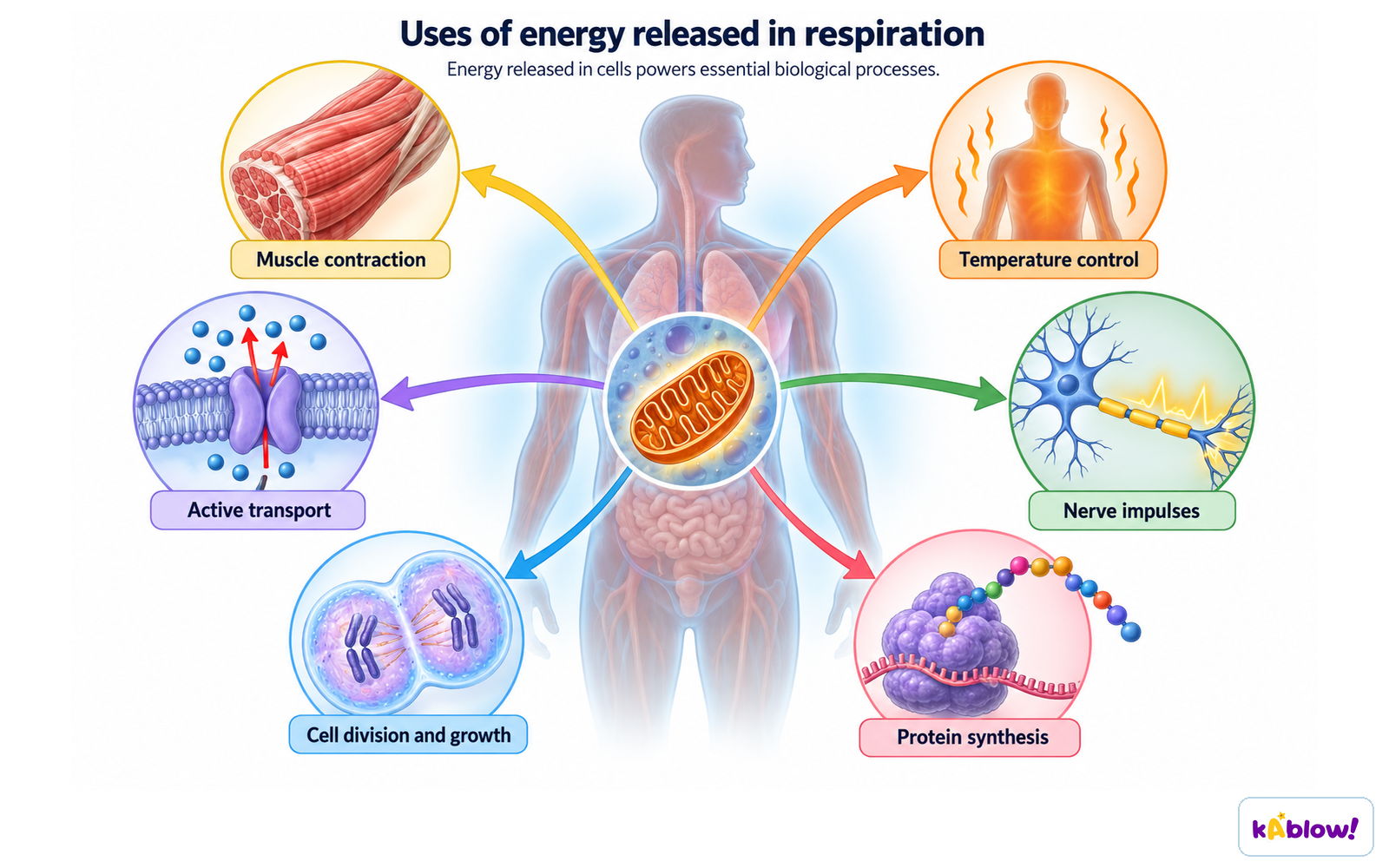
- The energy released is used for anabolic processes, muscle contraction, active transport, moving molecules around the cell, and generating heat to maintain body temperature in warm-blooded animals.
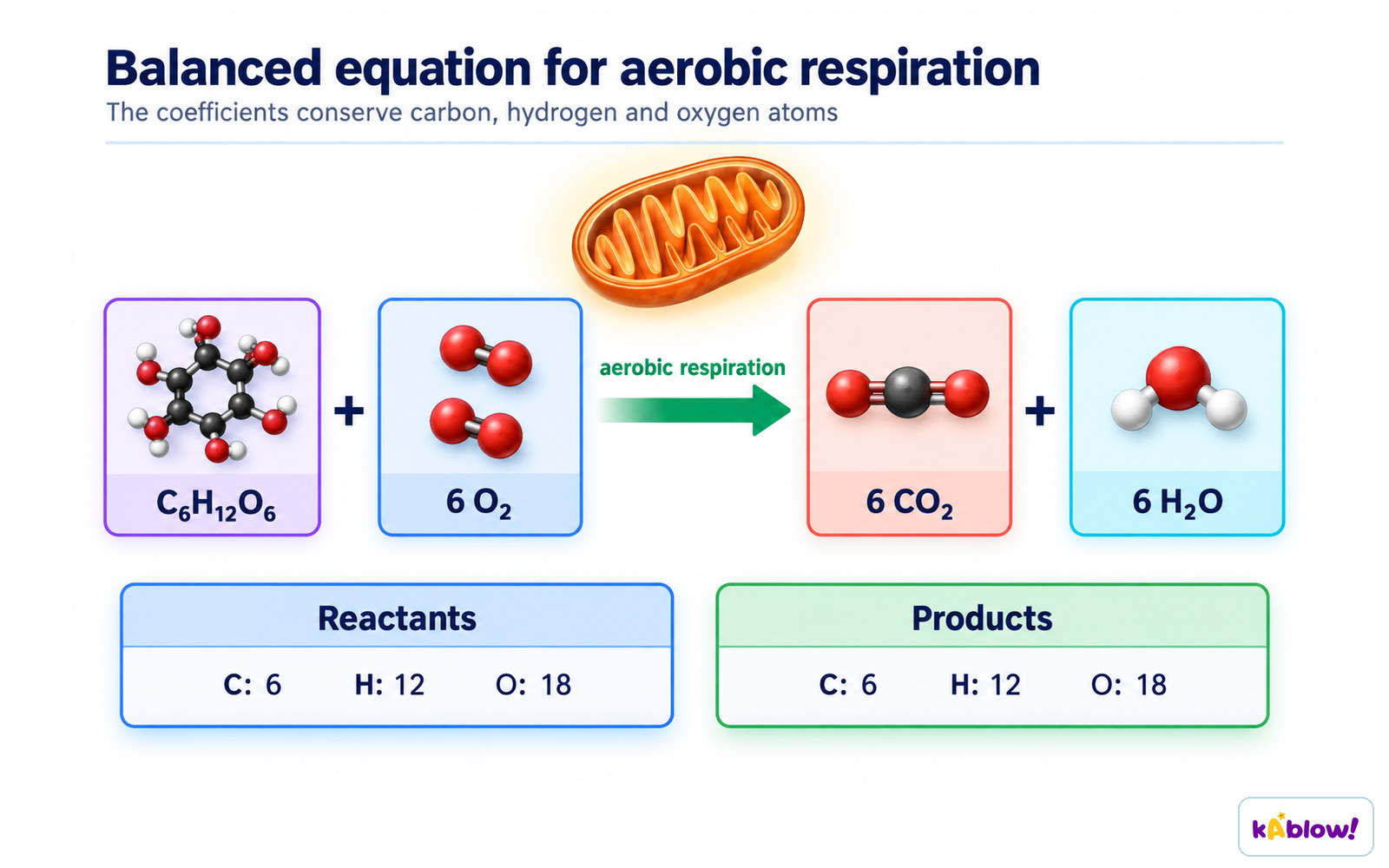
- Aerobic respiration requires oxygen, completely oxidises the substrate and yields about 36 ATP per glucose molecule.
- Anaerobic respiration occurs without oxygen, partially oxidises glucose and yields only about 2 ATP per glucose molecule.
Balanced equation for aerobic respiration
Anaerobic Respiration
- Anaerobic respiration takes place in the cytoplasm and does not involve the mitochondria.
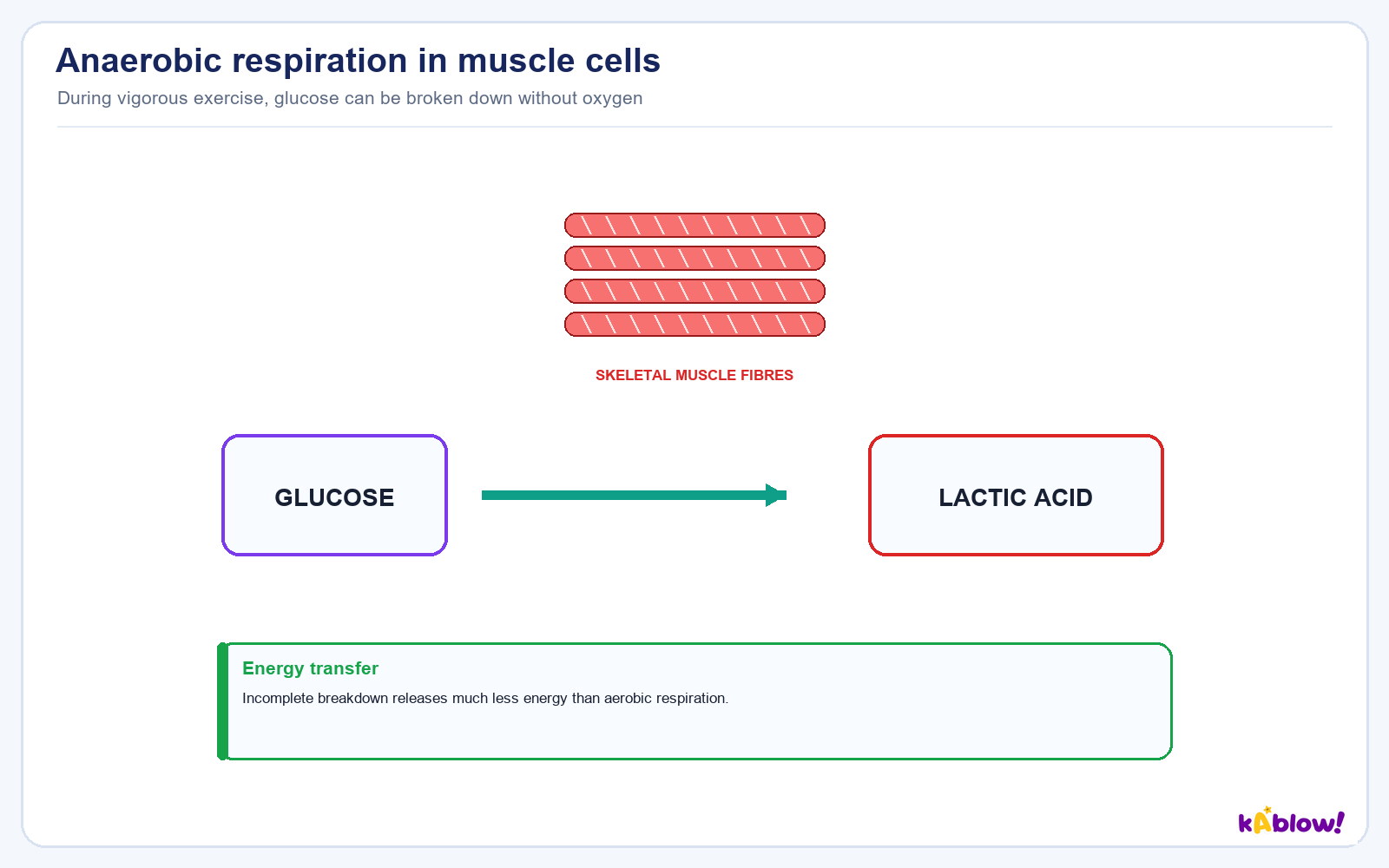
- It occurs when oxygen supply cannot keep up with demand (e.g. vigorous exercise) or when oxygen cannot reach the organism (e.g. waterlogged soil).
- Glucose is only partially oxidised, so only the first stage of respiration continues, producing a net yield of about 2 ATP per glucose molecule.
- Plants and yeasts produce ethanol and carbon dioxide during anaerobic respiration.
- Animals produce lactate during anaerobic respiration.
- In animals, pyruvate is reduced to lactate by the enzyme lactate dehydrogenase, with reduced NAD transferring its hydrogens to pyruvate.
- Lactate can be oxidised back to pyruvate (requiring extra oxygen, an oxygen debt) or converted into glycogen for storage in the liver.
- In yeast, pyruvate is decarboxylated to ethanal, producing CO2, and ethanal is then reduced to ethanol by alcohol dehydrogenase.
Anaerobic respiration in muscle
Oxidation and Reduction in Respiration
- Oxidation is the loss of electrons, loss of hydrogen, gain of oxygen, and is exergonic (releases energy).
- Reduction is the gain of electrons, gain of hydrogen, loss of oxygen, and is endergonic (absorbs energy).
- Use OILRIG to remember: Oxidation Is Loss, Reduction Is Gain.
- NAD (nicotinamide adenine dinucleotide) is the primary electron carrier in respiration; FAD (flavin adenine dinucleotide) is another.
- Both NAD and FAD are coenzymes that act as oxidising agents, gaining electrons and hydrogen ions to become reduced NAD (NADH) and reduced FAD (FADH2).
- NAD+ + 2e- + 2H+ → NADH + H+; FAD + 2e- + 2H+ → FADH2.
- When reduced carriers lose electrons, they return to their original form: NADH → NAD+ + 2e- + 2H+.
Glycolysis
- Glycolysis is the first stage of respiration and takes place in the cytoplasm.
- It traps glucose in the cell by phosphorylating it and then splits the glucose molecule in two.
- Phosphorylation: glucose (6C) is activated by phosphorylation from two ATP to form fructose-1,6-bisphosphate (6C), making it less stable and more reactive.
- Lysis: fructose-1,6-bisphosphate (6C) splits into two molecules of triose phosphate (3C).
- Oxidation: hydrogen is removed from triose phosphate by dehydrogenase and transferred to NAD, forming two reduced NAD; triose phosphate is oxidised to glycerate-3-phosphate.
- ATP formation: phosphates are transferred from intermediate substrates to form four ATP through substrate-linked phosphorylation.
- The net gain is 2 ATP (4 produced, 2 used) and 2 reduced NAD per glucose molecule.
- The end product is two pyruvate (3C) molecules; each step is catalysed by a different enzyme.
The Link Reaction
- The link reaction takes place in the matrix of the mitochondria and links glycolysis to the Krebs cycle.
- It is an oxidative decarboxylation reaction: carbon dioxide is removed to produce a 2C molecule.
- The 2C molecule is then oxidised (loss of hydrogen and 2 high-energy electrons), reducing NAD to NADH.
- The acetyl compound combines with coenzyme A to form acetyl CoA.
- The products are acetyl CoA, carbon dioxide and reduced NAD.
- Equation: pyruvate + NAD+ + CoA → acetyl CoA + carbon dioxide + reduced NAD.
- Acetyl CoA is supplied to the Krebs cycle where aerobic respiration continues.
The Krebs Cycle
- The Krebs cycle (citric acid cycle) takes place in the matrix of the mitochondria and consists of a series of enzyme-controlled reactions.
- Acetyl CoA (2C) enters the cycle and combines with oxaloacetate (4C) to form citrate (6C); coenzyme A is released to be reused.
- Citrate (6C) is converted back to oxaloacetate (4C) through a series of redox reactions.
- Decarboxylation of citrate releases two CO2 as waste gas.
- Oxidation (dehydrogenation) of citrate releases hydrogen atoms that reduce coenzymes: 3 NAD+ and 1 FAD → 3NADH + H+ and 1 FADH2.
- Substrate-level phosphorylation transfers a phosphate from an intermediate to ADP, forming one ATP.
- As the link reaction produces two acetyl CoA per glucose, the Krebs cycle occurs twice per glucose molecule.
- Per glucose molecule, the Krebs cycle produces 4 CO2, 2 ATP, 6 NADH + H+ and 2 FADH2.
Oxidative Phosphorylation
- The electron transport chain is made of a series of redox reactions via membrane proteins (electron carriers) embedded in the inner mitochondrial membrane.
- Electron carriers are positioned close together so electrons can pass from carrier to carrier.
- The cristae are impermeable to protons, so electron carriers pump protons across the membrane to establish a proton (electrochemical) gradient.
- Energy is transferred when a pair of electrons is passed to the first carrier, converting reduced NAD back to NAD+.
- As electrons are transported along the carriers, energy is released in a controlled manner and used to form ATP by adding π to ADP.
- 3 ATP molecules are produced for every molecule of reduced NAD, contributing to a total yield of 32 ATP per glucose molecule during aerobic respiration.
- Chemiosmosis: protons accumulate in the intermembrane space and return to the matrix through ATP synthase, which catalyses phosphorylation of ADP to generate ATP.
- Oxygen acts as the final electron acceptor, is reduced by electrons, and combines with protons to form water.
Respiratory Substrates: Lipids and Carbohydrates
- Lipids are an excellent source of energy, transferring more than twice the energy per gram as carbohydrates when oxidised.
- This is because lipids have fewer oxygen atoms per molecule than carbohydrates, making their hydrogen and carbon atoms more oxidisable.
- Lipids are good energy storage molecules because they are insoluble and do not decrease the water potential of a cell.
- Lipids can be used as a source of metabolic water for desert animals, as their oxidation produces more water than carbohydrates.
- Glycolysis and anaerobic respiration can only occur if carbohydrate is the substrate.
- To enter respiratory pathways, lipids must first be broken down into fatty acids, which are further broken down into 2C acetyl groups.
- These acetyl groups combine with coenzyme A to form acetyl CoA, which can enter the Krebs cycle.
Investigating Respiration: Skills
- The rate of cell respiration varies with metabolic activity, organism size, oxygen supply, substrate supply, temperature and pH.
- Respirometers measure the rate of oxygen consumption by live organisms such as seeds or invertebrates.
- A respirometer contains a sealed container with live organisms, an alkaline solution (e.g. potassium hydroxide) to absorb CO2, and a capillary tube with a manometer fluid.
- As organisms respire, oxygen is absorbed and CO2 is absorbed by the alkali, reducing air pressure and causing the manometer fluid to move towards the organisms.
- Respirometers must be kept in temperature-controlled conditions (e.g. a thermostatically controlled water bath) because temperature fluctuations affect air pressure.
- Repeat readings should be carried out to identify and eliminate anomalies and to give a reliable mean.
- The volume of oxygen consumed can be calculated using the formula πr²h, where r is the radius of the capillary tube lumen and h is the distance moved by the manometer fluid.
- Oxygen sensors and CO2 monitors can measure gas concentrations in real-time without exposing subjects to hazards such as strong alkalis.
Slide
Sign up free to view the lesson slides
Step through every slide for this topic — plus flashcards and revision notes — with a free account.
Câu hỏi luyện tập
Xem trước miễn phí — 8 trên 62 câu hỏi. Đăng ký để xem tất cả.
1.Which molecule is the universal energy currency of the cell?
Easy- AATP
- BGlucose
- CNADH
- DADP
2.Which of the following is NOT a component of ATP?
Easy- ADeoxyribose sugar
- BRibose sugar
- CAdenine base
- DThree phosphate groups
3.When ATP is hydrolysed, which products are formed?
Medium- AADP and a phosphate ion
- BAMP and two phosphate ions
- CAdenosine and three phosphate ions
- DADP and water
4.Which statement about the synthesis of ATP from ADP and π is correct?
Medium- AIt is a condensation reaction that releases water
- BIt is a hydrolysis reaction that uses water
- CIt is an exergonic reaction that releases energy
- DIt occurs only in the mitochondria
5.ATP is stored in large quantities in cells for long-term energy storage.
EasyTrue or false?
6.Which of the following are properties of ATP that make it suitable as an energy source for biological processes? (select all that apply)
Medium- AIt releases a small but sufficient quantity of energy
- BIt is relatively stable at cellular pH
- CIt can be recycled
- DIt is insoluble in water
- EIt is a large molecule that cannot move easily
7.Match each stage of aerobic respiration with its correct location in a eukaryotic cell.
Medium- Glycolysis
- Link reaction
- Krebs cycle
- Oxidative phosphorylation
- Cytoplasm
- Mitochondrial matrix
- Inner mitochondrial membrane
8.Place the stages of aerobic respiration in the correct sequence.
Medium- Glycolysis
- Link reaction
- Krebs cycle
- Oxidative phosphorylation
Unlock all 62 questions & more
Tạo tài khoản miễn phí để xem mọi câu hỏi, slide, thẻ ghi nhớ và ghi chú ôn tập cho chủ đề này.