Adaptation To Environment
Học bằng cách chơi
Trả lời những câu hỏi này để kiếm năng lượng, rồi câu cá và khám phá. Không cần tài khoản.
Ghi chú bài học
Habitats
- A habitat is the place where an organism lives.
- Any one habitat contains many species which together form a community.
- Habitats can be described in terms of geographical location, e.g. polar habitat is located at the North and South Poles.
- Habitats can be described in terms of ecosystem type, e.g. grassland habitat occurs in many locations, including prairies in North America and savannahs in Africa.
- Habitats can be described by both location and ecosystem type, e.g. North American grassland, Arctic polar habitat, Sahara desert, and UK wetland.
Abiotic Factors
- Abiotic factors are non-living factors that affect organisms within their habitat.
- Examples include light intensity and wavelength, temperature, turbidity (cloudiness of water), humidity, soil or water pH, soil or water salinity, soil composition, and oxygen or carbon dioxide concentration.
- Abiotic factors affect living organisms in specific ways: light is required by plants for photosynthesis; temperature affects the rate of enzyme-controlled reactions; water is required by all living organisms for survival.
- Different plant species require different soil pH levels and nutrient concentrations.
- High wind speeds can increase water loss by evaporation from the leaves of plants.
- Carbon dioxide is needed by plants for photosynthesis, and oxygen is needed by all organisms that carry out aerobic respiration.
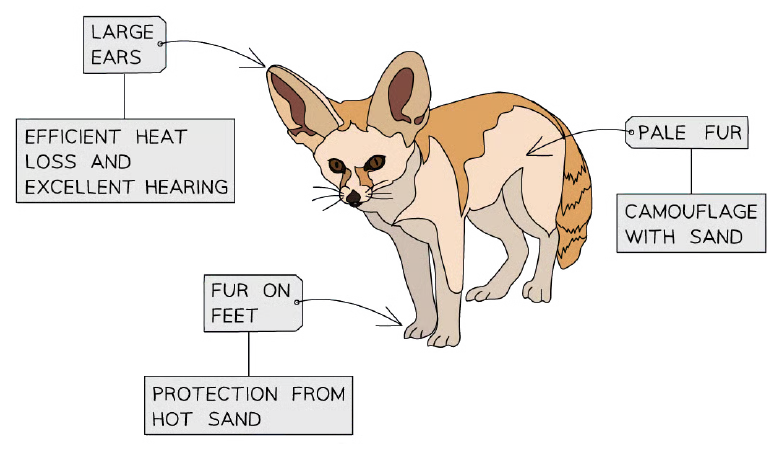
Adaptations of a fennec fox
Adaptations to Abiotic Factors: Sand Dune Grass
- Marram grass is commonly found on sand dunes, a habitat with low water availability, high salinity, and low nutrient levels.
- Marram grass is a xerophyte, a group of plants adapted to survive in dry conditions.
- Xerophytes face a steep concentration gradient between the inside of leaves and the surrounding air, causing rapid water evaporation from leaf cells.
- Some marram grass leaf adaptations raise the humidity of the air surrounding the leaf, reducing the steep concentration gradient and reducing water loss.
- Leaves are rolled up to reduce exposure to wind and trap water vapour inside.
- Stomata are sunken in pits to trap water vapour, and the inner leaf surface is covered in tiny hairs which also trap water vapour.
- Marram grass leaves have a thick waxy cuticle on their outer surface to reduce evaporation.
Adaptations to Abiotic Factors: Mangrove Trees
- Mangrove swamps are tropical, coastal habitats frequently submerged in sea water, with high salinity, low fresh water availability, and low oxygen availability.
- Mangrove roots underwater cannot take in oxygen for respiration, and the salty water creates a risk of water loss from roots by osmosis.
- Mangroves deal with low oxygen by having aerial root systems; parts of roots above water take in oxygen for respiration.
- Red mangroves have prop roots that also provide stability in unstable soil and shelter for marine animals.
- Black mangroves have pneumatophores that grow vertically upwards out of water-logged soil.
- Red mangroves have cells that do not allow salt entry into water-transport systems, allowing uptake of fresh water and preventing water loss by osmosis.
- Black mangroves take salt water into their cells and excrete excess salt through salt glands in their leaves.
Species Distribution and Range of Tolerance
- Abiotic factors in a habitat can act as limiting factors for species distribution.
- Species exist with a range of tolerance: certain conditions are ideal (optimum), but some variation can be tolerated.
- Species will not be found in areas with abiotic conditions outside their range of tolerance.
- Species adapted to extreme conditions may have an especially wide range of tolerance, allowing them to live where other species cannot.
- Such extreme species often have an environmental optimum higher or lower than average, e.g. marram grass has a lower optimum for water availability.
- Extreme species do well where competition from other species is low, but may do less well in moderate environments due to competition.
- Species have a range of tolerance for all abiotic factors, and these factors interact to determine distribution.
Species Distribution: Skills
- Distribution refers to where a species is found within an ecosystem.
- A limiting factor is any biotic or abiotic factor that restricts the growth of organisms.
- Transect sampling measures the change in species abundance along an environmental gradient.
- A transect is a line laid out across a site; a tape measure is laid out along the gradient and samples are taken along the line.
- Types of transect include continuous line transect (every species touching the tape is recorded), interrupted line transect (species at regular intervals are recorded), continuous belt transect (quadrats placed end-to-end), and interrupted belt transect (quadrats at regular intervals).
- Sampling involves taking measurements from a small area to represent a larger area; it saves time and samples must be representative with a large enough sample size.
- When investigating the impact of an abiotic factor, it is important to measure the relevant abiotic factor at each sample site along the transect.
Measuring Abiotic Factors
- Air temperature is measured with a thermometer; rainfall with a rain gauge (funnel collecting water in a measuring cylinder).
- Humidity is measured with a hydrometer, an electronic device measuring water vapour content of air.
- Dissolved oxygen is measured with an electronic oxygen sensor.
- Water turbidity is measured with a turbidity meter (light scattered by particles) or a Secchi disc lowered until no longer visible.
- Light intensity is measured with an electronic light meter.
- Landscape relief is measured using contour lines on a map or a GPS; site aspect with a compass; slope incline with a clinometer.
- Soil or water pH is measured with indicator solution; soil water content by the difference in mass before and after drying a soil sample.
Representing Results: Kite Diagrams
- Kite diagrams can show both distribution and abundance of species along a transect.
- The distribution of a species is shown by its position along a central horizontal line in each section.
- Each section of a kite diagram represents a different species.
- The distance along the transect is given on the x-axis, parallel to the horizontal line.
- The abundance of a species is shown by the width of the 'kite' around the central horizontal line; the shape extends an equal distance on each side.
- Additional sections can show changes in abiotic factors at different points along the transect, e.g. elevation or soil pH.
Coral Reef Formation and Distribution
- Corals result from a symbiotic relationship between a coral polyp (animal) and zooxanthellae algae.
- The polyp provides shelter and protection; the algae carry out photosynthesis and produce carbon compounds such as carbohydrates.
- Some coral polyps secrete calcium carbonate which builds up in layers to form a hard outer structure; over time deposits from thousands of individuals form a coral reef.
- Reef-building corals are limited to the tropics and subtropics; non-reef-building species can be found in other regions.
- Coral has a narrow range of tolerance for abiotic factors including water depth, pH, salinity, water clarity, and temperature.
- Water depth: corals grow only at shallow depths where light penetrates for zooxanthellae photosynthesis.
- pH: calcium carbonate dissolves at low pH; increased carbon dioxide from fossil fuel burning lowers ocean pH and reduces coral growth.
- Salinity: corals need salty water within a 32−42% range; freshwater run-off can limit growth.
- Water clarity: must be good for light penetration; sediment and pollution reduce clarity and limit growth.
- Temperature: corals tolerate roughly 20−28 °C, growing best above 23 °C; rising sea temperatures cause polyps to expel algae, leading to coral bleaching.
Biomes and Their Distribution
- A biome is a large community of plants and animals that has developed as a result of environmental factors.
- Biomes occur over large geographical areas and are usually named after their dominant vegetation type.
- Examples include temperate rainforest, tropical rainforest, temperate deciduous forest, boreal/coniferous forest (taiga), grassland, tundra, and desert.
- Biome distribution is affected by abiotic factors; average temperatures and rainfall patterns are significant in determining biome development.
- For any given combination of temperature and rainfall, a specific biome will result; this can be plotted on a climograph with mean annual rainfall and temperature on its axes.
- Climographs show distinct boundaries between biomes, but in reality there is a gradual shift from one biome to another.
- Rainfall and temperature are not the only factors influencing biome development; other variables such as soil type and animal grazing may play important roles.
- Because neither rainfall nor temperature is an independent or dependent variable, the allocation of temperature and rainfall to the graph axes may vary.
Biomes: Climate and Community Features
- Tropical forest: annual rainfall 2000−10 000 mm; temperatures consistently 20−25 °C; nutrient-poor soil due to lack of seasonal leaf fall; layers of vegetation (canopy, undercanopy); highly productive; very high biodiversity.
- Temperate forest: annual rainfall 750−1500 mm; seasonal but no extreme temperatures; fertile soil due to leaf fall each autumn; dominant deciduous trees; productive during part of the year; high biodiversity.
- Taiga (conifer forest): annual rainfall 300−900 mm but high snowfall; very short summer growing period; temperatures −40 to 20 °C; dominant coniferous (evergreen) trees; low productivity; small number of well-adapted species.
- Grassland: annual rainfall 500−950 mm; dry and wet seasons; temperatures −20 to 30 °C; dominant grasses; not enough water for significant tree growth; low productivity; grazing animals and a small number of top predators.
- Tundra: annual rainfall 150−250 mm; dark winter periods and frozen soil; temperatures −50 to 18 °C; not enough water, light, or warmth for tree growth; low productivity; hibernating or migrating animal species.
- Hot desert: annual rainfall less than 250 mm; hot days (up to 49 °C) and cold nights (down to 0 °C); very low productivity due to lack of water; a small number of well-adapted species.
Adaptations to Biomes
- Adaptations are traits or characteristics that increase survival chances in a specific environment.
- Adaptations come about by the process of natural selection.
- Species are adapted to the abiotic and biotic features of the biome in which they live.
- Saguaro cactus (hot desert): stem has a thick waxy cuticle to reduce water loss; spines instead of leaves reduce surface area for transpiration and reduce grazing; stem cells expand to store water; deep tap root accesses deep water and shallow surface roots absorb rainfall quickly.
- Kangaroo rat (hot desert): spends daylight hours in underground burrows (behavioural adaptation); extracts enough water from diet; produces highly concentrated urine; can go without drinking water for extended periods.
- Kapok tree (tropical rainforest): rapid growth allows it to outcompete other species by growing tall quickly to absorb sunlight; wide buttress roots provide a sturdy base.
- Orchid mantis (tropical rainforest): adult female looks like an orchid flower, attracting insect pollinators as prey (mimicry); believed to be an 'aggressive mimic' more attractive than surrounding flowers; male is smaller and plainer for camouflage among stems and branches.
- Regions with similar abiotic factors contain the same biome, e.g. desert occurs in Africa, North and South America, and Australia; ecosystems in equivalent biomes contain similar communities due to convergent evolution.
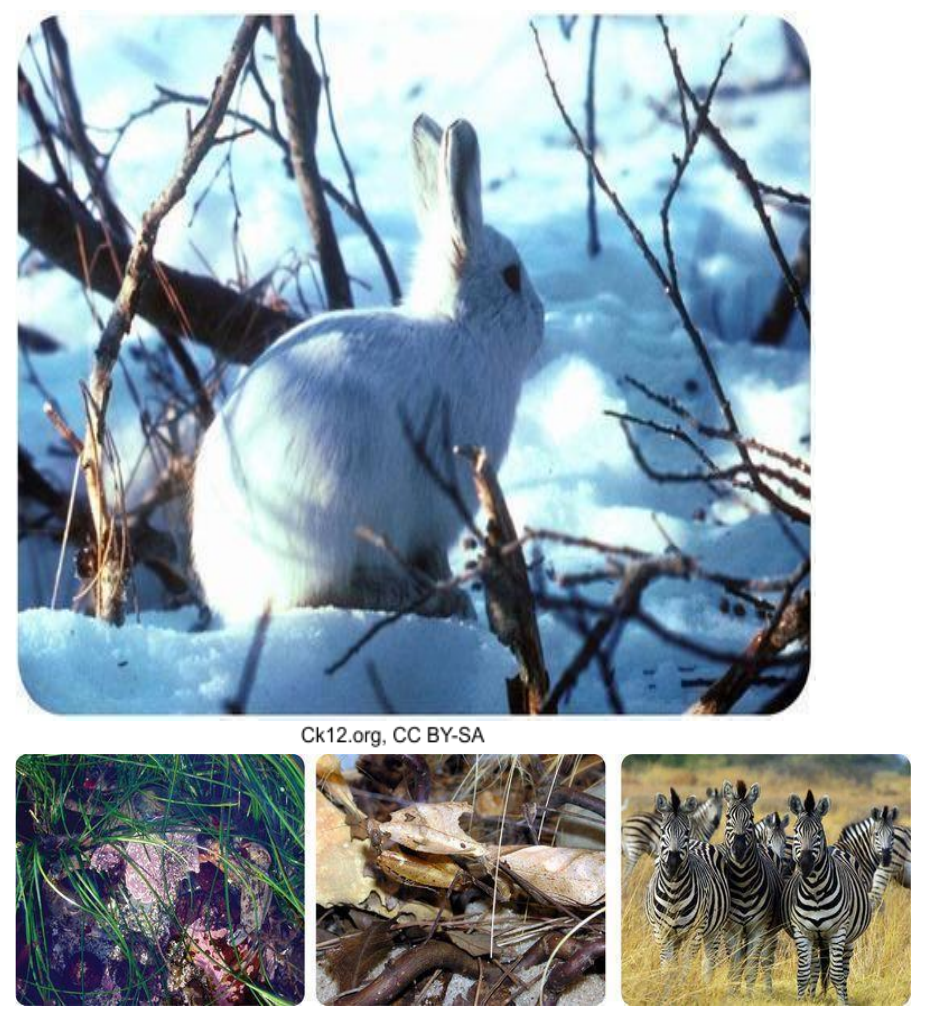
Camouflage as an adaptation
Slide
Sign up free to view the lesson slides
Step through every slide for this topic — plus flashcards and revision notes — with a free account.
Câu hỏi luyện tập
Xem trước miễn phí — 8 trên 61 câu hỏi. Đăng ký để xem tất cả.
1.Which option correctly lists some abiotic features of an ecosystem?
Easy- AMineral ions, light intensity, temperature
- BCompetition, predation
- CpH, producers, mineral ions
- DWind speed, decomposition, mineral ions
2.Which of the statements about the term habitat is/are correct? I. A habitat is the place where a community of organisms lives II. A habitat is the place where an individual organism lives III. Habitats can only be described in terms of their geographical location
Easy- AI and II only
- BII only
- CII and III only
- DI, II and III
3.Which of the statements about biomes is correct?
Easy- ABiome distribution is affected primarily by biotic factors.
- BFor any given temperature and rainfall pattern there are a range of ecosystem types that can develop.
- CA tropical rainforest biome will have high annual rainfall and low levels of biodiversity.
- DAverage temperatures and rainfall patterns are significant factors in determining the development of a biome.
4.Which of the following is a hazard to consider in a risk assessment when measuring abiotic factors in a natural environment?
Easy- AUneven ground.
- BSlipping on wet rock.
- CCutting oneself on a sharp rock.
- DBreaking an ankle by falling over.
5.How could levels of dissolved oxygen in a pond be measured?
Easy- ApH indicator
- BTurbidity meter
- CElectronic sensor
- DClinometer
6.Which of the following statements about adaptations to abiotic factors is correct?
Medium- ASome grasses are able to release chemicals that attract the predators of insect herbivore species.
- BSome grasses are adapted to increase the water vapour concentration gradient between their leaves and the surrounding air.
- CMangroves are adapted to survive in an environment with limited fresh water availability.
- DMangroves deal with low oxygen availability by absorbing oxygen from the atmosphere via their stomata.
7.Which row correctly describes an example of an adaptation for survival in the given biome?
Medium- ATropical forest — Thick waxy cuticles on leaves
- BTemperate forest — Nocturnal behaviour
- CTaiga — Wide buttress roots
- DHot desert — The ability to extract water from food
8.A habitat is the place where an organism lives.
EasyTrue or false?
Unlock all 61 questions & more
Tạo tài khoản miễn phí để xem mọi câu hỏi, slide, thẻ ghi nhớ và ghi chú ôn tập cho chủ đề này.