Counting Particles By Mass: The Mole
Học bằng cách chơi
Trả lời những câu hỏi này để kiếm năng lượng, rồi câu cá và khám phá. Không cần tài khoản.
Ghi chú bài học
The Mole and Avogadro's Constant
- The mole is the amount of substance that contains the same number of fundamental units as there are atoms in exactly 12.00 g of carbon-12.
- The Avogadro constant (NA or L) is the number of particles equivalent to the relative atomic mass (Ar) or relative molecular mass (Mr) of a substance in grams.
- The value of the Avogadro constant is 6.02 × 10²³ mol-1.
- The Avogadro constant applies to atoms, molecules and ions.
- One mole of any substance contains 6.02 × 10²³ fundamental units.
- The mass of a substance with this number of particles is called the molar mass.
Relative Atomic and Molecular Mass
- The relative atomic mass (Ar) of an element is the weighted average mass of one atom compared to one twelfth the mass of a carbon-12 atom.
- Ar is determined using the weighted average mass of the isotopes of the element.
- Ar has no units because it is a ratio and the units cancel.
- Relative molecular mass (Mr) is the sum of the relative atomic masses of the atoms in a molecule.
- For compounds containing ions, the term relative formula mass (Mr) is used and is calculated in the same way.
- Example: Mr of H2O = (2 × 1.01) + 16.00 = 18.02.
Moles and Mass Calculations
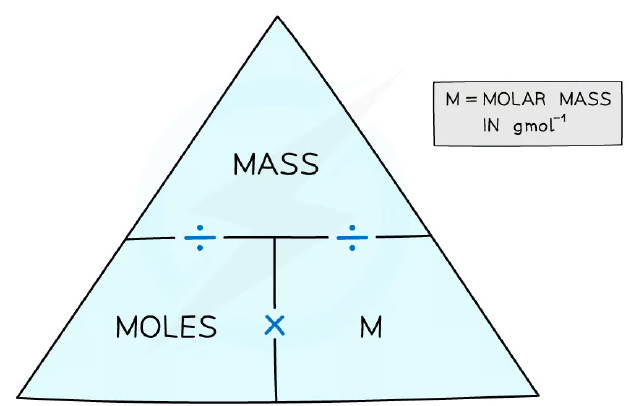
- The number of moles can be calculated using: moles = mass (g) ÷ molar mass (g mol-1).
- The molar mass of a substance is its relative atomic mass (Ar) or relative formula mass (Mr) expressed in grams.
- Molar mass is given in units of g mol-1.
- To find the mass of a substance: mass = moles × molar mass.
- Always show your workings in calculations to check for errors and possibly gain credit.
Moles, mass and molar mass
Moles and Particles
- The number of particles can be calculated using: number of particles = moles × Avogadro constant.
- To find the number of moles from particles: moles = number of particles ÷ Avogadro constant.
- When calculating the number of atoms in a molecule, multiply the number of moles of molecules by the number of atoms in one molecule.
- Example: 0.010 moles of CH3CHO contains 0.040 moles of H atoms, which is 2.4 × 10²² H atoms.
Empirical Formula
- The empirical formula gives the simplest whole-number ratio of atoms of each element in a compound.
- The molecular formula shows the actual number and type of atoms in a molecule.
- The empirical formula can be determined from percentage composition by mass data.
- To find the empirical formula: divide the mass or percentage of each element by its atomic mass, then divide by the smallest value to get the simplest ratio.
- The formula of an ionic compound is always written as an empirical formula.
- Organic compounds often have different empirical and molecular formulae.
Molecular Formula
- To determine the molecular formula from the empirical formula: divide the relative molecular mass (Mr) by the relative mass of the empirical formula.
- This gives a whole number multiplier.
- Multiply the empirical formula by this number to get the molecular formula.
- Example: If empirical formula is C4H10S and Mr = 180.42, the multiplier is 2, so molecular formula is C8H20S2.
Molar Concentration
- Concentration tells us how much solute is dissolved in a solvent to make a solution.
- It is usually measured as the amount of solute in 1 dm3 of solution.
- The solute is the substance being dissolved; the solvent is the liquid that does the dissolving.
- Concentration can be expressed as moles per unit volume (mol dm-3), mass per unit volume (g dm-3), or parts per million (ppm).
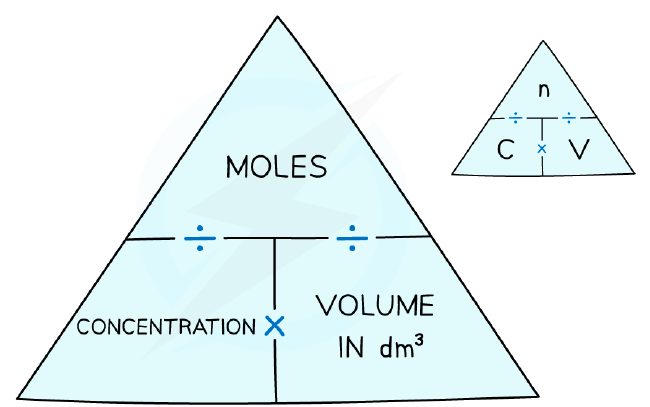
- Formula: concentration (mol dm-3) = moles of solute (mol) ÷ volume of solution (dm3).
- To convert cm3 to dm3, divide by 1000.
- To convert from mol dm-3 to g dm-3, multiply the molar concentration by the molar mass.
- To convert from g dm-3 to mol dm-3, divide the mass concentration by the molar mass.
Concentration, moles and volume
Parts Per Million (ppm)
- ppm is used for very low concentrations, such as pollutants in water or air.
- 1 ppm is defined as 1 mg of solute dissolved in 1 dm3 of water.
- Since 1 dm3 of water weighs 1 kg, 1 ppm is also 1 mg dissolved in 1 kg of water.
- This is equivalent to 10-3 g in 103 g, or a concentration of 1 in 106.
Avogadro's Law and Gas Volumes
- Avogadro's Law states that equal volumes of gases under the same conditions of temperature and pressure contain the same number of molecules.
- At standard temperature and pressure (STP), one mole of any gas occupies 22.7 dm3.
- STP conditions are defined as 0 °C (273 K) and 100 kPa pressure.
- The volume ratio of gaseous reactants and products in a balanced equation is the same as the mole ratio.
- Example: In C3H8(g) + 5O2(g) → 3CO2(g) + 4H2O(l), 50 cm3 of propane requires 250 cm3 of O2 and produces 150 cm3 of CO2.
- Gas volume relationships are only valid if all gases are measured under the same conditions of temperature and pressure.
- If gases are not in the same ratio as the balanced equation, use limiting reactant principles to determine the actual amount of product formed.
Slide
Sign up free to view the lesson slides
Step through every slide for this topic — plus flashcards and revision notes — with a free account.
Câu hỏi luyện tập
Xem trước miễn phí — 8 trên 66 câu hỏi. Đăng ký để xem tất cả.
1.Which statement defines the mole?
Easy- AThe amount of substance that contains 6.02 × 10²³ elementary entities.
- BThe mass of one atom of carbon-12.
- CThe volume occupied by one gram of any gas at room temperature.
- DThe number of particles in one gram of any substance.
2.What is the value of the Avogadro constant?
Easy- A6.02 × 10²³ mol⁻¹
- B6.02 × 10⁻²³ mol⁻¹
- C12.00 g mol⁻¹
- D22.7 dm³ mol⁻¹
3.Which statement about relative atomic mass (Ar) is correct?
Easy- AIt is the weighted average mass of an atom compared to one-twelfth the mass of a carbon-12 atom.
- BIt is the mass of one mole of an element in grams.
- CIt is the number of atoms in one mole of an element.
- DIt is the mass of one atom of an element in kilograms.
4.Which of the following is the relative formula mass (Mr) of ammonium sulfate, (NH₄)₂SO₄? (Ar: N=14.01, H=1.01, S=32.07, O=16.00)
Easy- A132.17
- B114.11
- C68.14
- D100.17
5.The empirical formula of a compound gives the simplest whole-number ratio of atoms of each element in the compound.
EasyTrue or false?
6.How many moles are present in 2.64 g of sucrose, C₁₂H₂₂O₁₁ (Mr = 342.3)?
Medium- A7.71 × 10⁻³ mol
- B7.71 × 10⁻² mol
- C0.771 mol
- D1.30 × 10² mol
7.Which of the following statements about concentration are correct? (select all that apply)
Medium- AConcentration in mol dm⁻³ is calculated as moles of solute divided by volume of solution in dm³.
- B1 ppm is equivalent to 1 mg of solute dissolved in 1 dm³ of water.
- CTo convert cm³ to dm³, divide by 1000.
- DA concentrated solution contains a small amount of solute per unit volume.
- EThe units of concentration can be mol dm⁻³, g dm⁻³ or ppm.
8.Match each term with its correct description.
Medium- Mole
- Molar mass
- Empirical formula
- Avogadro's Law
- The amount of substance containing 6.02 × 10²³ particles
- The mass of one mole of a substance in grams
- The simplest whole-number ratio of atoms in a compound
- Equal volumes of gases at the same temperature and pressure contain the same number of molecules
Unlock all 66 questions & more
Tạo tài khoản miễn phí để xem mọi câu hỏi, slide, thẻ ghi nhớ và ghi chú ôn tập cho chủ đề này.