Proton Transfer Reactions
Học bằng cách chơi
Trả lời những câu hỏi này để kiếm năng lượng, rồi câu cá và khám phá. Không cần tài khoản.
Ghi chú bài học
Brønsted–Lowry Acids and Bases
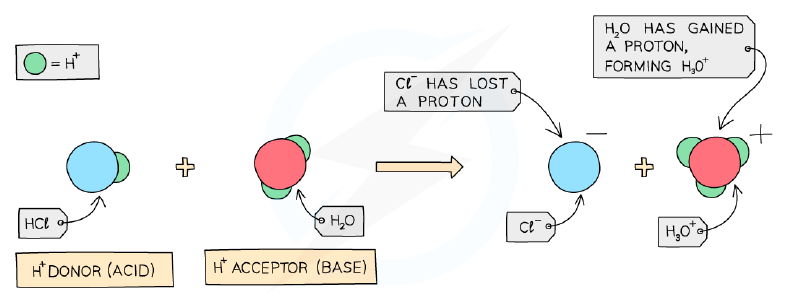
- A Brønsted–Lowry acid is a species that donates a proton (H⁺).
- A Brønsted–Lowry base is a species that accepts a proton using a lone pair of electrons.
- The theory applies to proton transfer in any solvent, including gas-phase reactions.
- In HCl(g) + H₂O(l) → H₃O⁺(aq) + Cl⁻(aq), HCl acts as the acid and water as the base.
- The formation of ions from a molecular acid or base is called dissociation or ionisation.
Proton transfer between an acid and a base
Conjugate Acids and Bases
- A conjugate acid–base pair consists of two species that differ by a single H⁺ ion.
- In CH₃COOH(aq) + H₂O(l) ⇌ CH₃COO⁻(aq) + H₃O⁺(aq), CH₃COOH/CH₃COO⁻ and H₂O/H₃O⁺ are conjugate pairs.
- The acid and its conjugate base are related by the loss of one proton; the base and its conjugate acid by the gain of one proton.
- Strong acids have weak conjugate bases; weak acids have strong conjugate bases.
- Strong bases have weak conjugate acids.
Amphiprotic Species
- An amphiprotic species can both donate and accept a proton (H⁺).
- Water is amphiprotic: it donates a proton to NH₃ and accepts a proton from HCl.
- An amphoteric substance can act as an acid or a base in a chemical reaction.
- All amphiprotic substances are amphoteric, but not all amphoteric substances are amphiprotic.
- Aluminium oxide, Al₂O₃, is amphoteric but not amphiprotic because it does not donate or accept protons.
The pH Scale
- pH is defined as pH = –log[H⁺], where [H⁺] is the concentration of hydrogen ions in mol dm⁻³.
- The hydrogen ion concentration can be found from pH using [H⁺] = 10^(–pH).
- The pH scale is logarithmic: a change of 1 pH unit corresponds to a tenfold change in [H⁺].
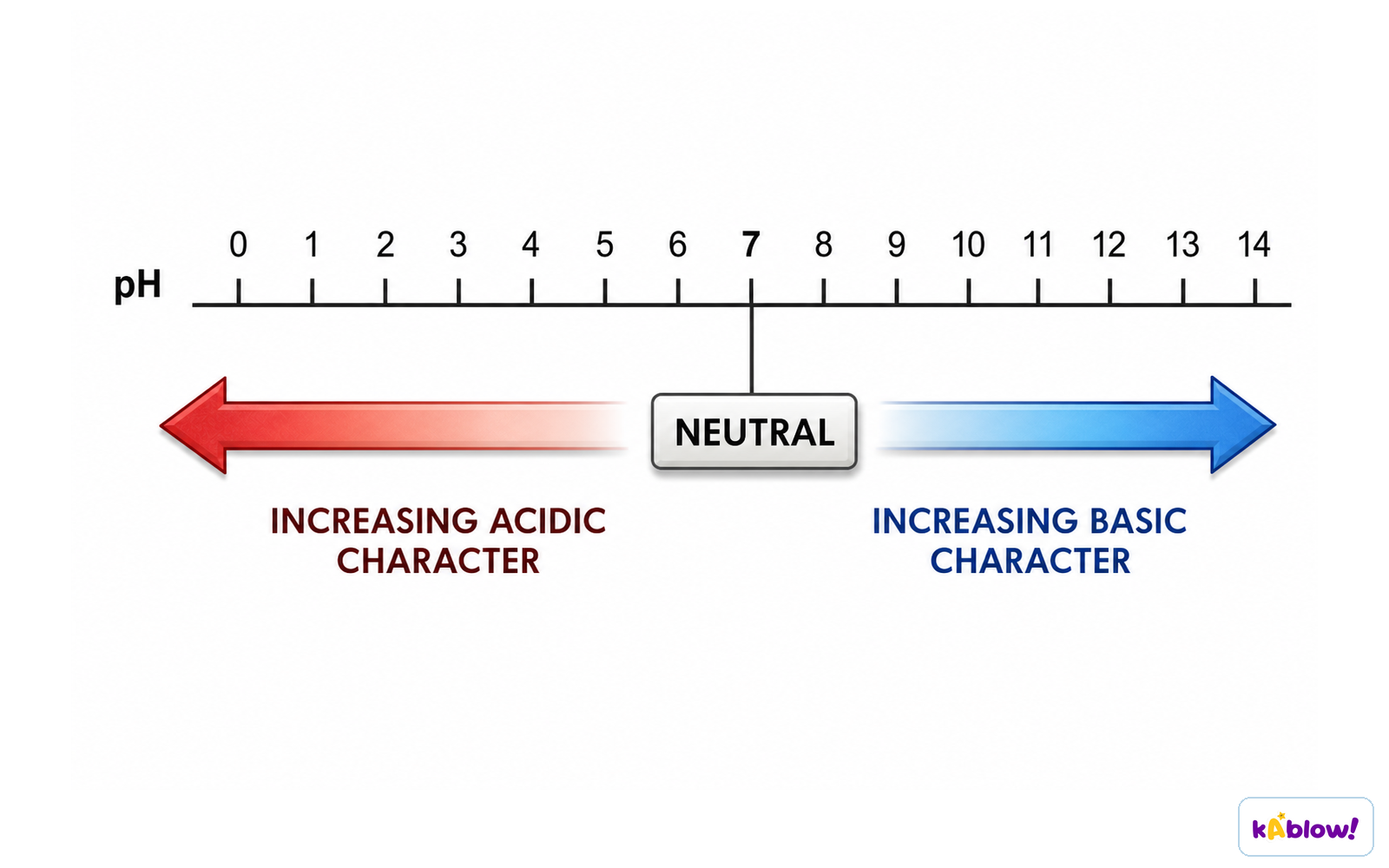
- Acidic solutions have pH < 7, basic solutions have pH > 7, and neutral solutions have pH = 7 at 298 K.
- The lower the pH, the more acidic the solution; the higher the pH, the more alkaline the solution.
- A pH meter gives the most accurate pH reading; universal indicator paper is less accurate.
The pH scale
The Ion Product of Water
- Water undergoes self-ionisation: H₂O(l) ⇌ H⁺(aq) + OH⁻(aq).
- The ion product of water, Kw, is defined as Kw = [H⁺][OH⁻].
- At 298 K, Kw = 1.00 × 10⁻¹⁴ mol² dm⁻⁶.
- In pure water at 298 K, [H⁺] = [OH⁻] = 1.00 × 10⁻⁷ mol dm⁻³, so pH = 7.
- The ionisation of water is endothermic; increasing temperature increases Kw and decreases the pH of pure water.
- Pure water remains neutral at any temperature because [H⁺] = [OH⁻].
Strong and Weak Acids and Bases
- A strong acid dissociates almost completely in aqueous solution (e.g. HCl, HNO₃, H₂SO₄).
- A weak acid dissociates only partially in aqueous solution (e.g. CH₃COOH, HCN, H₂CO₃).
- A strong base dissociates almost completely (e.g. Group 1 metal hydroxides).
- A weak base dissociates only partially (e.g. NH₃, amines).
- Strong acids have a higher [H⁺], lower pH, greater electrical conductivity, and react more vigorously with metals than weak acids of the same concentration.
- For hydrogen halides, acid strength increases down Group 17: HF < HCl < HBr < HI, because the H–X bond becomes longer and weaker.
Neutralisation Reactions
- A neutralisation reaction is: acid + base → salt + water.
- The essential reaction is H⁺(aq) + OH⁻(aq) → H₂O(l).
- The salt is formed from the spectator ions not involved in water formation.
- Acid + metal → salt + hydrogen; acid + metal oxide → salt + water; acid + metal hydroxide → salt + water.
- Acid + metal carbonate → salt + water + carbon dioxide; acid + metal hydrogencarbonate → salt + water + carbon dioxide.
- The salt produced depends on the acid used: hydrochloric acid forms chlorides, nitric acid forms nitrates, sulfuric acid forms sulfates.
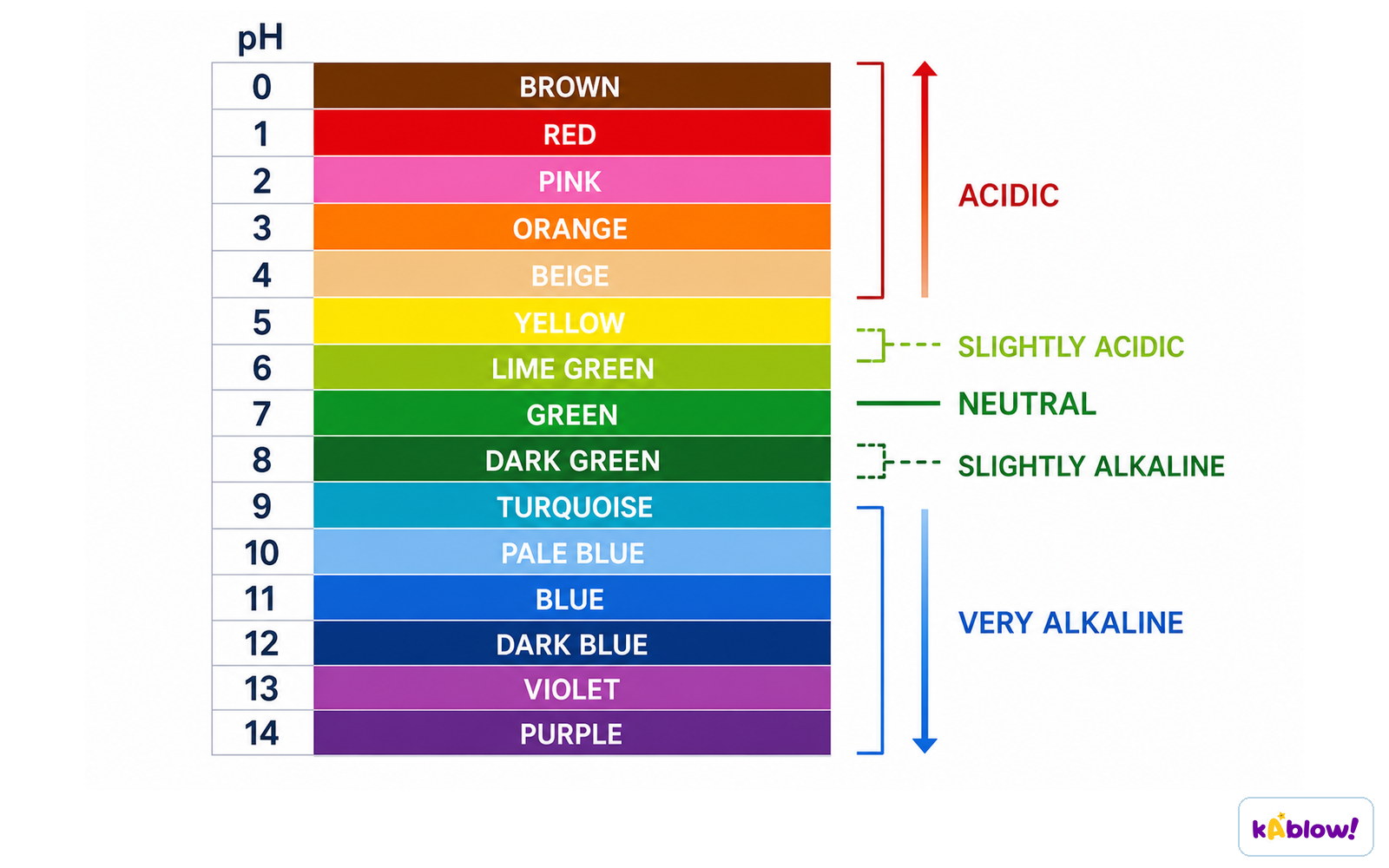
Universal indicator across the pH scale
pH Curves and Indicators
- A pH curve shows how pH changes as acid or base is added during a titration.
- All pH curves are S-shaped; the midpoint of the vertical section is the equivalence point.
- Strong acid–strong base: equivalence point at pH 7.
- Weak acid–strong base: equivalence point above pH 7; at half-equivalence, pH = pKa.
- Weak base–strong acid: equivalence point below pH 7; at half-equivalence, pOH = pKb.
- Weak acid–weak base: no sharp vertical section, so the equivalence point is difficult to determine and no suitable indicator exists.
The pOH Scale and Acid–Base Calculations (HL)
- pOH is defined as pOH = –log[OH⁻].
- The hydroxide concentration can be found from pOH using [OH⁻] = 10^(–pOH).
- At 298 K, pH + pOH = 14.
- The hydrogen ion concentration can be calculated from [OH⁻] using [H⁺] = Kw / [OH⁻].
- For a strong acid, pH = –log[acid] (for monoprotic acids).
- For a strong base, first find [OH⁻], then pOH, then pH = 14 – pOH.
Acid and Base Dissociation Constants (HL)
- The acid dissociation constant, Ka, for HA(aq) ⇌ H⁺(aq) + A⁻(aq) is Ka = [H⁺][A⁻] / [HA].
- The base dissociation constant, Kb, for B(aq) + H₂O(l) ⇌ BH⁺(aq) + OH⁻(aq) is Kb = [BH⁺][OH⁻] / [B].
- pKa = –log Ka and pKb = –log Kb.
- A larger Ka (smaller pKa) means a stronger acid; a larger Kb (smaller pKb) means a stronger base.
- For conjugate acid–base pairs, Ka × Kb = Kw.
- The range of pKa values for most weak acids is between 3 and 7.
Slide
Sign up free to view the lesson slides
Step through every slide for this topic — plus flashcards and revision notes — with a free account.
Câu hỏi luyện tập
Xem trước miễn phí — 8 trên 58 câu hỏi. Đăng ký để xem tất cả.
1.Using your knowledge of the Brønsted-Lowry theory, which of the following correctly describes ammonia?
Easy- Aneutral
- Bacid
- Cbase
- Damphoteric
2.In the Brønsted–Lowry theory of acids and bases, the difference between a conjugate acid and its conjugate base is the presence of which of the following?
Easy- Aa positive charge
- Ba pair of electrons
- Ca proton
- Da hydrogen atom
3.Which of the following ions or compounds is amphiprotic?
Medium- APO₄³⁻
- BHCO₃⁻
- CAl₂O₃
- DP₄O₁₀
4.In the following reaction, identify which two species are acting as Brønsted–Lowry acids: H₃PO₄(aq) + OH⁻(aq) ⇋ H₂PO₄⁻(aq) + H₂O(l)
Medium- AH₂PO₄⁻(aq) and OH⁻(aq)
- BH₃PO₄(aq) and H₂PO₄⁻(aq)
- CH₂PO₄⁻(aq) and H₂O(l)
- DH₃PO₄(aq) and H₂O(l)
5.Potassium hydrogen carbonate reacts vigorously with dilute sulfuric acid. Identify the correct formulas of the substances produced in the reaction.
Medium- AK₂SO₄ + H₂O + CO₂
- BK₂SO₄ + CO₂
- CKSO₄ + H₂O + CO₂
- DKSO₄ + H₂CO₃
6.Copper(II) sulfate can be made by the reaction between dilute sulfuric acid and which of the following? I. Cu II. CuO III. CuCO₃
Easy- AI and II only
- BI and III only
- CII and III only
- DI, II and III
7.Which statement is correct for the following equation? HSO₄⁻(aq) + OH⁻(aq) ⇌ SO₄²⁻(aq) + H₂O(l)
Medium- AOH⁻ and H₂O are an acid and conjugate base pair
- BSO₄²⁻ is acting as Brønsted–Lowry acid
- CHSO₄⁻ and SO₄²⁻ are a base and conjugate acid pair
- DOH⁻ and H₂O are a base and conjugate acid pair
8.Which of the following statements about amphiprotic species are correct? (select all that apply)
Medium- AThey can donate a proton.
- BThey can accept a proton.
- CAll amphiprotic species are also amphoteric.
- DAll amphoteric species are also amphiprotic.
- EThey must contain a metal ion.
Unlock all 58 questions & more
Tạo tài khoản miễn phí để xem mọi câu hỏi, slide, thẻ ghi nhớ và ghi chú ôn tập cho chủ đề này.