The Metallic Model
Học bằng cách chơi
Trả lời những câu hỏi này để kiếm năng lượng, rồi câu cá và khám phá. Không cần tài khoản.
Ghi chú bài học
Metallic Bonding
- Metal atoms are tightly packed in lattice structures.
- Outer shell electrons become delocalised and are free to move throughout the structure.
- Metal atoms become positively charged when they lose their outer electrons.
- The positive charges repel each other and keep the neatly arranged lattice in place.
- Metallic bonding is the strong electrostatic attraction between positive metal centres and the 'sea' of delocalised electrons.
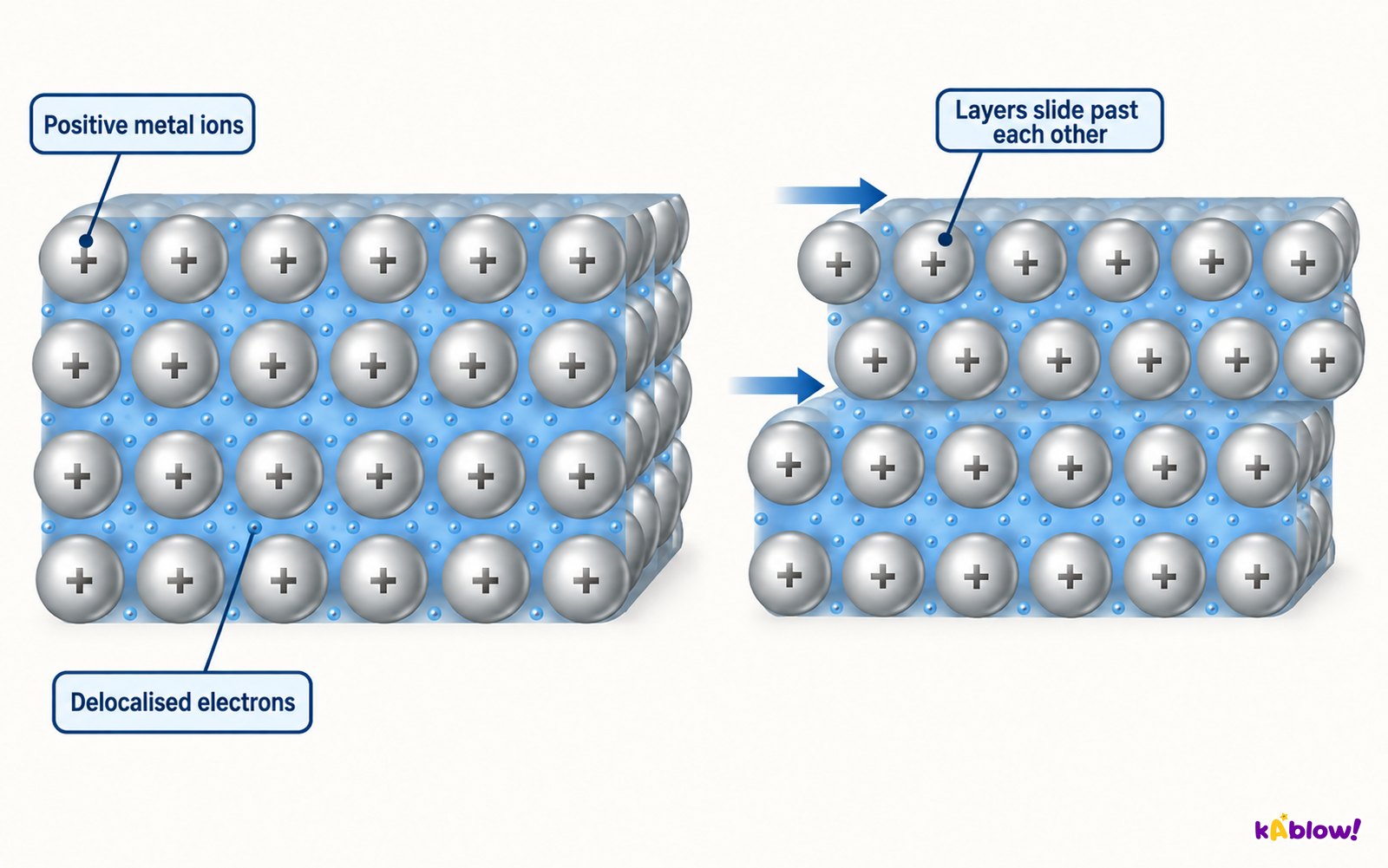
Metallic bonding and malleability
Properties of Metals
- Metals are malleable (can be hammered into sheets) and ductile (can be drawn into wires).
- Layers of metal ions can slide over each other when a force is applied, while delocalised electrons allow the metal to retain its structure without breaking bonds.
- Metals are typically strong and hard due to strong electrostatic attraction between cations and electrons and the closely packed structure of metal ions.
- Metals conduct electricity in both solid and liquid states because mobile electrons can freely move.
- When a potential difference is applied, delocalised electrons move towards the positive terminal.
- Metals are good thermal conductors: vibrating cations transfer kinetic energy to delocalised electrons, which rapidly carry it through the metal.
- Metals have high melting and boiling points because strong electrostatic forces between cations and delocalised electrons require large amounts of energy to overcome.
Trends in Metallic Bond Strength
- The strength of a metallic bond depends on the charge of the metal ion, the radius of the metal ion, and the number of delocalised electrons.
- Greater charge on the metal ion means more delocalised electrons and a greater charge difference, leading to stronger electrostatic attraction.
- Smaller ionic radius means the metal ion exerts a greater attraction on the sea of delocalised electrons, strengthening the metallic bond.
- Increasing the number of delocalised electrons per atom, increasing positive charge, and decreasing ionic size all increase the strength of metallic bonding.
Melting Points Across a Period
- Across Period 3, the number of valence electrons increases: Na (1), Mg (2), Al (3).
- Aluminium ions are also smaller than magnesium or sodium ions.
- These factors lead to stronger metallic bonding from Na to Al.
- Stronger metallic bonding requires more energy to break the lattice, so melting points increase across the period.
- Melting point data: Na = 371 K, Mg = 922 K, Al = 933 K.
Melting Points Down a Group
- Down a group, the size of the cation increases.
- This decreases the attraction between the outer electrons and the metallic lattice.
- Therefore, the melting point decreases down the group.
- Melting point data for Group 1: Na = 371 K, K = 337 K, Rb = 312 K.
Uses of Metals
- The choice of metal for a job depends on properties such as malleability/ductility, melting/boiling point, density, reactivity, electrical conductivity, strength, toxicity, lustre, thermal conductivity, strength-to-weight ratio, corrosion resistance, and sonority.
- Aluminium is used in food cans because it is non-toxic and resistant to corrosion and acidic food stuffs.
- Copper is used in electrical wiring because it is a good electrical conductor and malleable/ductile.
- Stainless steel is used for cutlery as it is strong and resistant to corrosion.
Transition Metals: Definition and Location
- A transition metal is an element with an incomplete d-subshell or an element that can form at least one stable cation with an incomplete d-subshell.
- Scandium and zinc are d-block elements but not transition metals: Sc only forms Sc³⁺ ([Ar] 3d⁰) and Zn only forms Zn²⁺ ([Ar] 3d¹⁰).
- The first transition series is Ti to Cu.
- Transition metals are located in the d-block: Period 4 from Ti to Cu, Period 5 from Zr to Ag.
- Periods 6 and 7 are complicated by the presence of the f-block lanthanides and actinides.
Physical Properties of Transition Metals
- Transition metals have a metallic lattice structure: layers of positive ions in a sea of delocalised electrons.
- The 3d and 4s subshells are close in energy, so transition metals can delocalise d-electrons to form metallic bonds.
- Transition metals form metallic bonds involving both s- and d-electrons, giving more delocalised electrons and stronger electrostatic attraction.
- This results in high melting points and high electrical conductivity.
- Period 4 transition metals have higher melting points than Group 1 and Group 2 metals (exception: Be has a melting point of 1,287 °C due to its small size).
- The three most conductive metals are Ag > Cu > Au; copper is most used in electrical cables due to cost and conductivity.
Slide
Sign up free to view the lesson slides
Step through every slide for this topic — plus flashcards and revision notes — with a free account.
Câu hỏi luyện tập
Xem trước miễn phí — 8 trên 61 câu hỏi. Đăng ký để xem tất cả.
1.Which of the following types of bonds does the statement 'electrostatic attraction between cations and delocalised electrons' best describe?
Easy- Ametallic
- Bionic
- Chydrogen
- Ddipole-dipole
2.Which of the following materials only contains one type of bonding?
Easy- Abrass
- Bgraphite
- Cice
- Diodine crystals
3.Substance L melts at 660 °C and conducts electricity when solid and when molten. What is the likely identity of substance L?
Medium- AAl
- Bgraphite
- CLi₂O
- DNaCl
4.What is the correct order of decreasing melting points for the Group 1 metals Na, K, Rb and Cs?
Medium- ANa > K > Rb > Cs
- BNa > K > Cs > Rb
- CCs > Rb > K > Na
- DK > Na > Rb > Cs
5.Which of the following Period 3 metals would have the highest melting point?
Medium- AAl
- BMg
- CNa
- DK
6.Which of the following species has the highest melting point?
Medium- A1s² 2s² 2p⁶ 3s² 3p²
- B1s² 2s² 2p⁶ 3s²
- C1s² 2s² 2p⁶ 3s¹
- D1s² 2s² 2p⁶ 3s² 3p¹
7.Which statement about metals is correct?
Medium- AThe melting point of vanadium is higher than that of calcium
- BScandium is a transition metal
- CTransition metals are good conductors of electricity due to the incomplete d-subshell
- DThe electronic configuration of Zn²⁺ is 1s² 2s² 2p⁶ 3s² 3p⁶ 4s² 3d¹⁰
8.Which of the following metals will have the greatest ability to conduct electricity?
Hard- AAl
- BMg
- CNa
- DLi
Unlock all 61 questions & more
Tạo tài khoản miễn phí để xem mọi câu hỏi, slide, thẻ ghi nhớ và ghi chú ôn tập cho chủ đề này.