Electron Pair Sharing Reactions
Học bằng cách chơi
Trả lời những câu hỏi này để kiếm năng lượng, rồi câu cá và khám phá. Không cần tài khoản.
Ghi chú bài học
Nucleophiles
- A nucleophile is an electron-rich species that can donate a pair of electrons.
- 'Nucleophile' means 'nucleus/positive charge loving' — nucleophiles are attracted to positively charged species.
- Neutral nucleophiles include H₂O, NH₃, ROH (alcohols) and RNH₂ (amines).
- Charged nucleophiles include OH⁻, Cl⁻, CN⁻ and carbanions (R⁻).
- OH⁻ is a stronger nucleophile than H₂O because it carries a full negative charge, while the oxygen in H₂O has only a partial negative charge.
- This makes OH⁻ more reactive and more likely to donate its lone pair quickly.
Nucleophilic Substitution
- Nucleophilic substitution is a reaction in which a nucleophile attacks a carbon atom carrying a partial positive charge.
- An atom with a partial negative charge is replaced by the nucleophile.
- Halogenoalkanes undergo nucleophilic substitution because the C–X bond is polar — the carbon is δ⁺ and the halogen is δ⁻.
- The bond that forms and the bond that breaks must both involve the carbon atom bonded to the leaving group.
- In the hydrolysis of a halogenoalkane, the nucleophile is OH⁻ and an aqueous solution of NaOH or KOH with ethanol is used.
- The reaction is very slow at room temperature, so the mixture is warmed.
- Example: CH₃CH₂Br + OH⁻ → CH₃CH₂OH + Br⁻ (bromoethane → ethanol), with Br⁻ as the leaving group.
- Halogens make good leaving groups because they form relatively weak bonds with carbon and their high electronegativity pulls electron density away from carbon.
Rate of Nucleophilic Substitution
- The rate depends on the halogen: the stronger the C–X bond, the slower the reaction.
- Bond enthalpy trend: C–F > C–Cl > C–Br > C–I.
- Fluoroalkanes are unreactive, while iodoalkanes react very quickly.
- When the nucleophile is neutral (e.g. H₂O), the initial product is positive and then deprotonates, losing H⁺ to form a neutral product.
- Example: CH₃CH₂Cl + H₂O → CH₃CH₂OH₂⁺ → CH₃CH₂OH + H⁺.
Heterolytic Fission
- Heterolytic fission is the breaking of a covalent bond so that both bonding electrons are taken by the more electronegative atom.
- This forms a negative ion (which gains both electrons) and a positive ion (left with none).
- In mechanism diagrams, a curly double-headed arrow shows the movement of a pair of electrons from the bond to one atom.
- For example, when an H–Cl bond breaks heterolytically, the electrons move to chlorine forming Cl⁻, leaving H⁺.
- The negative ion is electron-rich, can donate a pair of electrons and is a nucleophile.
- The positive ion is electron-deficient, can accept a pair of electrons and is an electrophile.
Nucleophile–Electrophile Interaction
- A nucleophile can donate a pair of electrons to an electrophile, forming a coordinate covalent bond.
- This is the opposite direction to heterolytic bond breaking and is key to many organic mechanisms, such as nucleophilic substitution.
- A nucleophile 'loves' a positive charge and an electrophile 'loves' a negative charge.
Electrophiles
- An electrophile is a species that forms a covalent bond when it reacts with a nucleophile by accepting electrons.
- Electrophiles are electron-deficient and typically have a full or partial positive charge.
- Neutral electrophiles include HX (hydrogen halides), X₂ (halogens), H₂O and RX (halogenoalkanes).
- Positively charged electrophiles include H⁺, NO₂⁺ (nitronium), NO⁺ (nitrosonium) and carbocations (R⁺).
Electrophilic Addition Reactions
- Electrophilic addition is the reaction of an electrophile with a carbon–carbon double bond, C=C.
- The C=C double bond is an area of high electron density, making it attractive to electrophiles.
- The C=C bond breaks, forming a single C–C bond and a new bond from each carbon to the electrophile.
- Electrophilic addition includes addition of steam (H₂O) to form alcohols, hydrogen halides (HX) to form halogenoalkanes, and halogens (X₂) to form dihalogenoalkanes.
- Alkenes are unsaturated and the atoms around the C=C bond are planar with a bond angle of 120°.
- The C=C bond consists of one σ-bond and a weaker π-bond; the π-bond can be broken and replaced by stronger σ-bonds.
- This allows alkenes to undergo addition reactions, which are not possible for saturated alkanes, making alkenes more reactive than alkanes.
Addition across a carbon–carbon double bond
Addition of Water (Hydration)
- Hydration occurs when alkenes are treated with steam at 300 °C and 60 atmospheres pressure.
- An acid catalyst such as sulfuric acid (H₂SO₄) or phosphoric acid (H₃PO₄) is used.
- Water is added across the double bond, converting the alkene into an alcohol.
- Example: CH₂=CH₂ + H₂O → CH₃CH₂OH (ethene → ethanol).
- The reaction proceeds via an intermediate in which H⁺ and HSO₄⁻ ions are added across the double bond.
- The intermediate is quickly hydrolysed by water, regenerating the sulfuric acid catalyst.
- This industrial route to ethanol is faster and more efficient than fermentation.
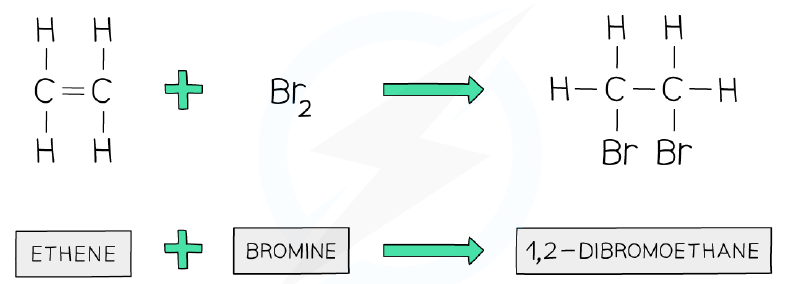
Addition of Halogens (Halogenation)
- Alkenes react with halogens in an electrophilic addition called halogenation.
- The π-bond breaks and is replaced by two new C–X bonds, forming a dihalogenoalkane.
- This reaction occurs readily at room temperature.
- Bromine water is an orange/yellow solution of Br₂(aq) and is used to test for unsaturation.
- If a C=C bond is present, an addition reaction occurs and the coloured solution becomes decolourised.
- If no C=C bond is present, there is no reaction and the solution remains orange/yellow.
- The bromine water test is the standard test for unsaturation in alkenes.
Addition of Hydrogen Halides (Hydrohalogenation)
- Alkenes react with hydrogen halides (e.g. HCl, HBr) to form halogenoalkanes.
- This is an electrophilic addition reaction that occurs rapidly at room temperature.
- All hydrogen halides react with alkenes in this way.
- The reaction is fastest in the order HI > HBr > HCl because weaker H–X bonds break more easily.
Slide
Sign up free to view the lesson slides
Step through every slide for this topic — plus flashcards and revision notes — with a free account.
Câu hỏi luyện tập
Xem trước miễn phí — 8 trên 61 câu hỏi. Đăng ký để xem tất cả.
1.Which of these compounds would act as a nucleophile?
Easy- AC6H12
- BH+
- COH-
- DAl
2.Ethene reacts with steam in the presence of sulfuric acid: C2H4 + H2O → CH3CH2OH. What type of reaction is this?
Easy- Aacid / base
- Baddition
- Chydrolysis
- Dsubstitution
3.Which reaction is an example of nucleophilic substitution?
Easy- AC6H6 + Br2 → C6H5Br + HBr
- BCH2=CH2 + HBr → CH3CH2Br
- CC3H7Br + H2O → C3H7OH + HBr
- DC2H6 + Br2 → C2H5Br + HBr
4.Bromomethane, CH3Br, can be made by reacting methanol with hydrogen bromide: CH3OH + HBr → CH3Br + H2O. What type of reaction is this?
Easy- Acondensation
- Belectrophilic substitution
- Cfree radical substitution
- Dnucleophilic substitution
5.What reagents and conditions are needed to convert but-2-ene into butane?
Easy- AConcentrated sulfuric acid, steam, 300 °C
- BHydrogen gas, Ni catalyst, 150 °C
- CAcidified potassium dichromate, heating under reflux
- DHydrogen bromide, room temperature
6.Which reaction(s) can alkenes undergo? I. Addition II. Hydration III. Reduction
Medium- AI and II only
- BI and III only
- CII and III only
- DI, II and III
7.In the hydrolysis of bromoethane by aqueous sodium hydroxide, what is the nature of the attacking group and of the leaving group?
Medium- Aattacking group: electrophile; leaving group: electrophile
- Battacking group: electrophile; leaving group: nucleophile
- Cattacking group: nucleophile; leaving group: electrophile
- Dattacking group: nucleophile; leaving group: nucleophile
8.The synthesis of ethyl butanoate can be carried out in three steps: C4H9Br → C4H9OH → C3H7COOH → C3H7COOC2H5. What is the correct classification of the steps I, II and III?
Medium- AI substitution; II oxidation; III condensation
- BI addition; II substitution; III condensation
- CI oxidation; II substitution; III condensation
- DI substitution; II oxidation; III substitution
Unlock all 61 questions & more
Tạo tài khoản miễn phí để xem mọi câu hỏi, slide, thẻ ghi nhớ và ghi chú ôn tập cho chủ đề này.