The Ionic Model
Học bằng cách chơi
Trả lời những câu hỏi này để kiếm năng lượng, rồi câu cá và khám phá. Không cần tài khoản.
Ghi chú bài học
Forming Ions
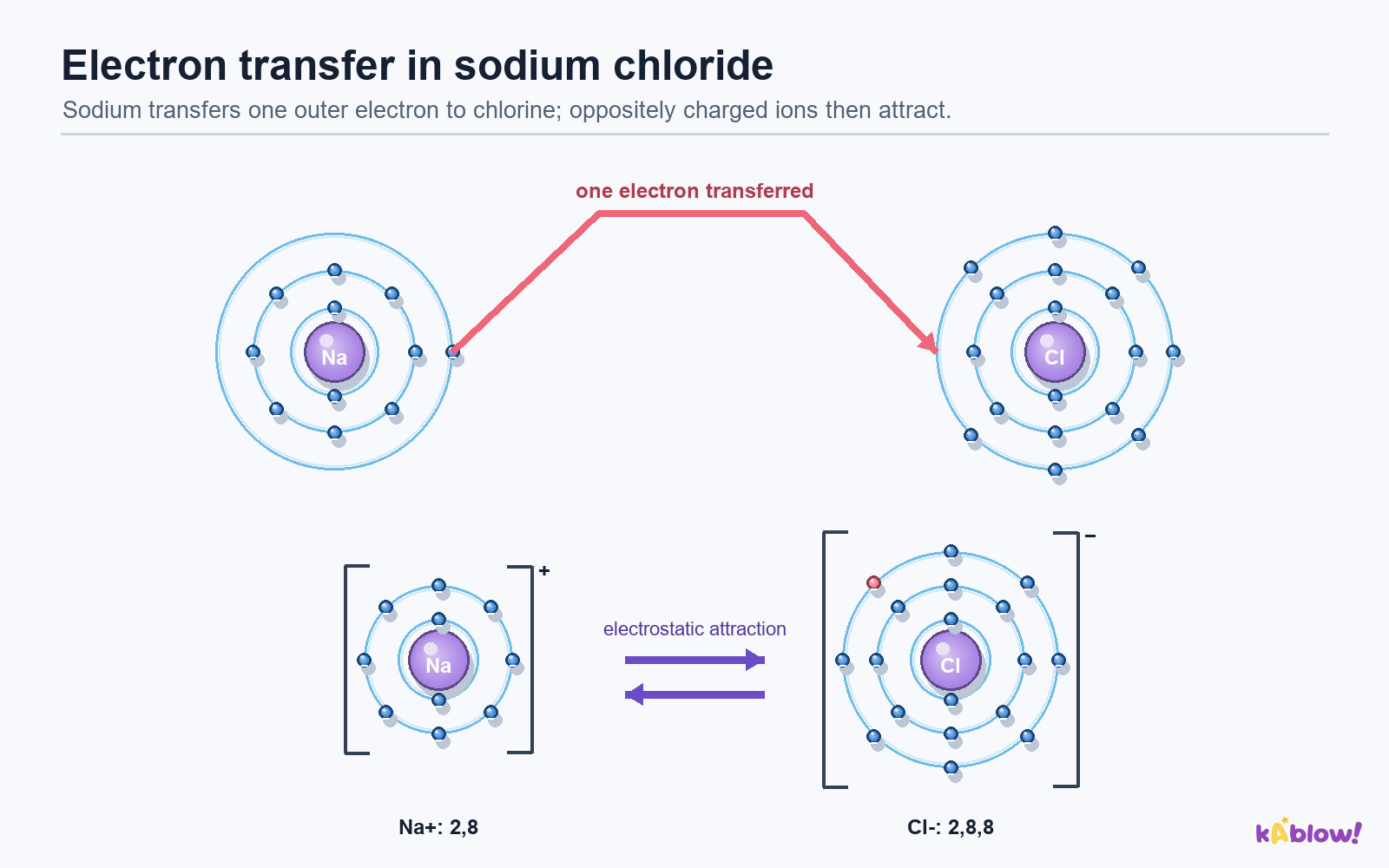
- Ionic bonds form by the transfer of electrons from a metallic element to a non-metallic element.
- Metals lose electrons from their valence shell to form positively charged cations.
- Non-metal atoms gain electrons to form negatively charged anions.
- Electron transfer usually gives both ions the electronic configuration of a noble gas.
- For example, Na⁺ has the same configuration as Ne ([2,8]) and Cl⁻ the same as Ar ([2,8,8]).
- The group of an element tells you how many electrons it is likely to lose or gain.
Formation of ions
Binary Ionic Compounds
- A binary ionic compound is composed of ions of two different elements: a metal cation and a non-metal anion.
- Ionic bonding is the force of attraction between oppositely charged species/ions.
- The electrostatic attractions between cations and anions are very strong and require a lot of energy to overcome, giving ionic compounds high melting points.
- Binary ionic compounds are named with the cation first, followed by the anion which takes the suffix -ide (e.g. sodium iodide).
- Ionic compounds are electrically neutral: the total positive charge equals the total negative charge.
Charges on Ions
- All metals form positive ions; some non-metals also form positive ions such as ammonium, NH₄⁺, and hydrogen, H⁺.
- Group 1, 2 and 13 metals form ions with charges of +1, +2 and +3 respectively.
- Transition elements can form ions with variable charges, shown using Roman numerals (Stock notation), e.g. copper(II) oxide has Cu²⁺ and copper(I) nitrate has Cu⁺.
- Non-metals in Groups 15–17 form negative ions with the suffix -ide: Group 17 gains 1 electron (1−), Group 16 gains 2 (2−), Group 15 gains 3 (3−).
- Examples: Br⁻, O²⁻, N³⁻.
Polyatomic Ions
- Polyatomic ions are ions made up of more than one type of atom; they are sometimes called compound negative ions.
- Most are negative, but some are positive, such as the ammonium ion, NH₄⁺.
- The seven polyatomic ions you need to know are: ammonium NH₄⁺, hydroxide OH⁻, nitrate NO₃⁻, hydrogencarbonate HCO₃⁻, carbonate CO₃²⁻, sulfate SO₄²⁻ and phosphate PO₄³⁻.
- When more than one polyatomic ion is needed in a formula, it is placed in brackets with the number outside, e.g. Ca(NO₃)₂.
Writing Formulae of Ionic Compounds
- To determine a formula, balance the positive and negative charges so they are equal.
- Magnesium chloride: Mg²⁺ and Cl⁻ → MgCl₂ (two chloride ions per magnesium ion).
- Aluminium oxide: Al³⁺ and O²⁻ → Al₂O₃ (two aluminium ions and three oxide ions).
- Ammonium sulfate: NH₄⁺ and SO₄²⁻ → (NH₄)₂SO₄ (two ammonium ions per sulfate ion).
Ionic Lattices
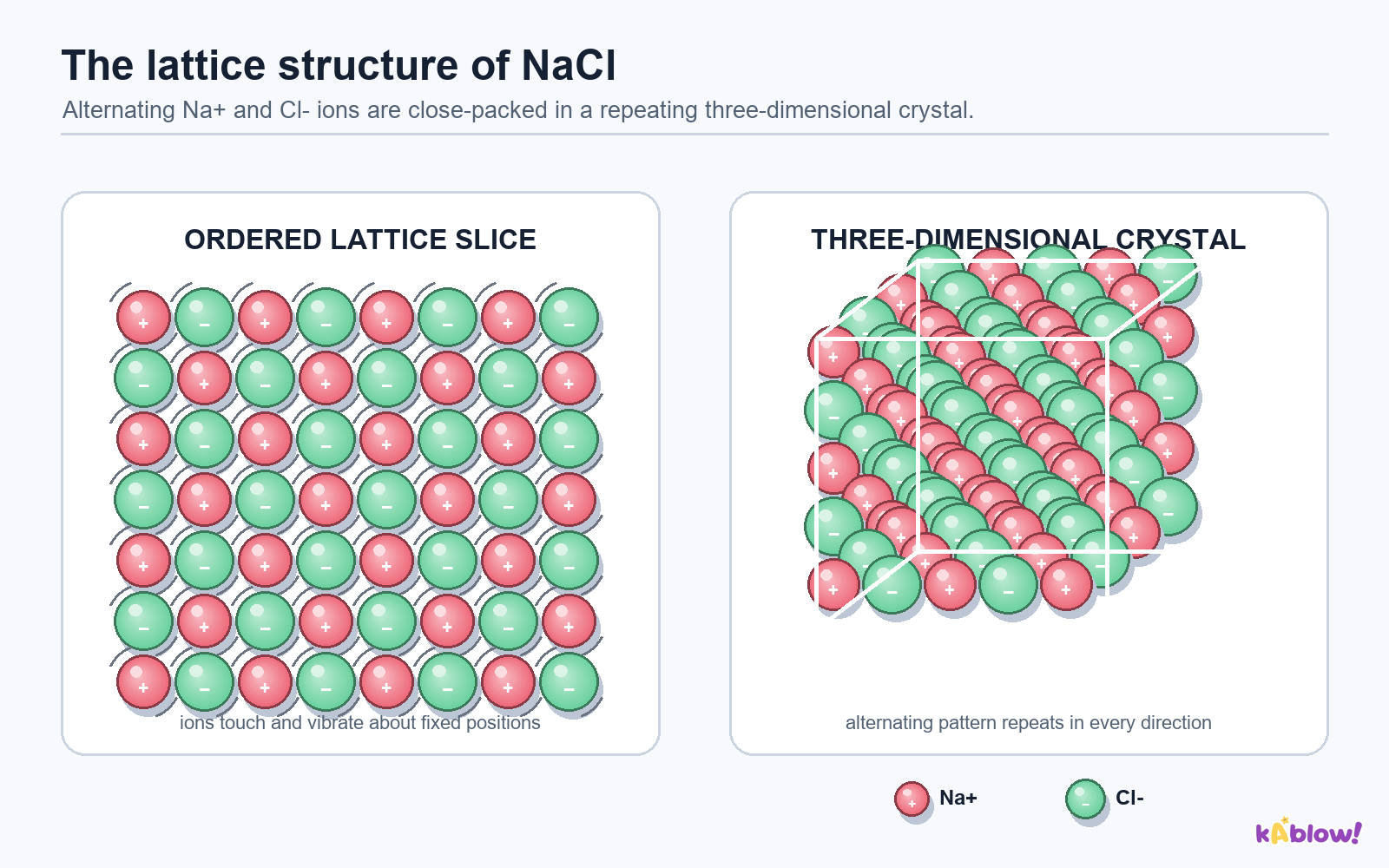
- An ionic lattice is a crystalline structure formed by ions in a regular, repeating pattern.
- The lattice consists of alternating cations and anions arranged so that positive and negative charges cancel out; the lattice is overall electrically neutral.
- Ionic compounds are represented using empirical formulas, which show the simplest whole-number ratio of ions.
- The strong electrostatic forces of attraction between the oppositely charged ions hold the lattice together — this is one definition of ionic bonding.
The lattice structure of sodium chloride
Lattice Enthalpy
- Lattice dissociation enthalpy (ΔHlatt) is the standard enthalpy change on the formation of 1 mole of gaseous ions from the solid lattice.
- Example: NaCl(s) → Na⁺(g) + Cl⁻(g) ΔHlatt = +790 kJ mol⁻¹.
- Lattice enthalpy increases as ionic charge increases and ionic radius decreases, due to stronger electrostatic attractions.
- The process is always endothermic (positive ΔH) because energy is always required to break the bonds between ions in the lattice.
Properties of Ionic Compounds
- Ionic compounds are strong and brittle: crystals shatter when layers shift and like charges align.
- They have high melting and boiling points because the strong electrostatic forces act in all directions; melting/boiling points increase with the charge density of the ions (e.g. MgO has a higher melting point than NaCl).
- Ionic compounds are not volatile — large amounts of energy are needed to overcome the strong electrostatic forces.
- They are generally soluble in water because polar water molecules hydrate the ions, forming ion–dipole interactions; lower solvent polarity reduces solubility.
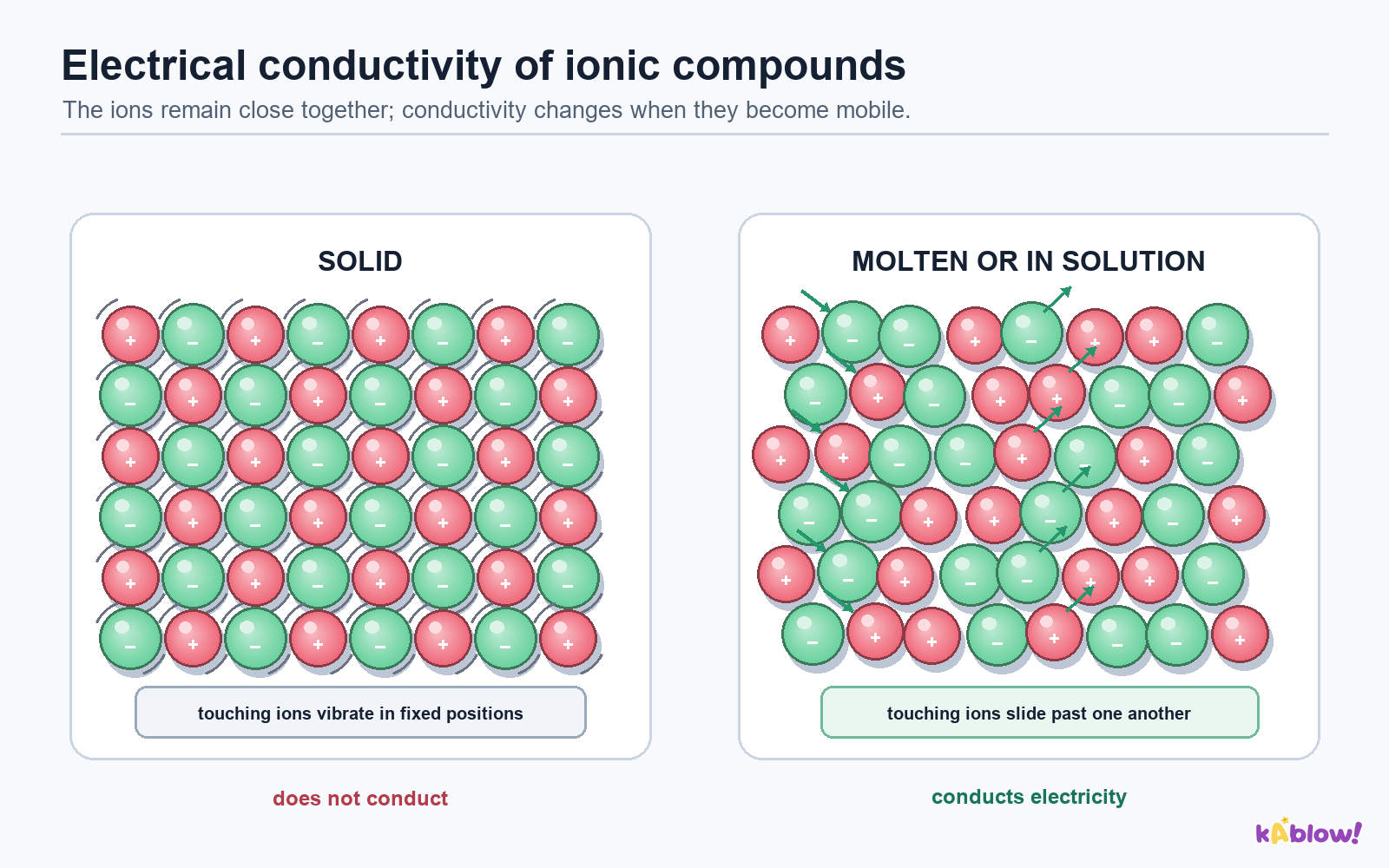
- They only conduct electricity when molten or in solution, because the ions are then free to move; as a solid the ions are in fixed positions.
Electrical conductivity of ionic compounds
Comparing Ionic Lattices with Other Structures
- Giant ionic: high melting/boiling points, conduct only when molten or in solution, generally soluble, hard and brittle, solid at room temperature; particles are ions held by electrostatic attraction.
- Giant metallic: moderately high to high melting/boiling points, conduct when solid or liquid, insoluble, hard and malleable; particles are positive ions in a sea of delocalised electrons.
- Simple covalent: low melting/boiling points, do not conduct electricity, usually insoluble unless polar, soft; particles are small molecules with weak intermolecular forces.
- Giant covalent: very high melting/boiling points, do not conduct electricity (except graphite), insoluble, very hard (diamond/silica) or soft (graphite); particles are atoms with covalent bonds between them.
Slide
Sign up free to view the lesson slides
Step through every slide for this topic — plus flashcards and revision notes — with a free account.
Câu hỏi luyện tập
Xem trước miễn phí — 8 trên 61 câu hỏi. Đăng ký để xem tất cả.
1.Which of the following statements about ions and ionic compounds are true? I. Nitrogen can form a 3− ion II. Potassium can form a cation III. The formula for aluminium chloride is AlCl2
Medium- AI and II only
- BI and III only
- CII and III only
- DI, II and III
2.What is the correct formula for ammonium carbonate?
Medium- ANH4CO3
- B(NH4)2CO3
- C(NH4)3CO3
3.Which crystal structure does not conduct electricity when solid, has a high melting point and can conduct electricity when molten?
Medium- AGiant metallic
- BGiant ionic
- CCovalent network
- DSimple molecular
4.Which of the following compounds is not bonded ionically?
Medium- ACaCO3
- BCH3OH
- CNaOH
- DBaCl2
5.Magnesium oxide has a very high melting temperature. Which of the following is the best description of its structure and bonding?
Medium- AGiant ionic
- BGiant metallic
- CNetwork covalent
- DSimple molecular
6.Which of the following compounds has both covalent and ionic bonds?
Medium- Acalcium bromide, CaBr2
- Bpotassium carbonate, K2CO3
- Cpropanoic acid, CH3CH2COOH
- Ddichloromethane, CH2Cl2
7.Which is the best description of ionic bonding?
Medium- Aelectrostatic attraction between cations and electrons
- Belectrostatic attraction between nuclei
- Celectrostatic attraction between oppositely charged ions
- Delectrostatic attraction of nuclei towards shared electrons in the bond between the nuclei
8.Potassium bromide is an ionic compound. When can potassium bromide conduct electricity? Solid | Molten | Aqueous
Medium- A✓ | ✓ | ✗
- B✓ | ✗ | ✓
- C✗ | ✓ | ✓
- D✗ | ✗ | ✓
Unlock all 61 questions & more
Tạo tài khoản miễn phí để xem mọi câu hỏi, slide, thẻ ghi nhớ và ghi chú ôn tập cho chủ đề này.