Electric & Magnetic Fields
Học bằng cách chơi
Trả lời những câu hỏi này để kiếm năng lượng, rồi câu cá và khám phá. Không cần tài khoản.
Ghi chú bài học
Electric Charge
- Charge is the property of matter responsible for the electric force; it is a scalar quantity measured in coulombs (C).
- One coulomb is the charge carried by a current of one ampere in one second.
- Charge is quantised: the charge on any object is a whole-number multiple of the elementary charge e = 1.60 × 10⁻¹⁹ C.
- Protons are positive, electrons are negative, and neutrons are neutral; atoms are neutral when protons and electrons balance.
- Like charges repel and opposite charges attract.
- The law of conservation of charge states that the total charge in an isolated system remains constant — charge can be transferred but not created or destroyed.
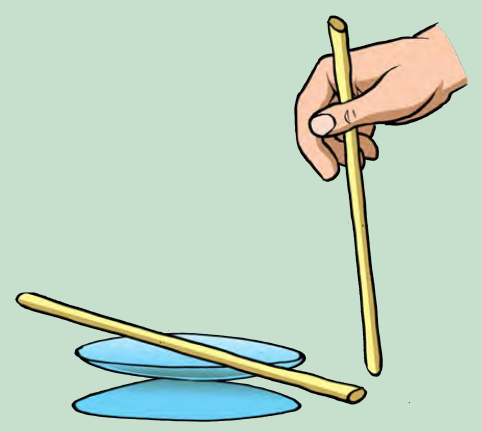
Testing charge with perspex rods and watch glasses
Millikan's Oil Drop Experiment
- Conducted by Millikan and Fletcher in 1909 to determine the value of the elementary charge.
- A fine mist of oil is sprayed into a chamber; oil is used because it does not evaporate quickly, so the mass of the drops stays constant.
- Drops become charged by friction as they leave the nozzle (or by ionisation with X-rays).
- Without an electric field, drops fall under gravity and reach terminal velocity when air resistance equals gravitational force.
- With an electric field, the upward electric force F = Eq can balance the gravitational force W = mg, allowing the charge to be found.
- The experiment showed charge is always a multiple of 1.60 × 10⁻¹⁹ C, providing evidence for the quantisation of charge.
Static Electricity
- Charging by friction: rubbing two insulators transfers electrons from one to the other, leaving one positive and the other equally negative.
- Earthing (grounding) connects a body to the Earth so it discharges to 0 V; current takes the path of lower resistance.
- Charging by electrostatic induction is the separation of charge caused by a nearby charged object without contact.
- A neutral conducting sphere can be charged by induction: bring a charged rod near, earth the sphere, then remove the earth and rod.
- Charging by contact transfers charge when two objects touch, reducing the potential difference between them (e.g. a 'shock' from a door handle).
- Large potential differences can cause breakdown of air and a spark, risking electrocution or igniting flammable gases; a bonding line to Earth reduces this risk.
Coulomb's Law
- Coulomb's law: the electric force between two point charges is directly proportional to the product of the charges and inversely proportional to the square of their separation.
- F = kq₁q₂ / r², where k = 8.99 × 10⁹ N m² C⁻² and r is the distance between the centres of the charges.
- Coulomb's constant is k = 1 / (4πε₀), where ε₀ is the permittivity of free space (8.85 × 10⁻¹² C² N⁻¹ m⁻²).
- If q₁q₂ is positive the force is repulsive; if q₁q₂ is negative the force is attractive.
- Coulomb's law applies only to point charges or spheres much smaller than their separation; it cannot be used for irregularly shaped objects.
- The relative permittivity εᵣ = ε / ε₀ is the ratio of a material's permittivity to that of free space and has no units; for air εᵣ ≈ 1.
Electric Field Strength
- An electric field is a region where a charge experiences a force; field strength is the force per unit positive test charge.
- E = F / q, measured in N C⁻¹ or V m⁻¹; it is a vector directed away from positive charges and towards negative charges.
- For a point charge, E = kq / r² — an inverse square law; a charged sphere behaves as a point charge with all charge at its centre.
- Inside a charged conducting sphere the electric field strength is zero.
- For a uniform field between parallel plates, E = V / d; a larger voltage gives a stronger field and a larger separation gives a weaker field.
- Fields from multiple charges combine by vector addition: add magnitudes if in the same direction, subtract if opposite, or use Pythagoras for perpendicular fields.
Electric Field Lines
- Field lines show the direction of the force on a positive test charge: they point from positive to negative and never cross.
- In a uniform field the lines are equally spaced; in a radial field they spread out, so field strength decreases with distance.
- Around a point charge, lines are radially outwards for positive and radially inwards for negative charges.
- Field lines are always perpendicular to the surface of a conducting sphere, and the field inside is zero.
- For two like charges, lines point away from both (or towards both) and there is a neutral point at the midpoint where the resultant field is zero.
- The density of field lines represents field strength: closer lines mean a stronger field.
Electric Potential & Potential Energy
- Electric potential at a point is the work done per unit charge bringing a small positive test charge from infinity to that point; it is a scalar measured in J C⁻¹ or V.
- Potential is zero at infinity and is calculated using V = kQ / r.
- Around a positive charge, potential is positive and increases as you move closer; around a negative charge, potential is negative and decreases as you move closer.
- The potential always decreases in the direction of the field lines.
- Electric potential energy is the work done in moving a charge between two points: Eₚ = qV.
- For multiple charges, potentials combine by simple addition (they are scalars): V = kQ₁/r₁ + kQ₂/r₂.
Electric Potential Gradient & Equipotential Surfaces
- The electric field strength equals the negative of the potential gradient: E = −ΔV / Δr.
- Equipotential surfaces are surfaces where the potential is constant; no work is done moving a charge along an equipotential.
- Equipotential lines are always perpendicular to electric field lines.
- In a uniform field, equipotentials are straight, evenly spaced lines perpendicular to the field.
- Around a point charge, equipotentials are concentric circles that become further apart as distance increases.
Magnetic Fields
- A magnetic field is a region where a magnetic force acts on a moving charge or a current-carrying conductor.
- The magnetic field around a straight current-carrying wire forms concentric circles in a plane perpendicular to the wire.
- The direction of the field around a wire is given by the right-hand grip rule: thumb along the current, fingers curl in the field direction.
- A solenoid produces a field like a bar magnet, with a North pole at the end where field lines emerge and a South pole where they enter.
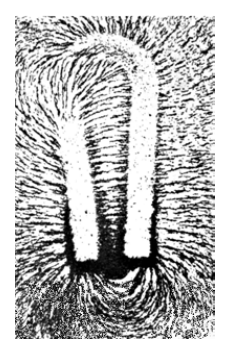
- Magnetic field lines run from North to South outside a magnet and form closed loops.
Magnetic field lines
Slide
Sign up free to view the lesson slides
Step through every slide for this topic — plus flashcards and revision notes — with a free account.
Câu hỏi luyện tập
Xem trước miễn phí — 8 trên 64 câu hỏi. Đăng ký để xem tất cả.
1.Which of the following best describes the shape of the electric field created by a point charge?
Easy- ARadial
- BUniform
- CInverse
- DVector
2.An equipotential surface is always perpendicular to a field line:
Easy- Afor both electric and gravitational fields
- Bfor electric fields only
- Cfor gravitational fields only
- Dfor neither electric nor gravitational fields
3.Which of the following statements about equipotential surfaces in a uniform electrostatic field is incorrect?
Medium- AThe equipotential lines are straight
- BThe equipotential lines are evenly spaced
- CThe equipotential lines become progressively further apart
- DThe equipotential lines are perpendicular to the field lines
4.Which of the following is incorrect regarding the similarities between gravitational and electrostatic fields?
Medium- AThe field lines around a point mass and a negative point charge are identical
- BThe work done in each field is either the product of mass and change in potential or charge and change in potential
- CThe gravitational potential and electric potential both have a 1/r relationship
- DThe gravitational and electrostatic forces are always attractive
5.Gravitational and electrostatic forces are similar in many ways. Which statements are correct about both? I. Both are always attractive. II. Both may be attractive or repulsive. III. Both follow an inverse square law. IV. The equations used to calculate these forces rely on knowing certain universal constants.
Medium- AI and III only
- BIII and IV only
- CI, II, and III only
- DII, III, and IV only
6.The electric field strength inside a charged conducting sphere is zero.
EasyTrue or false?
7.Electric field lines are always directed from a negative charge to a positive charge.
EasyTrue or false?
8.Which of the following methods can transfer electric charge? (select all that apply)
Medium- ACharging by friction
- BCharging by electrostatic induction
- CCharging by contact
- DCharging by electromagnetic induction
- ECharging by gravitational attraction
Unlock all 64 questions & more
Tạo tài khoản miễn phí để xem mọi câu hỏi, slide, thẻ ghi nhớ và ghi chú ôn tập cho chủ đề này.