Gravitational Fields
Học bằng cách chơi
Trả lời những câu hỏi này để kiếm năng lượng, rồi câu cá và khám phá. Không cần tài khoản.
Ghi chú bài học
Newton's Law of Gravitation
- Newton's law of gravitation states that the gravitational force between two point masses is proportional to the product of the masses and inversely proportional to the square of their separation.
- Equation: F = Gm₁m₂ / r², where F is the gravitational force (N), G is Newton's gravitational constant, m₁ and m₂ are the masses (kg), and r is the distance between their centres (m).
- The inverse square law means that if the separation is doubled, the force reduces by a factor of (½)² = ¼.
- The law applies to point masses, but planets and stars can be treated as point masses because their separation is much larger than their radii.
- The distance r is always measured from the centre of mass of each body, so for an object on or above a planet's surface, r = planet's radius + height above surface.
Gravitational Field Strength
- A gravitational field is a region of space where a test mass experiences a force due to the gravitational attraction of another mass.
- Gravitational field strength (g) at a point is defined as the force per unit mass experienced by a test mass at that point: g = F / m.
- The unit of g is N kg⁻¹.
- From equating F = mg with Newton's law, g = GM / r², where M is the mass producing the field and r is the distance from its centre.
- The field strength g depends only on the mass M producing the field, so all objects in that field experience the same g regardless of their own mass.
- g is inversely proportional to the square of the radial distance: g ∝ 1/r².
- Factors affecting g at a planet's surface are its radius and its mass (or density).
Gravitational Field Strength
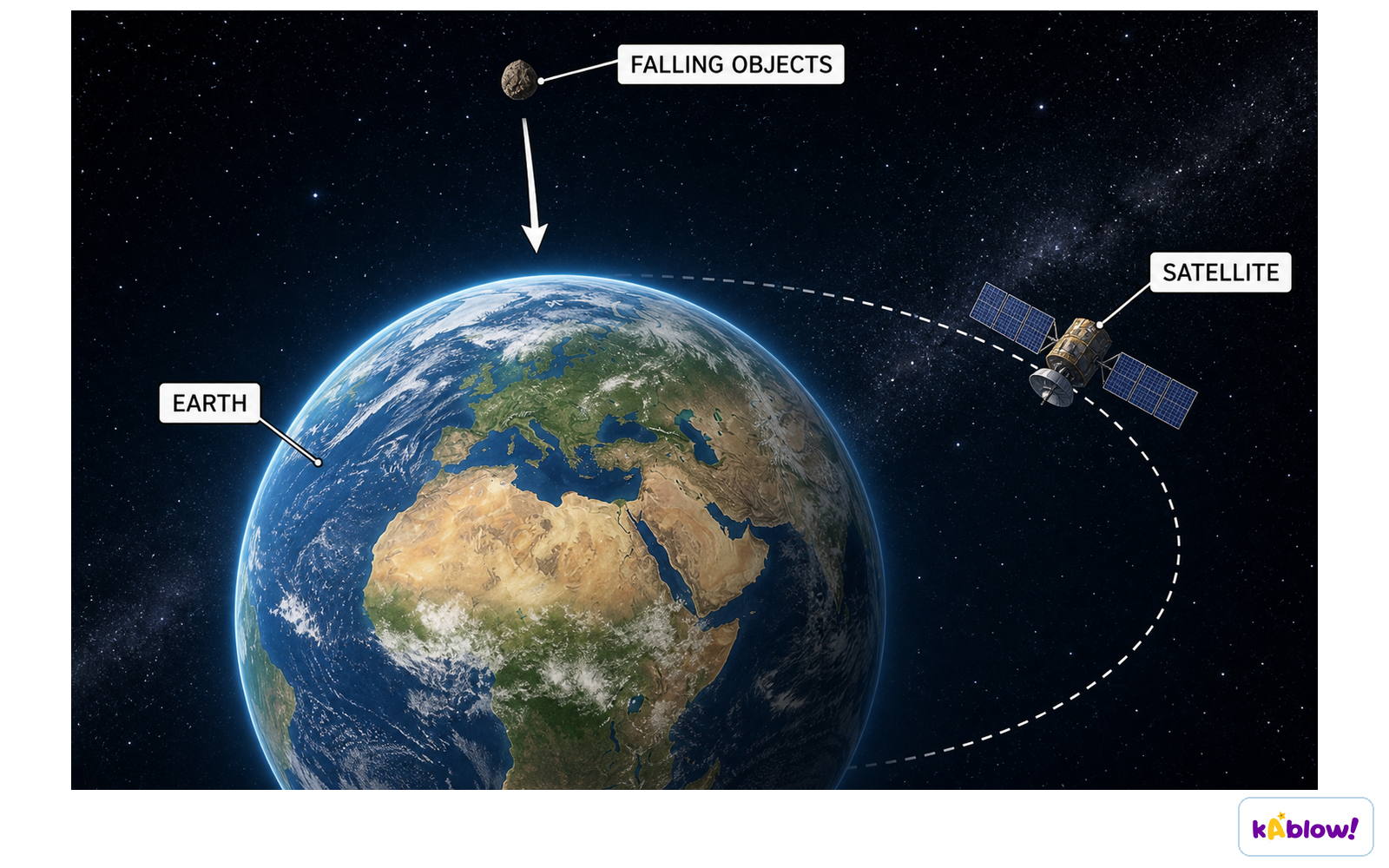
Gravitational Field Lines
- Gravitational field lines show the direction of the gravitational force that would act on a mass placed at that point.
- Field lines are always directed towards the centre of mass of the body because gravitational forces are always attractive.
- The gravitational field around a point mass is radial, with field lines pointing radially inwards.
- A uniform field (e.g. near the Earth's surface) is represented by equally spaced parallel field lines; g is the same throughout.
- Radial fields are non-uniform: g depends on the distance from the centre of mass.
- For a uniform sphere, the field outside it is identical to that of a point mass at its centre.
Gravitational Potential
- Gravitational potential (Vg) at a point is the work done per unit mass in bringing a test mass from infinity to that point.
- Unit: J kg⁻¹.
- Equation: Vg = − GM / r, where M is the mass producing the field and r is the distance from its centre.
- Gravitational potential is always negative because it is defined as zero at infinity, and work must be done to move a mass away from the body towards infinity.
- As r decreases (closer to the planet), Vg becomes more negative (smaller).
- As r increases (further away), Vg becomes less negative (larger), approaching zero at infinity.
- Gravitational potential is a scalar quantity, unlike gravitational field strength which is a vector.
Gravitational Potential Energy
- Gravitational potential energy (Ep) of two point masses is the work done to assemble the system from infinite separation: Ep = − Gm₁m₂ / r.
- Near the Earth's surface, where the field is approximately uniform, Ep = mgΔh.
- The change in GPE when a mass moves between two distances r₁ and r₂ is: ΔEp = Gm₁m₂ (1/r₁ − 1/r₂).
- The change in gravitational potential between two points is: ΔVg = Gm₁ (1/r₁ − 1/r₂).
- The work done in moving a mass m through a potential difference ΔVg is: ΔW = mΔVg.
- The area under a force–distance graph for a gravitational field represents the work done (change in GPE).
- Work is done when a mass moves against the gravitational field lines (away from the planet).
Gravitational Potential Gradient
- The gravitational field strength at a point is equal to the negative gradient of a potential–distance graph at that point: g = − ΔVg / Δr.
- The potential gradient is the rate of change of gravitational potential with respect to displacement in the direction of the field.
- For a planet, the graph of Vg against r follows a −1/r relation and all values of Vg are negative.
- The gradient of the Vg–r graph at any point gives the value of g at that point.
- To find g from the graph, draw a tangent at the point and calculate its gradient.
Gravitational Equipotential Surfaces
- Equipotential lines (2D) or surfaces (3D) join points that have the same gravitational potential.
- They are always perpendicular to the gravitational field lines.
- In a radial field, equipotential lines are concentric circles around the planet and become further apart as distance increases.
- In a uniform field, equipotential lines are horizontal, parallel, and equally spaced.
- No work is done when moving along an equipotential surface; work is only done when moving between different equipotential surfaces (ΔV = 0 along an equipotential).
Kepler's Laws of Planetary Motion
- Kepler's First Law: The orbit of a planet is an ellipse, with the Sun at one of the two foci.
- Kepler's Second Law: A line segment joining the Sun to a planet sweeps out equal areas in equal time intervals; consequently, planets move faster nearer the Sun and slower further away.
- Kepler's Third Law: For planets or satellites in circular orbit about the same central body, the square of the time period is proportional to the cube of the orbital radius: T² ∝ r³.
- The relationship between T and r is: T² = (4π² r³) / (GM), where M is the mass of the central body.
- A graph of log T against log r gives a straight line, since 2 log T ∝ 3 log r.
Escape Speed
- Escape speed is the minimum speed that will allow an object to escape a gravitational field with no further energy input.
- It is the same for all masses in the same gravitational field (e.g. a rocket and a tennis ball on Earth).
- Escape speed is derived by equating kinetic energy to gravitational potential energy: ½ m vesc² = GMm / r.
- The mass m cancels, giving: vesc = √(2GM / r).
- Escape speed depends on the mass and radius of the object creating the field (planet, moon, or black hole).
- Rockets launched from Earth do not need to reach escape velocity to enter orbit; they are continuously given energy by fuel and thrust.
Orbital Motion, Speed & Energy
- For a satellite in circular orbit, the gravitational force provides the centripetal force: GMm / r² = mv² / r.
- The mass of the satellite cancels, giving orbital speed: v = √(GM / r).
- All satellites, regardless of their mass, travel at the same speed in a particular orbit radius.
- An orbiting satellite has both kinetic energy (Ek) and gravitational potential energy (Ep); its total energy is constant.
- For a smaller orbital radius: gravitational force is larger, speed is higher, Ek is greater, Ep is lower, and orbital period T is shorter.
- For a larger orbital radius: gravitational force is smaller, speed is lower, Ek is lower, Ep is greater, and orbital period T is longer.
- Total energy = Ek + Ep; as orbital radius decreases, Ek increases and Ep decreases.
Effects of Drag on Orbital Motion
- Satellites in low orbits (<600 km) may experience viscous drag (air resistance) due to the very low but non-zero density of the upper atmosphere.
- Drag causes a small dissipation of kinetic energy into thermal energy due to friction between air particles and the satellite's surface.
- As a satellite loses energy, its orbital radius decreases and it spirals towards the Earth.
- As the orbit becomes lower, some potential energy is transferred to kinetic energy, so the satellite's speed increases.
- The increased speed in a lower orbit leads to greater air resistance and greater dissipation of kinetic energy.
- The satellite's total energy decreases if the overall decrease in potential energy is larger than the overall increase in kinetic energy: ΔEtotal < 0 if ΔEp > ΔEk.
Slide
Sign up free to view the lesson slides
Step through every slide for this topic — plus flashcards and revision notes — with a free account.
Câu hỏi luyện tập
Xem trước miễn phí — 8 trên 58 câu hỏi. Đăng ký để xem tất cả.
1.Which of the following best defines a gravitational field?
Easy- AA region of space where a test mass experiences a force due to the gravitational attraction of another mass
- BA region of space where a test mass experiences a repulsive force
- CThe force per unit mass experienced by a test mass
- DThe work done per unit mass in bringing a test mass from infinity
2.Which equation correctly represents Newton's law of gravitation?
Easy- AF = G m1 m2 / r2
- BF = G m1 m2 / r
- CF = G m1 m2 r2
- DF = m g
3.Which of the following statements about gravitational field lines are correct? (select all that apply)
Medium- AThey point towards the centre of mass of a body
- BThey are always directed radially outwards
- CThey can be used to represent the direction of the gravitational force on a mass placed in the field
- DThey are equally spaced in a uniform field
- EThey are always straight lines
4.Gravitational forces are always attractive.
EasyTrue or false?
5.Gravitational potential is a vector quantity.
EasyTrue or false?
6.Match each term with its correct definition.
Medium- Gravitational field strength
- Gravitational potential
- Escape speed
- The force per unit mass experienced by a test mass at a point
- The work done per unit mass in bringing a test mass from infinity to a point
- The minimum speed that will allow an object to escape a gravitational field with no further energy input
7.Place the following steps in the correct order to derive the equation for escape speed from a planet of mass M and radius r.
Medium- Set kinetic energy equal to gravitational potential energy: 1/2 m vesc2 = GMm/r
- Cancel the mass m from both sides
- Rearrange to make vesc the subject: vesc = √(2GM/r)
8.Match each gravitational quantity with its correct SI unit.
Medium- Gravitational force
- Gravitational field strength
- Gravitational potential
- Gravitational potential energy
- N
- N kg⁻¹
- J kg⁻¹
- J
Unlock all 58 questions & more
Tạo tài khoản miễn phí để xem mọi câu hỏi, slide, thẻ ghi nhớ và ghi chú ôn tập cho chủ đề này.