Kinematics
Học bằng cách chơi
Trả lời những câu hỏi này để kiếm năng lượng, rồi câu cá và khám phá. Không cần tài khoản.
Ghi chú bài học
Distance & Displacement
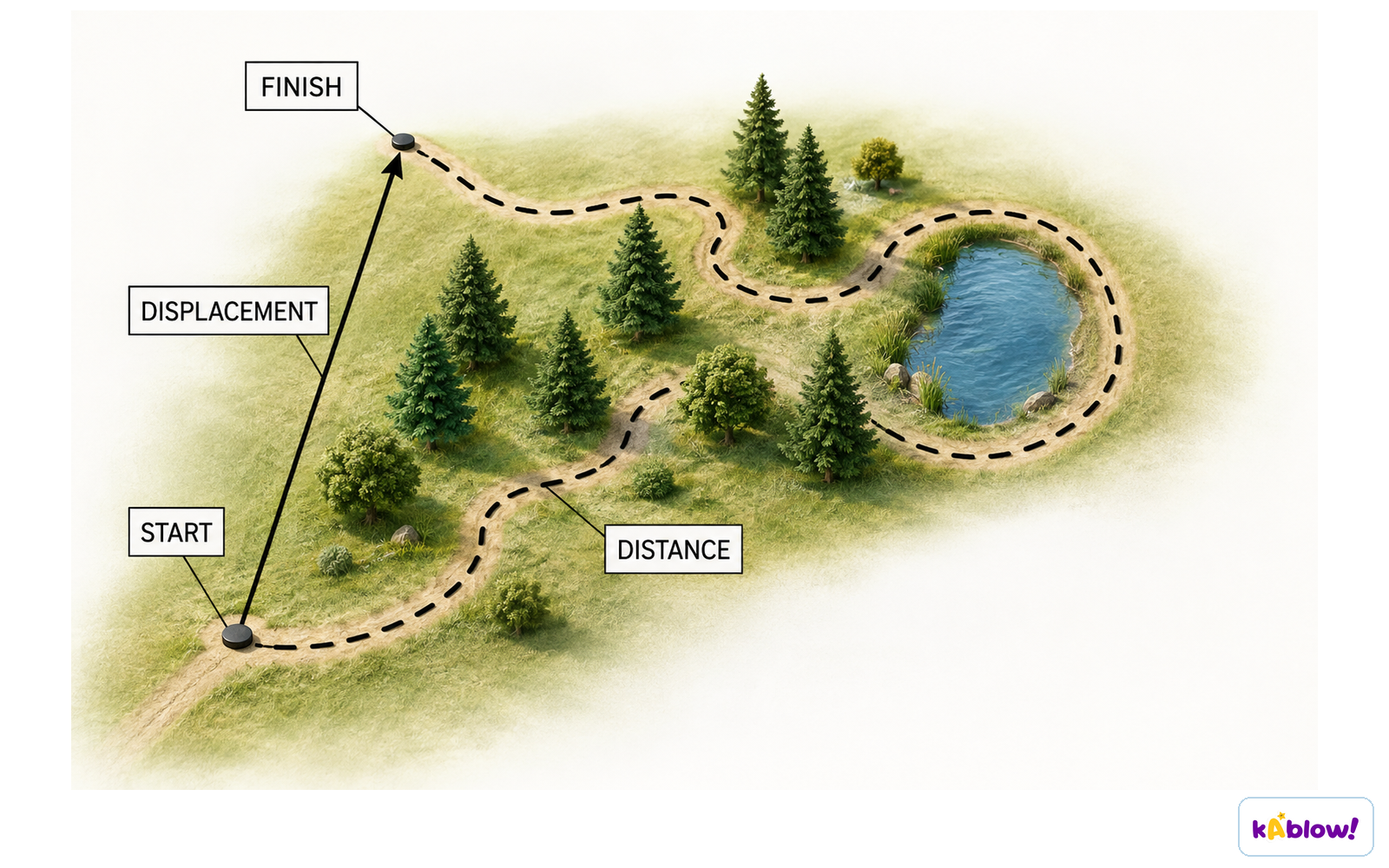
- Distance is a measure of how far an object travels; it is a scalar quantity, so direction is not important.
- Displacement is a measure of how far something is from its starting position, along with its direction; it is a vector quantity.
- Displacement is the change in position and describes both magnitude and direction.
- For a 300 m race on a 400 m track, the distance travelled is 300 m, but the displacement is 100 m to the right.
- If athletes run the full 400 m lap, their final displacement is zero because they finish at the starting point.
- When travelling to school, the distance includes all twists and turns, while the displacement is a straight line from home to school.
Distance vs displacement
Speed & Velocity
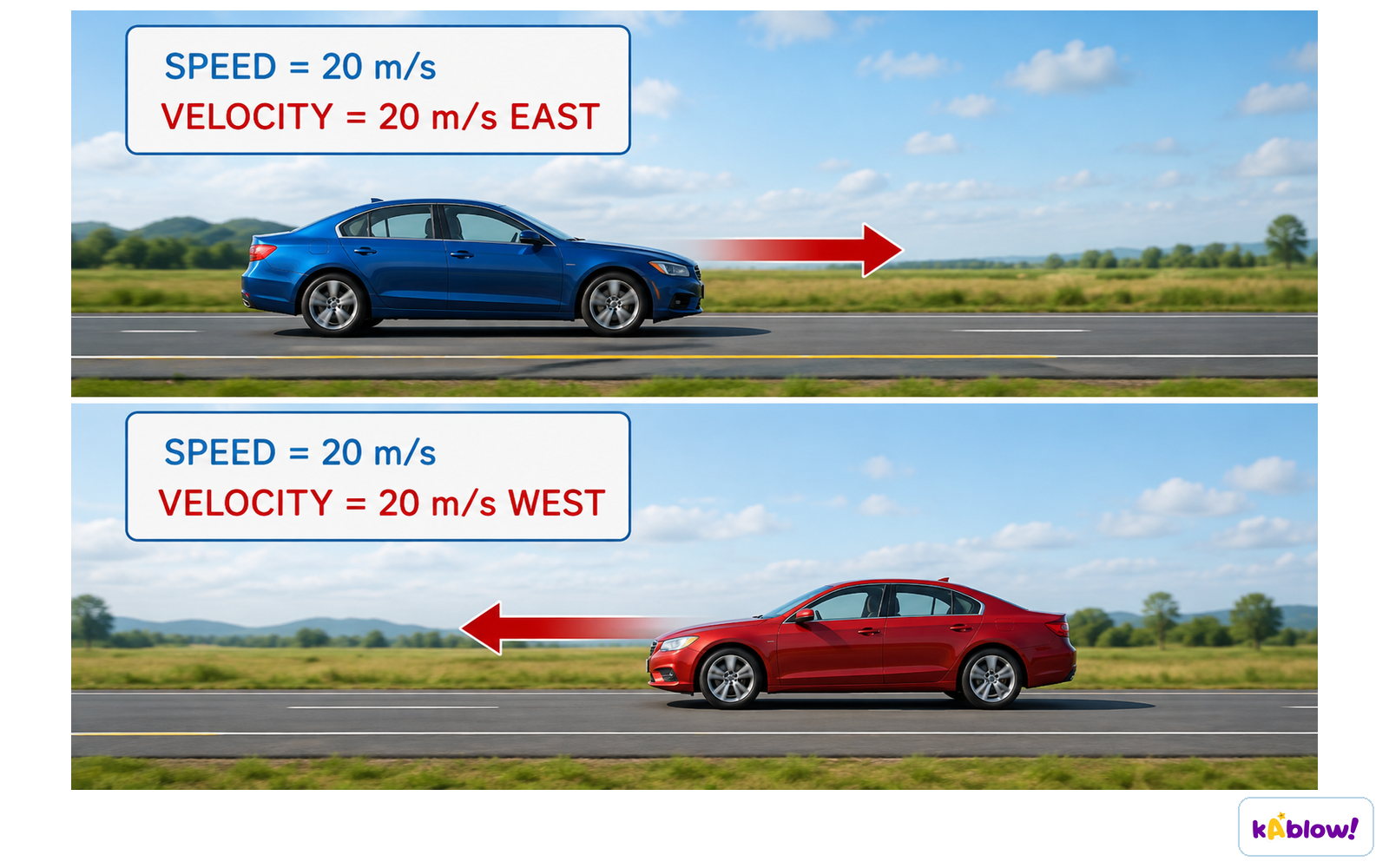
- Speed is the distance an object travels every second; it is a scalar quantity.
- Average speed is calculated as: average speed = total distance ÷ time taken.
- Velocity is the rate of change of displacement; it is a vector quantity because it has both magnitude and direction.
- Velocity is speed in a given direction, so it can be negative (e.g., a ball thrown upwards at 3 m s⁻¹ comes down at –5 m s⁻¹ if upwards is positive).
- Instantaneous speed (or velocity) is the speed (or velocity) at a given point in time; on a displacement-time graph, it is found by drawing a tangent and calculating its gradient.
- Average velocity is calculated as: v̄ = Δs / Δt, where Δs is total displacement and Δt is total time.
- If acceleration is constant and initial velocity u and final velocity v are known, average velocity can also be calculated as v̄ = (u + v) / 2.
Comparing speed and velocity
Acceleration
- Acceleration is defined as the rate of change of velocity; it is a vector quantity measured in metres per second squared (m s⁻²).
- Average acceleration is calculated as: a = Δv / Δt, where Δv = v – u (final velocity minus initial velocity).
- Instantaneous acceleration is the acceleration at a given point in time; on a velocity-time graph, it is the gradient at that point.
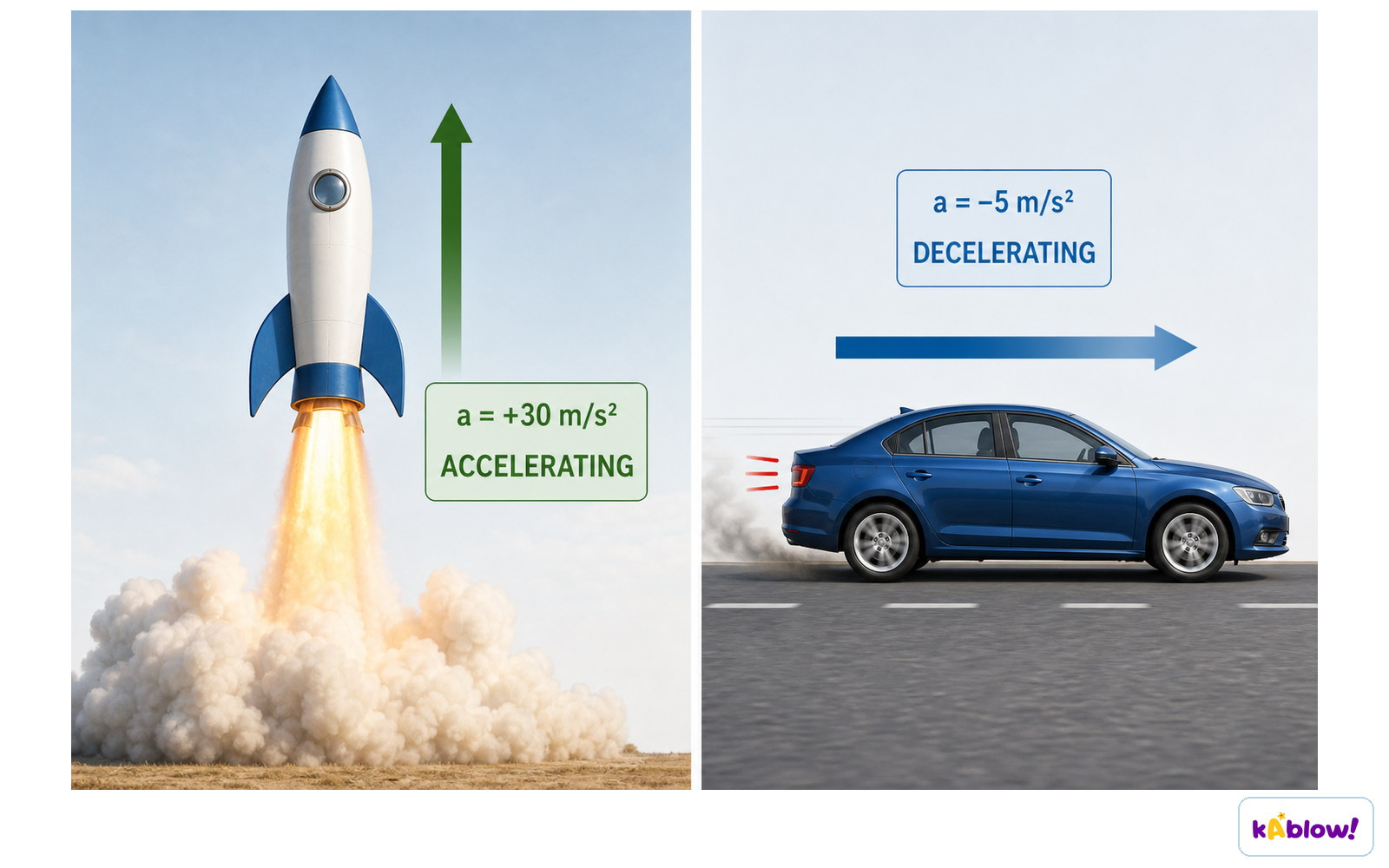
- If an object is speeding up, its acceleration is positive; if it is slowing down, its acceleration is negative (deceleration).
- Acceleration can also be negative if the object is accelerating in the negative direction.
- A curved line on a velocity-time graph indicates changing (non-uniform) acceleration.
Illustration of positive and negative acceleration with a rocket and a car.
Kinematic Equations
- The kinematic equations (often called SUVAT equations) describe motion with constant (uniform) acceleration.
- The five variables are: s = displacement, u = initial velocity, v = final velocity, a = acceleration, t = time interval.
- The four kinematic equations are: v = u + at, s = ut + ½at², v² = u² + 2as, and s = (u + v)t / 2.
- These equations are given in the data booklet, so you do not need to memorise them.
- Key phrases: 'starts from rest' means u = 0; 'falling due to gravity' means a = g = 9.8 m s⁻² (positive if downwards is positive, negative if upwards is positive).
- To solve problems: list known and unknown quantities, choose the equation containing those quantities, convert units to SI, then substitute and solve.
- Always choose a single direction as positive and stick with it throughout the question to avoid sign errors.
Motion Graphs
- On a displacement-time graph: slope equals velocity; a straight diagonal line represents constant velocity; a curved line represents acceleration; a horizontal line represents rest.
- On a velocity-time graph: slope equals acceleration; a straight diagonal line represents uniform acceleration; a curved line represents non-uniform acceleration; a horizontal line represents constant velocity.
- The area under a velocity-time graph equals the change in displacement.
- On an acceleration-time graph: the area under the curve equals the change in velocity; a horizontal line represents constant acceleration.
- For a bouncing ball (ignoring air resistance), acceleration due to gravity is always constant and directed downwards.
- At the highest point of a bounce, the ball momentarily has zero velocity, and its velocity changes from positive to negative.
- At the lowest point (ground), velocity changes instantaneously from negative to positive, but speed remains the same.
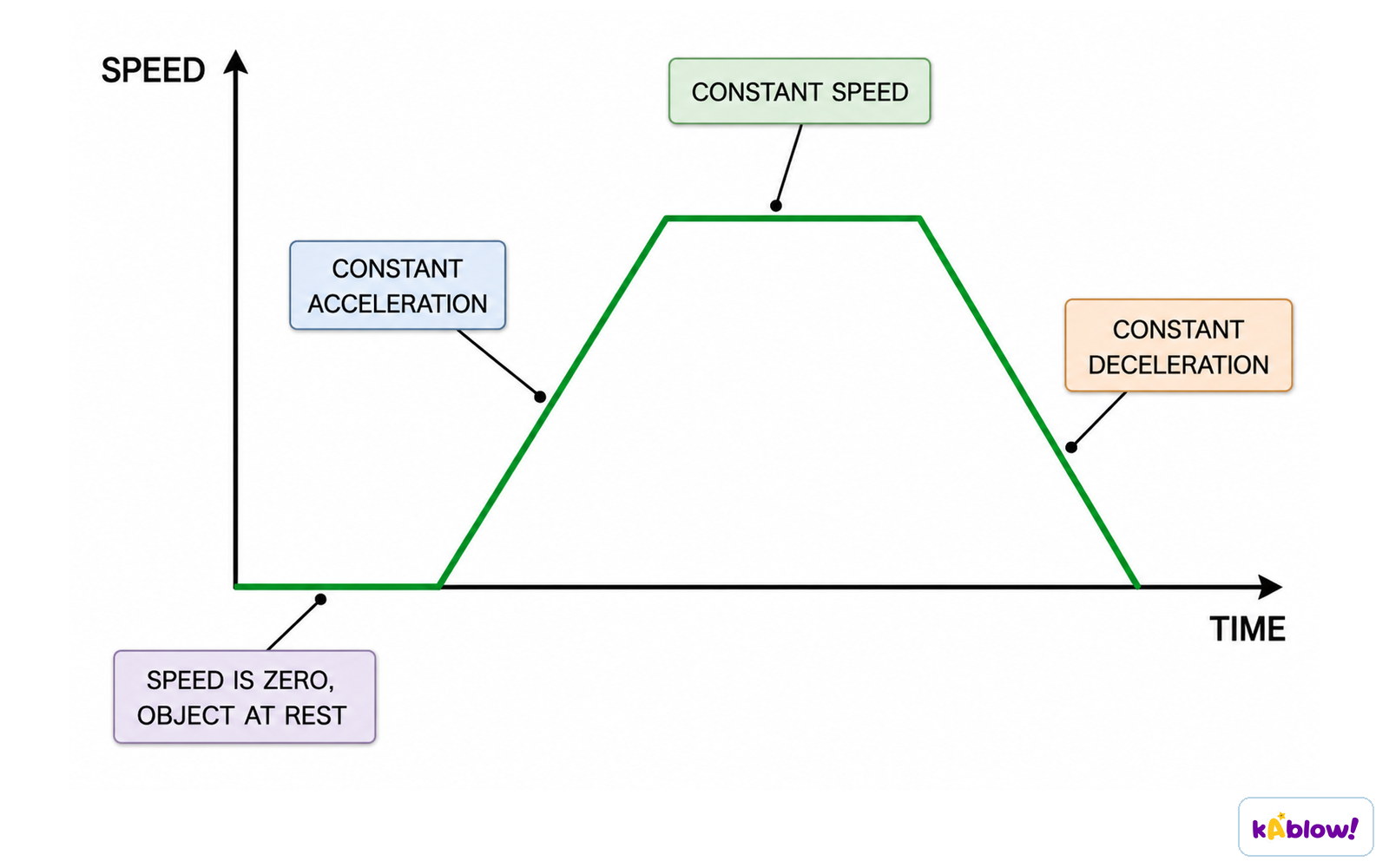
Motion on a speed–time graph
Projectile Motion
- A projectile is a particle moving freely (non-powered) under gravity in a two-dimensional plane; examples include a thrown ball or a cannonball.
- Assumptions: fluid resistance is negligible, and acceleration due to free-fall g is constant near Earth's surface.
- The horizontal and vertical components of motion are independent of each other and must be evaluated separately using SUVAT equations.
- Horizontal component: velocity is constant, acceleration is zero, and displacement is maximum range at the end of motion.
- Vertical component: velocity is zero at maximum height, acceleration is g = 9.8 m s⁻² (positive downwards, negative upwards).
- For a projectile launched at speed u and angle θ to the horizontal: vertical component = u sinθ, horizontal component = u cosθ.
- Time to maximum height is half the total time of flight; maximum height occurs when vertical velocity = 0.
- Projectile motion is typically symmetrical when air resistance is ignored, so total time or range can be found by doubling the value from start to peak.
Fluid Resistance
- Fluid resistance refers to the effects of gases and liquids on the motion of a body; these resistive forces are known as viscous drag (or air resistance).
- Frictional forces always act opposite to motion, never speed an object up, and transfer energy away from the object to the surroundings.
- Lift is an upward force on an object moving through a fluid, perpendicular to the fluid flow (e.g., air pushing up on aeroplane wings).
- Drag forces increase with the speed of the object.
- In projectile motion, air resistance decreases time of flight, horizontal velocity, and range, and increases horizontal deceleration.
- With air resistance, the trajectory is no longer a parabola; it is steeper on the way down than on the way up.
- For sports like long jump or javelin, an optimum angle against air resistance is used to produce the greatest range.
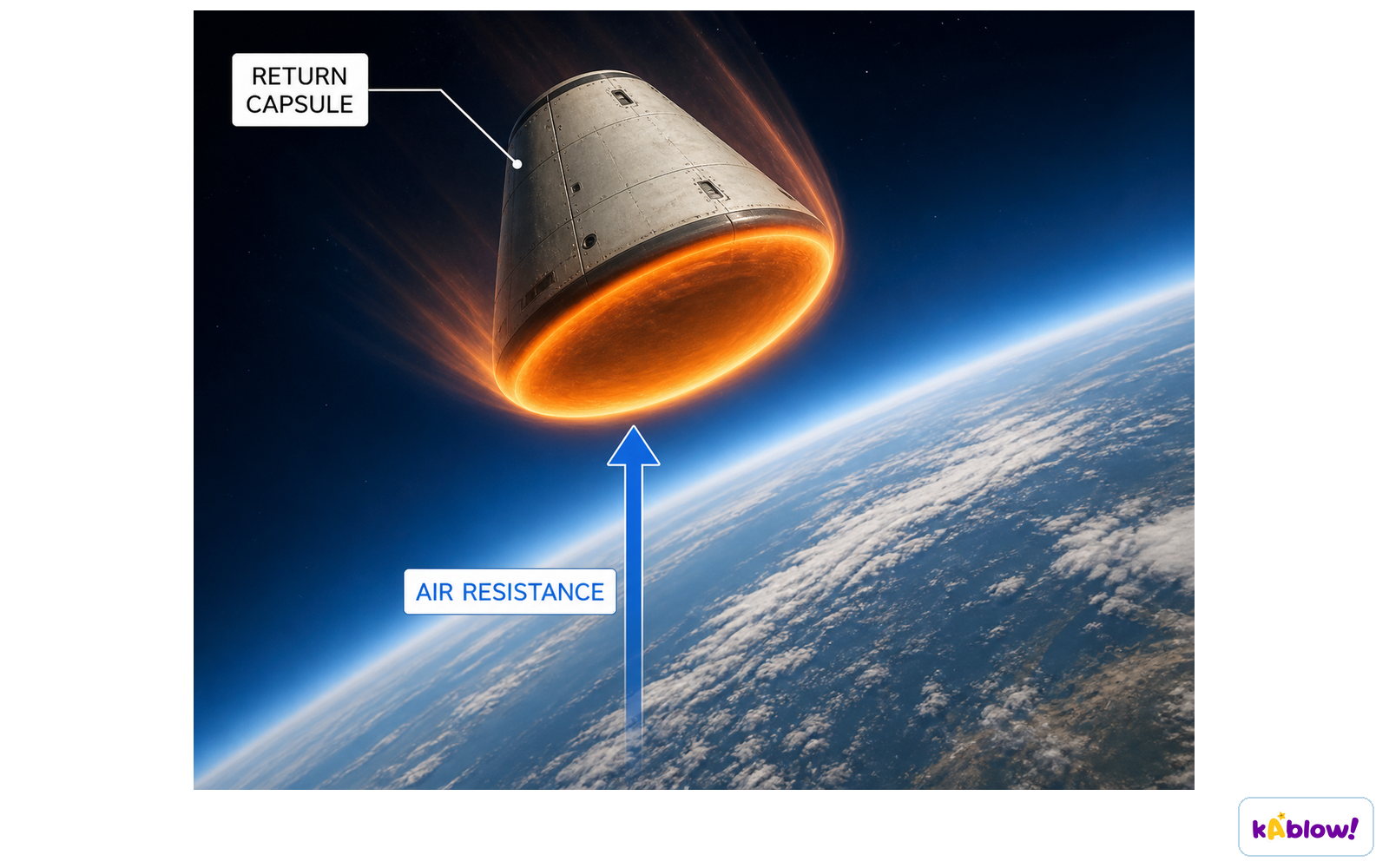
Air resistance is a type of drag: it opposes motion through a fluid and heats the object.
Terminal Speed
- For a body in free fall in a vacuum, the only force is weight, and acceleration is g due to gravity.
- As a body falls through a fluid, viscous drag increases with speed, so the resultant force and acceleration decrease (F = ma).
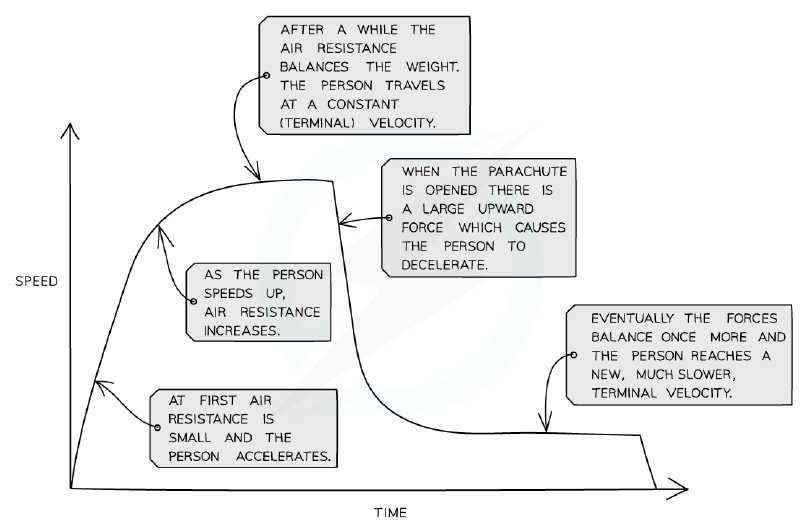
- Terminal velocity is reached when the viscous drag force equals the weight; the body then falls at a constant velocity with zero acceleration.
- Terminal velocity can occur for objects falling through a gas or a liquid.
- On a velocity-time graph for a skydiver, acceleration (gradient) decreases until it becomes zero at terminal velocity.
- After a parachute is deployed, the skydiver decelerates to a lower terminal velocity; they do not move upwards.
- A heavier skydiver reaches a higher terminal velocity and reaches it faster than a lighter skydiver with the same surface area and volume.
- If air resistance is 'negligible', it is taken to be so small that it has no effect on the motion.
A speed-time graph for a skydiver: air resistance builds as speed increases until it balances weight and a constant (terminal) velocity is reached.
Slide
Sign up free to view the lesson slides
Step through every slide for this topic — plus flashcards and revision notes — with a free account.
Câu hỏi luyện tập
Xem trước miễn phí — 8 trên 61 câu hỏi. Đăng ký để xem tất cả.
1.Which of the following quantities is a vector?
Easy- ADistance
- BSpeed
- CDisplacement
- DTime
2.A student walks 300 m around a curved path and ends up 100 m from the starting point. What are the distance travelled and the magnitude of the displacement?
Easy- A300 m and 300 m
- B300 m and 100 m
- C100 m and 300 m
- D100 m and 100 m
3.A runner completes one full lap of a 200 m track in 63.4 s. What is the average speed of the runner?
Easy- A0 m s⁻¹
- B3.15 m s⁻¹
- C6.31 m s⁻¹
- D200 m s⁻¹
4.A runner completes one full lap of a 200 m track. What is the average velocity over the entire lap?
Easy- A3.15 m s⁻¹
- B0 m s⁻¹
- C200 m s⁻¹
- D63.4 m s⁻¹
5.Which statement correctly defines instantaneous velocity?
Medium- AThe total displacement divided by the total time taken
- BThe velocity of an object at a particular moment in time
- CThe change in velocity divided by the time taken
- DThe total distance travelled divided by the total time taken
6.A train decelerates uniformly from 50 m s⁻¹ to 42 m s⁻¹ in 30 s. What is its acceleration?
Medium- A+0.27 m s⁻²
- B−0.27 m s⁻²
- C−8 m s⁻²
- D−240 m s⁻²
7.A ball is thrown vertically upwards. At its highest point, what are its velocity and acceleration?
Medium- AVelocity zero, acceleration zero
- BVelocity zero, acceleration 9.8 m s⁻² downwards
- CVelocity maximum, acceleration zero
- DVelocity zero, acceleration 9.8 m s⁻² upwards
8.On a velocity-time graph, what does the area under the curve represent?
Easy- AAcceleration
- BDisplacement
- CSpeed
- DForce
Unlock all 61 questions & more
Tạo tài khoản miễn phí để xem mọi câu hỏi, slide, thẻ ghi nhớ và ghi chú ôn tập cho chủ đề này.