Electric & Magnetic Fields
Học bằng cách chơi
Trả lời những câu hỏi này để kiếm năng lượng, rồi câu cá và khám phá. Không cần tài khoản.
Ghi chú bài học
Electric Charge
- Charge is the property of matter responsible for the electric force; its unit is the coulomb (C), defined as the charge carried by a current of one ampere in one second.
- Charge is a scalar quantity and is quantised — the charge on any object is always a whole-number multiple of the elementary charge e = 1.60 × 10⁻¹⁹ C.
- Atoms contain negative electrons, positive protons and neutral neutrons; most everyday objects are neutral because protons and electrons balance.
- An object becomes charged by gaining or losing electrons; it is a common misconception that positive charge is 'gained' — objects become positive only by losing electrons.
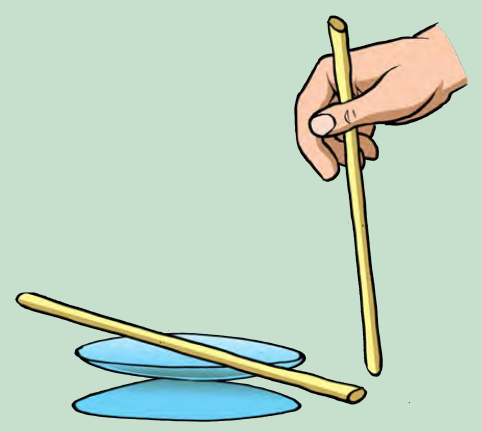
- Opposite charges attract, like charges repel — remember 'opposites attract'.
- The law of conservation of charge states that the total charge in an isolated system remains constant: charge can be transferred but not created or destroyed.
- When charged objects are brought into contact, charge is shared until evenly distributed — the final charge on each identical object is the average of the initial charges.
Testing charge with perspex rods and watch glasses
Millikan's Oil Drop Experiment
- Conducted by Millikan and Fletcher in 1909, this experiment determined the value of the fundamental elementary charge.
- A fine mist of oil (not water, because it does not evaporate quickly, keeping the mass constant) is sprayed into a chamber and charged by friction or by X-rays.
- The drops pass between two metal plates and are viewed through a microscope.
- Without an electric field, drops fall under gravity and reach terminal velocity when air resistance equals gravitational force.
- With an electric field, charged drops rise when the upward electric force exceeds the gravitational force; the electric force is F = Eq and the weight is W = mg.
- By equating the electric and gravitational forces, the fundamental charge was found to be 1.60 × 10⁻¹⁹ C — the magnitude of charge on any object is a multiple of this value, providing evidence for the quantisation of charge.
Static Electricity
- Charge can be transferred by friction, electrostatic induction and contact.
- Charging by friction: when two insulators are rubbed together, electrons transfer from one to the other — the material losing electrons becomes positive, the one gaining electrons becomes negative.
- Earthing (grounding) connects a body to the Earth so it discharges until it has a potential of 0 V; current takes the path of lower resistance, so a copper earth wire protects a person.
- Electrostatic induction is the separation of charge caused by a nearby charged object without physical contact (not the same as electromagnetic induction).
- A neutral conducting sphere can be charged by induction: a charged rod is brought near (without touching), the sphere is grounded, then the rod and earth connection are removed leaving excess charge.
- Charging by contact occurs when a charged object touches another object, allowing electrons to flow to reduce the potential difference — e.g. the 'shock' felt when touching a doorknob.
- Dangers of static electricity: a large potential difference can cause breakdown of air and a spark, risking electrocution (lightning) or igniting flammable gases — reduced by connecting a bonding line to Earth, e.g. when refuelling aeroplanes.
Coulomb's Law
- Coulomb's law states that the electric force between two point charges is directly proportional to the product of the charges and inversely proportional to the square of their separation.
- The force is calculated using F = kq₁q₂ / r², where k is the Coulomb constant (8.99 × 10⁹ N m² C⁻²), q₁ and q₂ are the magnitudes of the charges, and r is the distance between their centres.
- Coulomb's law is analogous to Newton's law of gravitation — both follow an inverse square law with separation.
- The Coulomb constant is given by k = 1 / (4πε₀), where ε₀ is the permittivity of free space (8.85 × 10⁻¹² C² N⁻¹ m⁻²).
- If the product q₁q₂ is positive, the charges repel; if negative, they attract — unlike gravity, which is only attractive.
- When a material is between the charges, k = 1 / (4πε), where ε = εᵣε₀; relative permittivity εᵣ is the ratio of the permittivity of a material to that of free space and has no units.
- Coulomb's law only applies to charged spheres whose size is much smaller than their separation (the point charge approximation), with r measured from the centres.
Electric Field Strength
- An electric field is a region of space in which an electric charge experiences a force.
- Electric field strength at a point is defined as the force per unit charge experienced by a small positive test charge placed at that point: E = F / q, measured in N C⁻¹.
- Electric field strength is a vector quantity, always directed away from a positive charge and towards a negative charge.
- The field due to a point charge follows an inverse square law: E = kq / r², decreasing with the square of the distance.
- A charged sphere behaves like a point charge with all its charge at the centre; inside the sphere the electric field strength is zero.
- Electric fields from multiple charges are combined by vector addition — add fields in the same direction, subtract opposite ones, or use Pythagoras' theorem for fields at right angles.
- For a uniform field between parallel plates, E = V / d, where V is the potential difference and d the separation; the field is directed from the positive plate to the negative plate.
- The units V m⁻¹ and N C⁻¹ for electric field strength are equivalent; if one plate is earthed it has a voltage of 0 V.
Electric Field Lines
- Field lines represent the direction and magnitude of an electric field; they are always directed from positive to negative charge and never cross.
- The closer the field lines, the stronger the field; the further apart, the weaker the field.
- In a uniform field (between parallel plates), field lines are equally spaced and the field strength is constant at all points.
- In a radial field (around a point charge), field lines spread out with distance, so field strength and force decrease with distance.
- Around a positive point charge, field lines are radially outwards; around a negative charge, radially inwards.
- Field lines are always perpendicular to the surface of a conducting sphere, and the field inside the sphere is zero.
- Between two opposite charges, field lines connect the surfaces (attraction); between two like charges, field lines do not connect and there is a neutral point at the midpoint where the resultant field is zero.
- The density of field lines represents field strength — a higher potential difference across parallel plates gives denser lines and a stronger field.
Magnetic Fields
- A magnetic field is a region of space in which a magnetic pole experiences a force; it is created by moving electric charge or by permanent magnets — a stationary charge does not produce a magnetic field.
- Magnetic flux density B is defined as the number of magnetic field lines passing through a region of space per unit area, measured in teslas (T).
- One tesla is the flux density that causes a force of 1 N on a 1 m wire carrying a current of 1 A at right angles to the field.
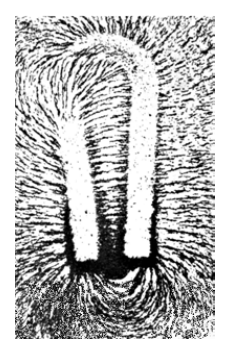
- Magnetic field lines are directed from the north pole to the south pole; the field is strongest where lines are closest together, and field lines never cross.
- Two like poles repel and two opposite poles attract; a uniform magnetic field is represented by equally spaced parallel lines, created when two opposite poles are held close together.
- The Earth's magnetic field acts like a bar magnet — a compass points to the Earth's magnetic south pole, which is the geographic north pole.
Magnetic field lines
Magnetic Fields from Currents
- Magnetic fields are formed wherever a current flows, such as in long straight wires, long solenoids and flat circular coils.
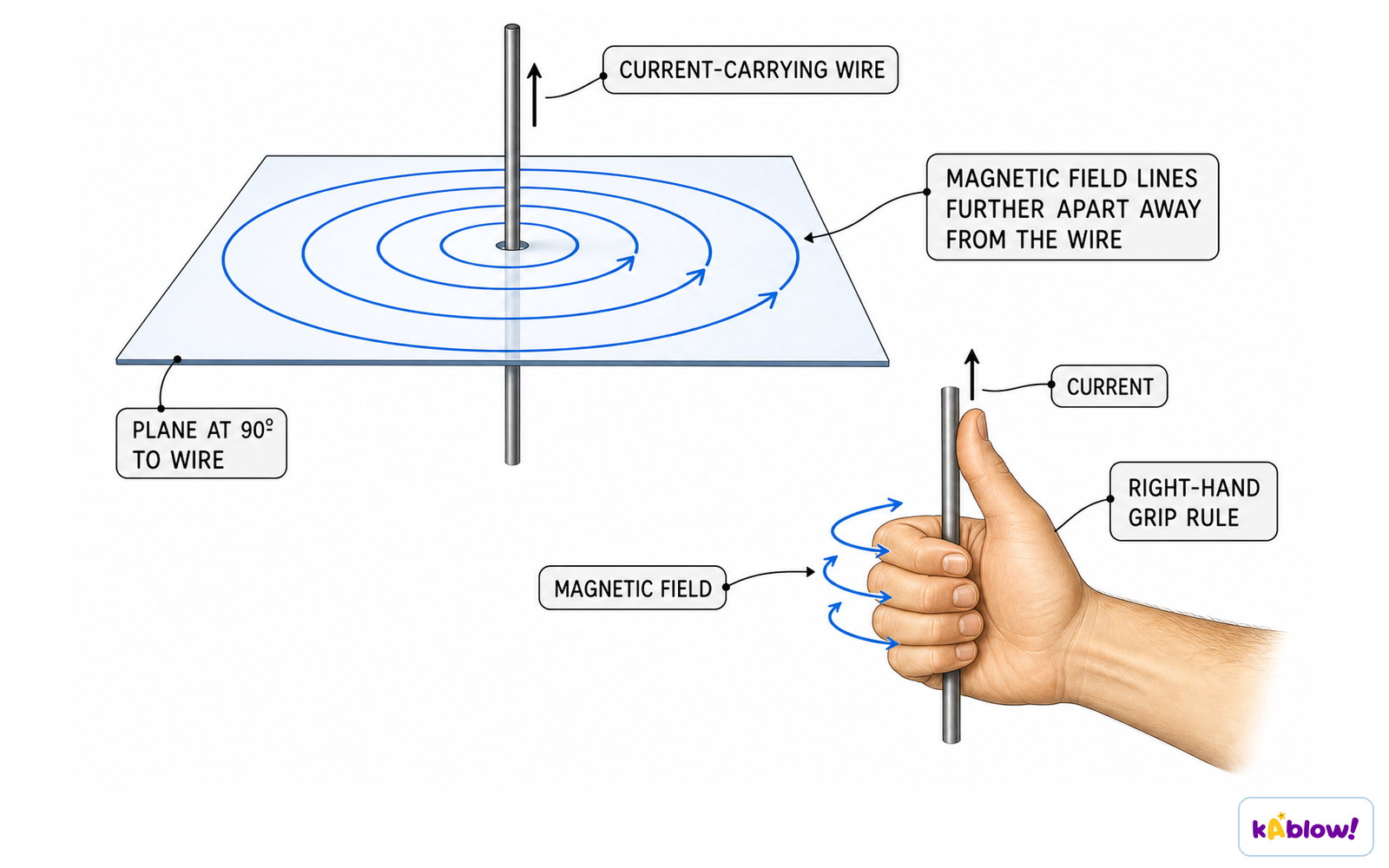
- Around a current-carrying wire, field lines are circular rings centred on the wire; they are closest together near the wire (strongest) and spread out with distance (weaker).
- Reversing the current reverses the direction of the magnetic field.
- The right-hand grip rule determines the field direction: point the right thumb in the direction of the (conventional) current and the curled fingers give the direction of the magnetic field.
- A solenoid (coil of wire) increases the magnetic flux density by adding more turns of wire into a smaller region; one end becomes a north pole and the other a south pole.
- The field lines around a solenoid are similar to those of a bar magnet — emerging from the north pole and returning to the south pole.
- For a solenoid, the right-hand grip rule is applied with curled fingers in the direction of current flow around the coil and the thumb pointing towards the north pole.
- A flat circular coil is equivalent to one coil of a solenoid; the field direction is found using the right-hand grip rule on the straight part of the coil.
Magnetic field around a current-carrying wire, showing field lines and the right-hand grip rule.
Slide
Sign up free to view the lesson slides
Step through every slide for this topic — plus flashcards and revision notes — with a free account.
Câu hỏi luyện tập
Xem trước miễn phí — 8 trên 62 câu hỏi. Đăng ký để xem tất cả.
1.What is the unit of electric charge?
Easy- ACoulomb (C)
- BAmpere (A)
- CVolt (V)
- DNewton (N)
2.Which of the following correctly describes the electric force between two charges of the same type?
Easy- AAttractive
- BRepulsive
- CZero
- DPerpendicular to the line joining them
3.Charge can be created or destroyed in an isolated system.
EasyTrue or false?
4.Which of the following is the correct definition of electric field strength at a point?
Easy- AThe force per unit charge experienced by a small positive test charge placed at that point
- BThe force per unit mass experienced by a small test mass placed at that point
- CThe force per unit charge experienced by a small negative test charge placed at that point
- DThe product of the force and the charge at that point
5.Which of the following best describes what is meant by the strength of an electric field?
Easy- AThe force per unit charge at a point in the field
- BThe total number of field lines in the field
- CThe potential difference between two points in the field
- DThe distance between two adjacent field lines
6.A negative ion is placed in a uniform electric field. In which direction does the electrostatic force act on the ion?
Medium- AOpposite to the direction of the electric field lines
- BIn the same direction as the electric field lines
- CPerpendicular to the electric field lines
- DThe force is zero because the ion is negative
7.An α particle approaches an aluminium nucleus. Which of the following describes the nature of the force between them?
Medium- ARepulsive, because both particles are positively charged
- BAttractive, because the α particle is negative and the nucleus is positive
- CRepulsive, because the α particle is negative and the nucleus is positive
- DAttractive, because both particles are positively charged
8.A stationary electric charge produces a magnetic field.
MediumTrue or false?
Unlock all 62 questions & more
Tạo tài khoản miễn phí để xem mọi câu hỏi, slide, thẻ ghi nhớ và ghi chú ôn tập cho chủ đề này.