Fusion & Stars
Học bằng cách chơi
Trả lời những câu hỏi này để kiếm năng lượng, rồi câu cá và khám phá. Không cần tài khoản.
Ghi chú bài học
Fusion Reactions in Stars
- Nuclear fusion is the joining of two small nuclei to produce a larger nucleus, releasing energy.
- In stars, four hydrogen nuclei (protons) fuse to form one helium nucleus, releasing a huge amount of energy.
- The proton-proton chain is the series of reactions that produces helium from hydrogen in stars like the Sun.
- The energy released provides an outward radiation pressure that prevents the star from collapsing under gravity.
- For fusion to occur, nuclei must overcome electrostatic repulsion and get close enough for the strong nuclear force to act.
- This requires extremely high temperature and density, such as in the core of a star, or high-speed collisions in a particle accelerator.
- On Earth, research focuses on the deuterium-tritium (D-T) reaction: ²₁H + ³₁H → ⁴₂He + ¹₀n, which releases a large amount of energy per unit mass.
Hydrogen fusion in a star
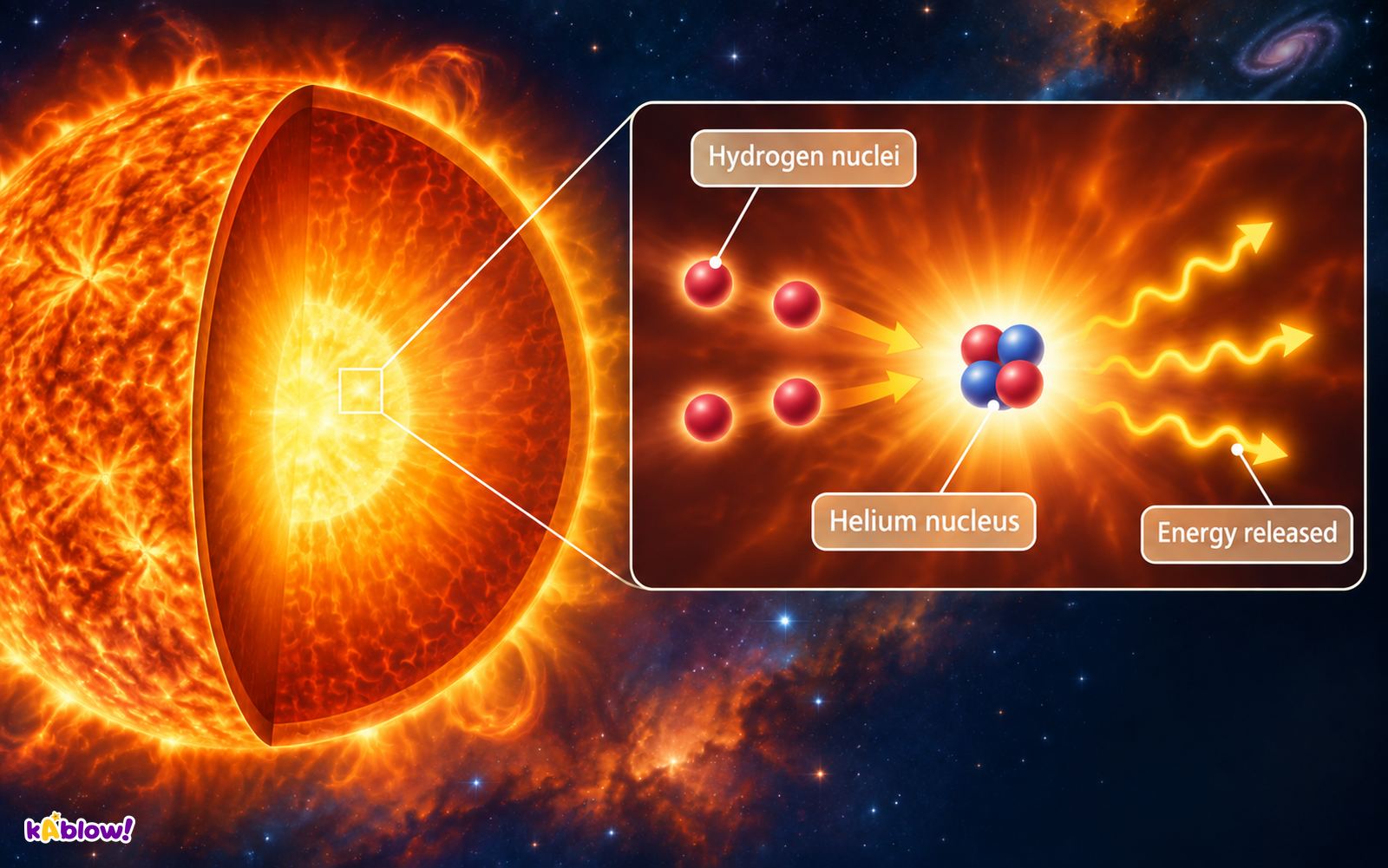
Energy Released in Fusion Reactions
- When two small nuclei fuse, the resulting larger nucleus has a higher binding energy per nucleon than the original nuclei.
- The mass defect (difference in mass between reactants and products) is converted into energy according to ΔE = Δmc².
- For example, fusing two deuterium nuclei into helium releases about 24 MeV (28 MeV − 4 MeV).
- In the proton-proton chain, the overall reaction is 4¹₁H → ⁴₂He + 2e⁺ + 2νₑ, releasing energy.
- The energy released per fusion reaction can be calculated from the mass defect and used to determine the rate of hydrogen consumption in a star.
Star Formation
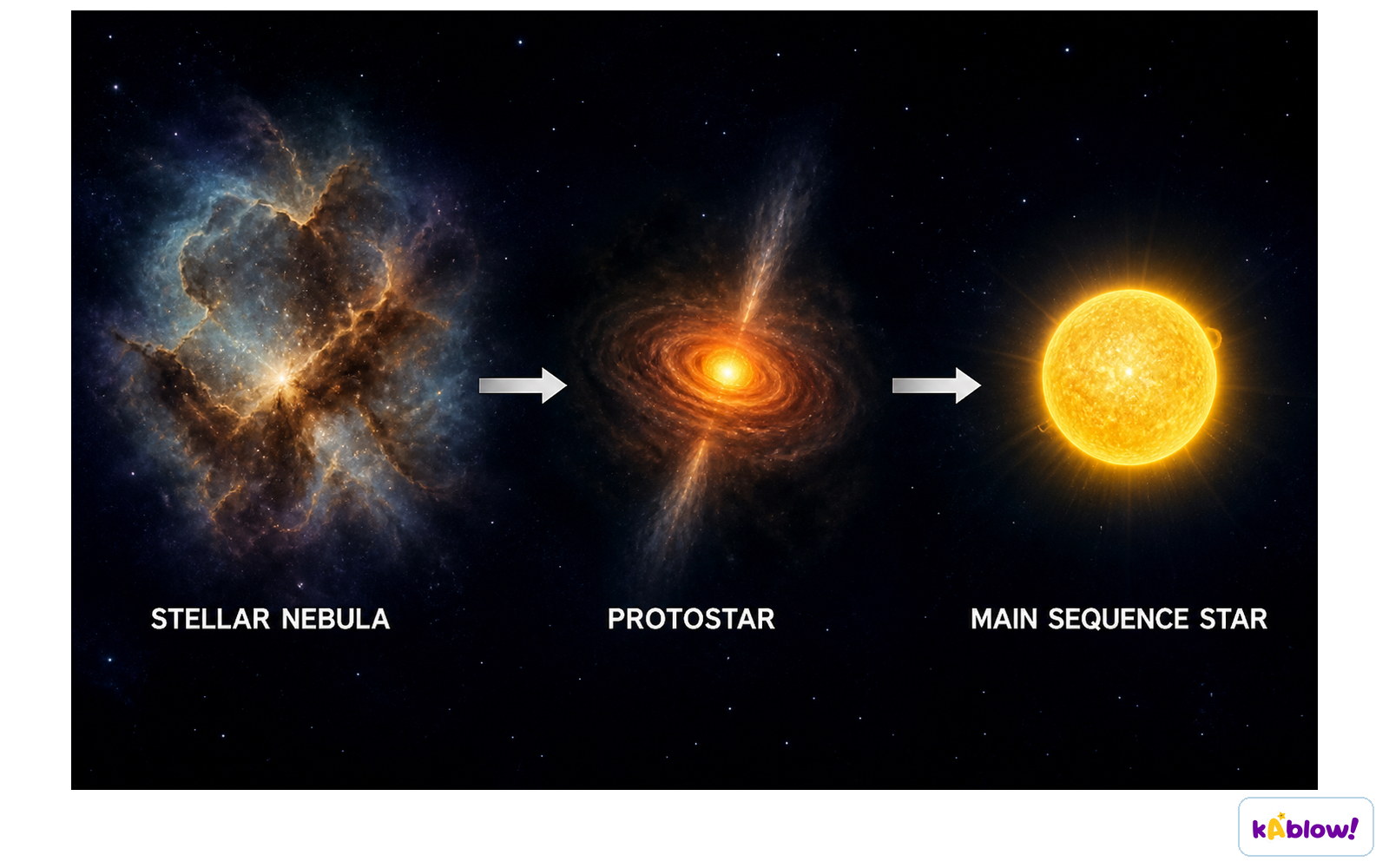
- Stars form from a nebula — a giant cloud of hydrogen gas and dust.
- Gravitational collapse causes denser clumps to form, heating up and glowing as a protostar.
- When the core temperature reaches millions of kelvin, hydrogen fusion begins, producing helium and releasing energy.
- The outward radiation pressure and gas pressure balance the inward gravitational force, leading to a stable main sequence star.
- If outward pressure > gravitational force, the star expands; if outward pressure < gravitational force, the star contracts.
- Equilibrium is maintained as long as the inward and outward forces are balanced.
Star formation stages
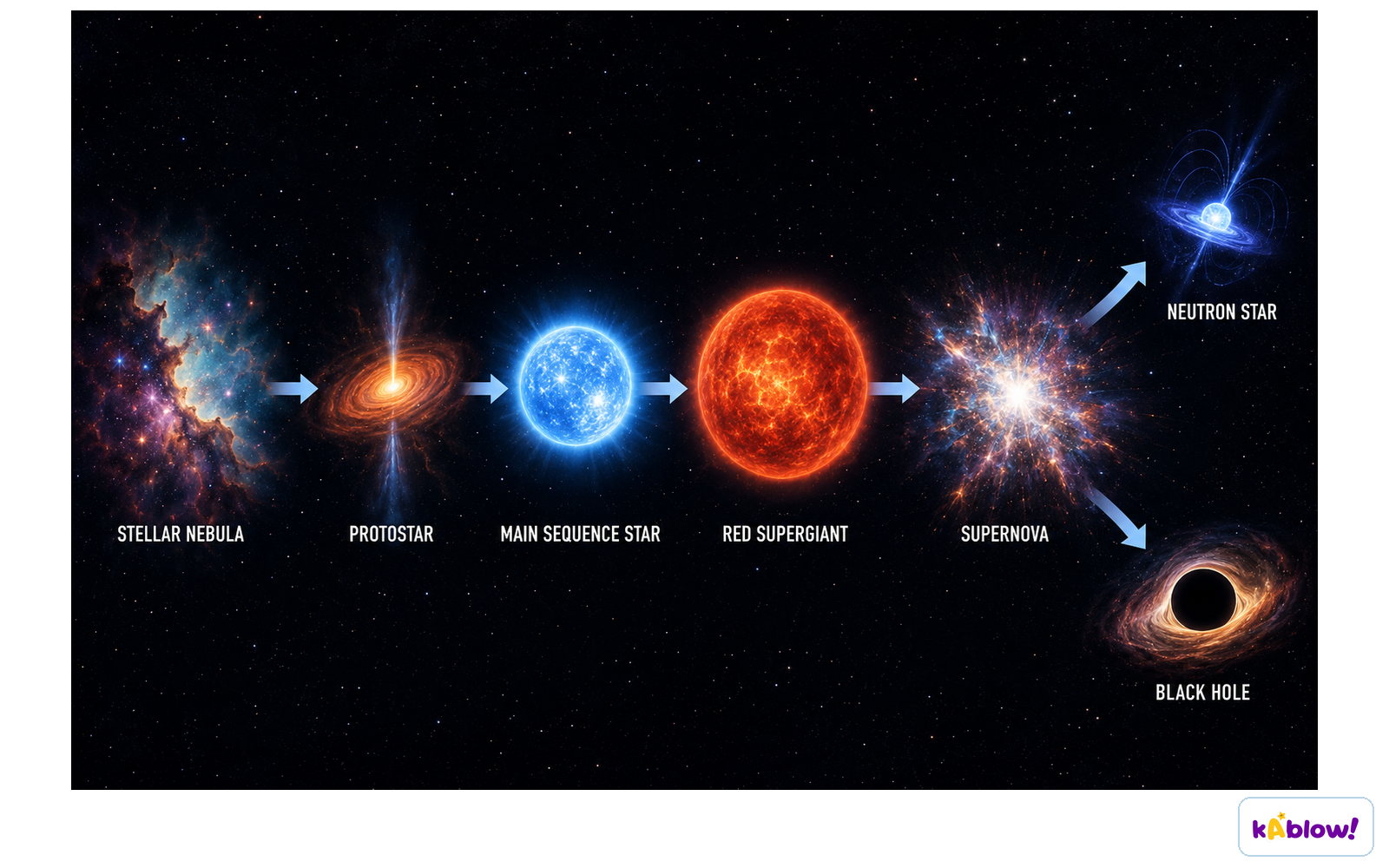
Life Cycle of a Star
- All stars begin with the same stages: nebula → protostar → main sequence star.
- A star spends most of its life on the main sequence, where it is stable due to balanced forces.
- Low-mass stars (like the Sun) evolve: red giant → planetary nebula → white dwarf.
- High-mass stars evolve: red supergiant → supernova → neutron star or black hole.
- In red giants, helium fusion occurs in the core, and the outer layers expand and cool.
- In massive stars, fusion continues up to iron, after which the core collapses and a supernova occurs.
- The remnant of a supernova can be a neutron star or, if massive enough, a black hole.
Life cycle of a large mass star
The Hertzsprung–Russell (HR) Diagram
- The HR diagram plots stellar luminosity (y-axis) against surface temperature (x-axis, decreasing to the right).
- Most stars lie on the main sequence, a diagonal band where luminosity increases with temperature.
- Red giants and red supergiants are above the main sequence, with high luminosity but cooler temperatures.
- White dwarfs are below and to the left of the main sequence: hot but low luminosity.
- The HR diagram only shows stars in stable phases; transitory phases are short-lived.
- The Sun is a main sequence star with a luminosity of 1 (relative to itself) and a surface temperature of about 5800 K.
Emission & Absorption Spectra in Stars
- A continuous spectrum contains all wavelengths and is produced by hot, dense sources like stellar cores.
- An emission line spectrum consists of bright lines on a black background, produced by hot, low-pressure gases.
- An absorption line spectrum consists of dark lines on a continuous spectrum, produced when white light passes through a cooler gas.
- Each element produces a unique pattern of spectral lines, acting as a fingerprint for identifying elements in stars.
- Stars emit an absorption spectrum because their outer atmospheres are cooler than the core.
- The chemical composition of a star can be determined by comparing its absorption spectrum with known emission spectra.
Stellar Parallax
- Stellar parallax is the apparent shift in position of a nearby star against distant background stars as Earth orbits the Sun.
- The parallax angle p (in arcseconds) is related to distance d (in parsecs) by p = 1/d.
- This method is accurate for stars up to about 100 pc away.
- 1 parsec is the distance at which 1 AU subtends an angle of 1 arcsecond: 1 pc ≈ 3.1 × 10¹⁶ m.
- 1 light-year is the distance light travels in one year: 1 ly ≈ 9.5 × 10¹⁵ m.
- 1 astronomical unit (AU) is the mean Earth-Sun distance: 1 AU ≈ 1.5 × 10¹¹ m.
Determination of Stellar Radii
- The radius of a star can be found by combining Wien's displacement law and the Stefan-Boltzmann law.
- Wien's displacement law: λmax T = 2.9 × 10⁻³ m K, gives the surface temperature from the peak wavelength.
- The Stefan-Boltzmann law: L = 4πr²σT⁴, relates luminosity, radius, and temperature.
- If luminosity and temperature are known, the radius can be calculated.
- For example, Betelgeuse has a radius about 1000 times that of the Sun.
Slide
Sign up free to view the lesson slides
Step through every slide for this topic — plus flashcards and revision notes — with a free account.
Câu hỏi luyện tập
Xem trước miễn phí — 8 trên 63 câu hỏi. Đăng ký để xem tất cả.
1.Which of the following is the correct definition of nuclear fusion?
Easy- AThe joining of two small nuclei to produce a larger nucleus
- BThe splitting of a large nucleus into two smaller nuclei
- CThe joining of two large nuclei to produce a smaller nucleus
- DThe emission of an α particle from a nucleus
2.Which of the following is the correct definition of nuclear fission?
Easy- AThe joining of two small nuclei to produce a larger nucleus
- BThe splitting of a large nucleus into two smaller nuclei
- CThe joining of two large nuclei to produce a smaller nucleus
- DThe emission of a β particle from a nucleus
3.In a main sequence star, the inward gravitational force is balanced by the outward radiation pressure.
EasyTrue or false?
4.Which force must be overcome for two nuclei to fuse?
Easy- AGravitational force
- BElectrostatic repulsion between protons
- CStrong nuclear force
- DWeak nuclear force
5.What is the name of the force that acts when nuclei get close enough to fuse?
Easy- AElectrostatic force
- BGravitational force
- CStrong nuclear force
- DWeak nuclear force
6.What are the two factors that the power output of a star depends on according to the Stefan-Boltzmann law?
Medium- ASurface temperature and radius
- BLuminosity and distance
- CMass and age
- DColour and chemical composition
7.What is the definition of a parsec?
Medium- AThe distance travelled by light in one year
- BThe mean distance from the centre of the Earth to the centre of the Sun
- CThe distance at which the parallax angle is 1 arcsecond
- DThe distance at which the parallax angle is 1°
8.A light-year is a unit of time.
EasyTrue or false?
Unlock all 63 questions & more
Tạo tài khoản miễn phí để xem mọi câu hỏi, slide, thẻ ghi nhớ và ghi chú ôn tập cho chủ đề này.