Greenhouse Effect
Học bằng cách chơi
Trả lời những câu hỏi này để kiếm năng lượng, rồi câu cá và khám phá. Không cần tài khoản.
Ghi chú bài học
Albedo
- Albedo (a) is the ratio of the total scattered (reflected) power to the total incident power for a surface.
- The albedo of a planet is the ratio between the total scattered radiation and the total incident radiation of that planet.
- Earth's albedo is generally taken as 0.3, meaning 30% of the Sun's rays that reach the ground are reflected back into the atmosphere.
- An albedo of 1 represents a surface that scatters all incident radiation; albedo has no units because it is a ratio.
- Earth's albedo varies daily and depends on cloud formations and season, latitude, terrain, and the incident angle of radiation.
- Typical albedo values: fresh asphalt 0.04, bare soil 0.17, green grass 0.25, desert sand 0.40, new concrete 0.55, ocean ice 0.50–0.70, fresh snow 0.85.
Emissivity
- Emissivity (e) is the ratio of the power radiated per unit area by a surface compared to that of a black body at the same temperature.
- It is calculated using: e = (power radiated by an object) / (power emitted by a black body).
- Calculations of emissivity assume the black body is at the same temperature and has the same dimensions as the object.
- For a perfect black body, emissivity = 1 (this must be remembered; it is not in the data booklet).
- For a non-black body, the Stefan-Boltzmann law becomes P = eσAT⁴, where P is total power emitted (W), σ is the Stefan-Boltzmann constant, A is total surface area (m²), and T is absolute temperature (K).
The Solar Constant
- The solar constant (S) is the intensity of the Sun's radiation arriving perpendicularly to the Earth's atmosphere when the Earth is at its mean distance from the Sun.
- Its average value is 1.36 × 10³ W m⁻² (about 1.4 kW m⁻²).
- The solar constant varies year-round because the Earth's orbit is elliptical (distance from the Sun changes) and the Sun's output varies by about 0.1% during its 11-year sunspot cycle.
- Calculations of the solar constant assume radiation is incident on a plane perpendicular to the Earth's surface and the Earth is at its mean distance from the Sun.
- The intensity of solar radiation received by different planets varies with distance from the Sun; e.g., Venus receives higher intensity than Earth because it is closer.
- Incoming radiative power: a planet's surface area is 4πr² but its radiative intensity covers a cross-sectional area of πr², so the mean intensity is S/4.
Greenhouse Gases
- The main greenhouse gases, in order of decreasing contribution, are: water vapour (H₂O), carbon dioxide (CO₂), methane (CH₄), and nitrous oxide (N₂O).
- Each greenhouse gas has both natural and human-generated origins.
- A greenhouse gas absorbs the long-wave (infrared) radiation re-emitted by the Earth's surface, trapping it in the atmosphere so it is not lost to space.
- Greenhouse gases act similarly to the glass in a greenhouse, hence the name.
- The two most significant contributors to the greenhouse effect are carbon dioxide and water vapour; ozone, methane, and nitrous oxides have lesser effects.
- The relative significance of a greenhouse gas depends on its concentration in the atmosphere and how much it can absorb specific wavelengths of radiation.
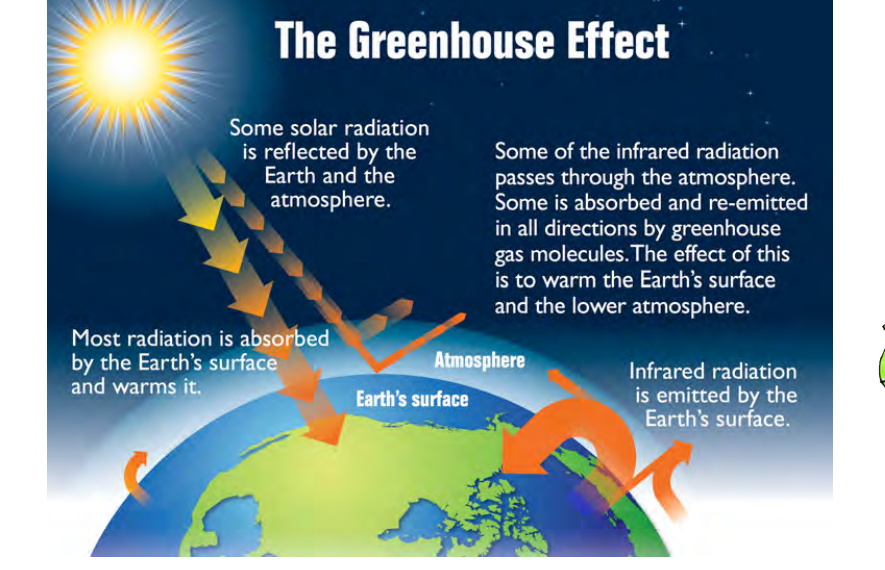
The greenhouse effect: sunlight reaching Earth's surface and infrared radiation being absorbed and re-emitted by greenhouse gases
Absorption by Greenhouse Gases
- About 25% of incoming short-wavelength solar radiation is absorbed by the atmosphere on its way to Earth, while about 80% of long-wavelength re-emitted radiation is absorbed on its way back out.
- Ozone (O₃) absorbs close to 100% of incoming ultraviolet rays and strongly absorbs outgoing infrared between 9 μm and 10 μm, but is not a significant greenhouse gas due to its low concentration.
- Carbon dioxide (CO₂) absorbs infrared with wavelengths between 1.5–30 μm, especially strongly at 15 μm; its increasing concentration makes it one of the most significant contributors.
- Water vapour (H₂O) is the best absorber of infrared, with wavelengths between 0.8–35 μm; its concentration increases as air becomes warmer.
- Overall, most ultraviolet, infrared, and microwave radiation is absorbed by the atmosphere, but the atmosphere is mostly transparent to incoming visible radiation.
The Greenhouse Effect
- Incoming solar radiation is mainly ultraviolet and visible; visible light is not absorbed by the atmosphere but by the Earth's surface.
- At night, the Earth re-radiates this energy as infrared radiation.
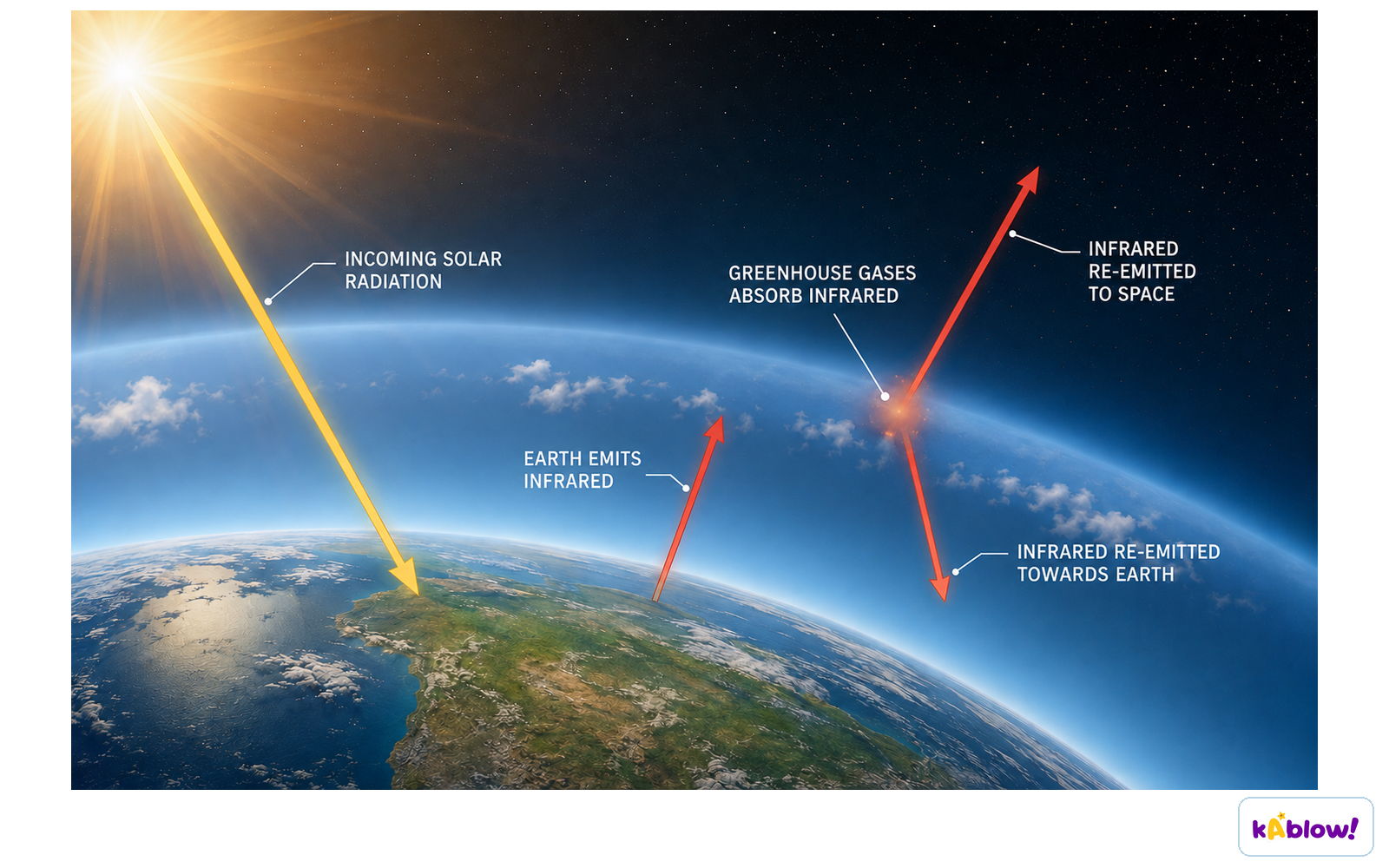
- Greenhouse gases absorb infrared radiation and re-emit it in all directions, including back towards the Earth's surface.
- The higher the concentration of greenhouse gases, the more infrared radiation remains in the Earth's surface-atmosphere system, trapping heat and raising average temperatures.
- The greenhouse effect occurs due to the molecular structure of greenhouse gases: infrared light causes atoms to vibrate, and greenhouse gases have natural frequencies in the infrared region, so they resonate and heat up when absorbing infrared.
- This absorbed radiation keeps Earth at a habitable temperature; imbalances in atmospheric composition can cause fluctuations in mean surface temperature.
The greenhouse effect
The Enhanced Greenhouse Effect
- Human activity is increasing greenhouse gas concentrations: atmospheric CO₂ has risen by more than 100 ppm to 420 ppm in 2020.
- The enhanced greenhouse effect means less long-wave radiation (heat) can escape the atmosphere.
- Average global temperatures have increased by over 1°C since pre-industrial times.
- Human sources of CO₂ include burning fossil fuels (power stations, vehicles), burning wood, and deforestation (fewer trees remove less CO₂ via photosynthesis).
- Human sources of methane include decay of organic matter (manure, landfill waste, crops); nitrous oxide comes from artificial fertilisers and burning fossil fuels.
- The greenhouse effect arises from natural causes, but the enhanced greenhouse effect arises from human activity.
Energy Balance Problems
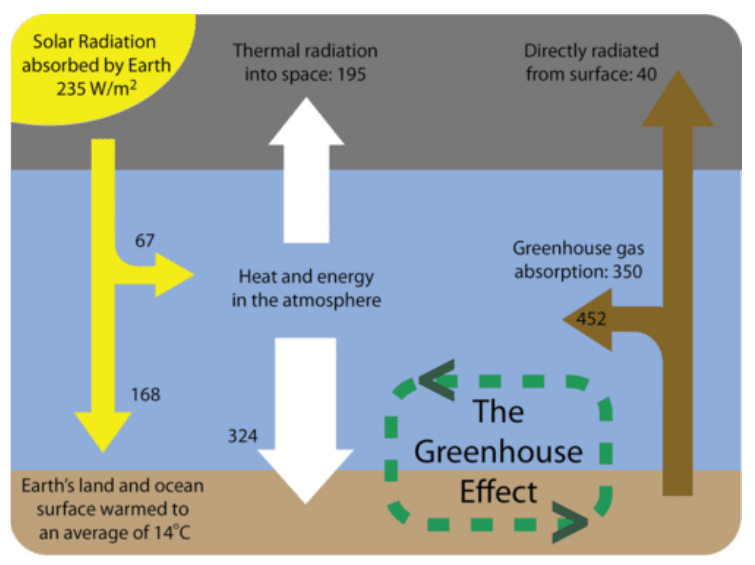
- Earth's energy balance compares incoming solar energy with outgoing energy; if they are in balance, Earth's temperature remains constant.
- Simple climate models help predict temperature fluctuations based on current and increased greenhouse gas concentrations.
- The simplest model uses a one-layer atmosphere above the Earth's surface.
- In simplified models, assume the Earth's surface and atmosphere act as black bodies (emissivity of the surface = 1) and remain at constant temperature.
- For a body, intensity = power per unit area, given by I = eσT⁴.
- The intensity absorbed by the Earth's surface is the sum of solar radiation reaching the surface plus the intensity radiated by the atmosphere.
Diagram of Earth's energy balance, showing solar radiation absorbed, thermal radiation into space, and greenhouse gas absorption in watts per square metre
Slide
Sign up free to view the lesson slides
Step through every slide for this topic — plus flashcards and revision notes — with a free account.
Câu hỏi luyện tập
Xem trước miễn phí — 8 trên 63 câu hỏi. Đăng ký để xem tất cả.
1.Which of the following contributes to the enhanced greenhouse effect?
Easy- ABurning fossil fuels
- BDestruction of the ozone layer
- CCarbon dioxide from active volcanoes around the world
- DIncrease in ultraviolet radiation penetrating the Earth's atmosphere
2.Which equation is used to calculate emissivity?
Easy- Apower radiated by an object / power emitted by a black body
- Bpower emitted by an object / power emitted by a black body
- Ctotal scattered power from an object / total incident power from a black body
- Dpower absorbed by an object / power absorbed by a black body
3.The average albedo of desert sand is 0.4. What is the ratio of power absorbed by desert sand to power reflected by desert sand?
Medium- A0.4
- B0.67
- C1.5
- D4.0
4.Which of the following describes the role of carbon dioxide in the greenhouse effect?
Easy- AIt absorbs incoming radiation from the Sun.
- BIt reflects incoming radiation from the Sun.
- CIt absorbs outgoing radiation from the Earth's surface.
- DIt reflects outgoing radiation from the Earth's surface.
5.The solar constant is the incoming radiative power of the Sun at
Easy- Athe surface of a planet
- Bthe surface of the Sun
- Cthe average distance between the Sun and the planet
- Dthe top of the planet's atmosphere
6.Which factors affect the amount of solar power incident on a given point on the surface of the Earth? (select all that apply)
Medium- AWeather conditions
- BLatitude
- CPosition of the Earth in its orbit of the Sun
- DThe Earth's albedo
7.The solar constant is quoted as an average rather than an absolute value. Which statements correctly explain this? (select all that apply)
Medium- AThe Earth follows an elliptical orbit around the Sun
- BThe Earth rotates on an axis which is tilted at 23.5° to the plane of its orbit
- CThe energy output of the Sun varies according to an 11-year cycle
- DThe Earth's atmosphere absorbs some solar radiation
8.Certain gases, for example carbon dioxide and methane, are categorised as greenhouse gases because they:
Medium- ATransmit incoming radiation from the Sun and then absorb outgoing radiation from the Earth
- BAbsorb incoming radiation from the Sun and also absorb outgoing radiation from the Earth
- CReflect incoming radiation from the Sun
- DReflect outgoing radiation from the Earth
Unlock all 63 questions & more
Tạo tài khoản miễn phí để xem mọi câu hỏi, slide, thẻ ghi nhớ và ghi chú ôn tập cho chủ đề này.