Thermal Energy Transfers
Học bằng cách chơi
Trả lời những câu hỏi này để kiếm năng lượng, rồi câu cá và khám phá. Không cần tài khoản.
Ghi chú bài học
Solids, Liquids & Gases
- The three states of matter are solid, liquid and gas; the kinetic theory of matter models particles as small spheres to explain their properties.
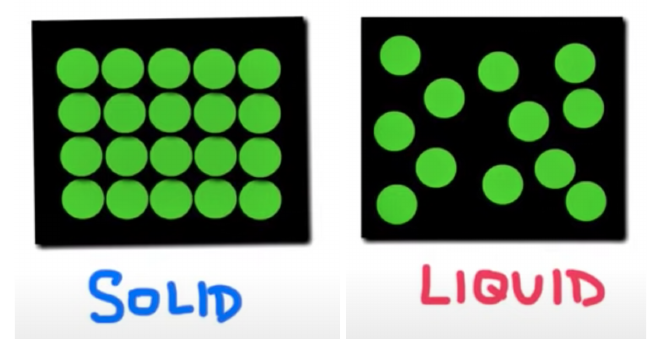
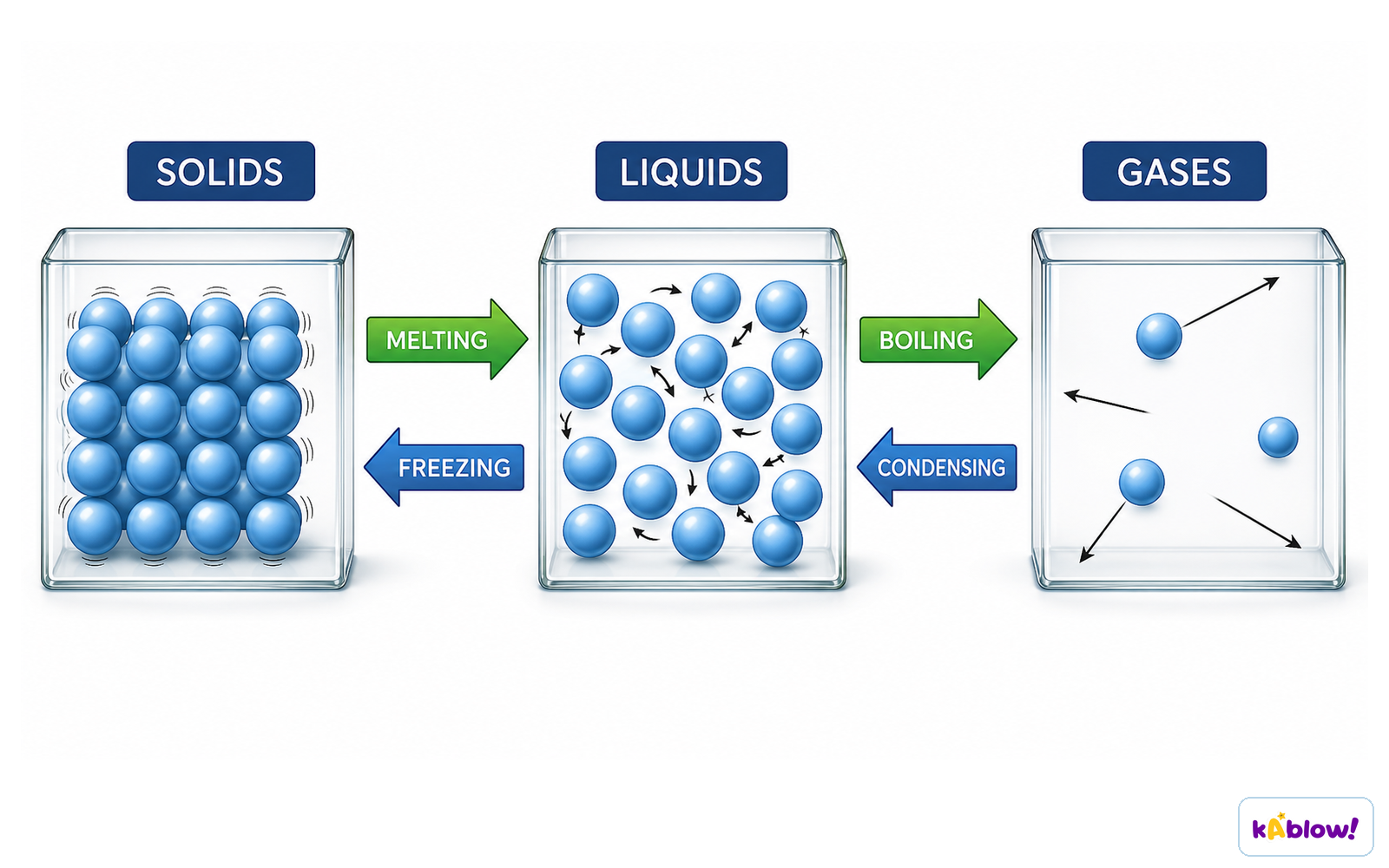
- In a solid, particles are closely packed in a fixed pattern (lattice), can only vibrate about fixed positions, and have low energy; solids have fixed shape, fixed volume, high density, and are very difficult to compress.
- In a liquid, particles are closely packed but randomly arranged, can flow past each other, and have medium energy; liquids have fixed volume but take the shape of their container, and have medium density.
- In a gas, particles are far apart (about 10 times the spacing in solids/liquids), move randomly at various speeds, and have high energy; gases have no fixed shape or volume, low density, and are compressible.
- The intermolecular forces are strongest in solids, weaker in liquids, and weakest in gases; particles in a gas have enough energy to completely overcome these forces.
- Density is mass per unit volume; gases are much less dense than liquids and solids due to their molecular arrangement.
Particles in a solid are packed close together in a fixed pattern; in a liquid they are still close but free to move past each other.
Temperature Scales & Kinetic Energy
- Absolute zero is the lowest possible temperature, equal to 0 K or −273 °C, at which molecules have zero kinetic energy.
- Convert between Celsius and Kelvin using: T / K = θ / °C + 273 or θ / °C = T / K − 273.
- A change of 1 K is equal to a change of 1 °C; temperature differences are the same on both scales.
- For an ideal gas, the average kinetic energy of molecules is Ek = (3/2) kBT, where kB = 1.38 × 10⁻²³ J K⁻¹.
- The absolute temperature of an ideal gas is directly proportional to the average kinetic energy of its molecules.
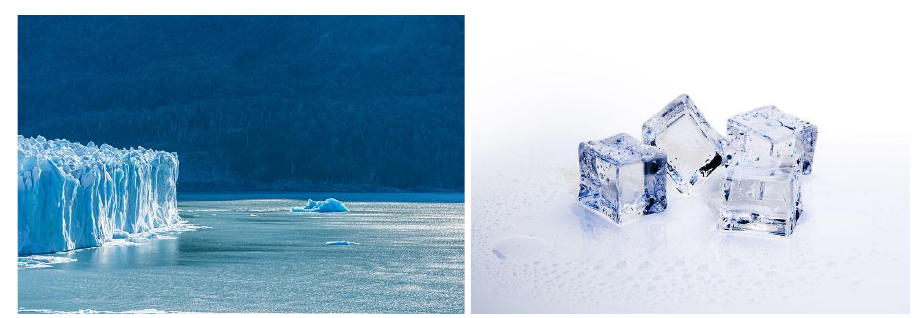
A large iceberg has more total kinetic (thermal) energy than a few small ice cubes of the same substance and temperature, because it is made of far more particles.
Internal Energy & Thermal Equilibrium
- Internal energy is the sum of the total kinetic energy and total intermolecular potential energy of all particles in a substance.
- When thermal energy is transferred to a substance, its internal energy increases; this can increase the average kinetic energy (temperature rises) or the potential energy (state changes).
- Temperature is a measure of the average kinetic energy of molecules; a change in average potential energy does not affect temperature.
- Thermal equilibrium is reached when two substances in contact no longer exchange heat energy and have the same temperature.
- Thermal energy always transfers from a hotter region to a cooler region until thermal equilibrium is reached.
Changes of State
- A change of state (phase change) occurs when matter changes between solid, liquid and gas; thermal energy is transferred but the temperature remains constant.
- During a phase change, only the potential energy of the molecules changes (spacing between particles); the average kinetic energy does not change.
- The four main phase changes are: melting (solid→liquid), freezing (liquid→solid), vaporisation/boiling (liquid→gas), and condensation (gas→liquid).
- Each substance has its own melting/freezing point and boiling point; for water, freezing is at 0 °C and boiling at 100 °C.
- Melting and boiling absorb thermal energy; freezing and condensation release thermal energy.
Particle arrangement and motion in solids, liquids and gases
Specific Heat Capacity
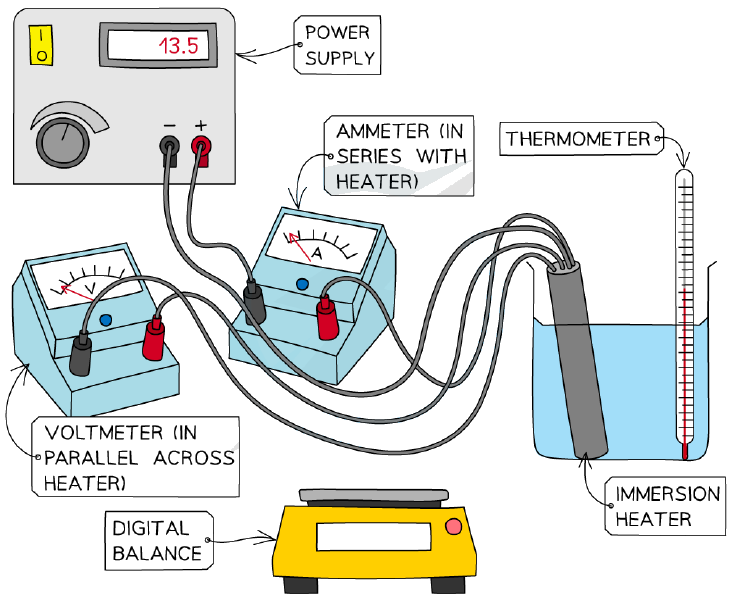
- The thermal energy needed to change the temperature of a substance depends on its mass, the temperature change, and its specific heat capacity.
- Specific heat capacity is the energy required to change the temperature of 1 kg of a substance by 1 K (or 1 °C).
- The equation for thermal energy transferred is Q = mcΔT, where m is mass (kg), c is specific heat capacity (J kg⁻¹ K⁻¹), and ΔT is temperature change (K or °C).
- A higher specific heat capacity means the substance heats up or cools down more slowly; water has a high specific heat capacity (4200 J kg⁻¹ K⁻¹) compared to metals like copper (390 J kg⁻¹ K⁻¹).
- In thermal equilibrium problems, energy lost by a hot object equals energy gained by a cold object: −Qc = Qw.
Diagram of apparatus for investigating specific heat capacity
Specific Latent Heat
- During a phase change, thermal energy is transferred without changing temperature; the energy is calculated using Q = mL.
- Specific latent heat is the energy required to change the state of 1 kg of a substance without changing its temperature; units are J kg⁻¹.
- Specific latent heat of fusion (Lf) applies to solid↔liquid changes; specific latent heat of vaporisation (Lv) applies to liquid↔gas changes.
- For any substance, Lv > Lf because completely overcoming intermolecular forces (vaporisation) requires more energy than partially overcoming them (fusion).
- Heating/cooling curves show flat sections during phase changes (temperature constant) and sloped sections when temperature changes.
Thermal Conduction
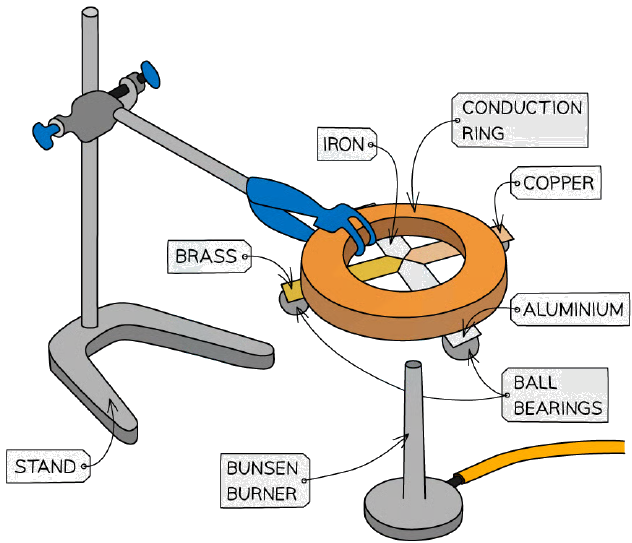
- Conduction is the main method of thermal energy transfer in solids; it occurs when two solids of different temperatures are in contact.
- Metals are the best thermal conductors because they have a high number of free (delocalised) electrons that collide with atoms and transfer energy quickly.
- Non-metals like plastic and glass are poor conductors; liquids and gases are even poorer because their atoms are further apart.
- Conduction occurs through atomic vibrations and free electron collisions; atoms at the hotter end vibrate more and bump into neighbouring atoms, transferring energy.
- Thermal conductivity (k) quantifies a material's ability to transfer heat via conduction; units are W m⁻¹ K⁻¹. High k means fast energy transfer.
- The rate of heat transfer via conduction is given by ΔQ/Δt = kAΔT/Δx, where A is cross-sectional area, ΔT is temperature difference, and Δx is thickness.
Conduction in metals
Thermal Convection
- Convection occurs when a fluid (liquid or gas) is heated, causing movement of groups of atoms or molecules due to density variations.
- Convection is the main way heat travels through liquids and gases; it cannot occur in solids because particles cannot travel relative to one another.
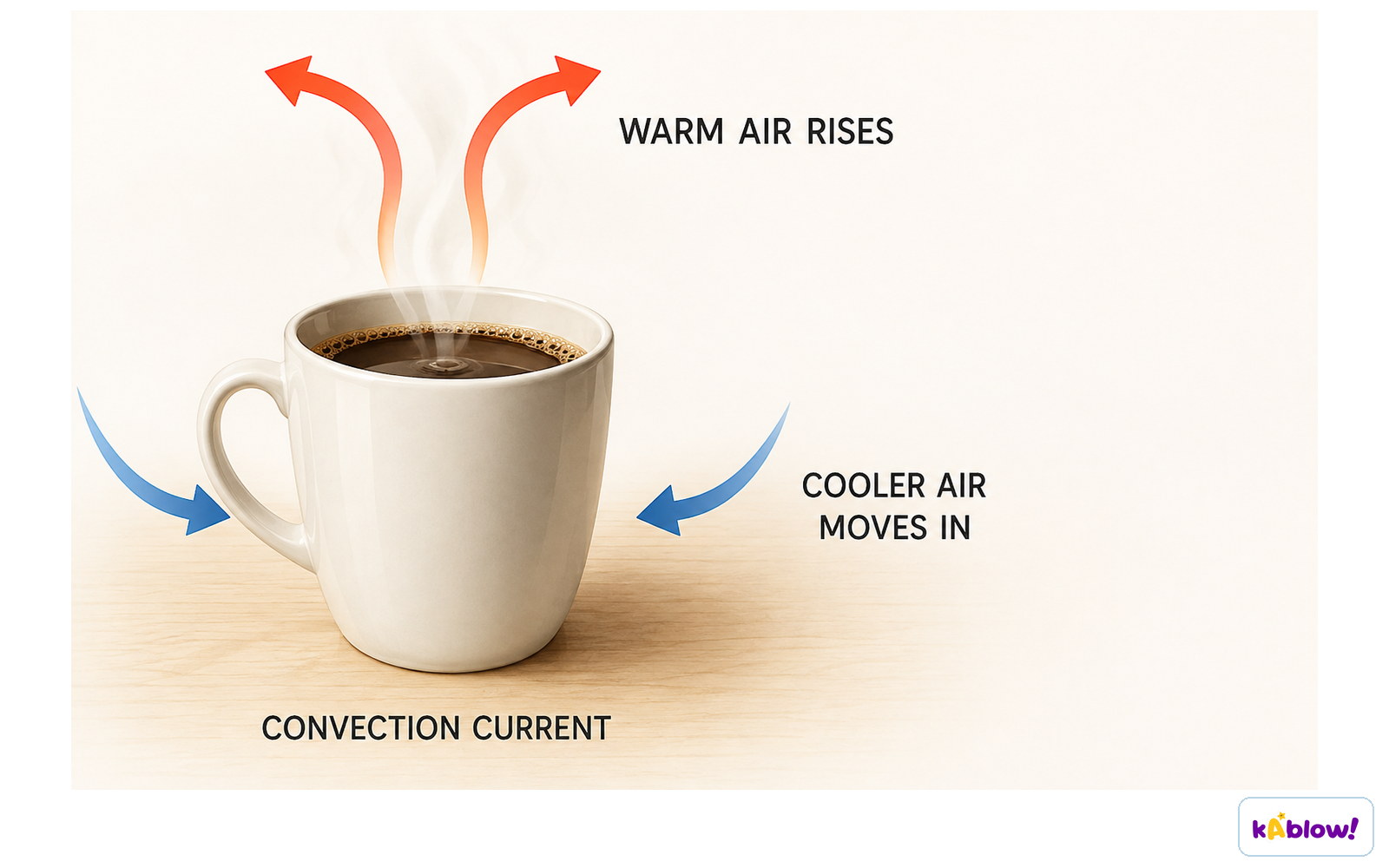
- When heated from below, the hot fluid expands, becomes less dense, and rises; cooler, denser fluid moves in to take its place, forming a convection current.
- Eventually, the hot fluid cools, contracts, and sinks back down, creating a continuous circulation.
- Examples of convection include atmospheric winds, sea breezes, convection currents in the Earth's mantle, and ocean currents.
Thermal energy is transferred from hot coffee by convection
Thermal Radiation
- Thermal radiation is heat transfer by electromagnetic waves, usually in the infrared region of the spectrum.
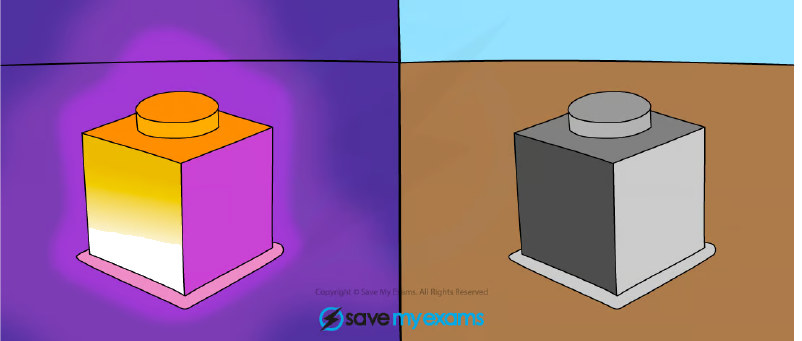
- All bodies emit thermal radiation; the hotter the object, the more infrared radiation it emits per second.
- Thermal radiation is the only method of thermal energy transfer that does not require matter; it can travel through a vacuum.
- The amount of thermal radiation emitted depends on surface colour (black emits more), texture (shiny emits less), and surface area (greater area emits more).
- Dark, dull objects are better emitters and absorbers of radiation; light, shiny objects are worse.
- A perfect black body absorbs all radiation incident on it and reflects or transmits none; black-body radiation is the thermal radiation emitted by all bodies.
Hotter objects emit more thermal radiation
Stefan-Boltzmann & Wien's Laws
- The Stefan-Boltzmann law relates the power output of a black body to its surface temperature and radius.
- Wien's Displacement Law states that the peak wavelength of emitted radiation is inversely proportional to absolute temperature: λmax ∝ 1/T.
- For a black body, the lower the wavelength at which peak intensity occurs, the higher the peak intensity.
- The power output of a black body depends on its surface temperature and radius.
Slide
Sign up free to view the lesson slides
Step through every slide for this topic — plus flashcards and revision notes — with a free account.
Câu hỏi luyện tập
Xem trước miễn phí — 8 trên 62 câu hỏi. Đăng ký để xem tất cả.
1.Thermal energy is transferred from a solid. Three properties of the solid are: I. Specific heat capacity; II. Mass; III. Area. Which of the above properties determine the decrease in temperature of the solid?
Medium- AII only
- BI and III only
- CI and II only
- DI only
2.What are the units of the ratio (specific latent heat of fusion of iron)/(specific heat capacity of iron)?
Medium- AJ K
- BNo units
- CK⁻¹
- DK
3.The strength of intermolecular forces varies between the different states of matter. What is the order from highest to lowest strength of intermolecular forces?
Easy- Asolid > liquid > gas
- Bsolid > gas > liquid
- Cliquid > gas > solid
- Dgas > liquid > solid
4.Molecules fuse from water vapour to form water. The vapour and the water have the same temperature. What is the change of the average potential energy and the change of the average random kinetic energy of these molecules when they move from the vapour to the water?
Medium- AAverage potential energy decreases; average random kinetic energy decreases
- BAverage potential energy no change; average random kinetic energy decreases
- CAverage potential energy decreases; average random kinetic energy no change
- DAverage potential energy no change; average random kinetic energy no change
5.Which of the following correctly identifies the properties of the molecules of a substance that determine the substance's internal energy?
Medium- AThe total gravitational potential energy and random electrostatic potential energy
- BThe total potential energy and random kinetic energy
- CThe random kinetic energy
- DThe total potential energy
6.The specific latent heat of vaporisation is the energy required to change the phase of:
Medium- Aone kilogram of a liquid to gas
- Ba solid at constant temperature
- Cone kilogram of a gas to liquid at constant temperature
- Da gas at constant temperature
7.A sample of solid aluminium is heated beyond its melting point. The graph of temperature against time shows flat sections. During which stage(s) is the aluminium melting?
Medium- AQ only
- BP, Q and R
- CP only
- DP and R only
8.What is the correct comparison of the specific latent heat of fusion Lf to the specific latent heat of vaporisation Lv for any substance?
Medium- ALf = Lv
- BLf > Lv
- CLf < Lv
- DDepends on the substance.
Unlock all 62 questions & more
Tạo tài khoản miễn phí để xem mọi câu hỏi, slide, thẻ ghi nhớ và ghi chú ôn tập cho chủ đề này.