Photosynthesis & Leaf Structure
Học bằng cách chơi
Trả lời những câu hỏi này để kiếm năng lượng, rồi câu cá và khám phá. Không cần tài khoản.
Ghi chú bài học
Photosynthesis Overview
- Photosynthesis is the process by which plants manufacture carbohydrates from raw materials using energy from light.
- Raw materials: carbon dioxide and water.
- Products: glucose (carbohydrate) and oxygen (waste product).
- Energy is obtained by the pigment chlorophyll trapping light from the Sun.
- Word equation: carbon dioxide + water → glucose + oxygen (in the presence of light and chlorophyll).
- Balanced chemical equation (Extended): 6CO₂ + 6H₂O → C₆H₁₂O₆ + 6O₂.
Chlorophyll
- Chlorophyll is a green pigment found in chloroplasts within plant cells.
- It reflects green light, giving plants their green colour.
- Chlorophyll absorbs light energy and transfers it into chemical energy for carbohydrate synthesis.
- Photosynthesis cannot occur in the absence of chlorophyll.
Use & Storage of Carbohydrates
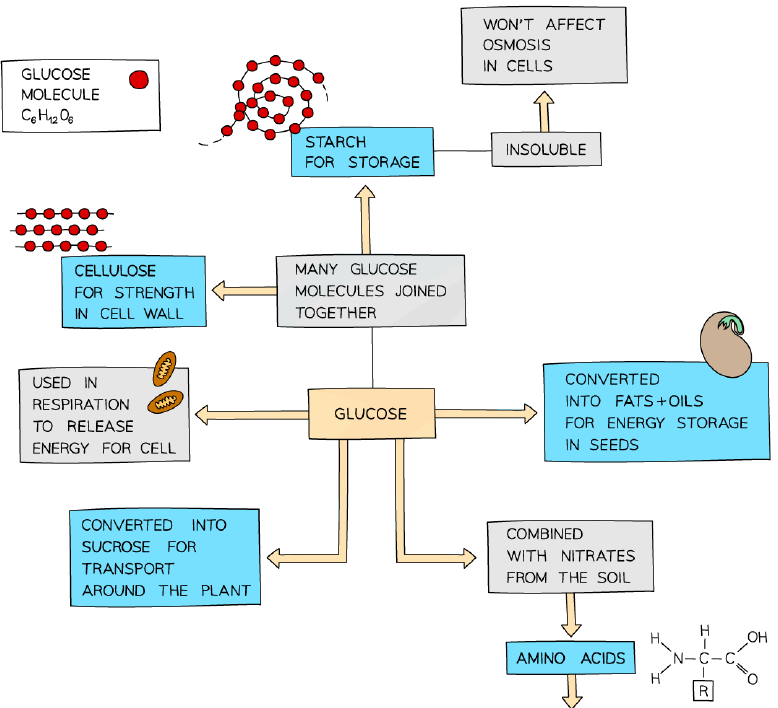
- Glucose is converted into starch for energy storage.
- Converted into cellulose to build cell walls.
- Used in respiration to provide energy.
- Converted to sucrose for transport in the phloem.
- Used as nectar to attract insects for pollination.
- Can be converted into lipids (energy source in seeds) and amino acids (for proteins) when combined with nitrogen and other mineral ions.
The fate of glucose
Minerals in Plants
- Plants need mineral ions absorbed from soil by root hair cells.
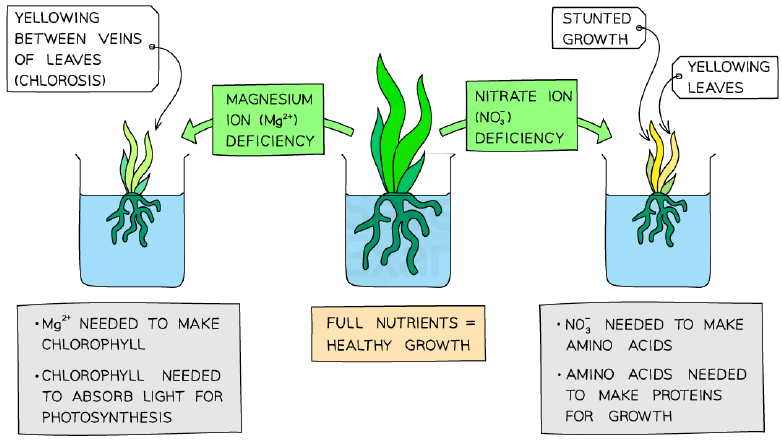
- Nitrate deficiency: stunted growth, yellowing leaves (chlorosis).
- Magnesium is needed for chlorophyll synthesis; deficiency causes yellow leaves.
- Nitrogen, phosphorus, and potassium are essential for plant growth.
Mineral deficiencies in plants
Investigating Requirements for Photosynthesis
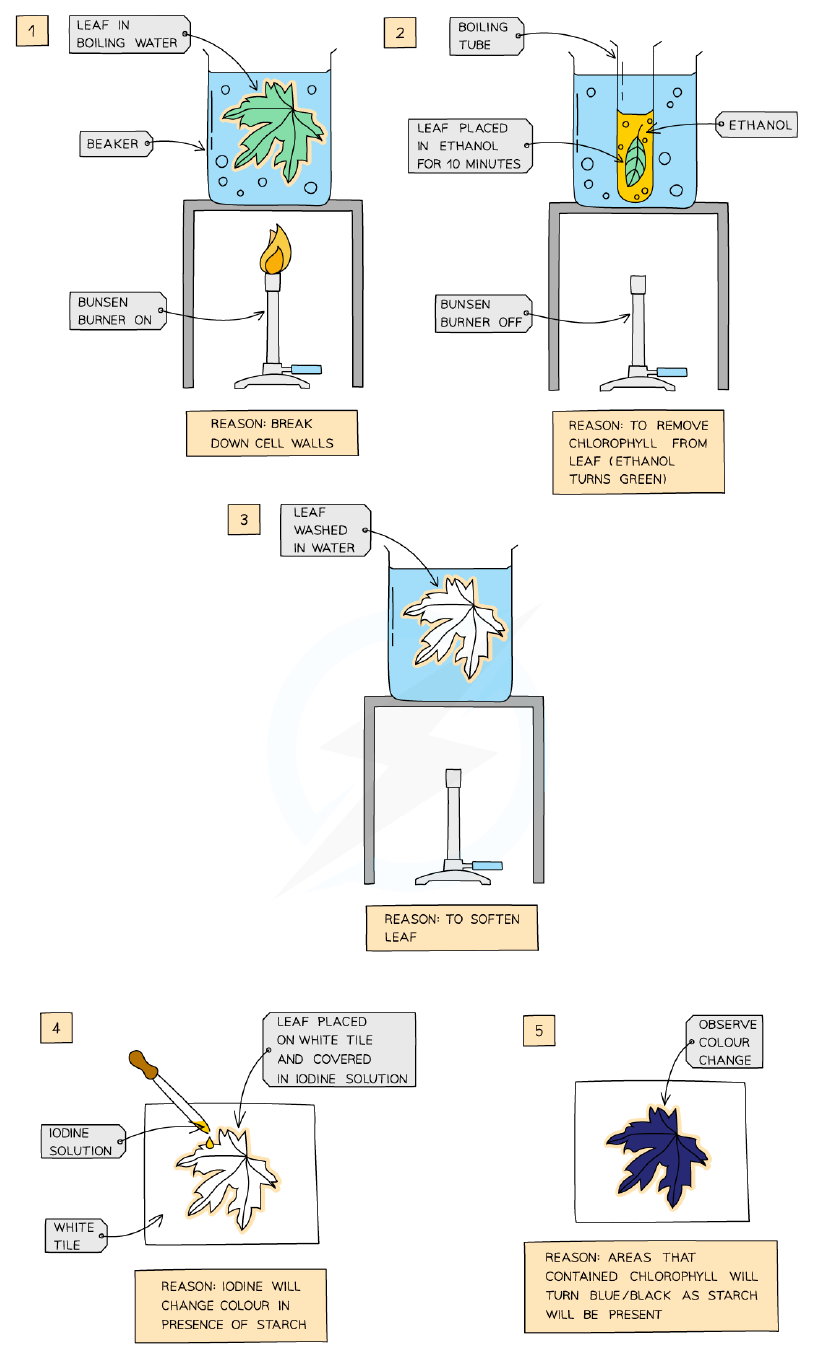
- Starch test: leaf boiled in water (kill cells), then hot ethanol (remove chlorophyll), then iodine solution.
- Chlorophyll needed: variegated leaf – only green parts turn blue-black with iodine.
- Light needed: destarch plant, cover part of leaf with foil; covered part remains orange-brown.
- Carbon dioxide needed: destarch two plants; one in bell jar with sodium hydroxide (absorbs CO₂) – no starch; control with water – starch present.
Testing a leaf for starch
Investigating Rate of Photosynthesis
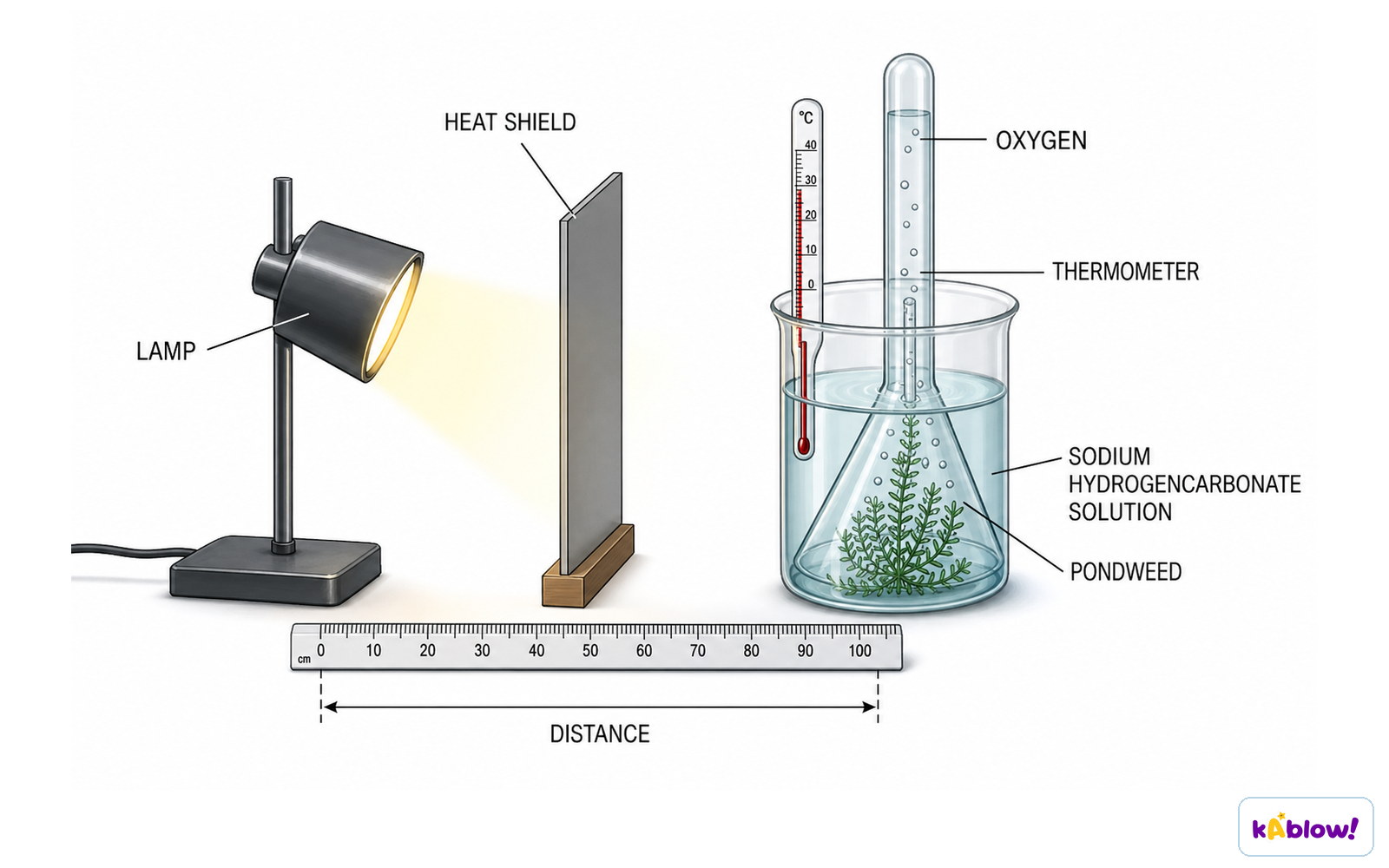
- Use pondweed (e.g.,×Elodea×or×Cabomba×) and count oxygen bubbles per minute.
- Change light intensity: move lamp closer/further; use a glass tank to absorb heat.
- Change temperature: heat/cool water bath.
- Change carbon dioxide concentration: dissolve different amounts of sodium hydrogencarbonate.
- Keep all other variables constant for a fair test.
Investigating the effect of light intensity
Gas Exchange in Plants
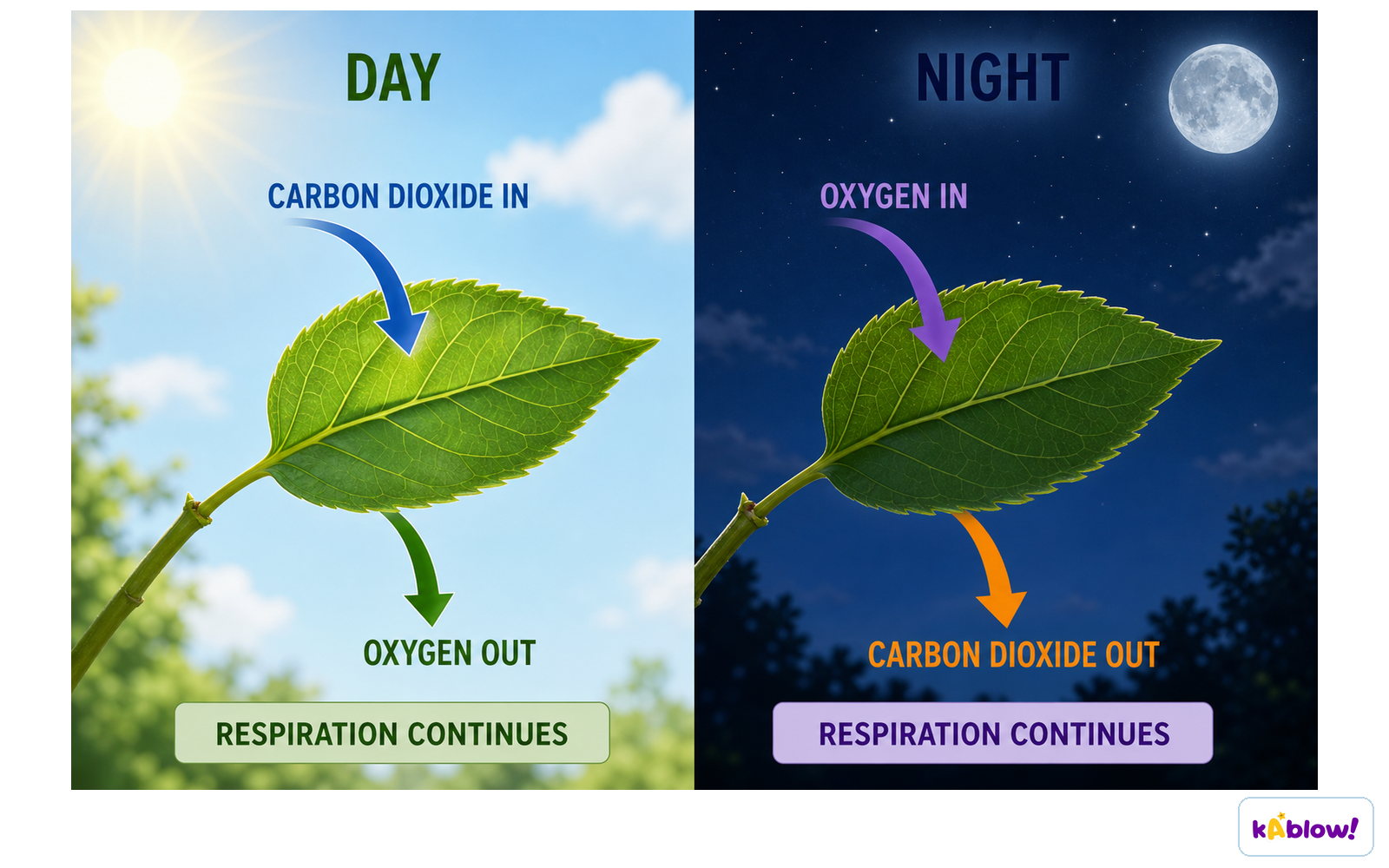
- Plants respire all the time (take in O₂, release CO₂).
- During daylight, photosynthesis rate > respiration rate → net intake of CO₂ and net output of O₂.
- At night, only respiration occurs → net release of CO₂.
- Use hydrogencarbonate indicator to show CO₂ concentration: yellow = high CO₂, red = medium, purple = low.
Photosynthesis and respiration in plants
Limiting Factors (Extended)
- A limiting factor restricts the rate of photosynthesis when in short supply.
- Three main factors: temperature, light intensity, carbon dioxide concentration.
- Water is not usually a limiting factor as the amount needed is small.
- Temperature: rate increases with temperature until enzymes denature (around 40–45°C).
- Light intensity: rate increases until another factor becomes limiting.
- CO₂ concentration: rate increases until another factor becomes limiting.
- On a graph, the rising part shows the factor on x-axis is limiting; the plateau shows another factor is limiting.
Leaf Structure & Adaptations
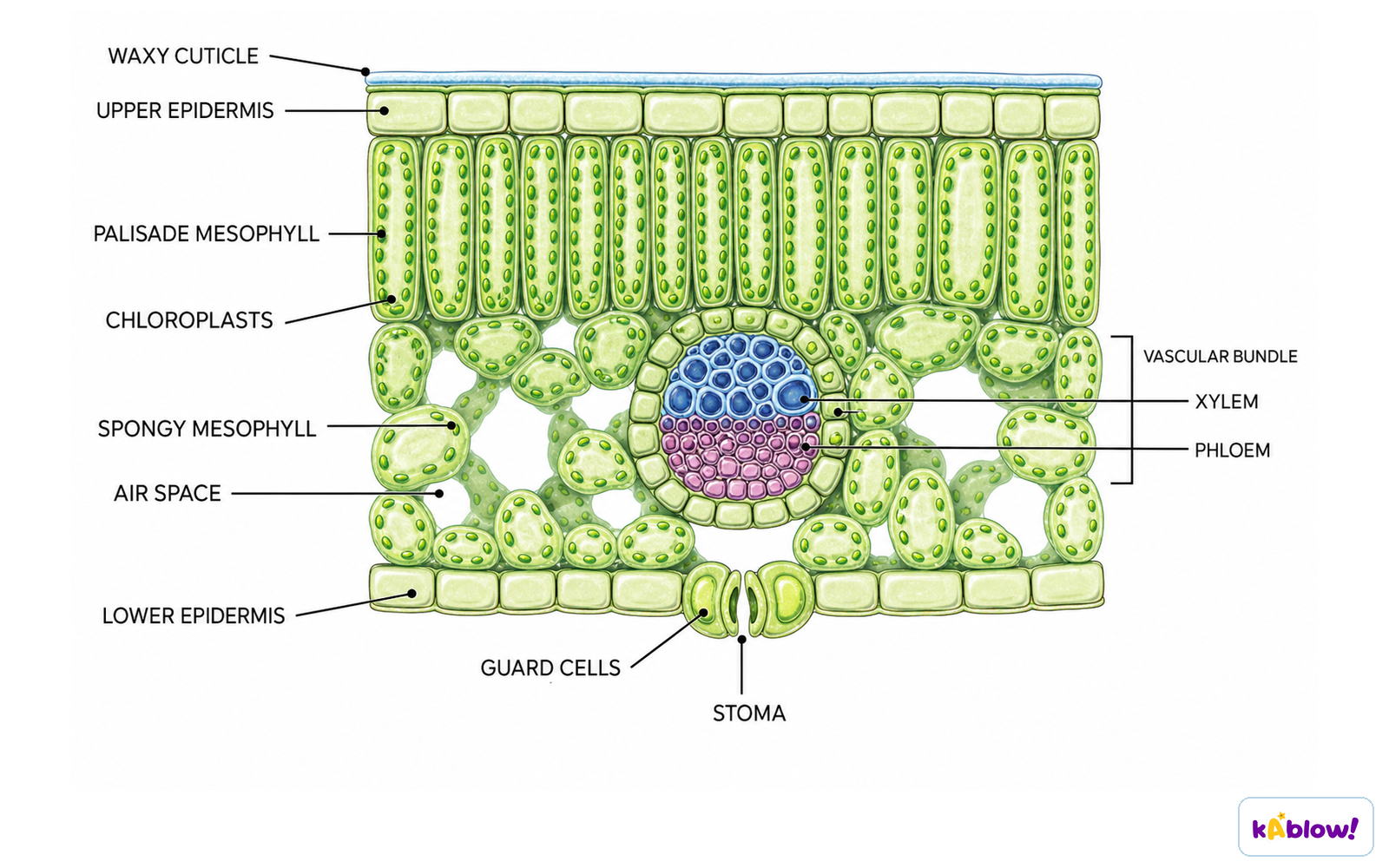
- Waxy cuticle: reduces water loss.
- Upper epidermis: transparent to let light through.
- Palisade mesophyll: tightly packed with chloroplasts for maximum light absorption.
- Spongy mesophyll: irregular cells with air spaces for gas diffusion.
- Stomata (mainly lower epidermis): allow gas exchange; guard cells control opening.
- Vascular bundles (xylem and phloem): transport water/minerals and sucrose.
- CO₂ pathway: atmosphere → air spaces → mesophyll cells → chloroplasts.
Cross-section of a leaf
Identifying Leaf Structures (Dicotyledonous Plant)
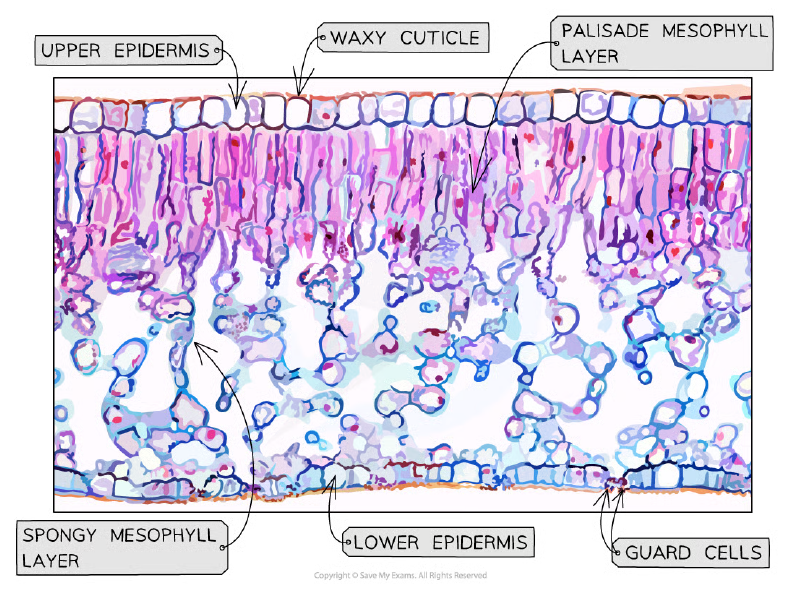
- Identify: chloroplasts, cuticle, guard cells, stomata, upper/lower epidermis, palisade mesophyll, spongy mesophyll, air spaces, vascular bundles (xylem and phloem).
- These structures are labelled on the annotated leaf diagrams below; practise naming each one from its position and appearance.
Electron micrograph of a leaf
Slide
Sign up free to view the lesson slides
Step through every slide for this topic — plus flashcards and revision notes — with a free account.
Câu hỏi luyện tập
Xem trước miễn phí — 8 trên 42 câu hỏi. Đăng ký để xem tất cả.
1.What is the green pigment found in chloroplasts that absorbs light energy for photosynthesis?
Easy- AChlorophyll
- BCarotene
- CXanthophyll
- DAnthocyanin
2.Which of the following is the word equation for photosynthesis?
Easy- Acarbon dioxide + water → glucose + oxygen
- Bglucose + oxygen → carbon dioxide + water
- Ccarbon dioxide + oxygen → glucose + water
- Dglucose + water → carbon dioxide + oxygen
3.A variegated leaf is tested for starch using iodine solution. The green parts turn blue-black, but the white parts remain orange-brown. What does this show?
Medium- AChlorophyll is necessary for photosynthesis
- BLight is necessary for photosynthesis
- CCarbon dioxide is necessary for photosynthesis
- DWater is necessary for photosynthesis
4.In an experiment to investigate the effect of light intensity on the rate of photosynthesis, pondweed is placed in water and the number of bubbles released per minute is counted. Which of the following would be the most accurate method to measure the rate?
Medium- ACount the number of bubbles produced in one minute
- BMeasure the volume of oxygen collected in an inverted measuring cylinder over a period of time
- CMeasure the change in mass of the pondweed
- DMeasure the change in pH of the water
5.Which requirements for photosynthesis are NOT raw materials? Select all that apply.
Easy- AWater
- BCarbon dioxide
- CLight energy
- DChlorophyll
6.Which layer of a leaf lies directly beneath the upper epidermis and is made of column-shaped cells tightly packed with chloroplasts?
Easy- APalisade mesophyll
- BSpongy mesophyll
- CLower epidermis
- DVascular bundle
7.Which of the following is a function of the waxy cuticle on a leaf?
Easy- AAllows gas exchange
- BReduces water loss
- CAbsorbs light for photosynthesis
- DTransports water
8.The balanced chemical equation for photosynthesis is: 6CO₂ + 6H₂O → C₆H₁₂O₆ + 6O₂. How many molecules of carbon dioxide are required to produce one molecule of glucose?
Easy- A1
- B6
- C12
- D3
Unlock all 42 questions & more
Tạo tài khoản miễn phí để xem mọi câu hỏi, slide, thẻ ghi nhớ và ghi chú ôn tập cho chủ đề này.