Atomic Structure & The Periodic Table
Học bằng cách chơi
Trả lời những câu hỏi này để kiếm năng lượng, rồi câu cá và khám phá. Không cần tài khoản.
Ghi chú bài học
Elements, Compounds & Mixtures
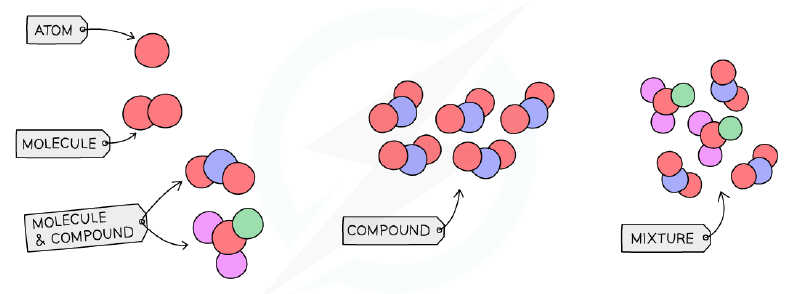
- Element: substance made of atoms with the same number of protons; cannot be split chemically.
- Compound: pure substance of two or more elements chemically combined; cannot be separated by physical means.
- Mixture: combination of substances not chemically combined; separable by physical methods (e.g., filtration).
- Examples: element = copper; compound = CO₂; mixture = sand and water.
Particle diagram showing elements, compounds and mixtures
Atomic Structure
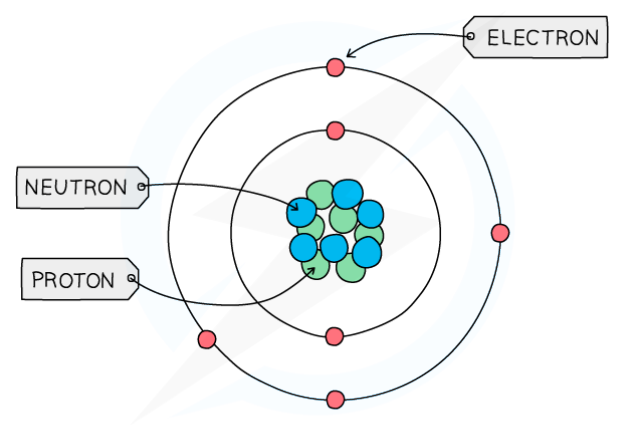
- Atoms consist of protons, neutrons (in nucleus) and electrons (in shells).
- Proton: relative mass 1, charge +1; Neutron: relative mass 1, charge 0; Electron: relative mass 1/1840, charge -1.
- Atomic number (Z) = number of protons; determines element and equals electrons in neutral atom.
- Mass number (A) = total protons + neutrons; also called nucleon number.
- Number of neutrons = mass number – atomic number.
The structure of the carbon atom
Electronic Configuration
- Electrons occupy shells (energy levels); first shell holds 2, second 8, third 8 (simplified).
- Electronic configuration lists electrons per shell, e.g., carbon = 2,4.
- Outermost shell (valence shell) determines chemical properties; full outer shell = stable (noble gas).
- Number of occupied shells = Period number; number of outer electrons = Group number (for Groups I–VII).
- Ions: e.g., Na⁺ has configuration 2,8 (lost one electron).
Bohr model of a sodium atom showing nucleus with 11 protons and 12 neutrons, and electron shells 2,8,1.
Isotopes
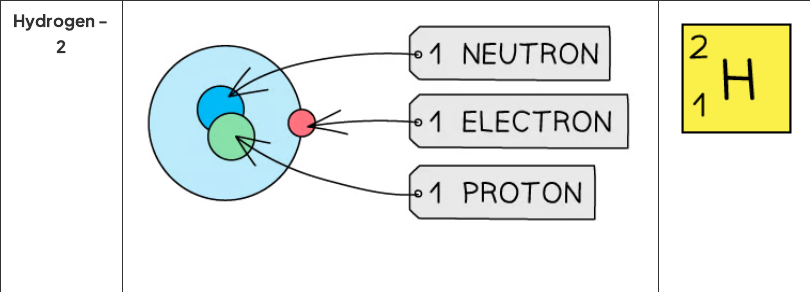
- Isotopes: same element, same number of protons, different number of neutrons.
- Isotopes have identical chemical properties (same outer electrons) but different physical properties (mass).
- Notation: e.g., carbon-14 or ¹⁴C.
The structure of a hydrogen-2 (deuterium) atom
Relative Atomic Mass (Extended)
- Relative atomic mass (Aᵣ) = weighted average mass of all isotopes compared to 1/12 mass of carbon-12.
- Formula: Aᵣ = (Σ(% abundance × mass)) / 100.
- Example: rubidium: (72×85 + 28×87)/100 = 85.6.
Periodic Table & Groups
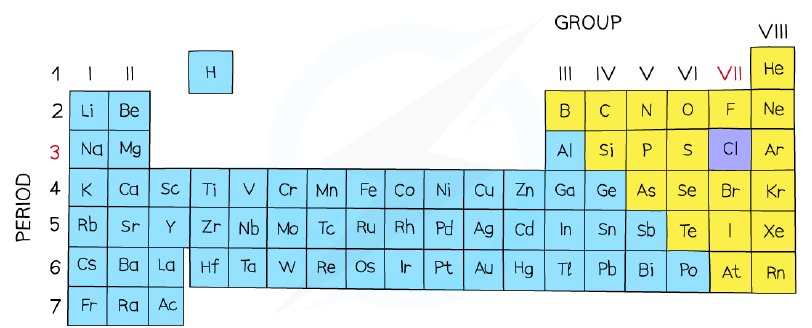
- Elements in same Group have same number of outer electrons and similar chemical properties.
- Noble gases (Group 0/VIII) have full outer shells and are unreactive.
- Group number for Groups I–VII equals number of outer electrons.
- Period number equals number of occupied electron shells.
The Periodic Table showing groups and periods
Slide
Sign up free to view the lesson slides
Step through every slide for this topic — plus flashcards and revision notes — with a free account.
Câu hỏi luyện tập
Xem trước miễn phí — 8 trên 54 câu hỏi. Đăng ký để xem tất cả.
1.Which option correctly describes the relative charges and masses of the subatomic particles?
Easy- AProton +1, neutron 0, electron -1; relative mass of proton 1, neutron 1, electron 0.00054
- BProton +1, neutron 0, electron -1; relative mass of proton 0.00054, neutron 1, electron 0
- CProton 0, neutron +1, electron -1; relative mass of proton 1, neutron 1, electron 0.00054
- DProton +1, neutron 0, electron 0; relative mass of proton 1, neutron 1, electron 0.00054
2.The atomic number of element Q is 9 and its mass number is 19. In which group of the Periodic Table should element Q be placed?
Easy- AGroup 0
- BGroup I
- CGroup VII
- DGroup II
3.The diagram shows the atomic structure of an element. Which element is it?
Easy- ACarbon
- BBeryllium
- COxygen
- DBoron
4.Which two atoms are isotopes?
Medium- AQ and S
- BQ and T
- CR and T
- DR and S
5.Which of the following statements is correct?
Easy- AElements contain different atoms
- BCompounds consist of elements that are not chemically combined
- CMixtures consist of elements that are chemically combined
- DA mixture can contain elements and compounds
6.Which statement about carbon is correct?
Medium- AIt has 4 electron shells.
- BIt has 2 outer shell electrons.
- CIt has 12 nucleons.
- DIt has an electron configuration of 2,8,2.
7.Two atoms, X and Y can be represented as shown: ³₇X and ³₈Y. Which row is correct for both atoms?
Medium- Aelectron configuration of X: 2,1; electron configuration of Y: 2,1; Is Y an isotope of X? Yes
- Belectron configuration of X: 2,1; electron configuration of Y: 2,6; Is Y an isotope of X? Yes
- Celectron configuration of X: 2,5; electron configuration of Y: 2,1; Is Y an isotope of X? No
- Delectron configuration of X: 2,5; electron configuration of Y: 2,6; Is Y an isotope of X? No
8.Element X contains 12 of each sub-atomic particle. What is the correct Group number for element X?
Medium- AGroup 0
- BGroup I
- CGroup VII
- DGroup II
Unlock all 54 questions & more
Tạo tài khoản miễn phí để xem mọi câu hỏi, slide, thẻ ghi nhớ và ghi chú ôn tập cho chủ đề này.