Extraction Of Metals
Học bằng cách chơi
Trả lời những câu hỏi này để kiếm năng lượng, rồi câu cá và khám phá. Không cần tài khoản.
Ghi chú bài học
Metals and Ores
- The Earth’s crust contains metals and metal compounds.
- A metal ore is a rock that contains enough of the metal to make extraction worthwhile.
- Many metal ores are oxides (e.g., hematite for iron, bauxite for aluminium).
- Extraction is a reduction process because oxygen is removed from the ore.
- Very unreactive metals like gold and platinum are found native (as uncombined elements).
Reactivity Series and Extraction Method
- The extraction method depends on the metal's position in the reactivity series.
- Metals above carbon must be extracted by electrolysis (e.g., aluminium).
- Metals below carbon can be extracted by heating with carbon or carbon monoxide (e.g., iron).
- Metals lower in the series are easier to extract than those higher up.
- Electrolysis uses large amounts of electricity, making it expensive.
Extraction of Iron from Hematite – Blast Furnace
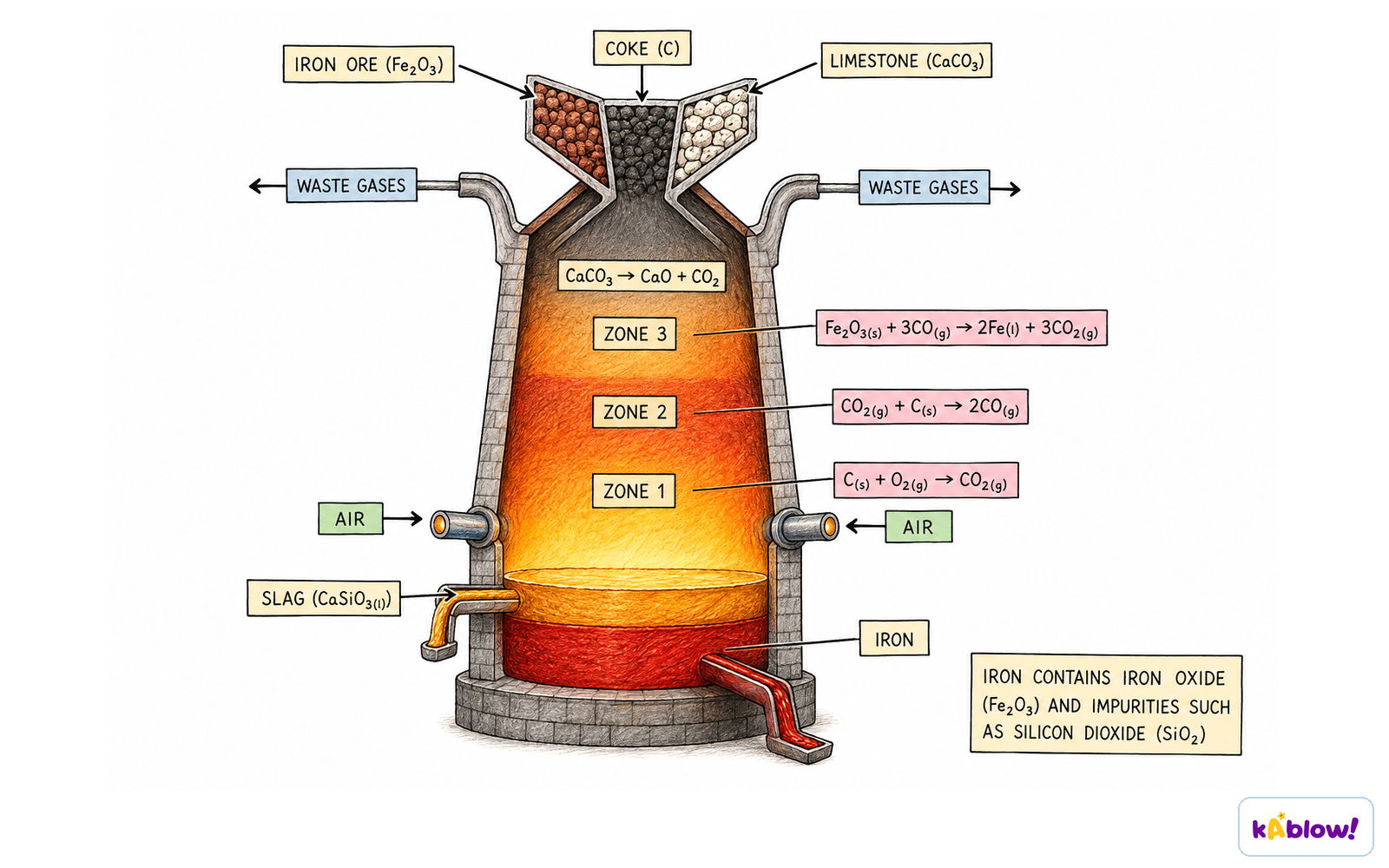
- Iron is extracted from its ore hematite (Fe₂O₃) in a blast furnace.
- Raw materials: iron ore, coke (impure carbon), and limestone (CaCO₃).
- Hot air is blown into the bottom of the furnace.
The blast furnace
Reactions in the Blast Furnace (Extended)
- Zone 1: Coke burns: C + O₂ → CO₂ (exothermic, provides heat).
- Zone 2: CO₂ + C → 2CO (carbon monoxide is the main reducing agent).
- Zone 3: Fe₂O₃ + 3CO → 2Fe + 3CO₂ (reduction of iron ore).
- Limestone decomposes: CaCO₃ → CaO + CO₂ (thermal decomposition).
- CaO removes SiO₂ impurity: CaO + SiO₂ → CaSiO₃ (slag).
- Molten iron is tapped from the bottom; slag floats on top and is removed separately.
Extraction of Aluminium from Bauxite – Electrolysis
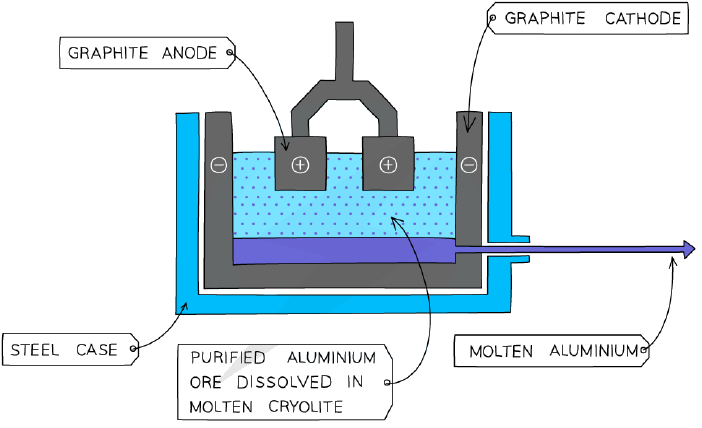
- Aluminium is extracted from bauxite (Al₂O₃) by electrolysis.
- Aluminium is above carbon in the reactivity series, so carbon reduction is not possible.
- Al₂O₃ is dissolved in molten cryolite to lower the melting point (from >2000°C to ~950°C).
- The electrolysis cell has a graphite lining (cathode) and graphite anodes.
- At cathode: Al³⁺ + 3e⁻ → Al (reduction).
- At anode: 2O²⁻ → O₂ + 4e⁻ (oxidation).
- Overall: 2Al₂O₃ → 4Al + 3O₂.
- Oxygen reacts with the carbon anodes to form CO₂, so anodes wear away and must be replaced.
Electrolysis of aluminium oxide
Key Points for Exams
- Remember OIL RIG: Oxidation Is Loss (of electrons), Reduction Is Gain (of electrons).
- For iron extraction, know the three zones and the role of limestone.
- For aluminium, explain why cryolite is used and why anodes need replacing.
- Unreactive metals (Cu, Ag, Au) may be found native or extracted by simple heating.
Slide
Sign up free to view the lesson slides
Step through every slide for this topic — plus flashcards and revision notes — with a free account.
Câu hỏi luyện tập
Xem trước miễn phí — 8 trên 43 câu hỏi. Đăng ký để xem tất cả.
1.Which of the following is the main ore of aluminium?
Easy- ABauxite
- BHematite
- CMalachite
- DLimestone
2.Which of the following metals is found native (as the uncombined element) in the Earth's crust?
Easy- AGold
- BIron
- CAluminium
- DZinc
3.What is the main reducing agent in the blast furnace for the extraction of iron?
Easy- ACarbon monoxide
- BCarbon dioxide
- CCoke
- DLimestone
4.In the extraction of aluminium by electrolysis, why is aluminium oxide dissolved in molten cryolite?
Medium- ATo lower the melting point of the mixture
- BTo provide a source of aluminium ions
- CTo act as a reducing agent
- DTo increase the conductivity of the solution
5.In the blast furnace, which substance is added to remove impurities such as silicon dioxide?
Easy- ALimestone
- BCoke
- CIron ore
- DCarbon monoxide
6.Which of the following statements about transition elements is correct?
Easy- ATheir compounds are highly coloured
- BThey have low melting points
- CTheir compounds are colourless
- DThey have only one oxidation state
7.The overall equation for the extraction of aluminium is 2Al2O3 → 4Al + 3O2. At the anode, oxygen reacts with the graphite electrodes. What is the main reason the anodes need to be replaced periodically?
Medium- AThe graphite reacts with oxygen to form CO2, wearing away the anode
- BThe aluminium produced attacks the anode
- CThe cryolite dissolves the graphite
- DThe high temperature melts the graphite
8.In the blast furnace, which reaction is an example of thermal decomposition?
Easy- ACaCO3 → CaO + CO2
- BC + O2 → CO2
- CCO2 + C → 2CO
- DFe2O3 + 3CO → 2Fe + 3CO2
Unlock all 43 questions & more
Tạo tài khoản miễn phí để xem mọi câu hỏi, slide, thẻ ghi nhớ và ghi chú ôn tập cho chủ đề này.