Reversible Reactions & Equilibrium
Học bằng cách chơi
Trả lời những câu hỏi này để kiếm năng lượng, rồi câu cá và khám phá. Không cần tài khoản.
Ghi chú bài học
Reversible Reactions
- In reversible reactions, products can react to reform reactants; the reaction occurs in both directions.
- The symbol ⇌ is used to indicate a reversible reaction.
- If the forward reaction is exothermic, the reverse reaction is endothermic (same amount of heat transferred).
- Example: N₂ + 3H₂ ⇌ 2NH₃ (forward exothermic, reverse endothermic).
- Hydrated salts contain water of crystallisation; heating removes water to form anhydrous salts.
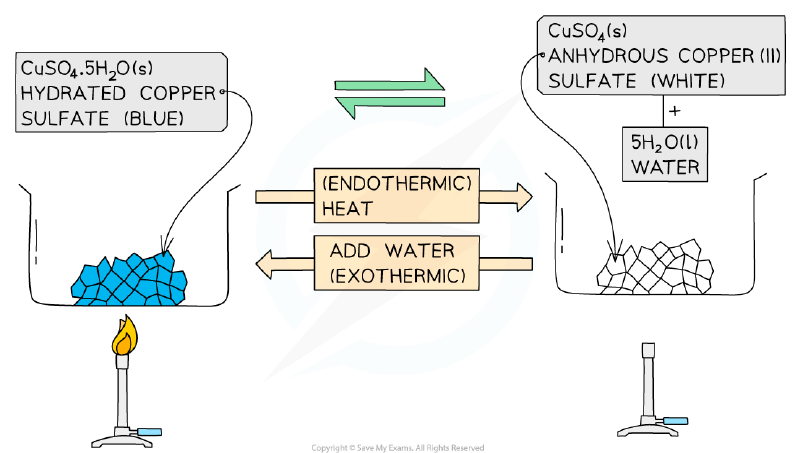
- Copper(II) sulfate: CuSO₄·5H₂O (blue) ⇌ CuSO₄ (white) + 5H₂O; forward endothermic, reverse exothermic.
- Cobalt(II) chloride: CoCl₂·6H₂O (pink) ⇌ CoCl₂ (blue) + 6H₂O; forward endothermic, reverse exothermic.
- These colour changes are used as tests for water (blue to pink for CoCl₂, white to blue for CuSO₄).
Hydrated copper(II) sulfate (blue) heated to anhydrous copper(II) sulfate (white); adding water reverses the change
Equilibrium (Extended Tier)
- A reversible reaction reaches equilibrium in a closed system (no reactants or products can escape).
- At equilibrium: rate of forward reaction = rate of reverse reaction; concentrations of reactants and products remain constant.
- Equilibrium is dynamic – molecules continuously interconvert at equal rates.
- Example: In the Haber process, initially forward rate is high; as reactants decrease and products increase, rates become equal.
Le Chatelier's Principle (Extended Tier)
- Le Chatelier's Principle: If a change is made to a system at equilibrium, the system moves to oppose the change.
- Temperature: Increase temperature favours the endothermic direction; decrease favours the exothermic direction.
- Pressure: Increase pressure shifts equilibrium to the side with fewer gas molecules; decrease shifts to side with more gas molecules.
- Concentration: Increase reactant concentration shifts equilibrium to the right (more products); increase product concentration shifts to the left.
- Catalyst does not affect the position of equilibrium – it speeds up both forward and reverse reactions equally, reaching equilibrium faster.
Le Chatelier's Principle: effect of conditions
The Haber Process (Extended Tier)
- Manufactures ammonia via N₂(g) + 3H₂(g) ⇌ 2NH₃(g) (forward exothermic).
- Raw materials: Nitrogen from fractional distillation of liquid air; Hydrogen from natural gas (methane).
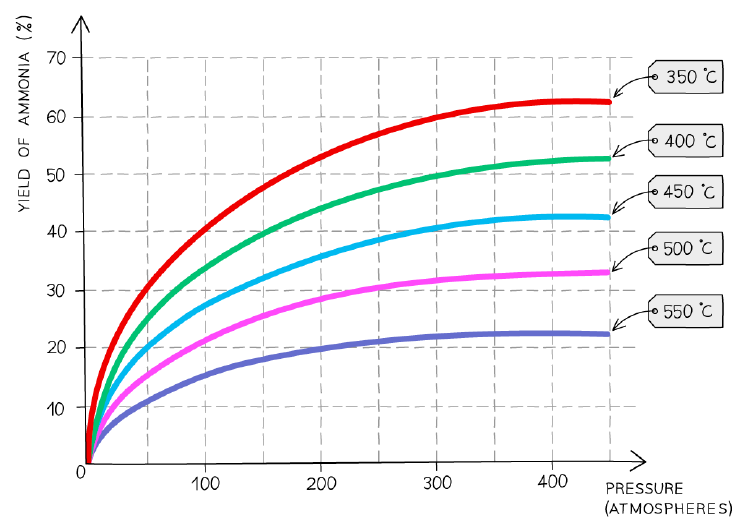
- Conditions: 450 °C, 200 atm, iron catalyst.
- Compromise conditions: Lower temperature favours yield but slows rate; higher pressure favours yield but is expensive and dangerous.
- Catalyst (iron) allows equilibrium to be reached faster, enabling a lower operating temperature.
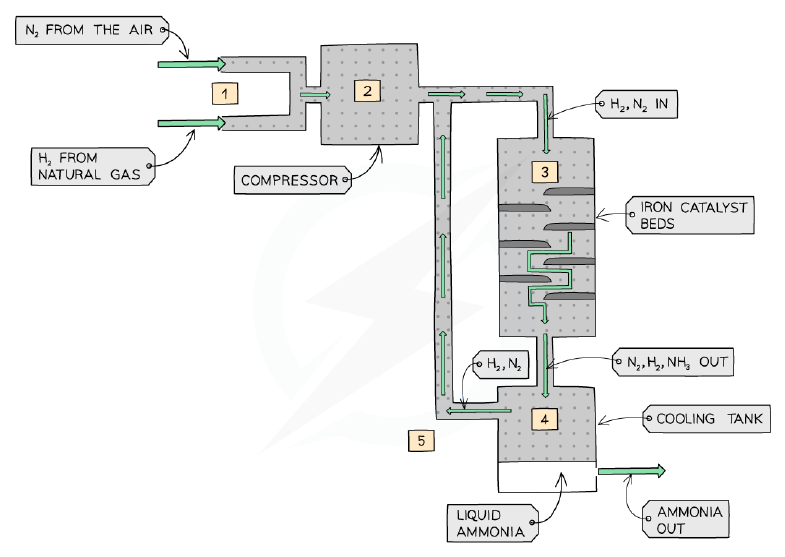
- Process stages: Compress gases → react over catalyst → cool to liquefy ammonia → recycle unreacted N₂ and H₂.
- Yield increases with increasing pressure and decreasing temperature (see data tables).
The production of ammonia by the Haber process
The Contact Process (Extended Tier)
- Manufactures sulfuric acid via main stage: 2SO₂(g) + O₂(g) ⇌ 2SO₃(g) (forward exothermic).
- Catalyst: Vanadium(V) oxide (V₂O₅).
- Conditions: 450 °C, 2 atm (200 kPa).
- Compromise: Low temperature favours yield but slows rate; pressure is kept low (≈1 atm) because equilibrium already gives ~96% yield and high pressure would liquefy SO₂.
- SO₃ is absorbed into 98% sulfuric acid to form oleum (H₂S₂O₇), then diluted to give concentrated H₂SO₄.
- SO₃ is not absorbed directly into water to avoid forming a dangerous mist of sulfuric acid.
Slide
Sign up free to view the lesson slides
Step through every slide for this topic — plus flashcards and revision notes — with a free account.
Câu hỏi luyện tập
Xem trước miễn phí — 8 trên 45 câu hỏi. Đăng ký để xem tất cả.
1.What does the symbol ⇌ mean in a chemical equation?
Easy- AThe reaction is reversible
- BThe reaction goes to completion
- CThe reaction is exothermic
- DThe reaction is at equilibrium
2.When anhydrous cobalt(II) chloride is added to water, what colour change is observed?
Easy- ABlue to pink
- BPink to blue
- CWhite to blue
- DBlue to white
3.Which of the following is a condition needed for a reversible reaction to reach equilibrium?
Easy- AOpen system
- BClosed system
- CHigh temperature
- DPresence of a catalyst
4.In the Haber process, what is the source of nitrogen?
Easy- ANatural gas
- BAir
- CWater
- DAmmonia
5.For the reversible reaction N2(g) + 3H2(g) ⇌ 2NH3(g), the forward reaction is exothermic. Which change would increase the yield of ammonia at equilibrium?
Medium- AIncreasing the temperature
- BDecreasing the pressure
- CAdding a catalyst
- DDecreasing the temperature
6.In the Contact process, the main stage reaction is 2SO2(g) + O2(g) ⇌ 2SO3(g). The forward reaction is exothermic. What is the approximate temperature used for this stage?
Easy- A200 °C
- B450 °C
- C800 °C
- D1000 °C
7.Which statement is correct about a catalyst in a reversible reaction at equilibrium?
Medium- AIt increases the yield of products
- BIt speeds up the forward reaction only
- CIt increases the rate of both forward and reverse reactions equally
- DIt shifts the equilibrium to the right
8.Hydrated copper(II) sulfate is heated. Which statement describes this reaction?
Easy- AEndothermic, blue to white
- BExothermic, white to blue
- CEndothermic, white to blue
- DExothermic, blue to white
Unlock all 45 questions & more
Tạo tài khoản miễn phí để xem mọi câu hỏi, slide, thẻ ghi nhớ và ghi chú ôn tập cho chủ đề này.