Simple Molecules & Covalent Bonds
Học bằng cách chơi
Trả lời những câu hỏi này để kiếm năng lượng, rồi câu cá và khám phá. Không cần tài khoản.
Ghi chú bài học
Covalent Bonds
- A covalent bond is formed when pairs of electrons are shared between atoms.
- Only non-metal elements participate in covalent bonding.
- Each atom gains a full outer shell of electrons (noble gas configuration).
- Covalently bonded substances may consist of small molecules or giant molecules.
- Dot-and-cross diagrams show the electronic configuration: dots for one atom's electrons, crosses for the other's.
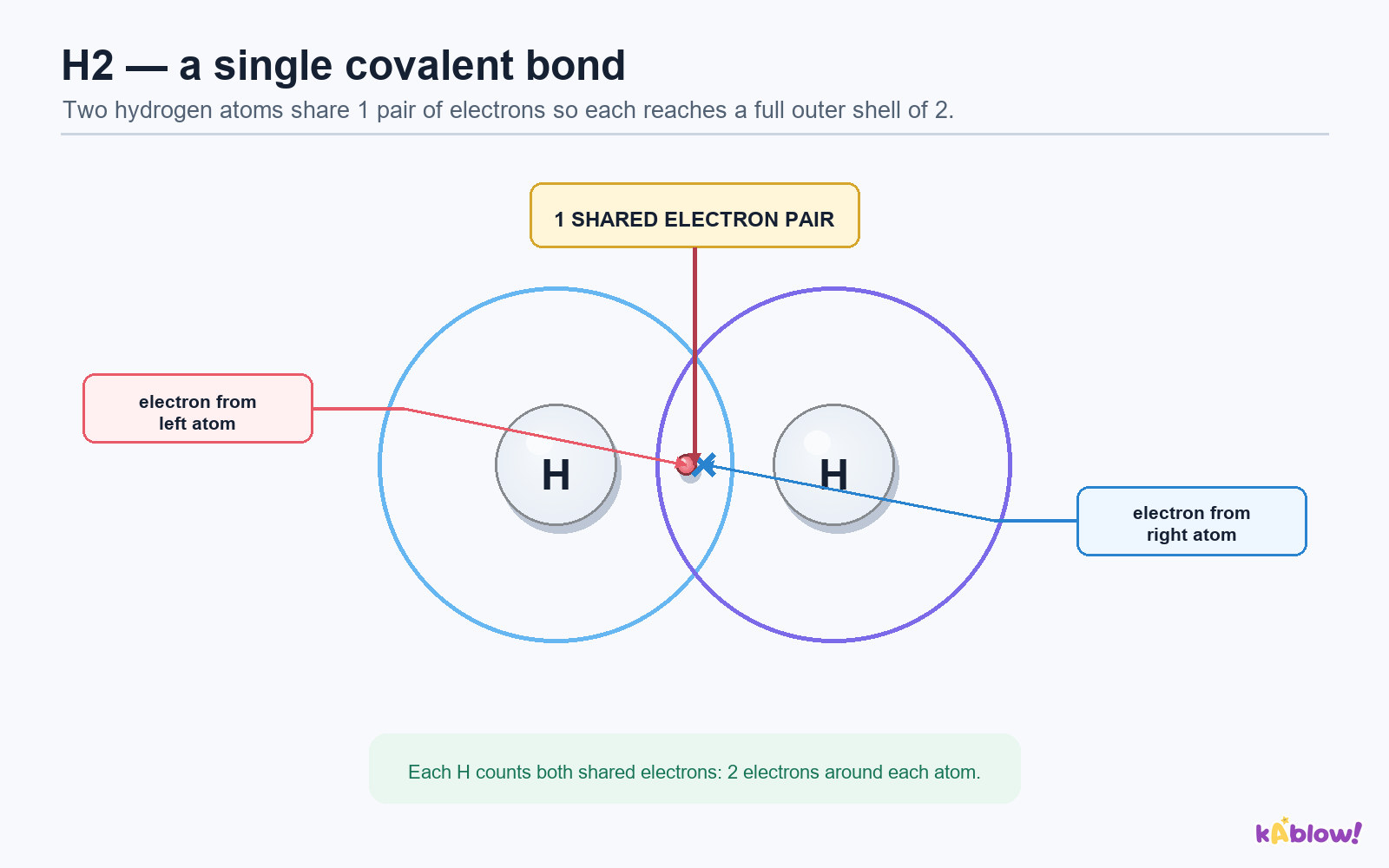
- Electron shells overlap and shared electrons are shown in the overlap region.
A single covalent bond in hydrogen
Single Covalent Bonds
- A single covalent bond involves one shared pair of electrons.
- Examples: H₂ (H–H), Cl₂ (Cl–Cl), H₂O, CH₄, NH₃, HCl.
- In H₂O, oxygen shares one electron with each hydrogen atom, forming two single bonds.
- In CH₄, carbon shares one electron with each of four hydrogen atoms.
- In NH₃, nitrogen shares one electron with each of three hydrogen atoms.
- In HCl, hydrogen and chlorine share one pair of electrons.
H₂O dot-and-cross diagram: oxygen forms a single covalent bond with each hydrogen atom.
Double and Triple Covalent Bonds (Extended)
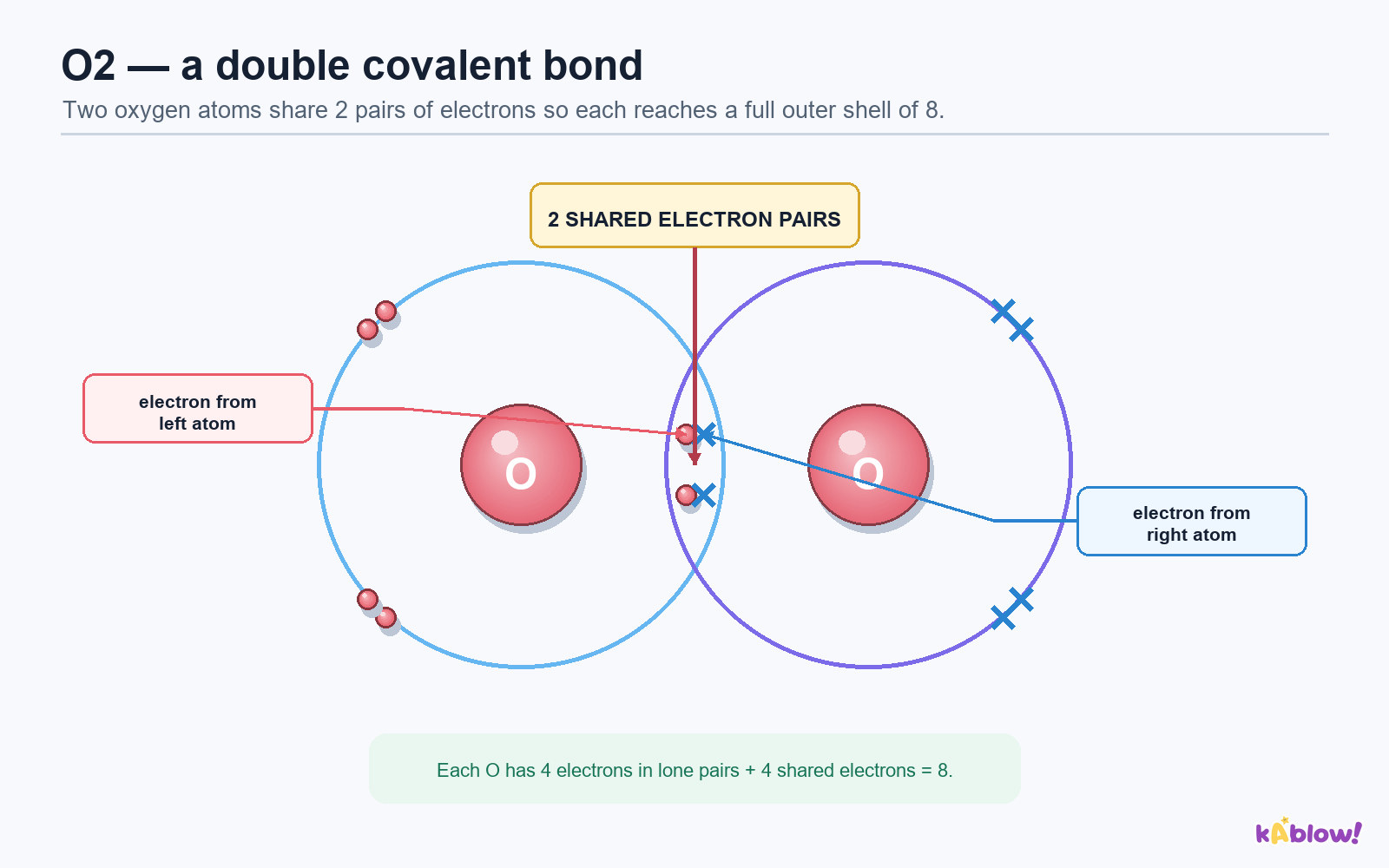
- Some atoms share two pairs of electrons to form a double bond.
- Some atoms share three pairs of electrons to form a triple bond.
- O₂ has a double bond (O=O) – each oxygen shares two electrons.
- N₂ has a triple bond (N≡N) – each nitrogen shares three electrons.
- Ethene (C₂H₄) has a double bond between the two carbon atoms.
- Carbon dioxide (CO₂) has two double bonds (O=C=O).
A double covalent bond in oxygen
Properties of Simple Molecular Compounds
- Simple molecular compounds have low melting and boiling points.
- They are usually liquids or gases at room temperature.
- As molecule size increases, melting and boiling points increase.
- They have poor electrical conductivity – do not conduct in solid or liquid state.
- They are insulators (e.g., plastic coating on wires).
Explaining Properties (Extended)
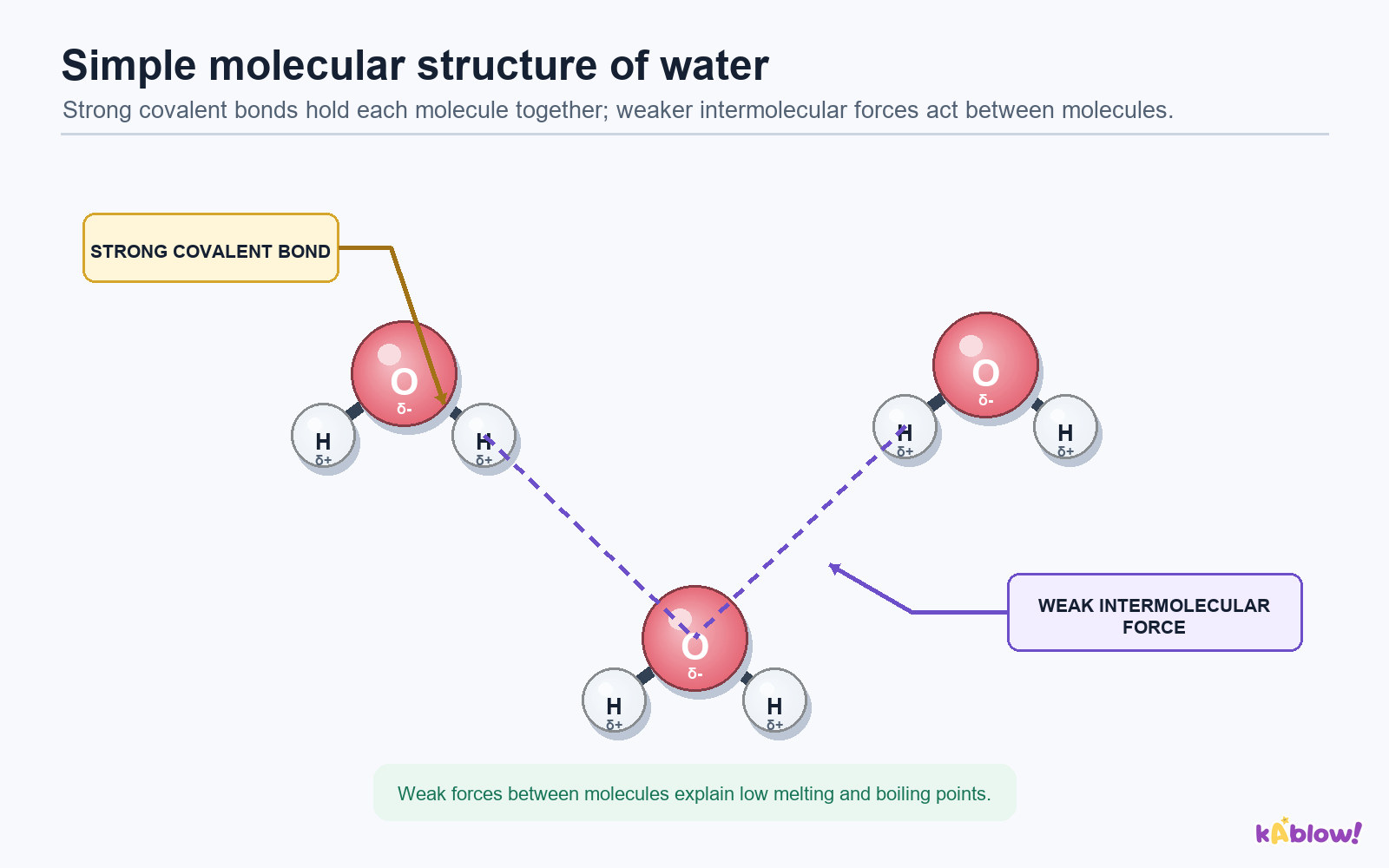
- Atoms within molecules are held by strong covalent bonds.
- Between molecules there are weak intermolecular forces.
- Low melting/boiling points are due to weak intermolecular forces requiring little energy to overcome.
- Intermolecular forces are about one tenth as strong as covalent bonds.
- Larger molecules have more electrons, increasing intermolecular forces and raising melting/boiling points.
- Poor conductivity because there are no free ions or electrons to carry charge.
Bonds within and between water molecules
Distinguishing Covalent from Ionic
- Covalent compounds contain only non-metals.
- Ionic compounds contain metal and non-metal.
- In dot-and-cross diagrams, covalent compounds show overlapping shells with shared electrons.
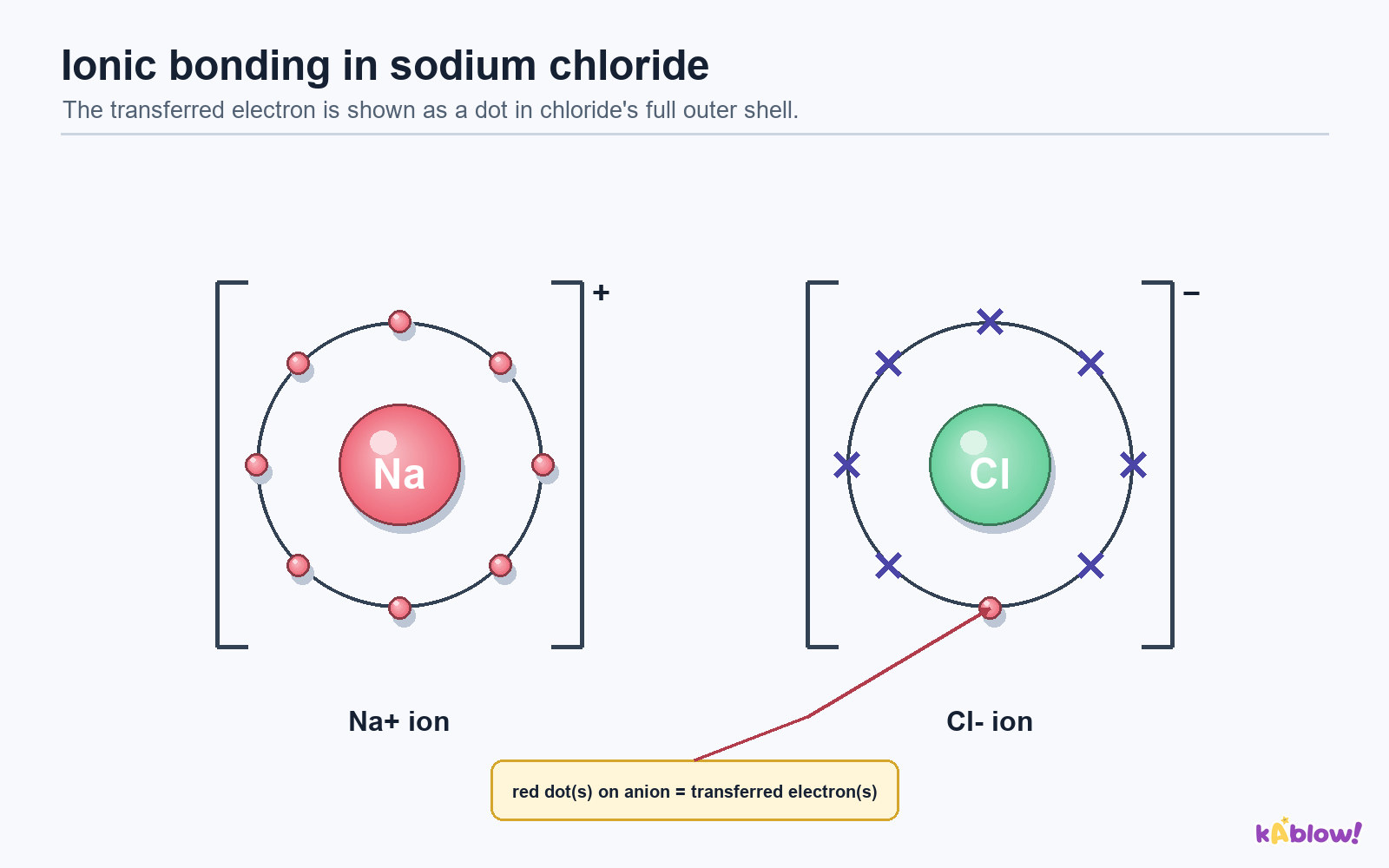
- Ionic compounds show separate ions with square brackets and charges.
- Covalent compounds have low melting points; ionic compounds have high melting points.
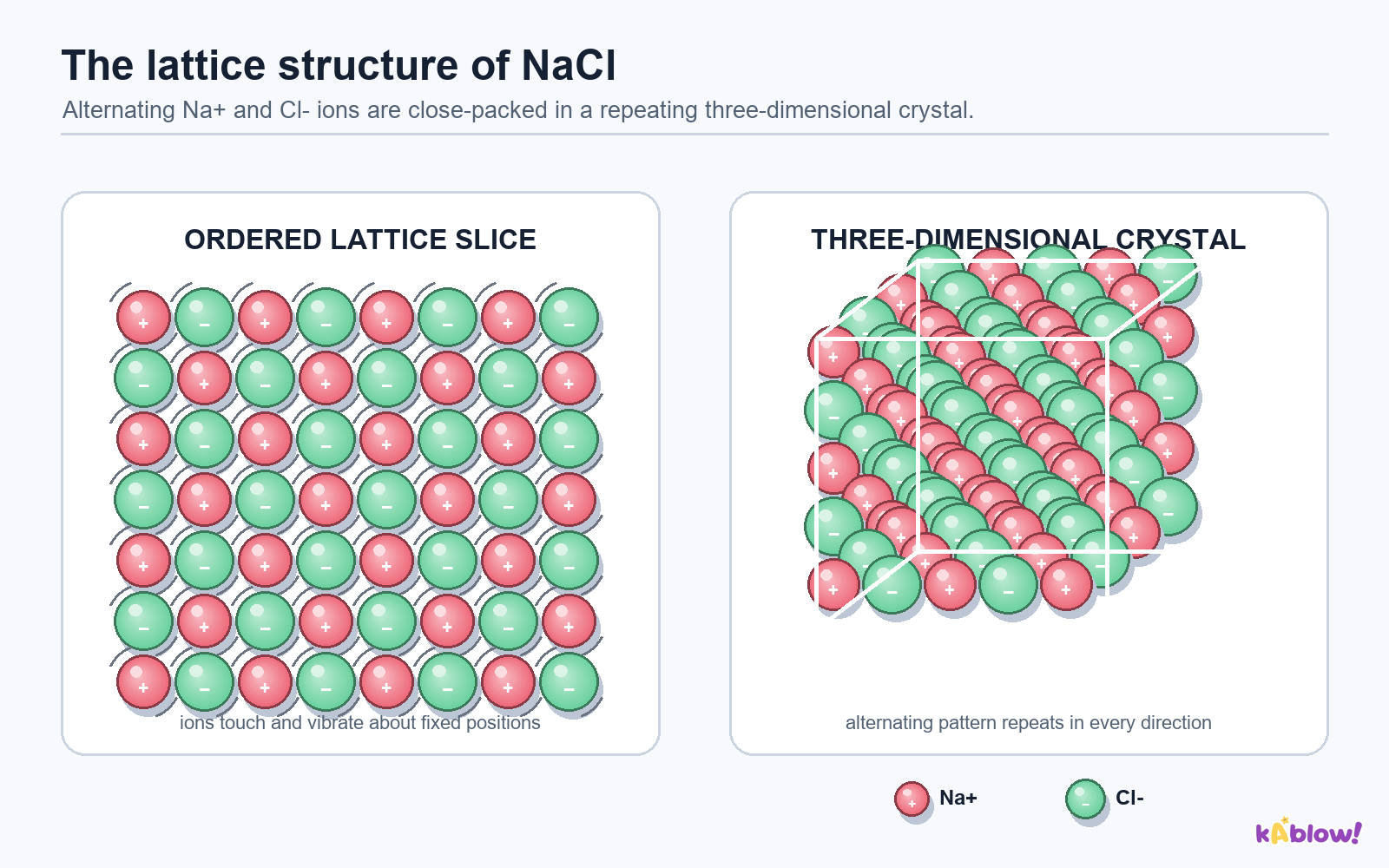
Ionic bonding in sodium chloride
Slide
Sign up free to view the lesson slides
Step through every slide for this topic — plus flashcards and revision notes — with a free account.
Câu hỏi luyện tập
Xem trước miễn phí — 8 trên 45 câu hỏi. Đăng ký để xem tất cả.
1.What type of bonding is found in methane?
Easy- ACovalent
- BIonic
- CMetallic
- DHydrogen bonding
2.Which of the following substances has a simple molecular structure?
Easy- ACarbon dioxide
- BCalcium carbonate
- CCopper
- DMagnesium oxide
3.A covalent bond is formed when two atoms:
Easy- AShare a pair of electrons
- BTransfer electrons
- CShare protons
- DAttract via opposite charges
4.When a simple molecular substance melts, what is broken?
Easy- AIntermolecular forces
- BCovalent bonds
- CIonic bonds
- DMetallic bonds
5.Which of the following statements explains why ammonia does not conduct electricity?
Easy- AIt does not contain any free ions or free electrons
- BIts ions are in a fixed position
- CIt has delocalised electrons
- DIt contains free electrons
6.The boiling point of nitrogen is very low even though the bond between atoms in a nitrogen molecule is very strong. Why?
Medium- AOnly weak intermolecular forces need to be overcome
- BThe covalent bonds are broken during boiling
- CNitrogen molecules are very small
- DNitrogen is a gas at room temperature
7.Which of the following elements can form covalent bonds?
Easy- ACarbon
- BSodium
- CCalcium
- DIron
8.Which of the following molecules contains a double bond?
Easy- AOxygen (O2)
- BHydrogen (H2)
- CChlorine (Cl2)
- DMethane (CH4)
Unlock all 45 questions & more
Tạo tài khoản miễn phí để xem mọi câu hỏi, slide, thẻ ghi nhớ và ghi chú ôn tập cho chủ đề này.