The Characteristic Properties Of Acids & Bases
Học bằng cách chơi
Trả lời những câu hỏi này để kiếm năng lượng, rồi câu cá và khám phá. Không cần tài khoản.
Ghi chú bài học
Properties of Acids
- Acids have pH < 7, sour taste (if edible), and are corrosive.
- Acids neutralise bases to form a salt and water.
- In water, acids produce H⁺ ions (e.g., HCl → H⁺ + Cl⁻).
- Acids react with metals (above H in reactivity series) to give salt + hydrogen.
- Acids react with metal carbonates to give salt + CO₂ + water.
- Acids react with bases (metal oxides/hydroxides) to give salt + water (neutralisation).
Properties of Bases & Alkalis
- Bases have pH > 7; a water‑soluble base is an alkali.
- Bases neutralise acids to form a salt and water.
- In water, alkalis produce OH⁻ ions (e.g., NaOH → Na⁺ + OH⁻).
- Alkalis react with ammonium salts on warming to produce ammonia gas (damp red litmus turns blue).
- Common bases are metal oxides and metal hydroxides.
Indicators
- Indicators change colour in acid or alkali; litmus (red in acid, blue in alkali) is from lichens.
- Methyl orange: red in acid, yellow in alkali.
- Thymolphthalein: colourless in acid, blue in alkali.
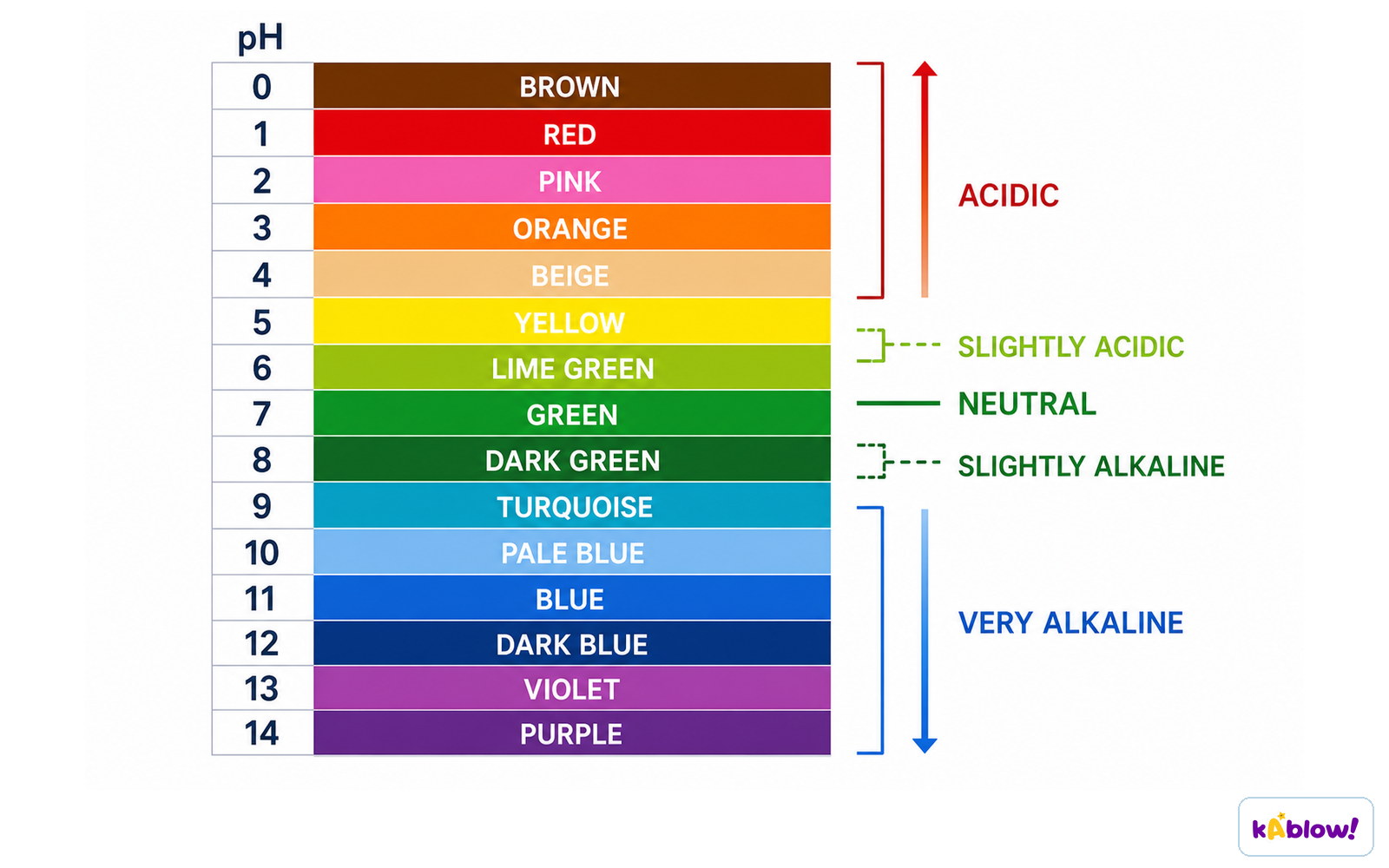
- Universal indicator is a mixture giving a range of colours to estimate pH.
- Synthetic indicators (methyl orange, thymolphthalein) have sharp colour changes for titrations; litmus is not suitable for titrations.
Universal indicator colours across the pH scale
The Ions in Acids & Alkalis & Neutralisation
- Acids are sources of H⁺ ions; alkalis are sources of OH⁻ ions.
- Neutralisation: H⁺(aq) + OH⁻(aq) → H₂O(l).
- Not all acid reactions are neutralisations (e.g., acid + metal produces no water).
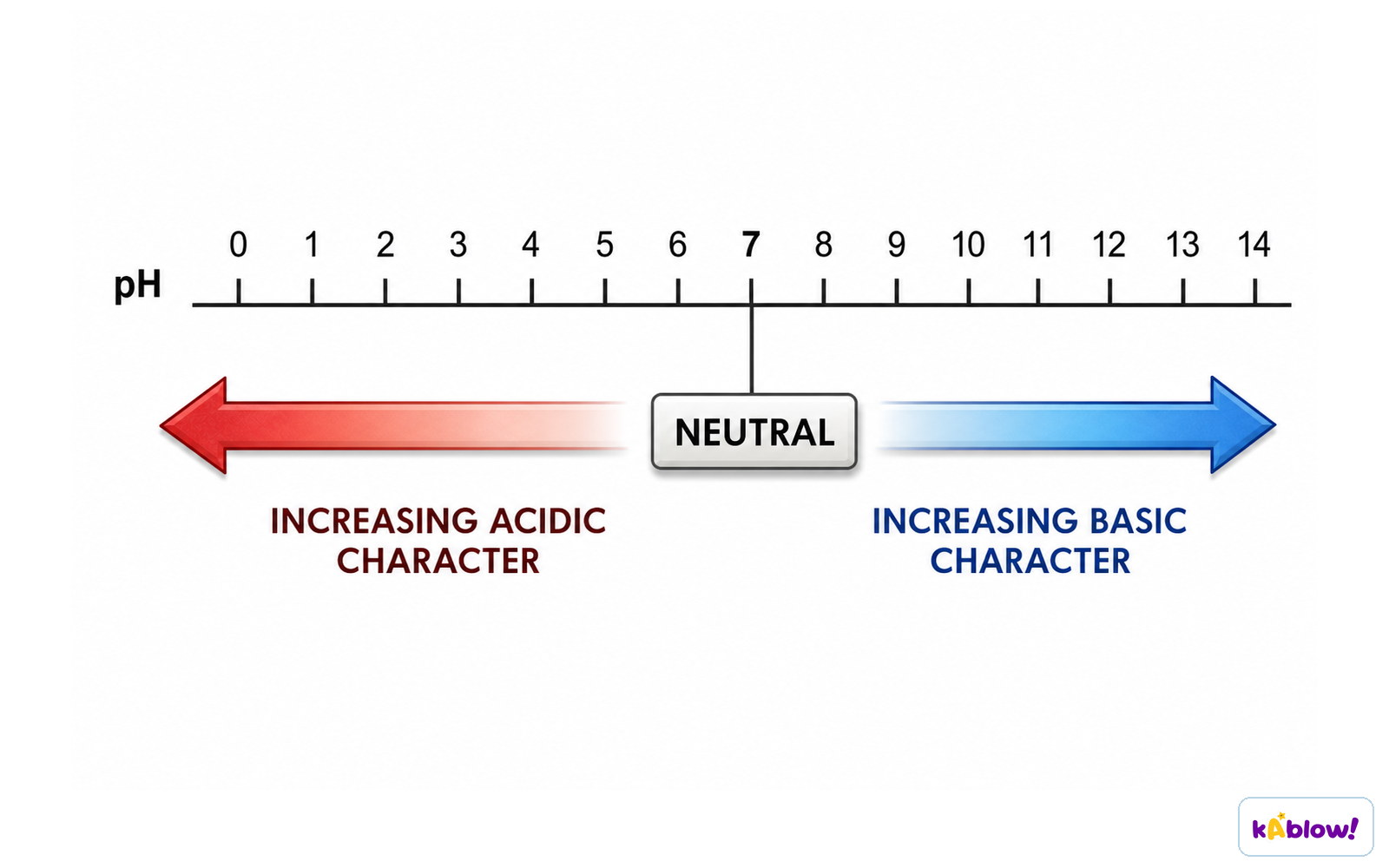
- The pH scale runs 0–14; pH < 7 = acid, pH = 7 = neutral, pH > 7 = alkali.
- pH is a logarithmic measure of H⁺ concentration: a change of 1 pH unit = ×10 change in [H⁺].
- Strong acids have pH 0–2; weak acids pH 3–6; weak alkalis pH 8–11; strong alkalis pH 12–14.
The pH scale showing acidity, neutrality and alkalinity
Proton Transfer (Extended Tier)
- Acids are proton donors (H⁺ = proton).
- Bases are proton acceptors.
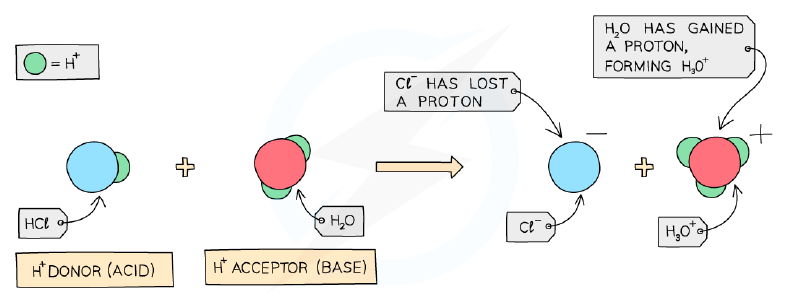
- In water, HCl donates a proton to H₂O, forming H₃O⁺ and Cl⁻.
Proton transfer between hydrochloric acid and water
Strong & Weak Acids (Extended Tier)
- Strong acids completely dissociate in water (e.g., HCl, H₂SO₄).
- Weak acids partially dissociate; an equilibrium exists (e.g., CH₃CH₂COOH ⇌ H⁺ + CH₃CH₂COO⁻).
- Concentration ≠ strength: a dilute strong acid can be more acidic than a concentrated weak acid.
- Weak acids have pH closer to 7 (e.g., propanoic acid pH ≈ 5).
Classifying Oxides
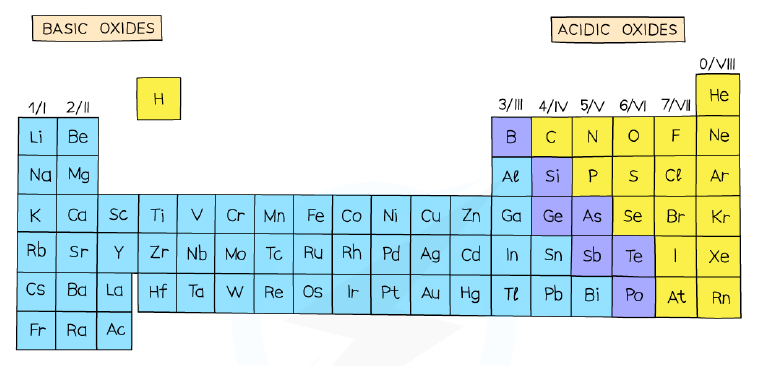
- Acidic oxides (non‑metal + oxygen): react with bases to form salt + water; produce acidic solutions (e.g., CO₂, SO₂).
- Basic oxides (metal + oxygen): react with acids to form salt + water; produce alkaline solutions (e.g., CuO, CaO).
- Amphoteric oxides (e.g., ZnO, Al₂O₃) react with both acids and bases to give salt + water.
- Neutral oxides (e.g., N₂O, NO, CO) do not react with acids or bases.
- Al₂O₃ + 6HCl → 2AlCl₃ + 3H₂O (as base); Al₂O₃ + 2NaOH → 2NaAlO₂ + H₂O (as acid).
Metals form basic oxides while non-metals form acidic oxides
Slide
Sign up free to view the lesson slides
Step through every slide for this topic — plus flashcards and revision notes — with a free account.
Câu hỏi luyện tập
Xem trước miễn phí — 8 trên 40 câu hỏi. Đăng ký để xem tất cả.
1.Which of the following is a property of acids?
Easy- AThey have a pH greater than 7
- BThey turn blue litmus red
- CThey are proton acceptors
- DThey release hydroxide ions in water
2.Which ion is present in aqueous solutions of alkalis?
Easy- AH⁺
- BOH⁻
- CCl⁻
- DNa⁺
3.What is the colour of methyl orange in an alkaline solution?
Easy- ARed
- BYellow
- CBlue
- DColourless
4.Which of the following statements about strong and weak acids is correct?
Medium- AA strong acid has a higher pH than a weak acid of the same concentration
- BA weak acid partially dissociates in water
- CA strong acid has a lower concentration of hydrogen ions than a weak acid
- DA weak acid completely dissociates in water
5.Which type of oxide is formed when a non-metal combines with oxygen?
Medium- ABasic oxide
- BAcidic oxide
- CAmphoteric oxide
- DNeutral oxide
6.Which substance could be used to neutralise an acid?
Medium- ALemon juice (pH 2)
- BBattery acid (pH 1)
- CToothpaste (pH 8)
- DVinegar (pH 3)
7.Which gas is produced when an acid reacts with a metal carbonate?
Medium- AHydrogen
- BOxygen
- CCarbon dioxide
- DAmmonia
8.The pH of acid X is 6 and the pH of acid Y is 3. Which statement is correct?
Hard- AThe hydrogen ion concentration of acid X is 1000 times greater than acid Y
- BThe hydrogen ion concentration of acid Y is 3 times greater than acid X
- CThe hydrogen ion concentration of acid Y is 1000 times greater than acid X
- DThe hydrogen ion concentration of acid X is 100 times greater than acid Y
Unlock all 40 questions & more
Tạo tài khoản miễn phí để xem mọi câu hỏi, slide, thẻ ghi nhớ và ghi chú ôn tập cho chủ đề này.