Water & Water Pollution
Học bằng cách chơi
Trả lời những câu hỏi này để kiếm năng lượng, rồi câu cá và khám phá. Không cần tài khoản.
Ghi chú bài học
Chemical Tests for Water
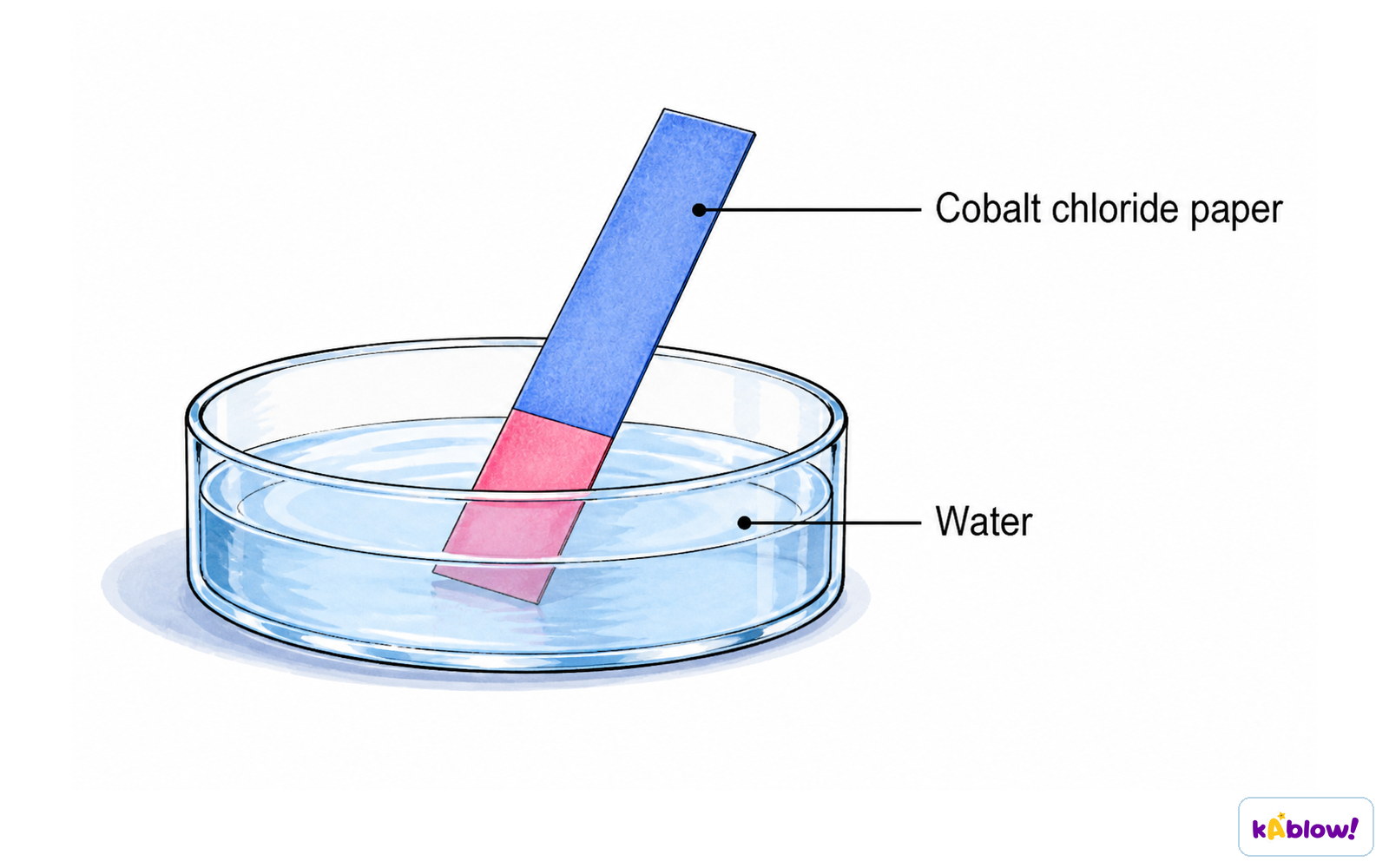
- Anhydrous cobalt(II) chloride (blue) turns pink in the presence of water, forming hydrated cobalt(II) chloride.
- Cobalt chloride paper is commonly used: blue → pink indicates water.
- Anhydrous copper(II) sulfate (white) turns blue in the presence of water, forming hydrated copper(II) sulfate.
- Both tests are reversible: hydration on adding water, dehydration on heating.
Cobalt chloride paper changes from blue to pink in the presence of water
Purity of Water
- Pure water has a sharp boiling point of 100 °C and melting point of 0 °C.
- Impurities raise the boiling point and lower the melting point, giving a range.
- Distilled water is produced by boiling water and condensing the steam, removing most dissolved impurities.
- Distilled water is used in chemistry to avoid interference from dissolved ions in tap water.
Substances in Natural Water Sources
- Natural water comes from lakes, rivers, and groundwater stored in aquifers.
- Beneficial substances: dissolved oxygen (essential for aquatic life) and metal compounds (e.g., Ca²⁺, Mg²⁺ provide essential minerals).
- Harmful substances: toxic metals (e.g., lead, aluminium), plastics, sewage (harmful microbes), and nitrates/phosphates from fertilisers.
- Nitrates and phosphates can cause eutrophication – excessive plant growth leading to deoxygenation of water.
Water Treatment
- Untreated water contains insoluble (soil, plant matter) and soluble (dissolved ions) impurities.
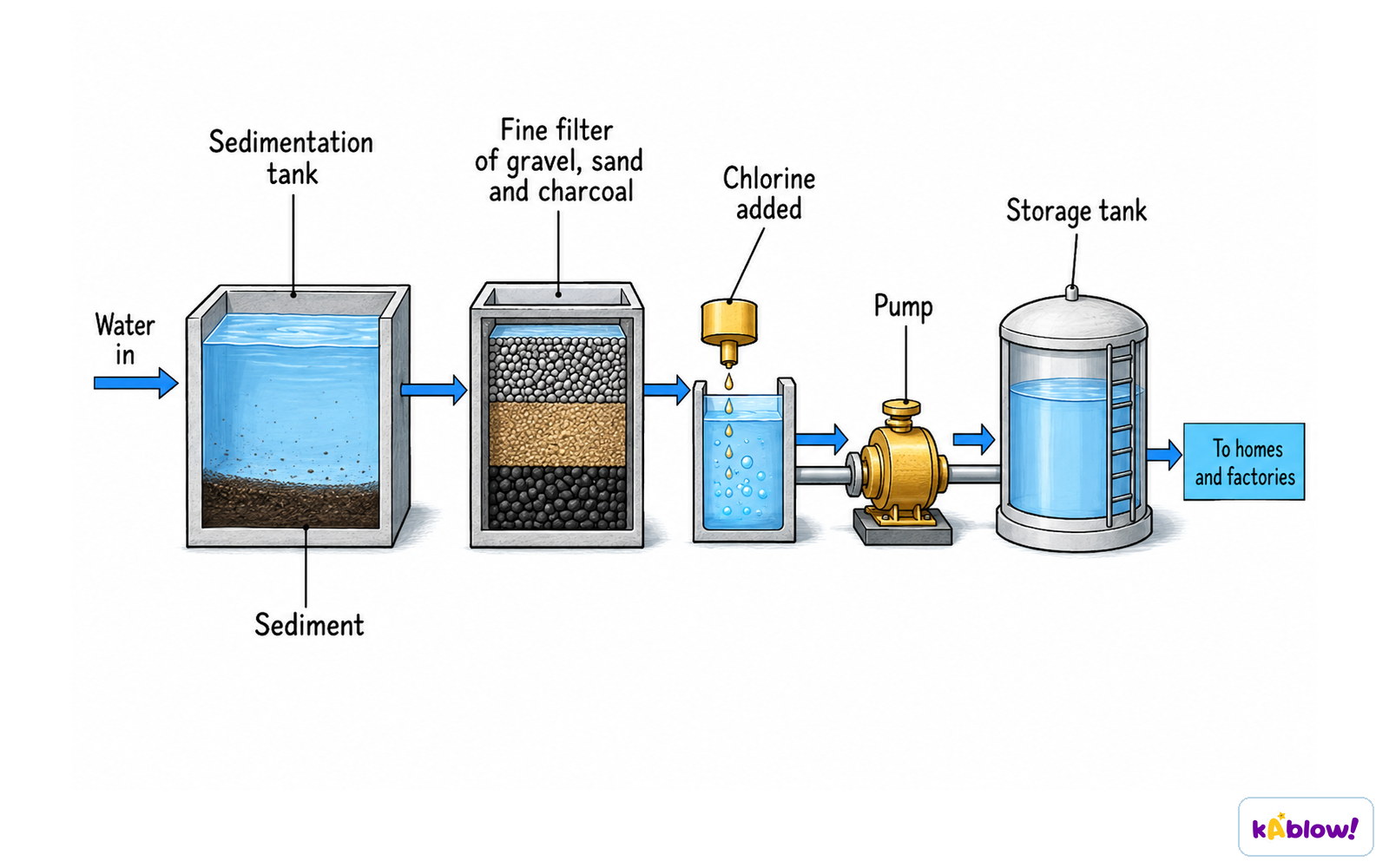
- Step 1 – Sedimentation: Water stands in tanks; heavy particles settle by gravity.
- Step 1 – Filtration: Water passes through sand and gravel to remove smaller particles.
- Step 2 – Carbon filtration: Removes unpleasant tastes and odours.
- Step 3 – Chlorination: Chlorine is added to kill bacteria and microbes (prevents diseases like cholera and typhoid).
The stages of treating water are sedimentation, filtration with carbon and chlorination
Fertilisers
- NPK fertilisers supply nitrogen (N), phosphorus (P), and potassium (K) for healthy plant growth.
- Nitrogen promotes leaves (chlorophyll and protein); phosphorus promotes roots; potassium promotes fruit and flowers.
- Water-soluble ions: ammonium (NH₄⁺) and nitrate (NO₃⁻) for nitrogen; phosphate (PO₄³⁻) for phosphorus; potassium (K⁺) from soluble potassium compounds.
- Common fertiliser compounds: ammonium nitrate (NH₄NO₃), ammonium phosphate ((NH₄)₃PO₄), potassium nitrate (KNO₃).
- Fertilisers must be water-soluble so plants can absorb ions through their roots.
Slide
Sign up free to view the lesson slides
Step through every slide for this topic — plus flashcards and revision notes — with a free account.
Câu hỏi luyện tập
Xem trước miễn phí — 8 trên 48 câu hỏi. Đăng ký để xem tất cả.
1.Which colour change indicates the presence of water when using anhydrous cobalt(II) chloride?
Easy- Ablue to pink
- Bpink to blue
- Cwhite to blue
- Dblue to white
2.Which colour change indicates the presence of water when using anhydrous copper(II) sulfate?
Easy- Awhite to blue
- Bblue to white
- Cpink to blue
- Dwhite to pink
3.What is the term for a rock that stores water?
Easy- Aaquifer
- Breservoir
- Csediment
- Daqueduct
4.Which of the following is a beneficial substance that can be found in natural water sources?
Easy- Adissolved oxygen
- Blead compounds
- Csewage
- Dnitrates from fertilisers
5.What is the main purpose of chlorination in water treatment?
Easy- Ato kill bacteria and other microbes
- Bto remove insoluble particles
- Cto remove unpleasant tastes and odours
- Dto add essential minerals
6.A sample of water boils at 101 °C at standard pressure. What does this indicate about the water?
Easy- Ait is pure water
- Bit contains dissolved impurities
- Cit is distilled water
- Dit has a lower boiling point than pure water
7.Which of the following is NOT a stage in the treatment of water for domestic supply?
Easy- Asedimentation
- Bfiltration through carbon
- Cdistillation
- Dchlorination
8.Fertilisers contain soluble ions. Which ion provides phosphorus for plant growth?
Easy- Aphosphate, PO₄³⁻
- Bnitrate, NO₃⁻
- Cammonium, NH₄⁺
- Dpotassium, K⁺
Unlock all 48 questions & more
Tạo tài khoản miễn phí để xem mọi câu hỏi, slide, thẻ ghi nhớ và ghi chú ôn tập cho chủ đề này.