Variation And Natural Selection
Học bằng cách chơi
Trả lời những câu hỏi này để kiếm năng lượng, rồi câu cá và khám phá. Không cần tài khoản.
Ghi chú bài học
Variation
- Variation refers to differences between individuals of the same species, giving rise to different phenotypes.
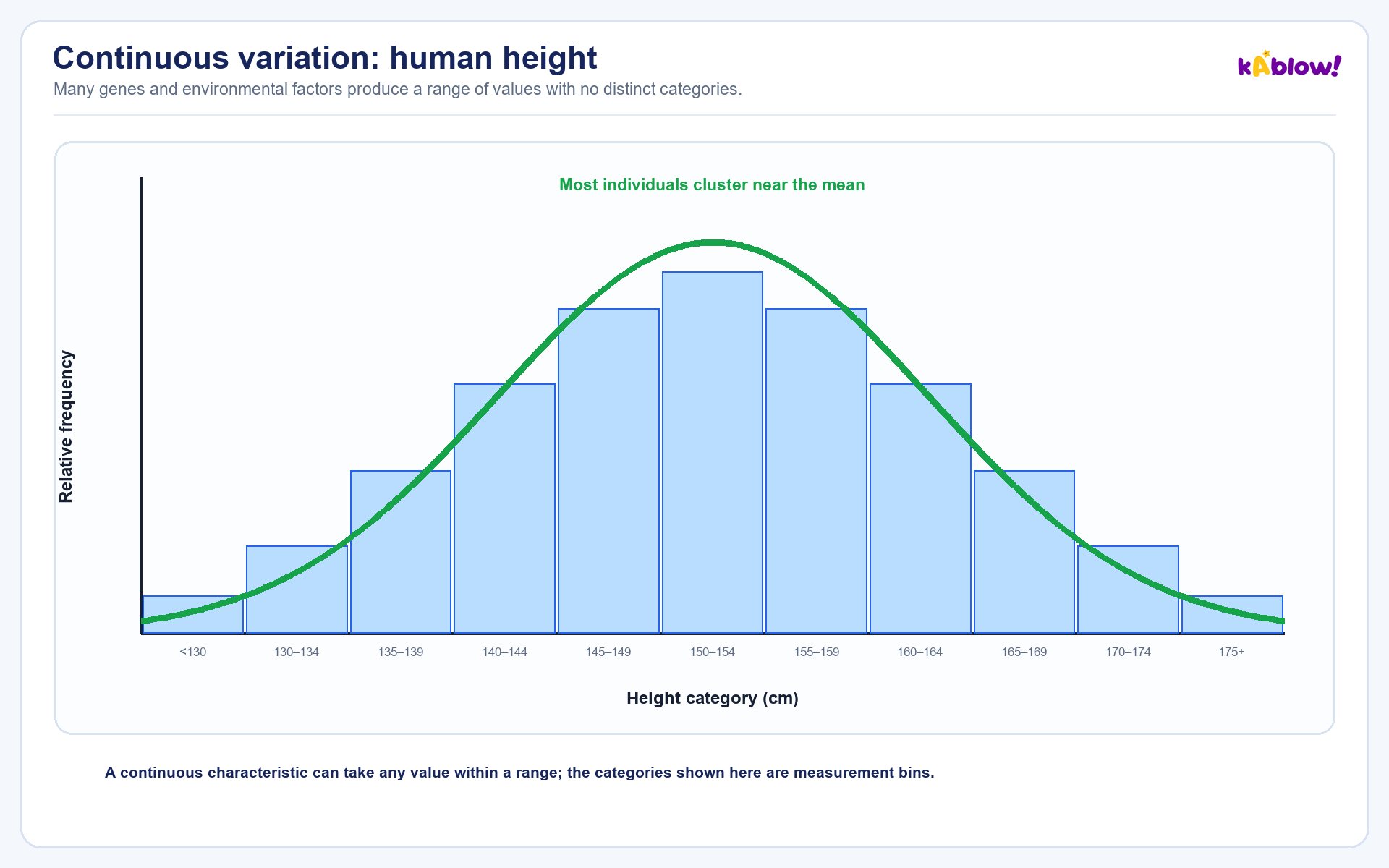
- Continuous variation shows a range of phenotypes with no distinct categories (e.g., height, body mass).
- Continuous variation produces a smooth bell-shaped curve when plotted as a frequency histogram.
- Discontinuous variation results in a limited number of distinct phenotypes (e.g., blood group, pea seed shape).
- Discontinuous variation produces a step-shaped bar graph.
- Mutation is a genetic change involving alterations to DNA, leading to new alleles and phenotypic variation.
Distribution of height showing continuous variation
Natural Selection
- Natural selection is the process where better adapted individuals survive and reproduce more successfully.
- Individuals in a species show variation due to genetic differences.
- Overproduction of offspring leads to competition for resources and a struggle for survival.
- Individuals with advantageous alleles are more likely to survive and reproduce.
- Advantageous alleles are passed on to offspring, increasing in frequency over generations.
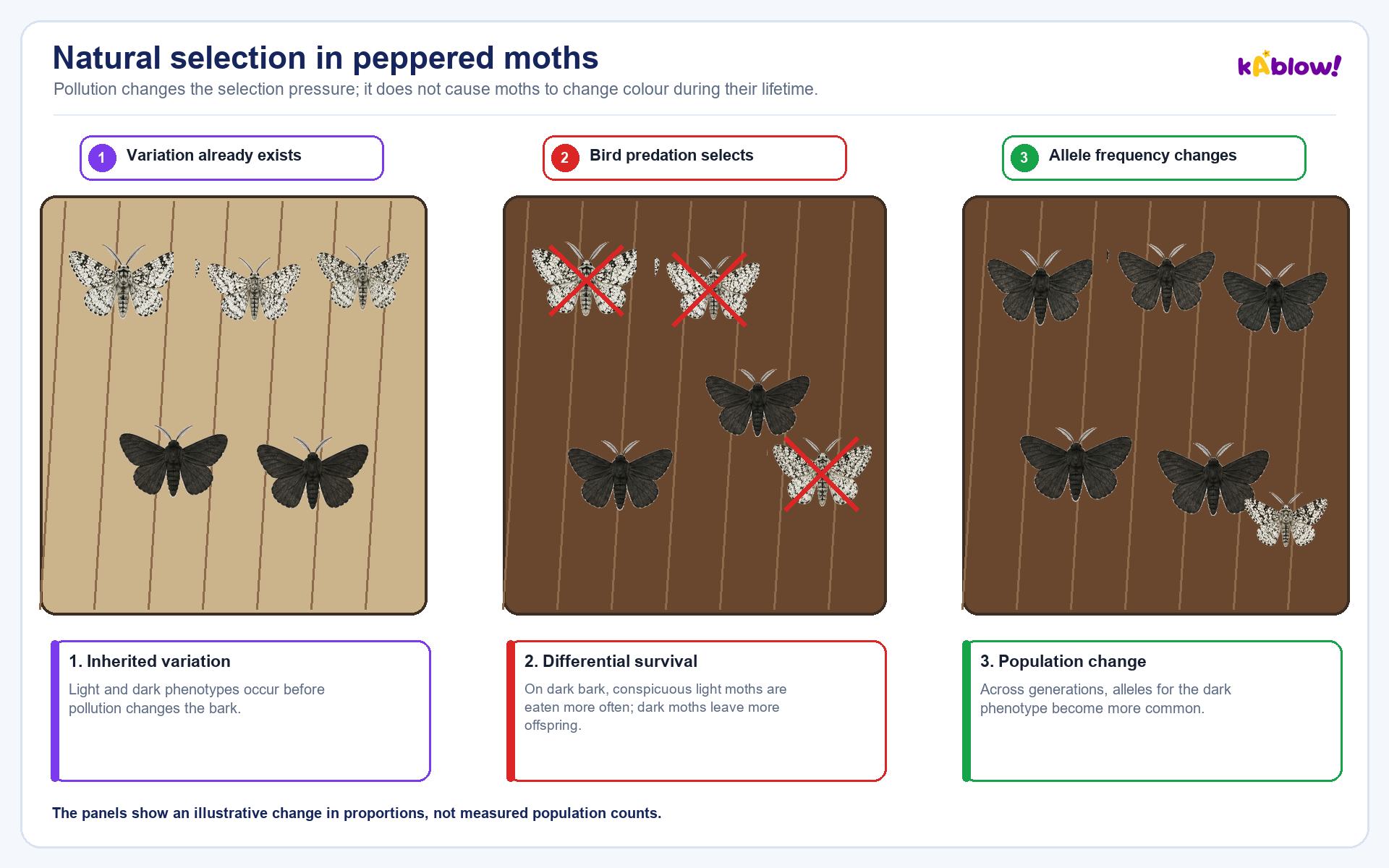
- Example: Peppered moths – environmental change made the dark allele advantageous, leading to increased frequency.
Natural selection in peppered moths
Natural Selection: Antibiotic Resistance (Extended)
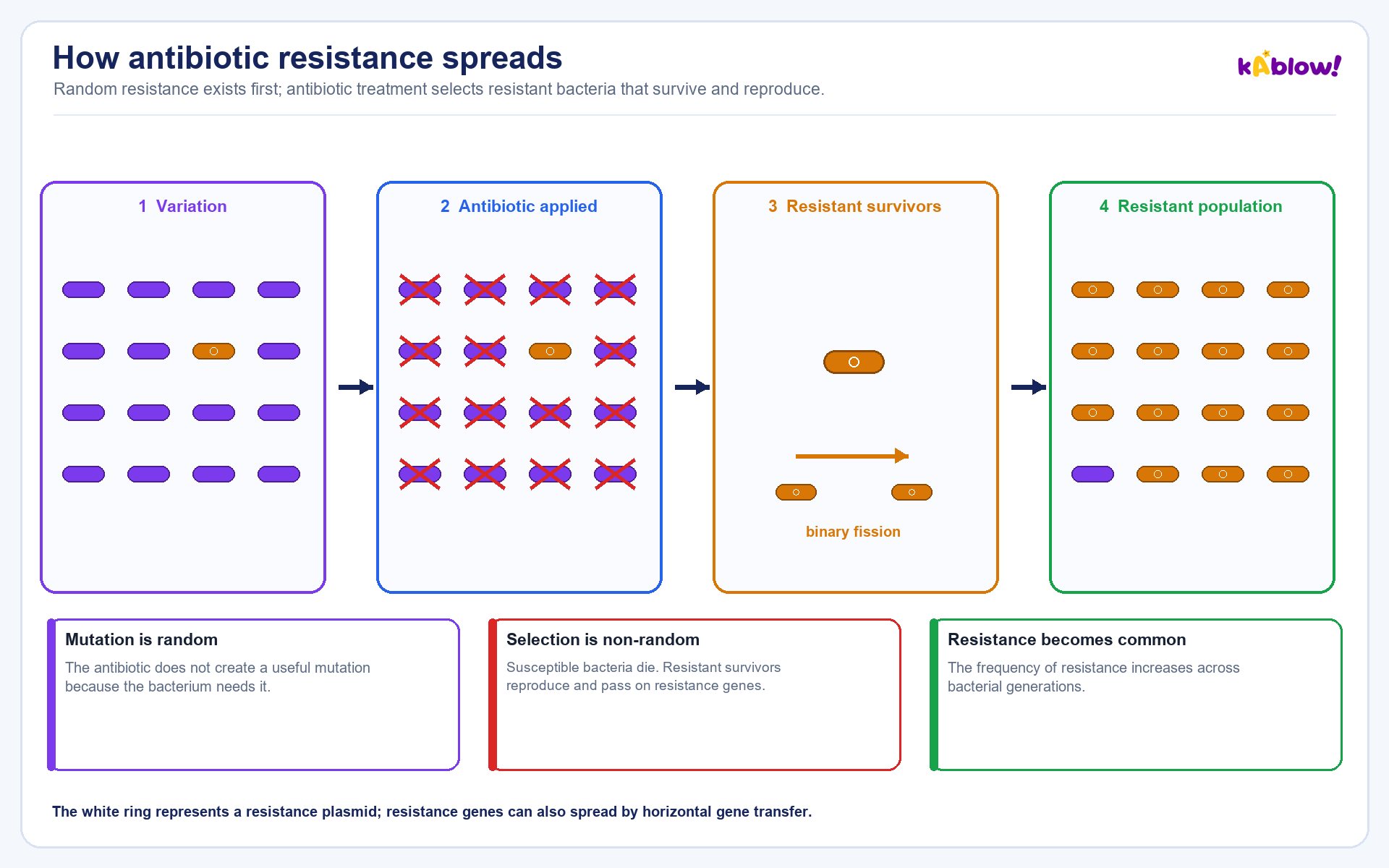
- Variation in bacteria includes some with resistance alleles to an antibiotic.
- Exposure to antibiotic kills non-resistant bacteria; resistant ones survive and reproduce.
- The resistance allele is passed on, becoming more common in the population.
- Over time, the entire population becomes an antibiotic-resistant strain.
- Key steps: variation → competition → survival of fittest → inheritance of advantageous alleles.
Natural selection in bacteria: antibiotic resistance
Artificial Selection (Selective Breeding)
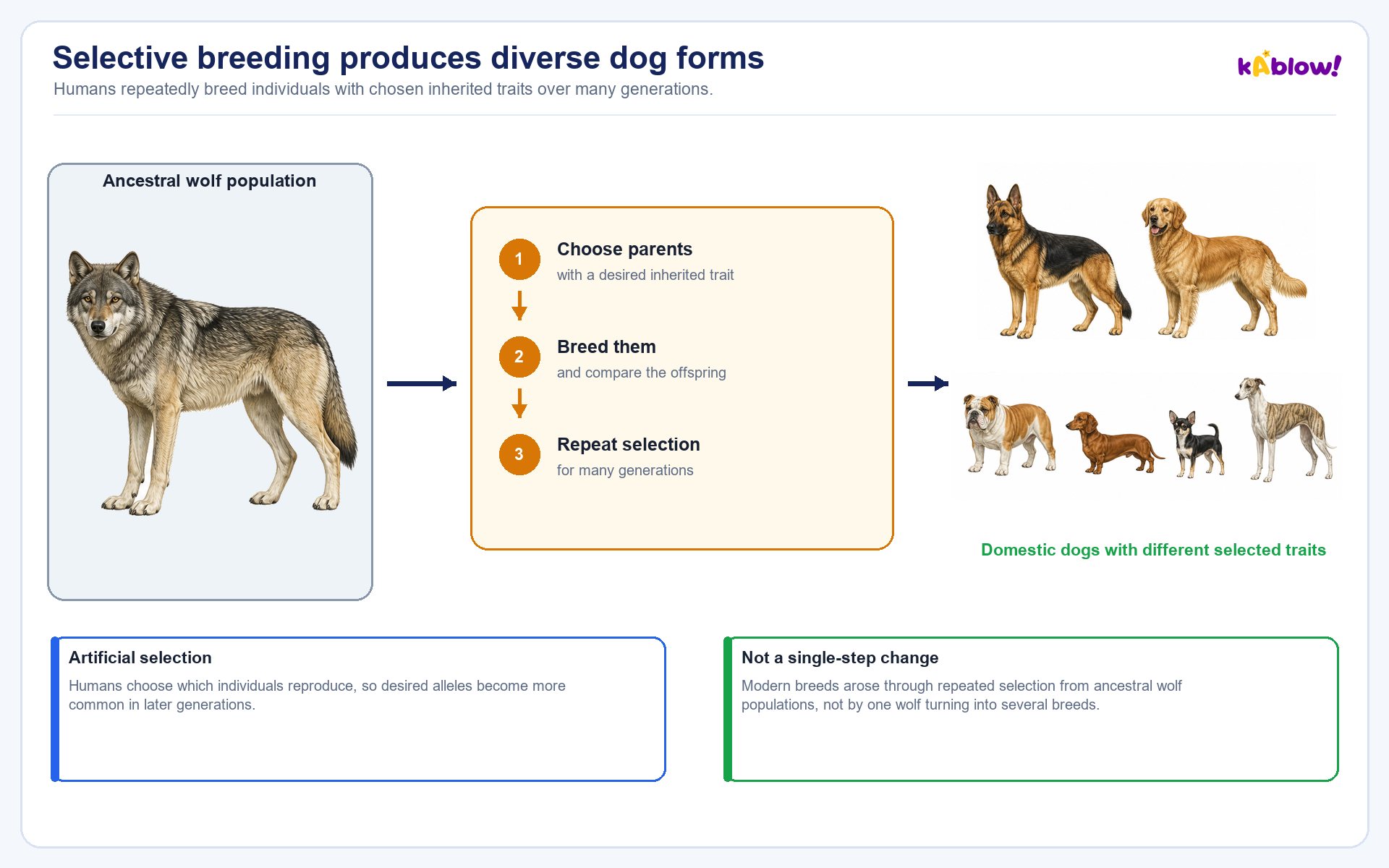
- Selective breeding is the process where humans choose individuals with desirable characteristics to breed.
- Selected individuals are crossed together, and offspring with the desired traits are chosen.
- This process is repeated over many generations to enhance the traits.
- Examples: dog breeds with calm temperaments, crop varieties with high yield or pest resistance.
- Selective breeding has produced a wide range of domestic varieties from wild ancestors.
Selective breeding of dog breeds from wolves
Slide
Sign up free to view the lesson slides
Step through every slide for this topic — plus flashcards and revision notes — with a free account.
Câu hỏi luyện tập
Xem trước miễn phí — 8 trên 57 câu hỏi. Đăng ký để xem tất cả.
1.Which of the following is an example of discontinuous variation?
Easy- AHeight in humans
- BBody mass in dogs
- CBlood group in humans
- DLeaf length in plants
2.Continuous variation produces a limited number of distinct phenotypes.
EasyTrue or false?
3.Define variation.
Easy4.Complete the sentence about natural selection:
EasyIndividuals that are better ____ to their environment have a higher chance of survival and more chances to reproduce.
5.Place the following steps of natural selection in the correct order:
Medium- Advantageous alleles become more common in the population
- Individuals in a species show variation
- Better adapted individuals survive and reproduce
- Struggle for survival due to competition
6.What is the source of new alleles in a population?
Easy7.Match each type of variation with its correct description:
Easy- Continuous variation
- Discontinuous variation
- Shows a range of phenotypes
- Results in a limited number of phenotypes
8.In a population of bacteria, 5% initially carry a resistance allele. After exposure to an antibiotic, 80% of the surviving bacteria carry the resistance allele. If the survival rate of non-resistant bacteria is 0.1%, what is the survival rate of resistant bacteria? (Assume the population was large and the antibiotic killed all non-resistant bacteria that did not survive.)
Hard- A10
- B7
- C8
- D9
Unlock all 57 questions & more
Tạo tài khoản miễn phí để xem mọi câu hỏi, slide, thẻ ghi nhớ và ghi chú ôn tập cho chủ đề này.