Experimental Techniques
Học bằng cách chơi
Trả lời những câu hỏi này để kiếm năng lượng, rồi câu cá và khám phá. Không cần tài khoản.
Ghi chú bài học
Apparatus for Measurements
- Time is measured with a stopwatch or stopclock, accurate to one or two decimal places; units are seconds or minutes.
- Temperature is measured with a thermometer (precision ±0.5 °C) or digital temperature probe (precision ±0.1 °C); units are degrees Celsius (°C).
- Mass is measured using a digital balance (usually to two decimal places); balance must be tared before use and allowed to settle.
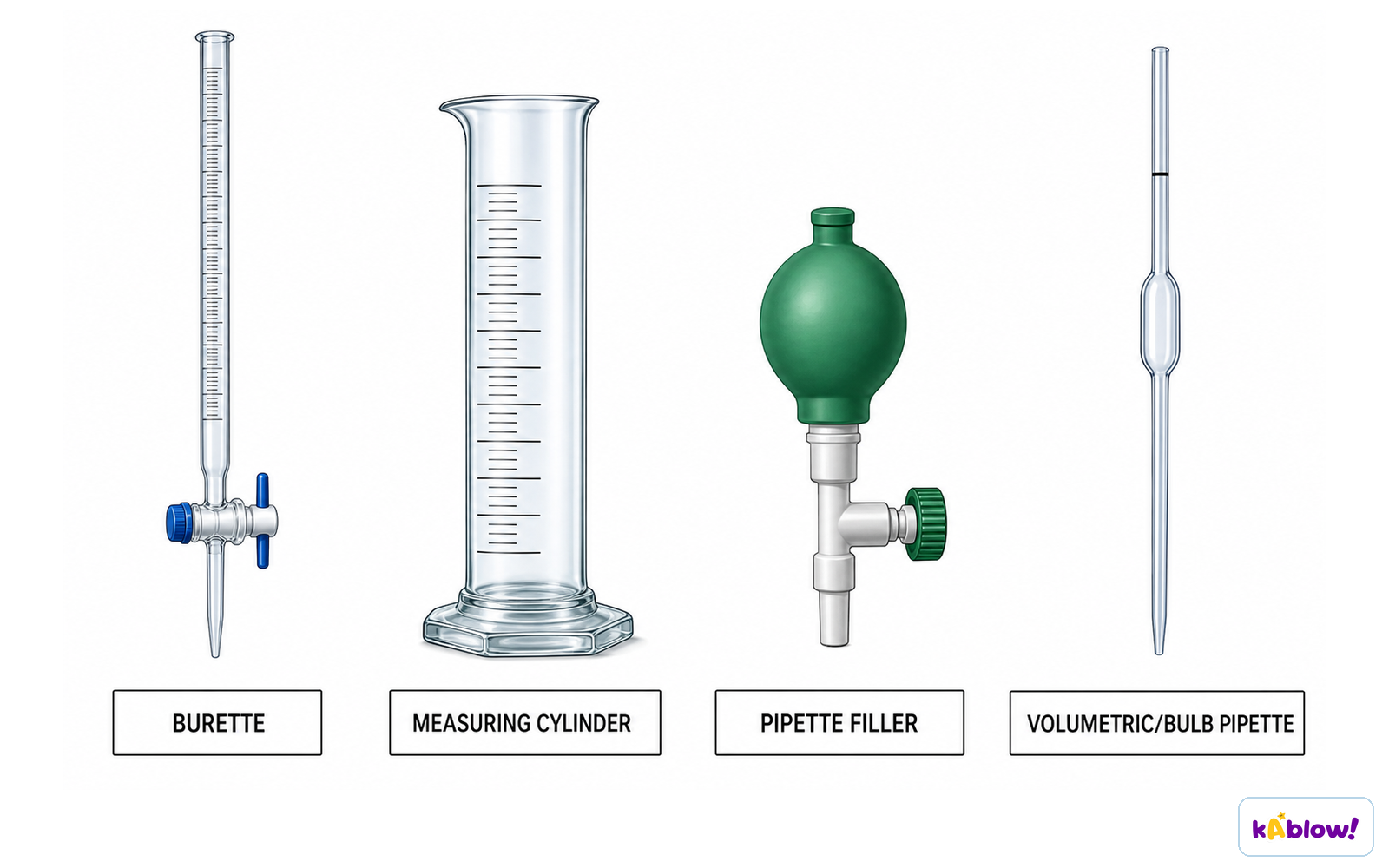
- Volume of liquid is measured with burettes (most accurate for variable volumes, 0–50 cm³), volumetric pipettes (most accurate for fixed volumes, e.g. 10 cm³ or 25 cm³), or measuring cylinders (for approximate volumes).
- Volume of gas is measured using a gas syringe (more precise) or by downward displacement of water (not suitable for soluble gases).
- When reading a burette, read from the bottom of the meniscus; the scale runs from 0.00 cm³ at the top to 50.00 cm³ at the bottom.
Apparatus for measuring volume
Solutions
- Solvent: the liquid in which a solute dissolves (e.g. water in seawater).
- Solute: the substance that dissolves in a solvent (e.g. salt in seawater).
- Solution: the mixture formed when a solute dissolves in a solvent (e.g. seawater).
- Saturated solution: contains the maximum concentration of solute dissolved at a given temperature.
- Soluble substances dissolve; insoluble substances do not dissolve.
- Filtrate: the liquid that passes through a filter; residue: the solid left behind after filtration or evaporation.
Acid-Base Titrations
- Titration determines the concentration of an acid or alkali by neutralisation; can also be used to prepare salts.
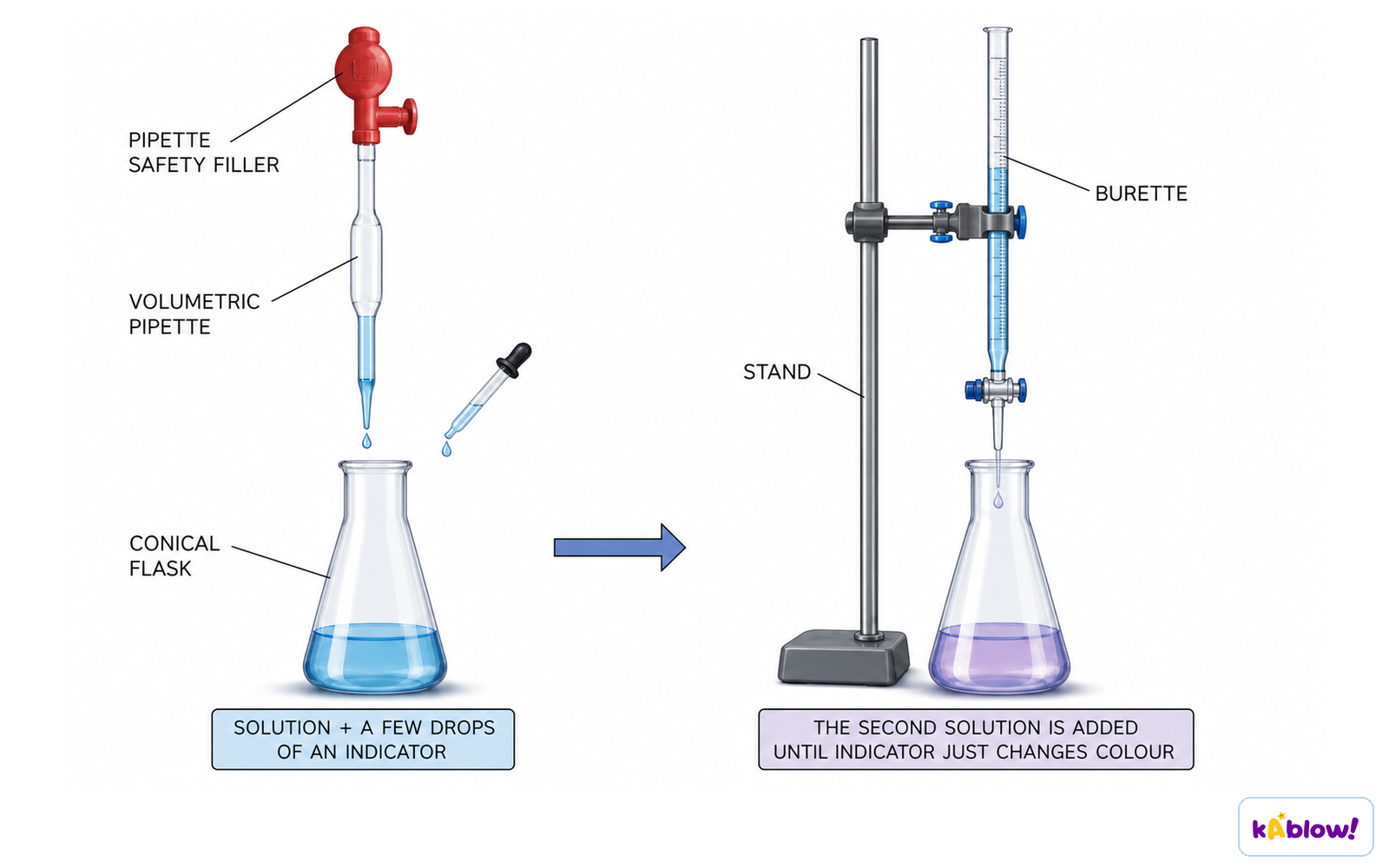
- Apparatus: 25 cm³ volumetric pipette, pipette filler, 50 cm³ burette, 250 cm³ conical flask, funnel, indicator, clamp stand, white tile.
- Method: pipette a fixed volume of alkali into a conical flask, add indicator, then add acid from the burette while swirling until the endpoint (sharp colour change).
- Record burette readings to the nearest 0.05 cm³; repeat until two concordant results (within 0.1 cm³) are obtained.
- Common indicators: methyl orange (red in acid, yellow in alkali, orange at endpoint) and phenolphthalein (colourless in acid, pink in alkali).
- Common errors: not removing the funnel from the burette, not filling the jet space, and reading the burette from the top of the meniscus.
Titration apparatus set-up
Slide
Sign up free to view the lesson slides
Step through every slide for this topic — plus flashcards and revision notes — with a free account.
Câu hỏi luyện tập
Xem trước miễn phí — 8 trên 48 câu hỏi. Đăng ký để xem tất cả.
1.Which piece of apparatus is most accurate for measuring a variable volume of liquid between 0 and 50 cm³?
Easy- AMeasuring cylinder
- BBurette
- CVolumetric pipette
- DGas syringe
2.A volumetric pipette is used to measure a fixed volume of liquid accurately.
EasyTrue or false?
3.A stopwatch displays 1:30 (minutes:seconds). What is the time in seconds?
Easy- A99
- B81
- C90
- D108
4.Complete the sentence about titration.
EasyThe endpoint is reached when one drop causes a sharp ____ change.
5.Match each indicator to its colour in acid.
Medium- Methyl orange
- Phenolphthalein
- Litmus
- Red
- Colourless
6.Arrange the following steps in a titration in the correct order.
Medium- Add indicator to conical flask
- Fill burette with acid
- Record initial burette reading
- Perform rough titration
7.Which of the following is the most accurate way to measure a fixed volume of liquid?
Easy- AMeasuring cylinder
- BBurette
- CVolumetric pipette
- DBeaker
8.What term describes a solution that contains the maximum concentration of solute at a given temperature?
Easy
Unlock all 48 questions, flashcards & more
Tạo tài khoản miễn phí để xem mọi câu hỏi, slide, thẻ ghi nhớ và ghi chú ôn tập cho chủ đề này.