Extraction Of Metals
Học bằng cách chơi
Trả lời những câu hỏi này để kiếm năng lượng, rồi câu cá và khám phá. Không cần tài khoản.
Ghi chú bài học
Metals and Ores
- The Earth’s crust contains metals and metal compounds.
- A metal ore is a rock containing enough metal to make extraction worthwhile.
- Many metal ores are oxides (e.g., hematite – iron ore, bauxite – aluminium ore).
- Extraction involves removing oxygen from the compound, so it is a reduction process.
- Very unreactive metals like gold and platinum occur native (uncombined).
Reactivity Series and Extraction Method
- The higher a metal in the reactivity series, the harder it is to extract.
- Metals above carbon must be extracted by electrolysis (e.g., aluminium).
- Metals below carbon can be extracted by heating with carbon or carbon monoxide (e.g., iron in blast furnace).
- Very unreactive metals (e.g., gold, silver) are often found native or require little processing.
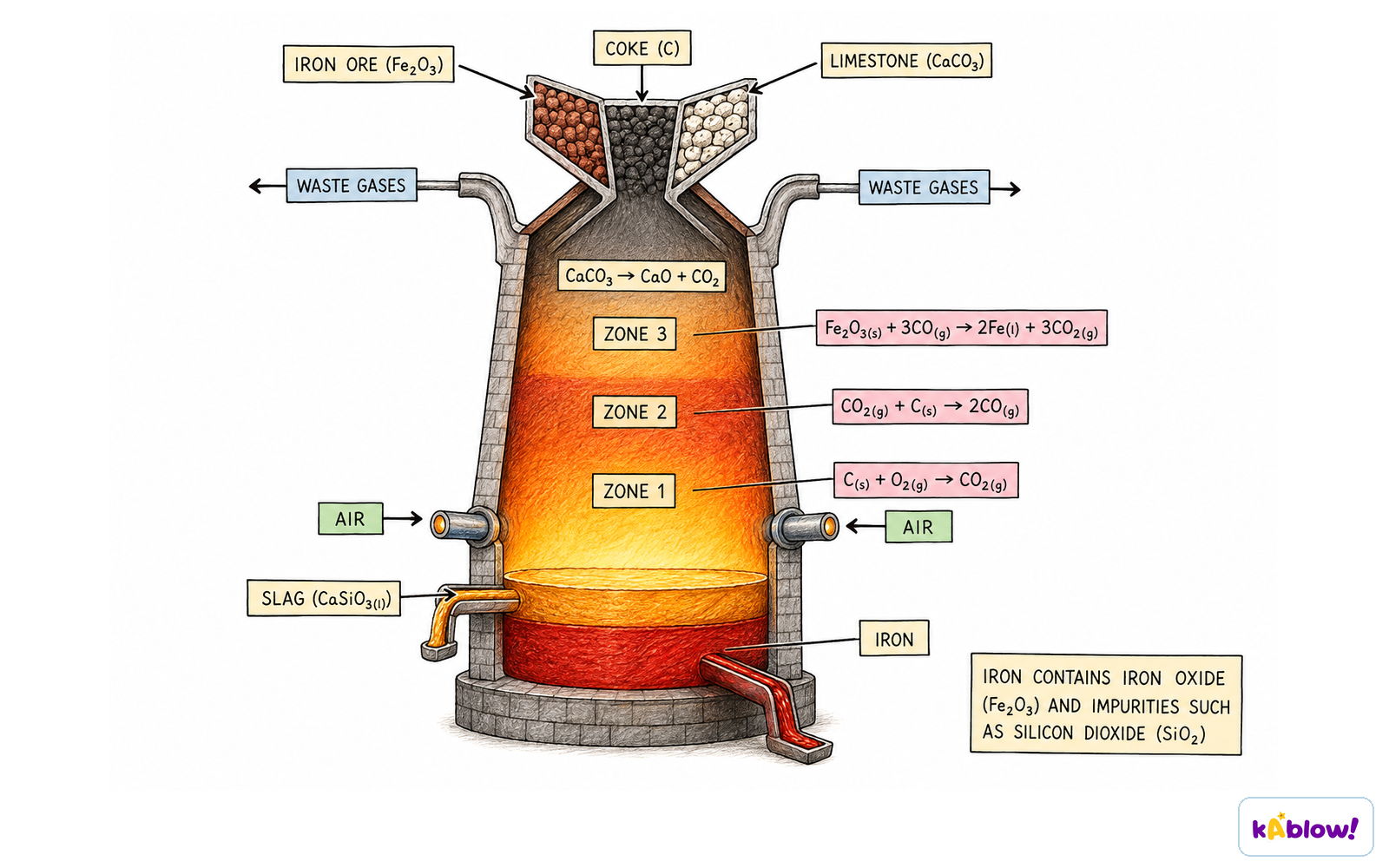
Extraction of Iron from Hematite – The Blast Furnace
- Iron is extracted in a blast furnace from its ore hematite (Fe₂O₃).
- Raw materials: iron ore, coke (impure carbon), and limestone are added at the top.
- Hot air is blown into the bottom.
- Zone 1: Coke burns in hot air to form CO₂, providing heat: C + O₂ → CO₂.
- Zone 2: Coke reacts with CO₂ to form CO (main reducing agent): C + CO₂ → 2CO.
- Zone 3: CO reduces iron(III) oxide to molten iron: Fe₂O₃ + 3CO → 2Fe + 3CO₂.
- Limestone decomposes to CaO, which reacts with SiO₂ impurity to form slag (calcium silicate).
- Molten iron and slag are tapped off separately.
The blast furnace
Extraction of Aluminium from Bauxite – Electrolysis
- Aluminium is above carbon in the reactivity series, so it cannot be reduced by carbon.
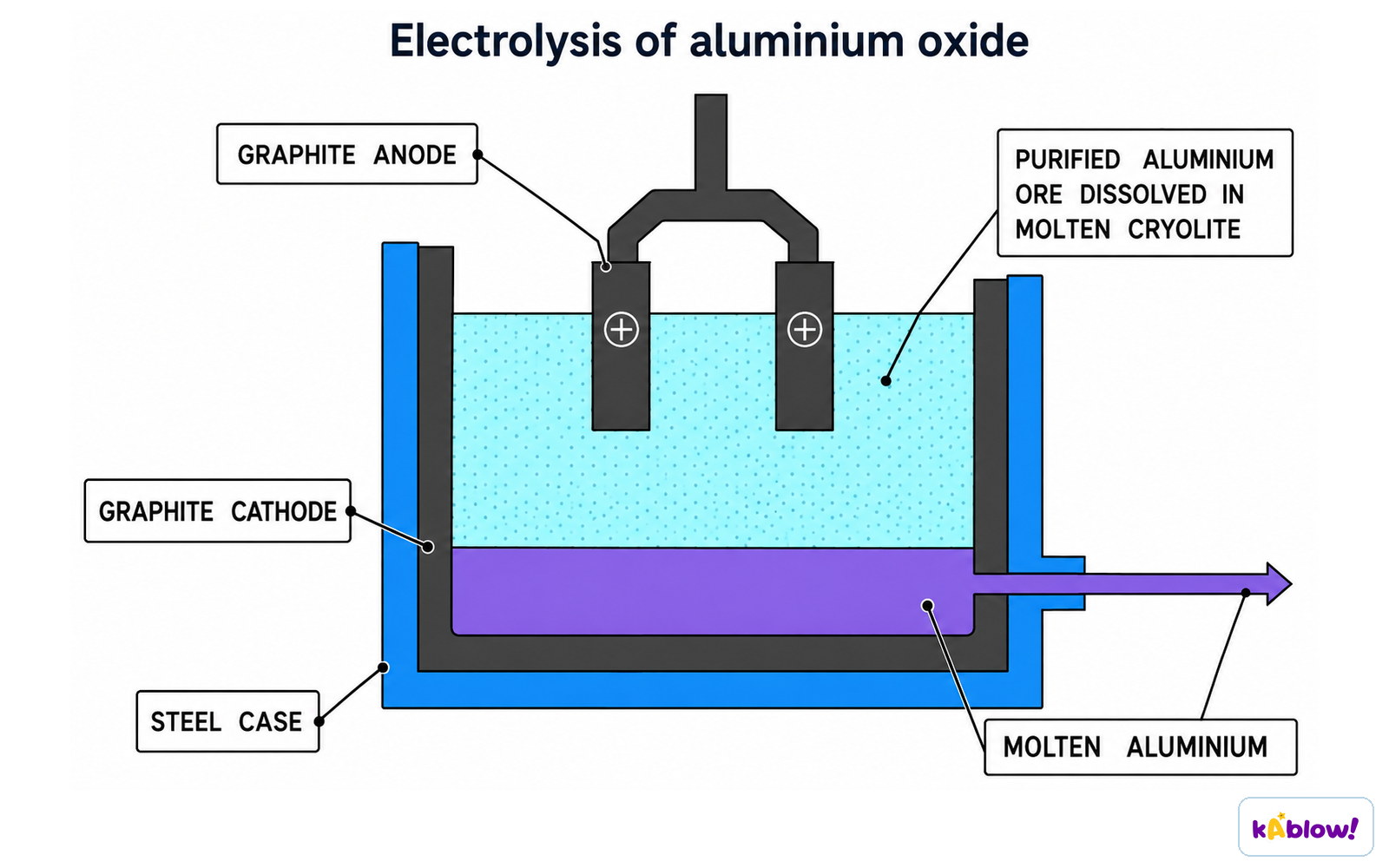
- Its ore is bauxite (aluminium oxide, Al₂O₃).
- Aluminium oxide is dissolved in molten cryolite to lower the melting point.
- The mixture is electrolysed using carbon electrodes.
- Aluminium ions are reduced at the cathode to form molten aluminium metal.
- Oxide ions are oxidised at the anode to form oxygen gas.
- The carbon anodes are burned away by the oxygen and must be replaced regularly.
Electrolysis of aluminium oxide
Key Equations (Extended Tier)
- Burning of coke: C(s) + O₂(g) → CO₂(g)
- Formation of CO: CO₂(g) + C(s) → 2CO(g)
- Reduction of iron ore: Fe₂O₃(s) + 3CO(g) → 2Fe(l) + 3CO₂(g)
- Thermal decomposition of limestone: CaCO₃(s) → CaO(s) + CO₂(g)
- Slag formation: CaO(s) + SiO₂(s) → CaSiO₃(l)
Slide
Sign up free to view the lesson slides
Step through every slide for this topic — plus flashcards and revision notes — with a free account.
Câu hỏi luyện tập
Xem trước miễn phí — 8 trên 59 câu hỏi. Đăng ký để xem tất cả.
1.What is a metal ore?
Easy- AA rock that contains enough of a metal to make extraction worthwhile
- BA pure metal found in the Earth's crust
- CA compound of a metal with oxygen only
- DA mineral that contains carbon
2.Extraction of a metal from its ore is a reduction process because oxygen is removed from the compound.
EasyTrue or false?
3.Which metal is found native (uncombined) in the Earth's crust?
Easy- AIron
- BAluminium
- CGold
- DZinc
4.Complete the sentence about the extraction of iron.
EasyIn the blast furnace, the main reducing agent is ____.
5.State two raw materials added to the top of the blast furnace for iron extraction.
Medium6.How many tonnes of iron does a modern blast furnace produce per day?
Easy- A9000
- B10000
- C12000
- D11000
7.Why is aluminium extracted by electrolysis rather than by heating with carbon?
Medium- AAluminium is more reactive than carbon
- BAluminium is less reactive than carbon
- CAluminium ore is not an oxide
- DAluminium has a low melting point
8.What is the purpose of adding limestone to the blast furnace?
Easy
Unlock all 59 questions, flashcards & more
Tạo tài khoản miễn phí để xem mọi câu hỏi, slide, thẻ ghi nhớ và ghi chú ôn tập cho chủ đề này.