Preparation Of Salts
Học bằng cách chơi
Trả lời những câu hỏi này để kiếm năng lượng, rồi câu cá và khám phá. Không cần tài khoản.
Ghi chú bài học
Naming Salts
- A salt is formed when the hydrogen atom in an acid is replaced by a metal or ammonium ion.
- The name of a salt has two parts: first from the metal/metal oxide/carbonate, second from the acid.
- Hydrochloric acid produces chlorides; sulfuric acid produces sulfates; nitric acid produces nitrates.
- Example: sodium hydroxide + hydrochloric acid → sodium chloride.
Method A1: Excess Metal
- Used for metals that react with dilute acids (e.g., Mg + H₂SO₄).
- Add dilute acid to a beaker, then add metal in small pieces until no more reacts (metal in excess).
- Filter to remove excess metal; heat the filtrate gently until concentrated.
- Leave to crystallise, decant excess liquid, dry crystals with filter paper.
- Example: Mg(s) + H₂SO₄(aq) → MgSO₄(aq) + H₂(g).
Preparing a soluble salt by the excess solid method
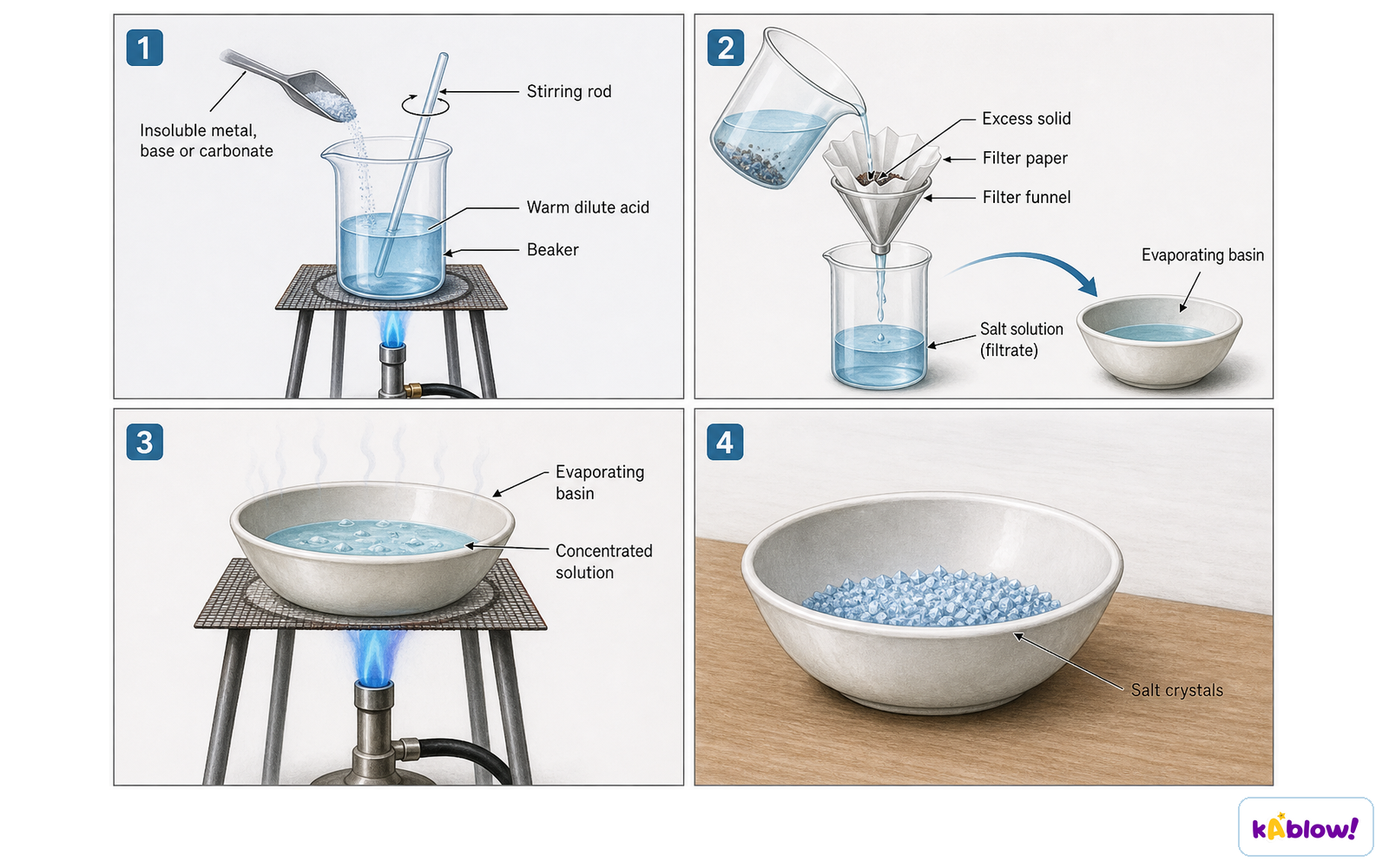
Method A2: Excess Insoluble Base
- Used for insoluble bases such as metal oxides (e.g., CuO).
- Warm dilute acid gently, add insoluble base slowly while stirring until no more reacts (base in excess).
- Filter to remove excess base; heat filtrate until concentrated.
- Crystallise, decant, and dry crystals.
- Example: CuO(s) + H₂SO₄(aq) → CuSO₄(aq) + H₂O(l).
Preparing a soluble salt by the excess solid method
Method A3: Excess Insoluble Carbonate
- Used for insoluble metal carbonates (e.g., CaCO₃).
- Warm dilute acid, add carbonate slowly until no more reacts (carbonate in excess).
- Filter, heat filtrate, crystallise, and dry.
- Example: CaCO₃(s) + 2HCl(aq) → CaCl₂(aq) + CO₂(g) + H₂O(l).
Preparing a soluble salt by the excess solid method
Method B: Titration (Soluble Alkali)
- Used for soluble bases like NaOH.
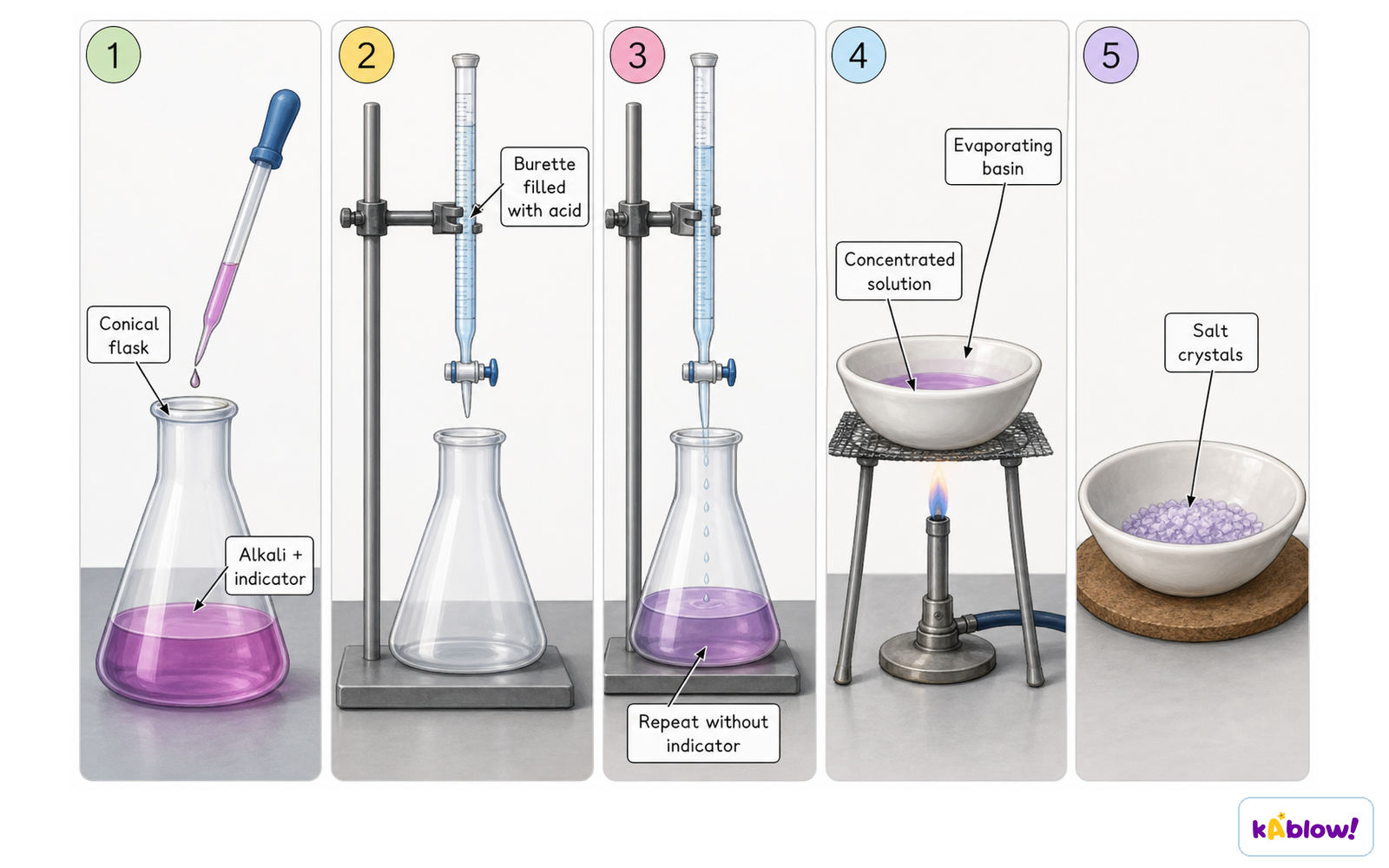
- Pipette alkali into conical flask, add indicator (e.g., phenolphthalein).
- Add acid from burette until colour change (end point); record volume.
- Repeat without indicator using same volume of acid.
- Heat neutral solution to concentrate, crystallise, and dry.
- Example: NaOH(aq) + HCl(aq) → NaCl(aq) + H₂O(l).
Preparing a soluble salt by titration
Preparing Insoluble Salts (Precipitation)
- Extended tier only: use precipitation reaction between two soluble reactants.
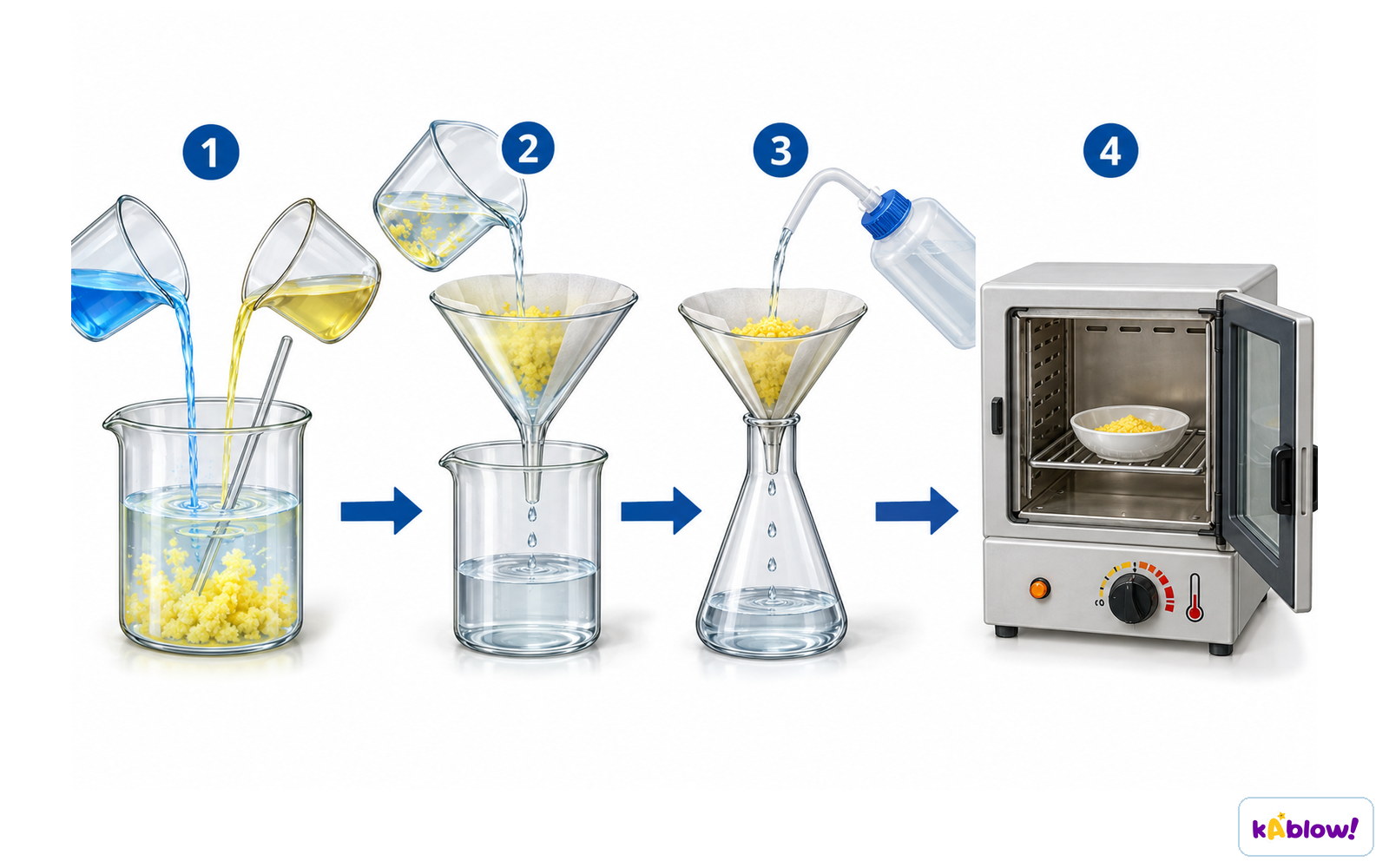
- Mix aqueous solutions of two soluble salts; insoluble salt forms as precipitate.
- Filter to collect precipitate, wash with distilled water, dry in warm oven.
- Example: Pb(NO₃)₂(aq) + K₂SO₄(aq) → PbSO₄(s) + 2KNO₃(aq).
Preparing an insoluble salt by precipitation
Hydrated & Anhydrous Salts
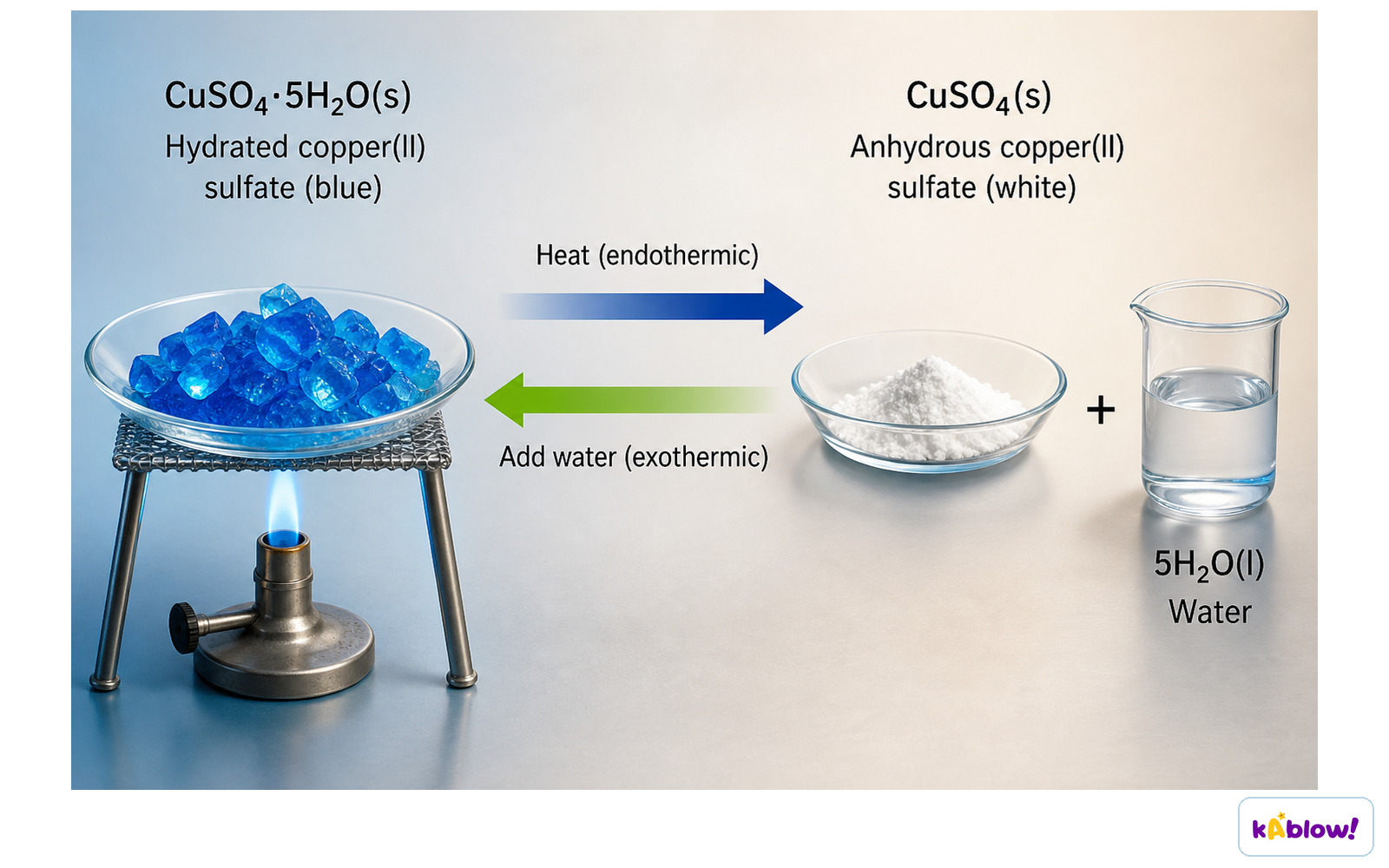
- Hydrated salts contain water within their crystal structure (e.g., blue CuSO₄·5H₂O).
- Anhydrous salts contain no water (e.g., white CuSO₄).
- Heating hydrated copper(II) sulfate removes water, turning it white (dehydration).
- Adding water to anhydrous copper(II) sulfate reverses the reaction, turning it blue.
- Equation: hydrated CuSO₄ ⇌ anhydrous CuSO₄ + water.
Dehydration of hydrated copper(II) sulfate
Slide
Sign up free to view the lesson slides
Step through every slide for this topic — plus flashcards and revision notes — with a free account.
Câu hỏi luyện tập
Xem trước miễn phí — 8 trên 56 câu hỏi. Đăng ký để xem tất cả.
1.Which method is used to prepare a soluble salt when the base is soluble (an alkali)?
Easy- AExcess metal method
- BExcess insoluble base method
- CExcess insoluble carbonate method
- DTitration method
2.What is the name of the salt formed when zinc oxide reacts with sulfuric acid?
Easy3.Complete the sentence about naming salts.
EasyThe name of a salt has two parts: the first part comes from the ____ or metal oxide or metal carbonate, and the second part comes from the ____.
4.A salt is a compound formed when the hydrogen atom in an acid is replaced by a metal or ammonium ion.
EasyTrue or false?
5.In the preparation of magnesium sulfate crystals, if 0.24 g of magnesium reacts completely with excess sulfuric acid, calculate the maximum mass of magnesium sulfate (MgSO4) that can be obtained. (Ar: Mg=24, S=32, O=16)
Hard- A2.2
- B1.2
- C3.2
- D0.2
6.Arrange the following steps in the correct order for preparing a soluble salt using the excess insoluble base method.
Medium- Filter the mixture to remove excess base
- Heat the filtrate to concentrate the solution
- Add the insoluble base to warm dilute acid while stirring
- Leave the concentrated solution to crystallize
7.Match each acid to the salt it produces.
Easy- Hydrochloric acid
- Sulfuric acid
- Nitric acid
- Sulfate
- Chloride
- Nitrate
8.Which of the following is the correct equation for the preparation of calcium chloride using excess calcium carbonate?
Medium- ACaCO3 + 2HCl → CaCl2 + CO2 + H2O
- BCaCO3 + HCl → CaCl2 + CO2 + H2O
- CCaCO3 + 2HCl → CaCl2 + H2 + CO2
- DCaCO3 + HCl → CaCl2 + H2O + CO
Unlock all 56 questions, flashcards & more
Tạo tài khoản miễn phí để xem mọi câu hỏi, slide, thẻ ghi nhớ và ghi chú ôn tập cho chủ đề này.