Properties Uses And Alloys Of Metals
Học bằng cách chơi
Trả lời những câu hỏi này để kiếm năng lượng, rồi câu cá và khám phá. Không cần tài khoản.
Dành cho giáo viên: slide bài học, ghi chú ôn tập sẵn dùng cho Properties Uses And Alloys Of Metals (Co-ordinated Sciences (Double Award) [CIE], Chemistry) — dùng trong bài giảng của bạn, hoặc chạy chủ đề như một hoạt động lớp học tương tác để học sinh chơi như một trò chơi trực tiếp.
Ghi chú bài học
Physical Properties of Metals
- Metals conduct heat and electricity due to delocalised electrons that move through the structure.
- They are malleable (can be hammered into shapes) and ductile (can be drawn into wires) because layers of positive ions can slide over each other.
- Metals generally have high melting and boiling points because of strong electrostatic attraction (metallic bonds) between positive ions and delocalised electrons.
Metallic bonding in aluminium
Chemical Properties of Metals
- Metals react with water (cold or steam) to produce a metal hydroxide or oxide plus hydrogen gas.
- Example with cold water: Ca + 2H₂O → Ca(OH)₂ + H₂.
- Example with steam: Zn + H₂O → ZnO + H₂.
- Metals react with acids to produce a salt and hydrogen: metal + acid → salt + hydrogen.
- Example: Fe + 2HCl → FeCl₂ + H₂.
Uses of Aluminium
- Aluminium has low density and is resistant to corrosion due to a protective oxide layer.
- Used in aeroplane bodies because of high strength-to-weight ratio.
- Used in overhead power cables because it is a good electrical conductor and has low density.
- Used in food cans because it is non-toxic and resistant to corrosion and acidic foods.
Uses of Copper
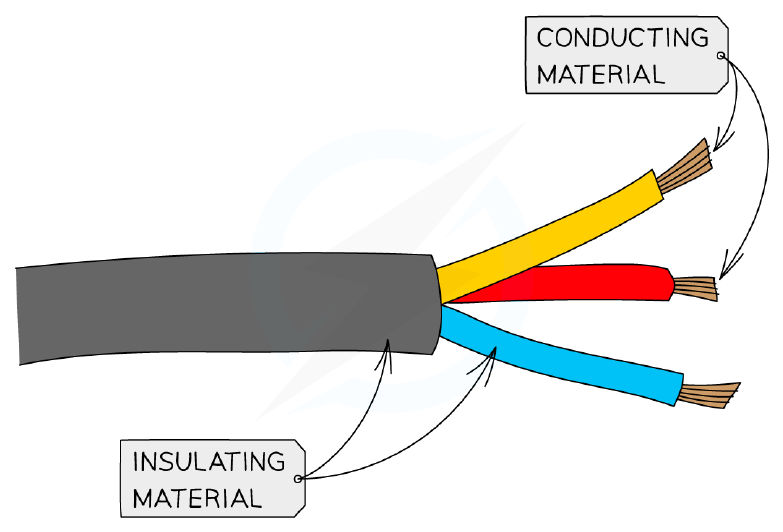
- Copper is a very good electrical conductor and is ductile.
- Used in electrical wiring due to high conductivity and ductility.
- Used in pots and pans because it is a good heat conductor, unreactive, and malleable.
- Used in water pipes because it is non-toxic, unreactive with water, and malleable.
Structure of an electrical cable
Alloys – Composition and Properties
- An alloy is a mixture of a metal with other elements (often other metals, sometimes non-metals).
- Brass (copper + zinc) is much stronger than either metal; used in musical instruments, ornaments, door knobs.
- Stainless steel (iron + chromium, nickel, carbon) is hard and resistant to corrosion/rusting; used in cutlery.
- Other alloys: iron with tungsten (extremely hard, heat resistant); aluminium with copper, manganese, silicon (strong, low density for aircraft).
- Alloys are not compounds – they are mixtures, not chemically combined.
Structure of Alloys (Extended Tier)
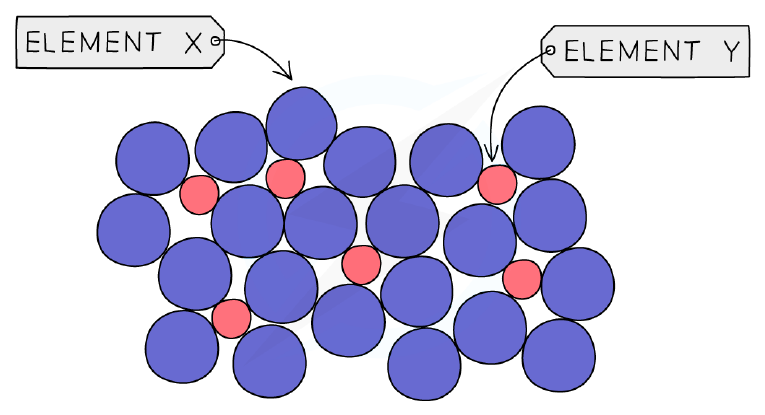
- Pure metals have a regular arrangement of positive ions in layers.
- Alloys contain atoms of different sizes, which distort the regular lattice.
- The distortion makes it harder for layers to slide over each other, so alloys are usually harder/stronger than pure metals.
Structure of an alloy
Slide
Sign up free to view the lesson slides
Step through every slide for this topic — plus flashcards and revision notes — with a free account.
Câu hỏi luyện tập
Xem trước miễn phí — 8 trên 56 câu hỏi. Đăng ký để xem tất cả.
1.State two physical properties of metals.
Easy2.State two uses of aluminium.
Easy3.State two uses of copper.
Easy4.What is an alloy?
Easy5.State two examples of alloys and their uses.
Easy6.Explain why alloys are usually harder than pure metals.
Medium7.Which property makes aluminium suitable for making aeroplane bodies?
Easy- Ahigh density
- Blow density
- Chigh reactivity
- Dpoor conductor of electricity
8.Which of the following is an alloy?
Easy- Apure copper
- Bpure iron
- Cbrass
- Daluminium
Unlock all 56 questions, flashcards & more
Tạo tài khoản miễn phí để xem mọi câu hỏi, slide, thẻ ghi nhớ và ghi chú ôn tập cho chủ đề này.
Đề thi cũ
Luyện đề thi cũ cho chủ đề này sắp ra mắt.
Sắp ra mắt