Water And Water Pollution
Học bằng cách chơi
Trả lời những câu hỏi này để kiếm năng lượng, rồi câu cá và khám phá. Không cần tài khoản.
Ghi chú bài học
Chemical Tests for Water
- Anhydrous cobalt(II) chloride (blue) turns pink in the presence of water, forming hydrated cobalt(II) chloride.
- Anhydrous copper(II) sulfate (white) turns blue in the presence of water, forming hydrated copper(II) sulfate.
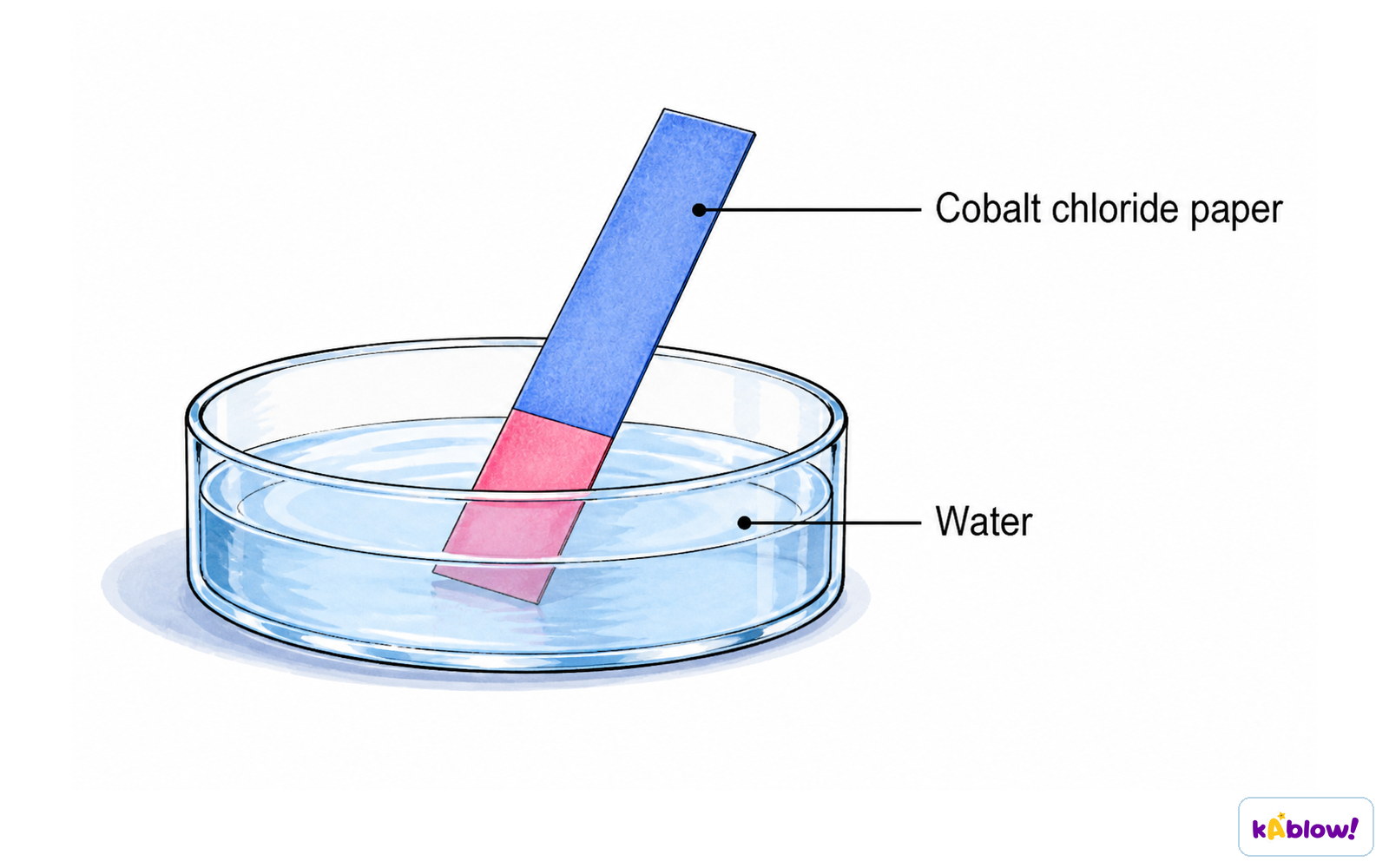
- Cobalt chloride paper is commonly used to test for water: blue → pink.
- These tests are reversible: heating the hydrated salt drives off water, restoring the anhydrous colour.
Cobalt chloride paper changes from blue to pink in the presence of water
Purity of Water
- Pure water has a sharp boiling point of 100 °C and melting point of 0 °C.
- Impurities raise the boiling point and lower the melting point of water.
- Boiling/melting point data can be used to assess water purity.
- Distilled water is produced by boiling water and condensing the steam, removing most dissolved impurities.
- Distilled water is used in experiments to avoid interference from dissolved ions.
Water Treatment: Sedimentation and Filtration
- Untreated water contains insoluble impurities (soil, plant matter) and soluble impurities (dissolved calcium, metal compounds).
- First, water is left to stand in sedimentation tanks so that heavy particles settle by gravity.
- The water is then filtered through sand and gravel to remove smaller suspended particles.
Water Treatment: Carbon Filtration and Chlorination
- Filtration through carbon (charcoal) removes unpleasant tastes and odours.
- Chlorination kills bacteria and other microorganisms that are too small to be filtered.
- Chlorine is carefully added to the water supply to prevent diseases such as cholera and typhoid.
Summary of Water Treatment Stages
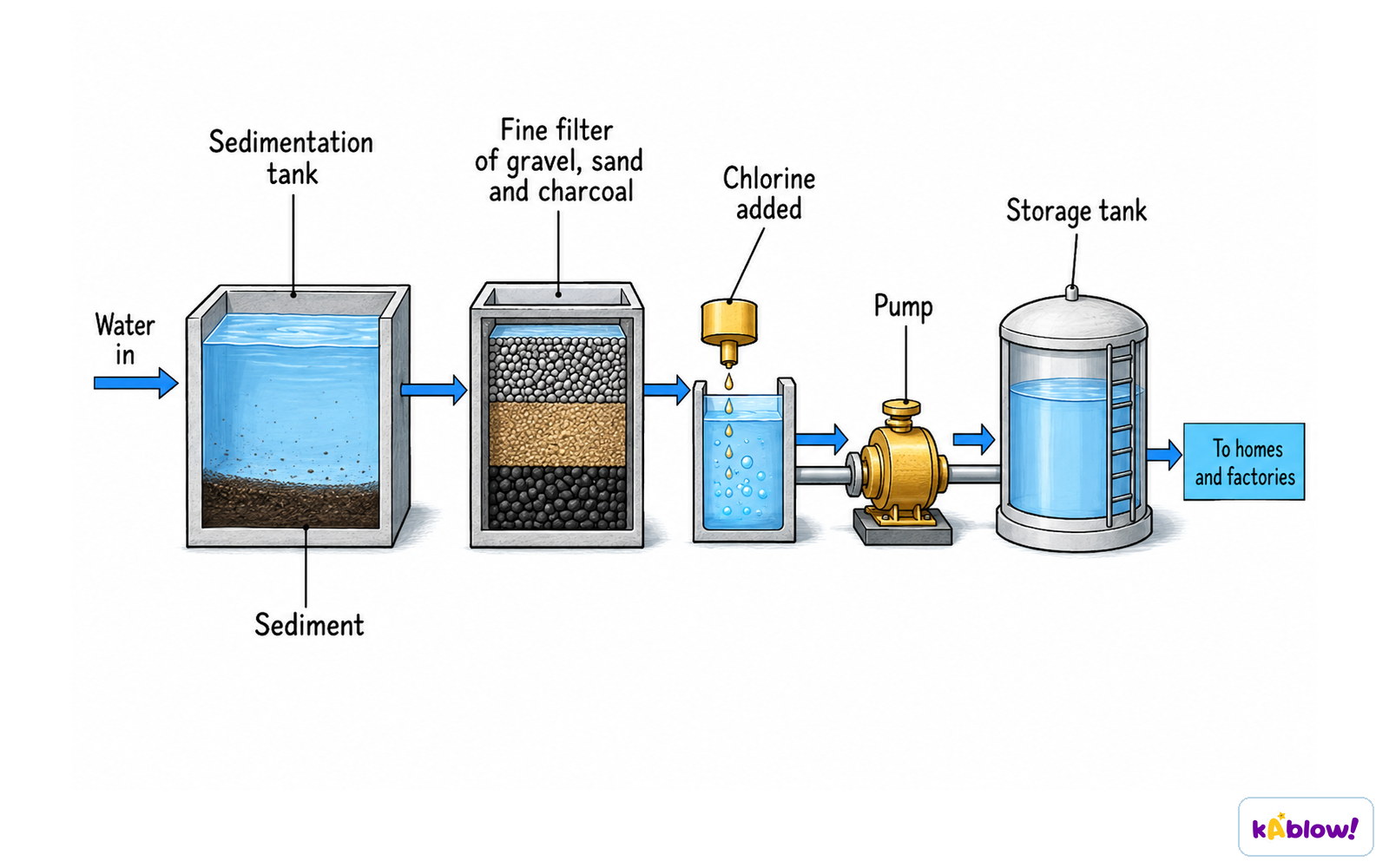
- Stage 1: Sedimentation and filtration – solids settle out, then the water is filtered through sand and gravel.
- Stage 2: Carbon filtration – removes unpleasant tastes and odours.
- Stage 3: Chlorination – kills bacteria and other microbes.
The stages of treating water are sedimentation, filtration with carbon and chlorination
Slide
Sign up free to view the lesson slides
Step through every slide for this topic — plus flashcards and revision notes — with a free account.
Câu hỏi luyện tập
Xem trước miễn phí — 8 trên 58 câu hỏi. Đăng ký để xem tất cả.
1.Which of the following is the colour change observed when anhydrous cobalt(II) chloride is added to water?
Easy- Ablue to pink
- Bpink to blue
- Cwhite to blue
- Dblue to white
2.What colour does anhydrous copper(II) sulfate turn in the presence of water?
Easy- Awhite to blue
- Bblue to white
- Cwhite to pink
- Dpink to white
3.Pure water boils at exactly 100 °C and melts at exactly 0 °C.
EasyTrue or false?
4.State one reason why distilled water is used in practical chemistry rather than tap water.
Easy5.Complete the sentence about the test for water using anhydrous copper(II) sulfate.
EasyAnhydrous copper(II) sulfate is ____ and turns ____ in the presence of water.
6.Match each stage of water treatment with its purpose.
Medium- Sedimentation
- Filtration through carbon
- Chlorination
- Removes unpleasant tastes and odours
- Kills bacteria and microorganisms
- Removes mud, sand and other particles
7.Place the following stages of water treatment in the correct order.
Medium- Chlorination
- Sedimentation and filtration
- Filtration through carbon
8.Give the chemical equation for the reaction of anhydrous cobalt(II) chloride with water.
Medium
Unlock all 58 questions, flashcards & more
Tạo tài khoản miễn phí để xem mọi câu hỏi, slide, thẻ ghi nhớ và ghi chú ôn tập cho chủ đề này.