Data Storage & Compression
Học bằng cách chơi
Trả lời những câu hỏi này để kiếm năng lượng, rồi câu cá và khám phá. Không cần tài khoản.
Ghi chú bài học
Units of Data Storage
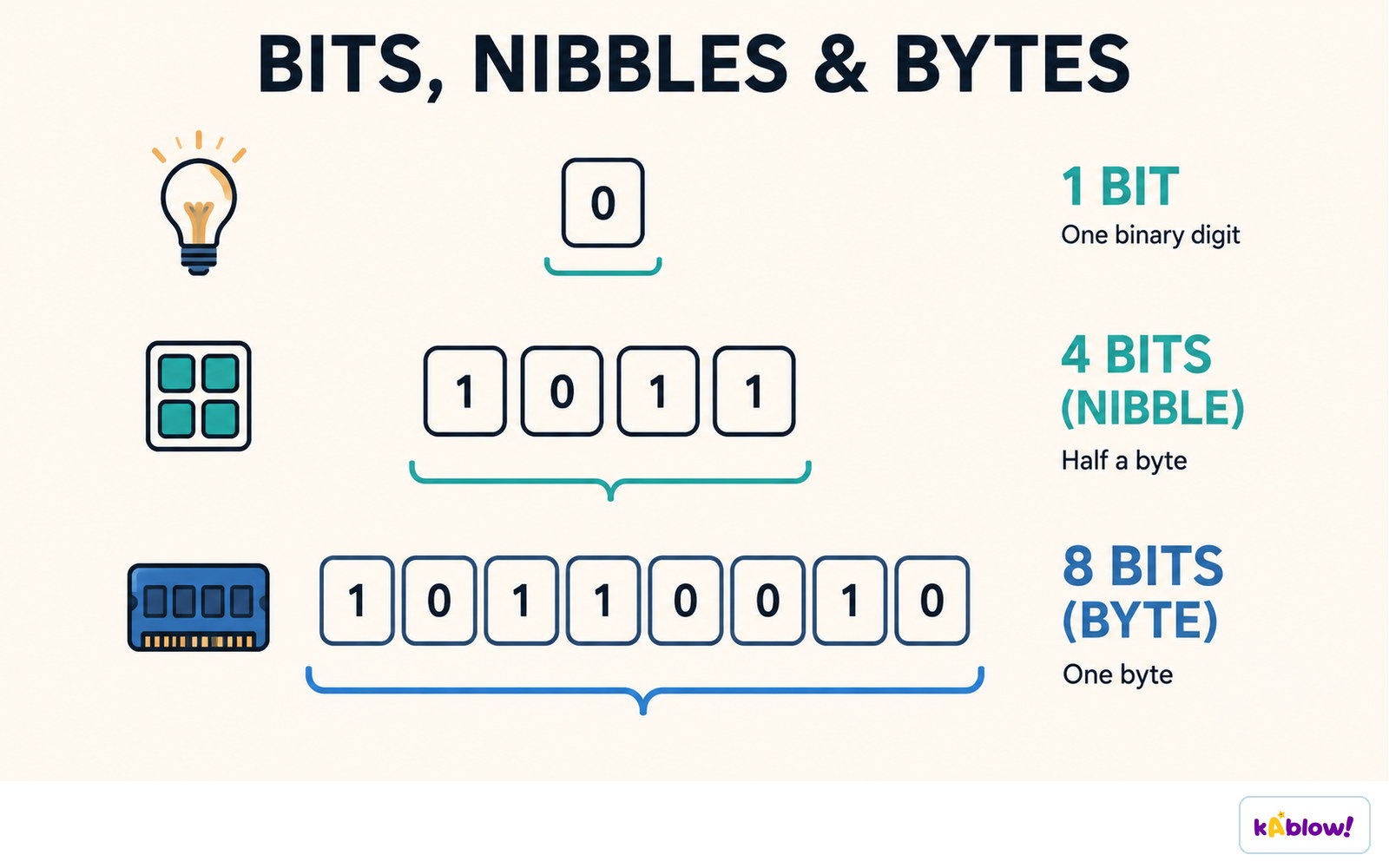
- A bit (b) is the smallest unit, representing a 1 or 0.
- A nibble = 4 bits; a byte (B) = 8 bits.
- Larger units: Kibibyte (KiB) = 1024 B, Mebibyte (MiB) = 1024 KiB, Gibibyte (GiB) = 1024 MiB, Tebibyte (TiB) = 1024 GiB, Pebibyte (PiB) = 1024 TiB, Exbibyte (EiB) = 1024 PiB.
- Binary prefixes (KiB, MiB) use powers of 2 (1024); decimal prefixes (KB, MB) use powers of 10 (1000).
- To convert to a larger unit, divide by 1024; to a smaller unit, multiply by 1024.
- Between bits and bytes: multiply/divide by 8.
One binary digit is a bit, four bits are a nibble, and eight bits are a byte.
Calculating File Sizes
- Bitmap image size = Resolution × Colour Depth (or width × height × colour depth).
- Resolution = width × height in pixels; colour depth = bits per pixel.
- Sound file size = Sample Rate × Duration (seconds) × Sample Resolution.
- Sample rate = samples per second; sample resolution = bits per sample.
- Convert bits to bytes by dividing by 8; bytes to KiB by dividing by 1024.
Compression Overview
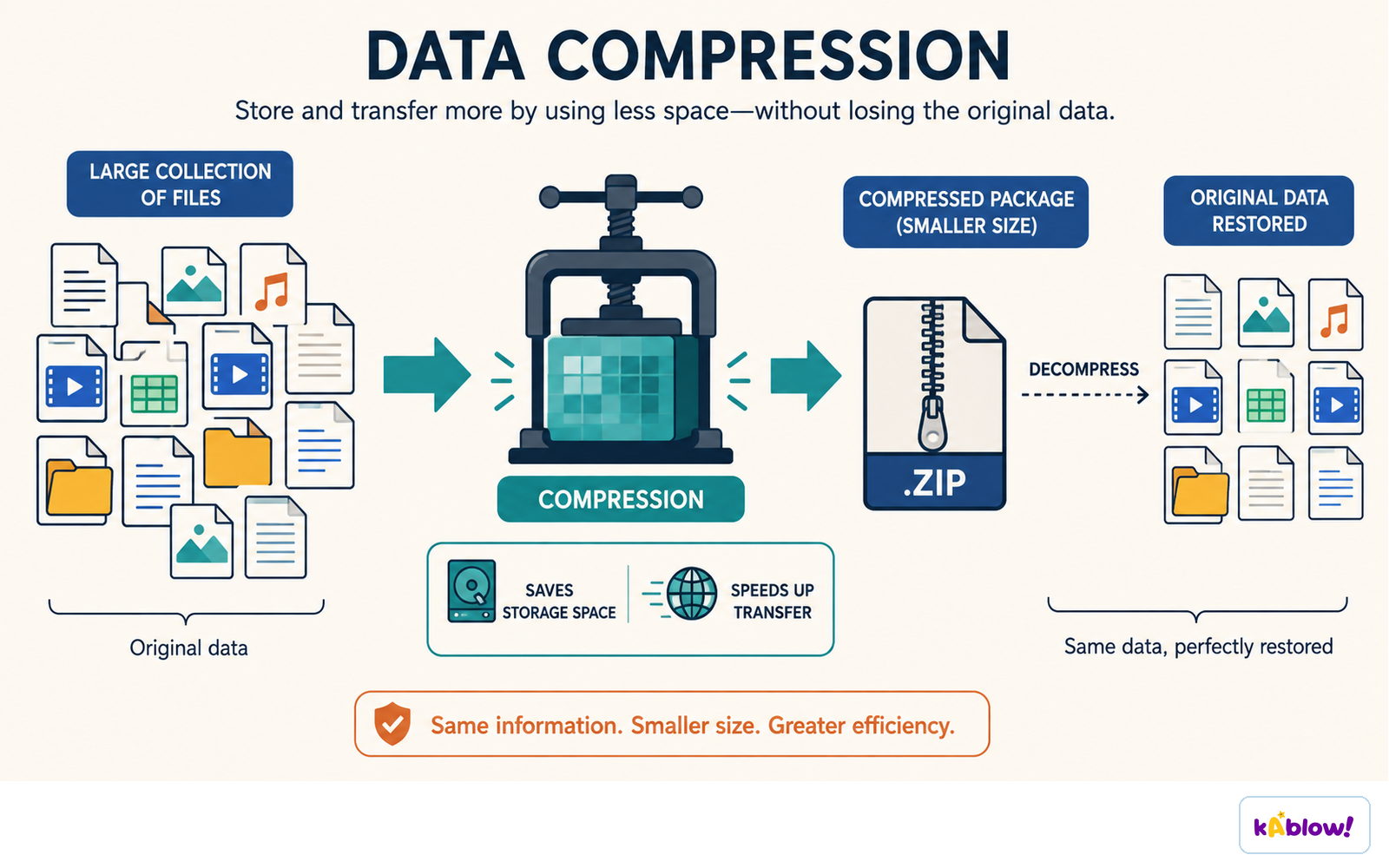
- Compression reduces file size to save storage space, reduce bandwidth, and shorten transmission time.
- Two types: lossy and lossless.
Compression stores and transfers the same information in less space.
Lossy Compression
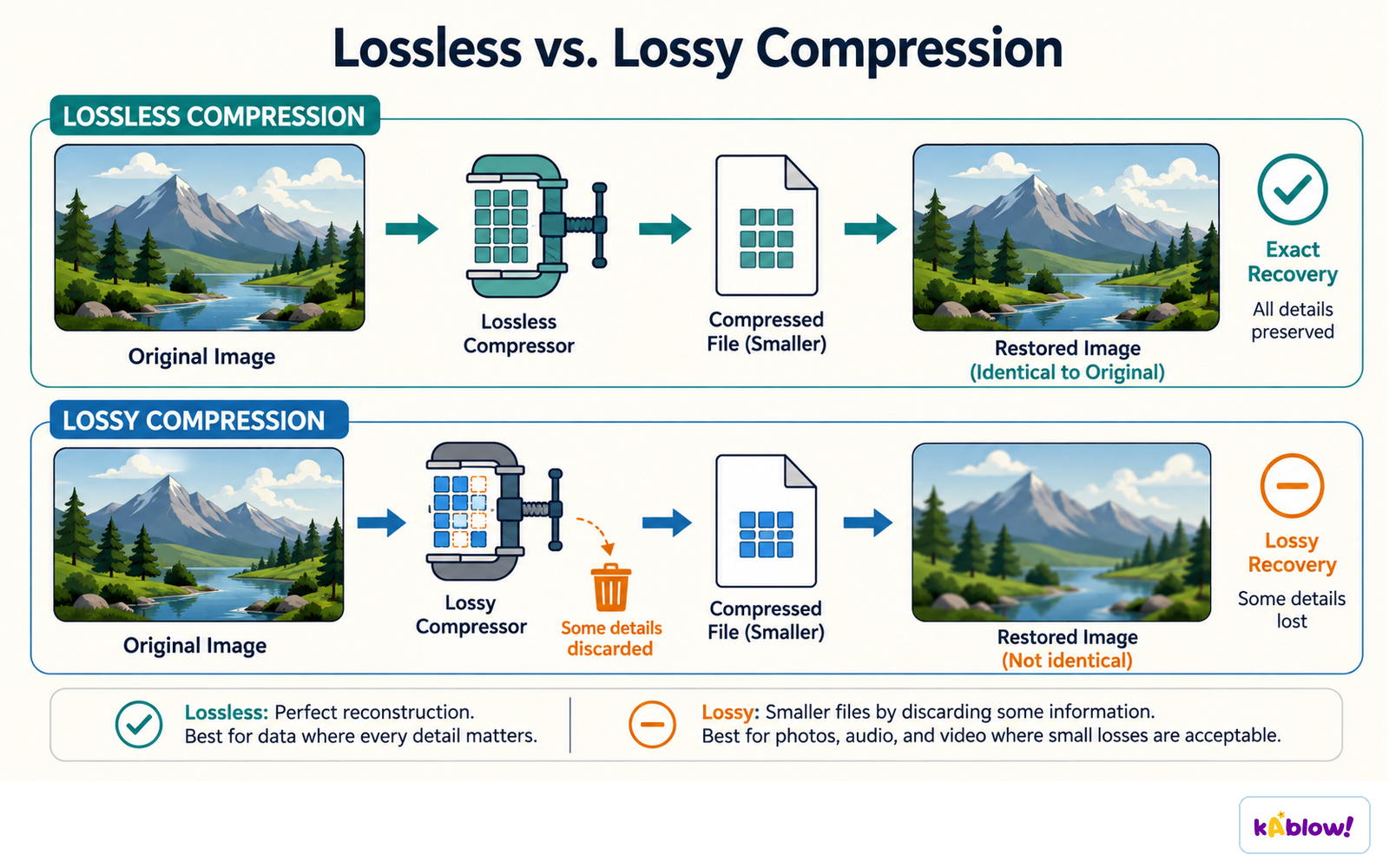
- Lossy compression permanently removes data to reduce file size; it is irreversible.
- Achieves large size reductions but at the cost of quality loss.
- Suitable for images, video, and sound where some quality loss is acceptable.
- Example: grouping similar colours in a photograph reduces colour count while keeping visual quality.
Lossless compression restores the original exactly; lossy compression discards some detail to shrink the file further.
Lossless Compression
- Lossless compression encodes data to reduce size without losing information; it is reversible.
- Produces smaller files than original but not as small as lossy.
- Suitable for text/documents where quality must be preserved.
- Uses algorithms like Run-Length Encoding (RLE) to find patterns and repetition.
Run-Length Encoding (RLE)
- RLE compresses consecutive identical elements into a count and the value.
- Example: `AAAABBBCCDAA` becomes `4A3B2C1D2A`.
- Used in bitmap images to compress runs of the same colour (e.g., `5R3B` for 5 red, 3 blue pixels).
Slide
Sign up free to view the lesson slides
Step through every slide for this topic — plus flashcards and revision notes — with a free account.
Câu hỏi luyện tập
Xem trước miễn phí — 8 trên 69 câu hỏi. Đăng ký để xem tất cả.
1.Which of the following is the smallest unit of data storage?
Easy- ABit
- BByte
- CNibble
- DKilobyte
2.How many bits are there in one byte?
Easy- A4
- B8
- C16
- D1024
3.What is the value of 1 KiB (kibibyte) in bytes?
Easy- A1000
- B1024
- C8
- D10242
4.Convert 2 MiB to KiB.
Easy- A2048
- B2000
- C1024
- D4096
5.A sound file has a sample rate of 44,100 Hz, a duration of 10 seconds, and a sample resolution of 16 bits. What is the file size in bytes?
Medium- A882,000
- B705,600
- C7,056,000
- D44,100
6.Which formula correctly calculates the size of a bitmap image?
Easy- AResolution × colour depth
- BWidth × height × sample rate
- CSample rate × duration × colour depth
- DWidth × height × duration
7.What is compression?
Easy- AReducing the size of a file
- BIncreasing the quality of a file
- CConverting a file to a different format
- DEncrypting a file for security
8.Which type of compression is irreversible?
Easy- ALossy
- BLossless
- CRun length encoding
- DAll compression
Unlock all 69 questions & more
Tạo tài khoản miễn phí để xem mọi câu hỏi, slide, thẻ ghi nhớ và ghi chú ôn tập cho chủ đề này.