Methods Of Error Detection
Học bằng cách chơi
Trả lời những câu hỏi này để kiếm năng lượng, rồi câu cá và khám phá. Không cần tài khoản.
Ghi chú bài học
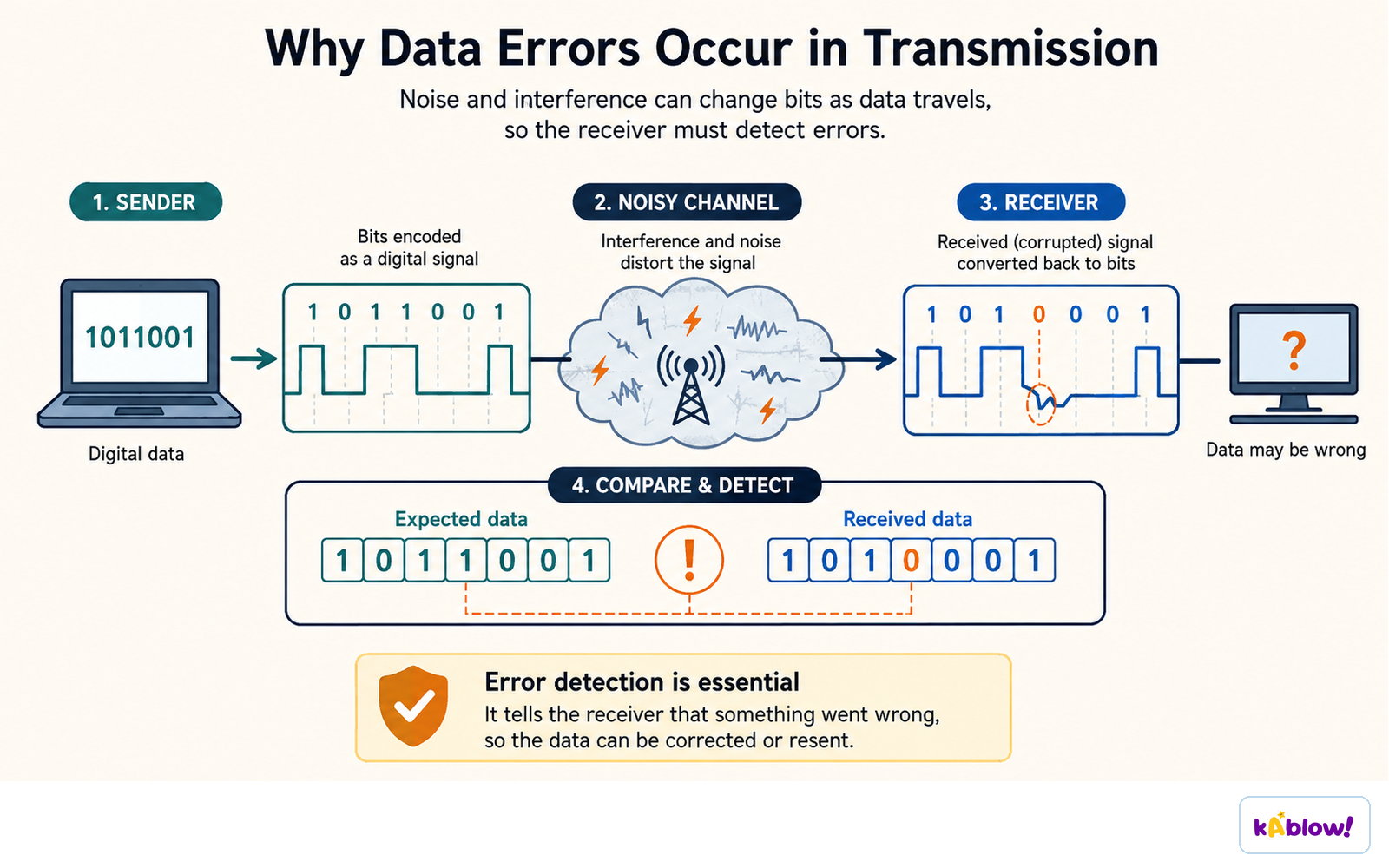
Why Errors Occur
- Errors occur due to interference in wired or wireless transmission (e.g., wire degradation, electrical fields, weather, physical barriers).
- Results of interference: data loss, data gain, or data change (bits flipped).
- Computers expect data in specific formats; unexpected data causes errors or corruption.
Noise and interference distort the signal in transit, so received bits can differ from the ones sent.
Parity Check
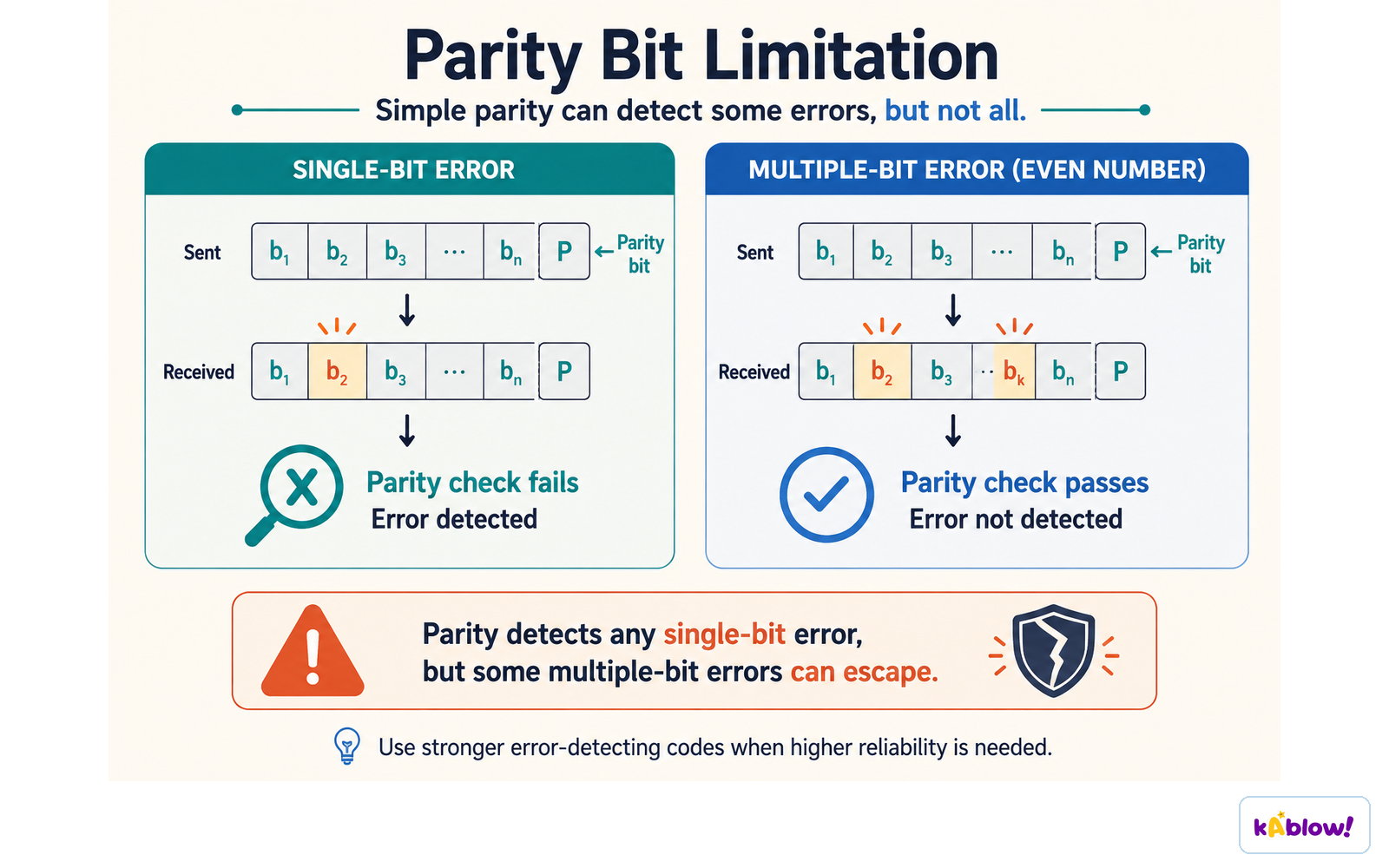
- A parity bit is added to each byte; sender and receiver agree on odd or even parity.
- For even parity, total number of 1s (including parity bit) must be even; for odd parity, total must be odd.
- If parity doesn't match, an error is detected, but the location is unknown.
- Limitation: parity check fails if an even number of bits are flipped or bits are transposed.
Parity detects any single-bit error, but an even number of flipped bits passes the check undetected.
Parity Block & Parity Byte
- A parity block uses horizontal (per byte) and vertical (per column) parity calculations.
- The parity byte contains vertical parity bits for each column.
- Cross-referencing horizontal and vertical parity pinpoints the exact error location.
- The error can be corrected automatically or a retransmission requested.
Checksum
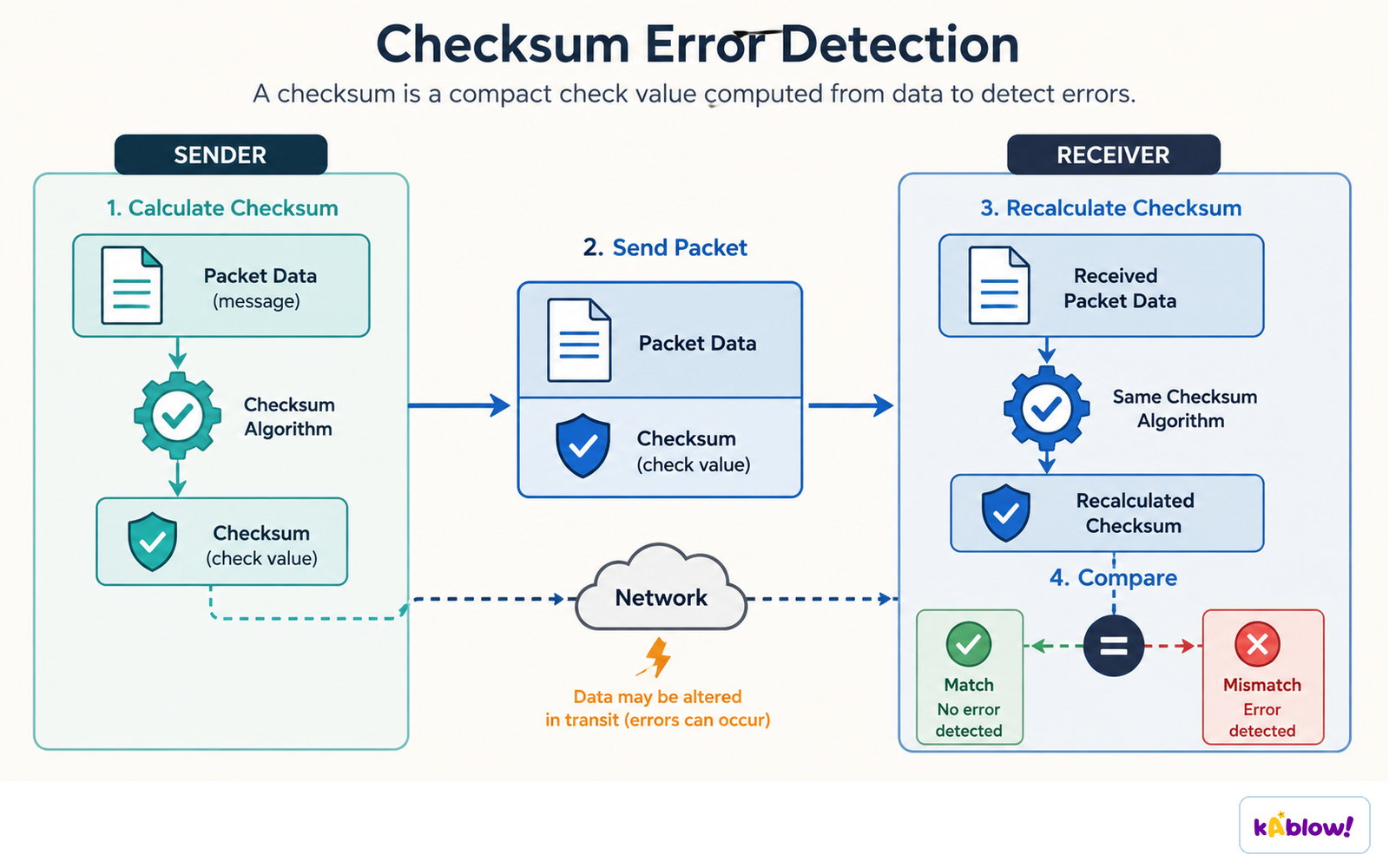
- A checksum is a value calculated from data using an algorithm and sent with the data.
- Receiver recalculates the checksum and compares it to the transmitted value.
- If they do not match, an error is assumed; checksum does not indicate error location.
The sender computes a checksum from the data; the receiver recalculates it and compares.
Echo Check
- The receiver echoes (sends back) the received data to the sender.
- Sender compares echoed data to original; if different, an error occurred and data is retransmitted.
- Limitation: an error could occur during the echo transmission itself.
Check Digits
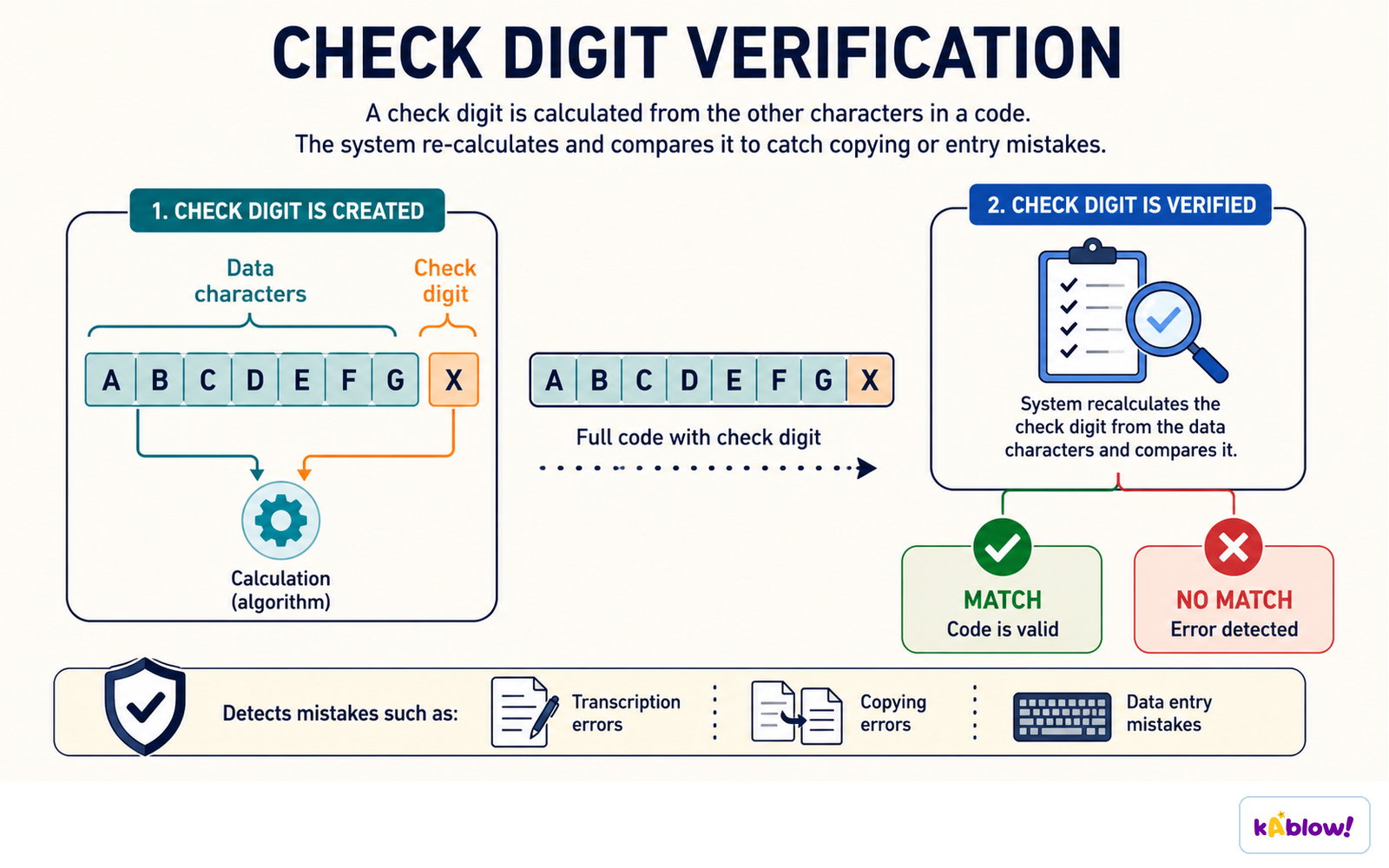
- A check digit is the last digit in a numeric code (e.g., ISBN, barcode) used to detect entry errors.
- Detects: incorrect digits, omitted/extra digits, phonetic errors.
- Calculated using a standard algorithm; if the result is a whole number, the code is valid.
A check digit is recalculated from the other characters and compared, catching copying and entry mistakes.
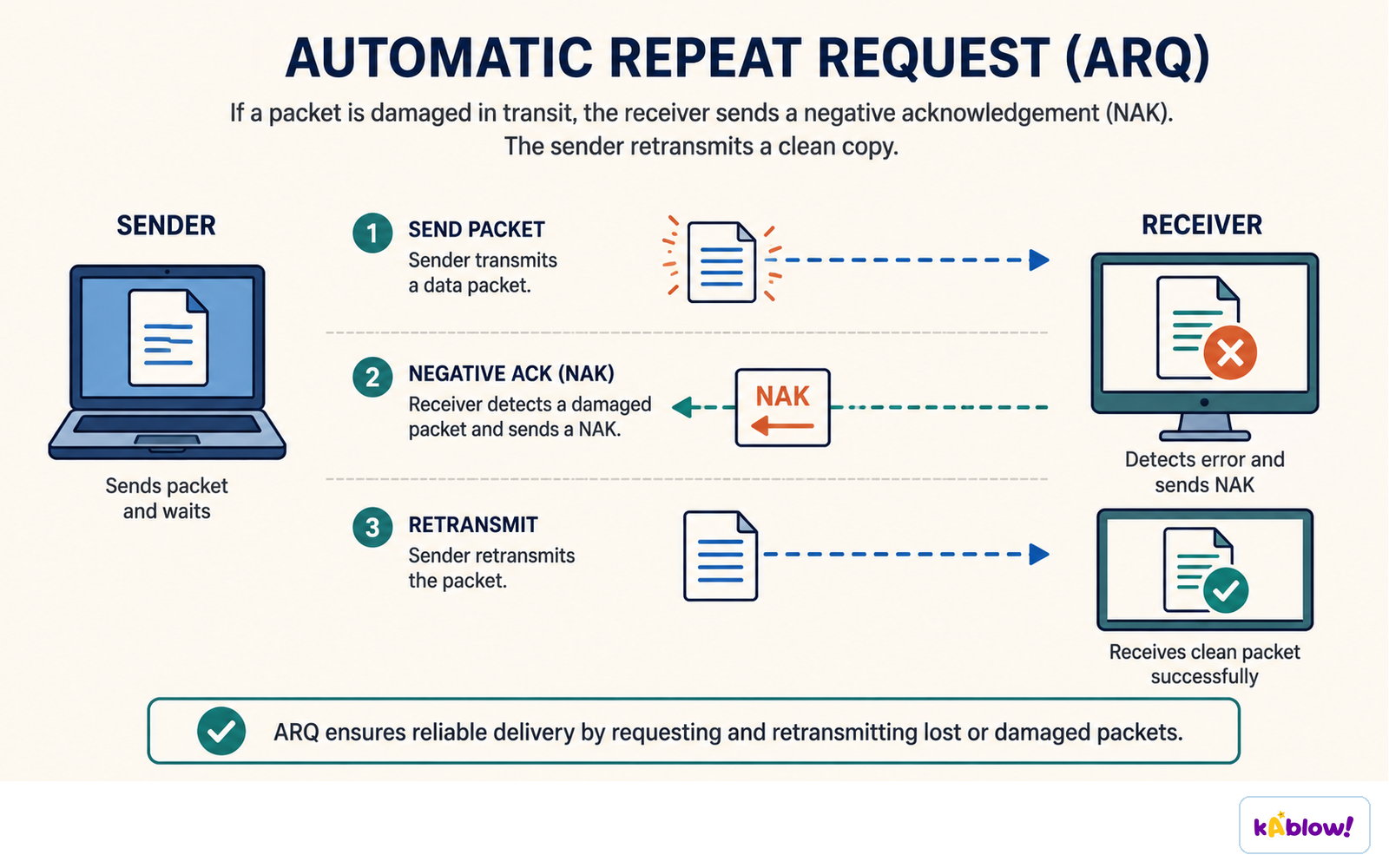
Automatic Repeat Query (ARQ)
- ARQ is a protocol using acknowledgements and timeout to ensure error-free transmission.
- Receiver sends positive acknowledgement (ACK) if data is correct, or negative acknowledgement (NAK) if corrupted.
- If no acknowledgement is received within a timeout period, the sender automatically retransmits the data.
- Process repeats until data is received correctly or a limit is reached.
If a packet arrives damaged the receiver sends a negative acknowledgement and the sender retransmits.
Slide
Sign up free to view the lesson slides
Step through every slide for this topic — plus flashcards and revision notes — with a free account.
Câu hỏi luyện tập
Xem trước miễn phí — 8 trên 58 câu hỏi. Đăng ký để xem tất cả.
1.Which of the following is a result of interference during data transmission?
Easy- AData loss
- BData encryption
- CData compression
- DData indexing
2.What is the purpose of a parity bit in data transmission?
Easy- ATo detect errors in the transmitted data
- BTo correct errors in the transmitted data
- CTo encrypt the transmitted data
- DTo compress the transmitted data
3.A byte is transmitted with even parity. The byte received is 10110010. Does this byte contain an error?
Medium- AYes, because there are four 1s
- BNo, because there are four 1s
- CYes, because there are five 1s
- DNo, because there are five 1s
4.Why might a parity check fail to detect an error?
Medium- AIf an even number of bits are flipped
- BIf an odd number of bits are flipped
- CIf the parity bit itself is corrupted
- DIf the data is encrypted
5.In a parity block check using odd parity, the parity byte is calculated as 01111111. If the received parity byte is 01111110, what does this indicate?
Medium- AAn error has occurred in bit column 8
- BAn error has occurred in bit column 7
- CAn error has occurred in byte row 8
- DNo error has occurred
6.What is a checksum used for?
Easy- ATo determine if data has been corrupted
- BTo encrypt data
- CTo compress data
- DTo convert data to a different format
7.In an echo check, the receiver sends the received data back to the sender. Why is this method not fully reliable?
Medium- AAn error could occur when the receiver transmits the data back
- BThe sender cannot detect errors
- CThe receiver cannot detect errors
- DIt requires too much bandwidth
8.What is a check digit?
Easy- AThe last digit in a code used to detect errors in numeric data entry
- BThe first digit in a code used to identify the data type
- CA digit used to encrypt the data
- DA digit used to compress the data
Unlock all 58 questions & more
Tạo tài khoản miễn phí để xem mọi câu hỏi, slide, thẻ ghi nhớ và ghi chú ôn tập cho chủ đề này.