Programming Concepts
Học bằng cách chơi
Trả lời những câu hỏi này để kiếm năng lượng, rồi câu cá và khám phá. Không cần tài khoản.
Ghi chú bài học
Variables & Constants
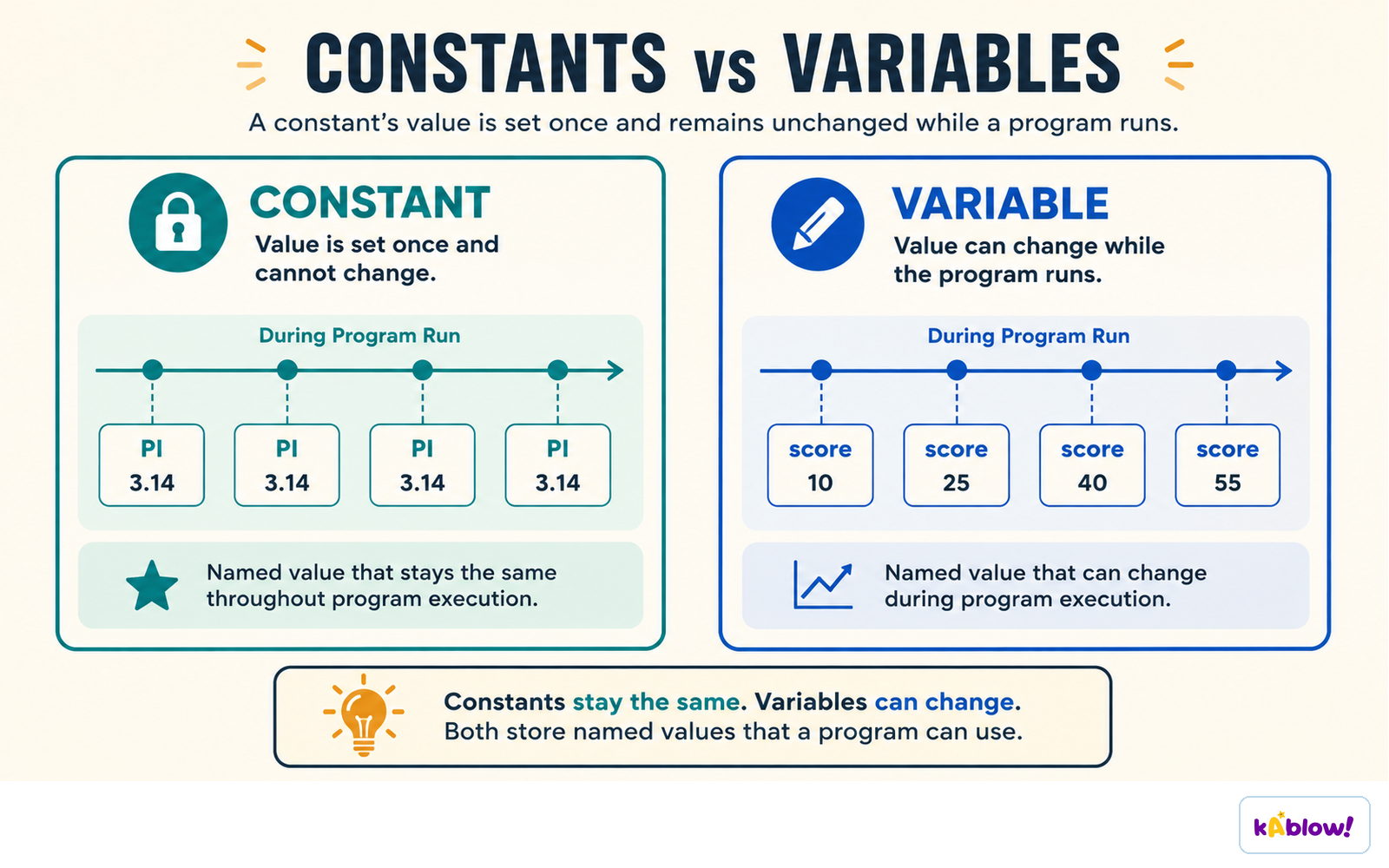
- A variable is an identifier that can change during program execution; declared with `DECLARE <id> : <datatype>` in pseudocode.
- Identifiers should use PascalCase, contain only letters/digits, and start with a capital letter.
- A constant is an identifier set once; named in UPPERCASE to improve readability and maintainability.
- Constants are declared with `CONSTANT <id> ← <value>`; changing a constant only requires alteration in one place.
A constant is set once and stays fixed; a variable can change while the program runs.
Data Types
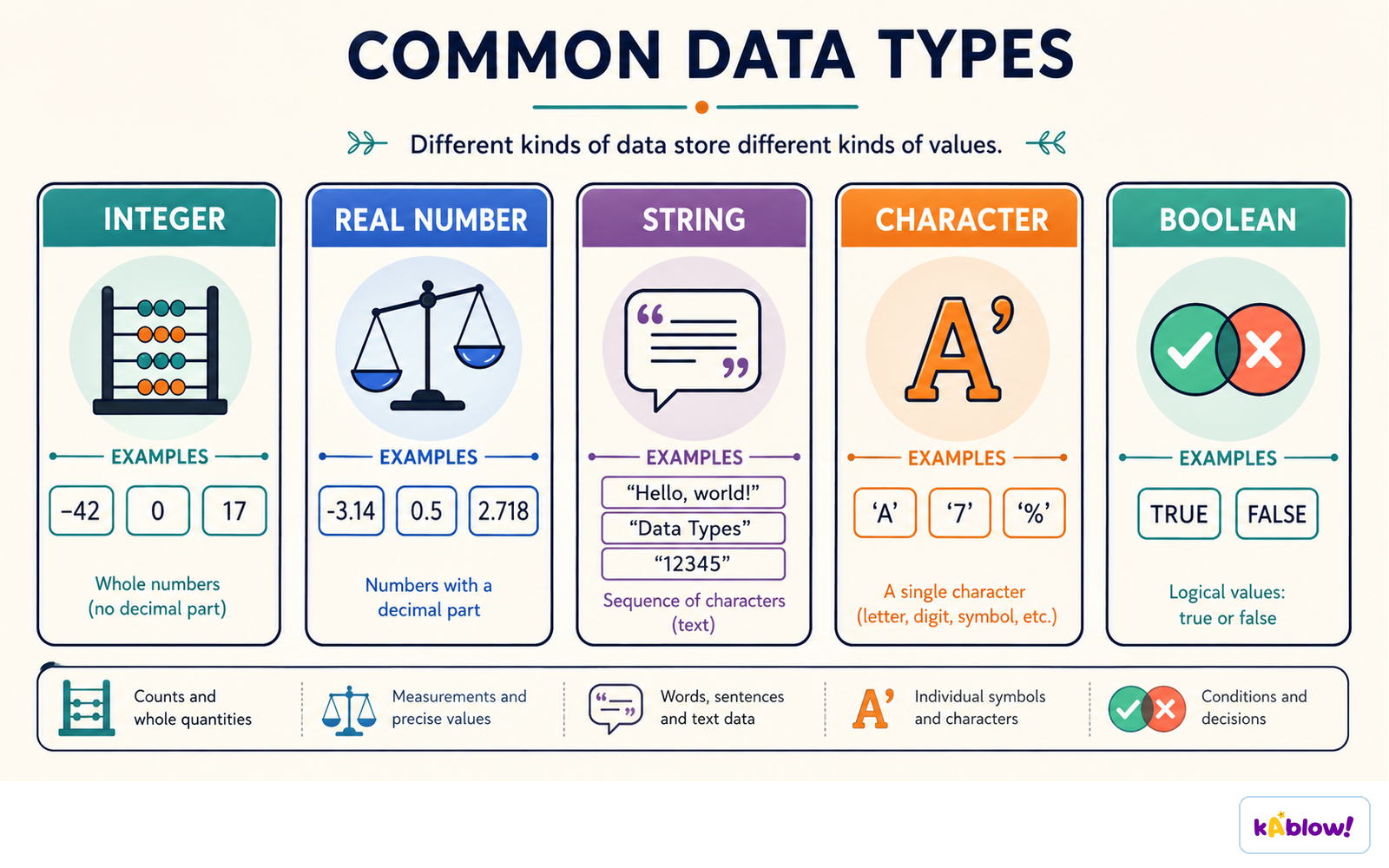
- Basic data types: Integer (whole numbers), Real (decimal), Character (single char), String (sequence of chars), Boolean (True/False).
- Choosing the correct data type ensures accuracy and efficiency; casting converts between types.
- Pseudocode examples: `DECLARE Age : INTEGER`, `DECLARE Price : REAL`, `DECLARE GameOver : BOOLEAN`.
Integer, real, string, character and Boolean each store a different kind of value.
Input & Output
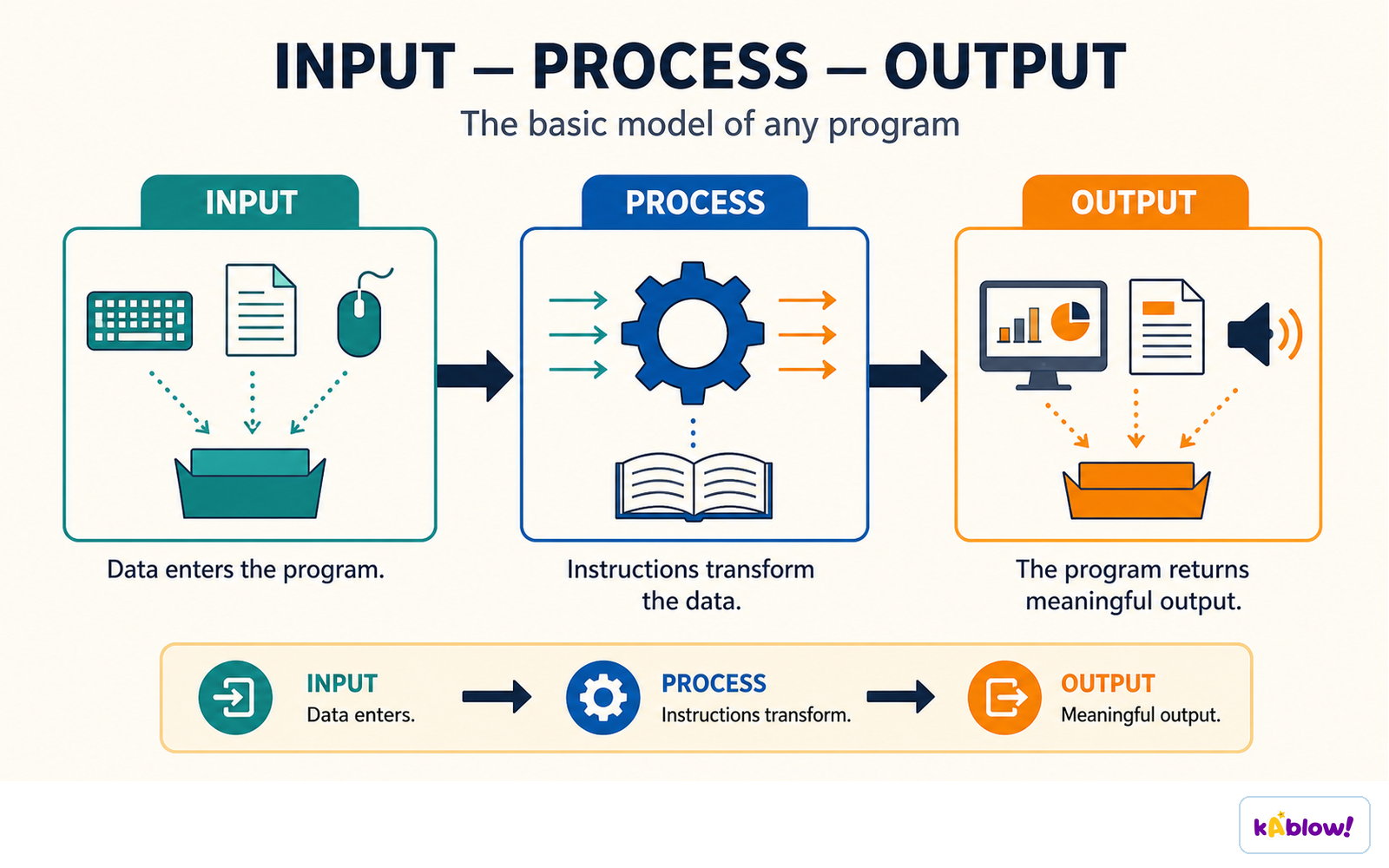
- Input reads data from an input device (e.g., keyboard) using `INPUT <identifier>` in pseudocode.
- Output sends data to an output device (e.g., monitor) using `OUTPUT <identifier(s)>`.
- Without input, programs cannot interact with the outside world; without output, results cannot be seen.
Every program has the same shape: data enters, instructions transform it, and meaningful output leaves.
Sequence
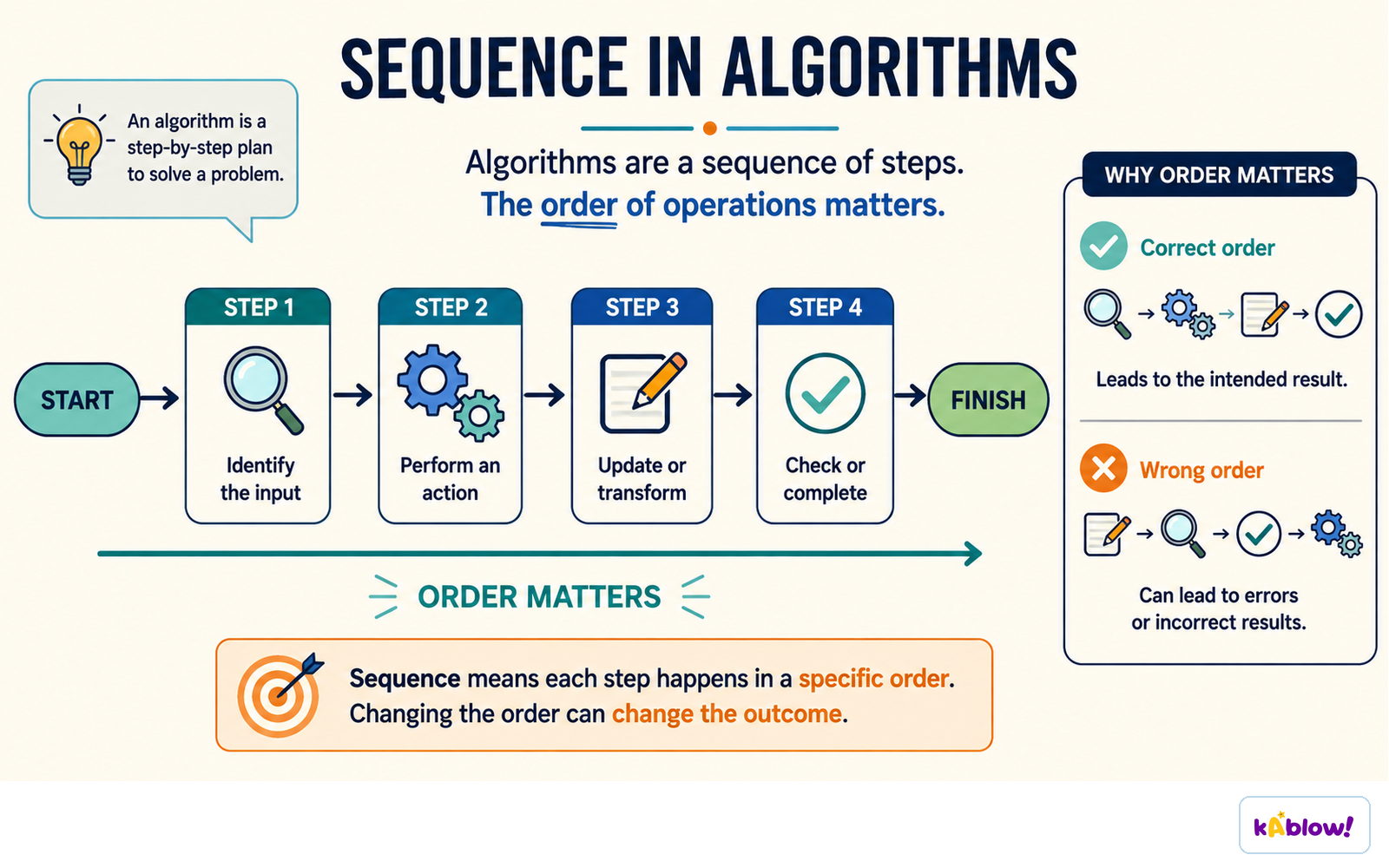
- Sequence means lines of code run one at a time in the order they are written.
- Incorrect sequence can cause unexpected behaviour or runtime errors (e.g., returning a variable before it is assigned).
Sequence: each instruction runs in a precise order from start to output.
Selection
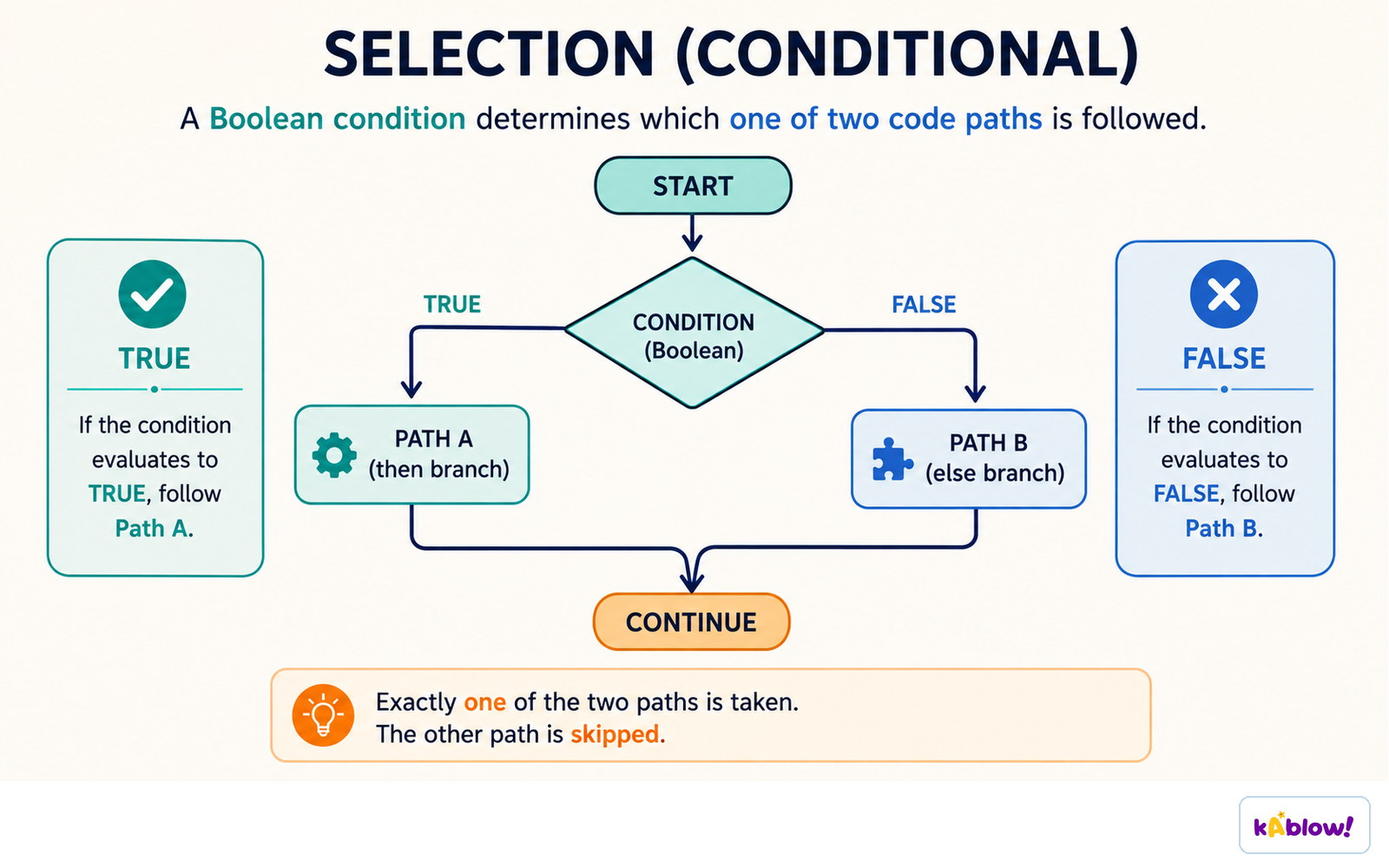
- Selection changes program flow based on conditions; uses `IF...THEN...ELSE` or `CASE` statements.
- `IF` statements: `IF <condition> THEN <statements> ELSE <statements> ENDIF`.
- Nested selection places one IF inside another; CASE compares multiple values of the same variable.
- Boolean operators `AND`, `OR`, `NOT` combine conditions; `AND` true if both true, `OR` true if at least one true, `NOT` inverts.
A Boolean condition decides which one of two paths runs; the other is skipped.
Iteration
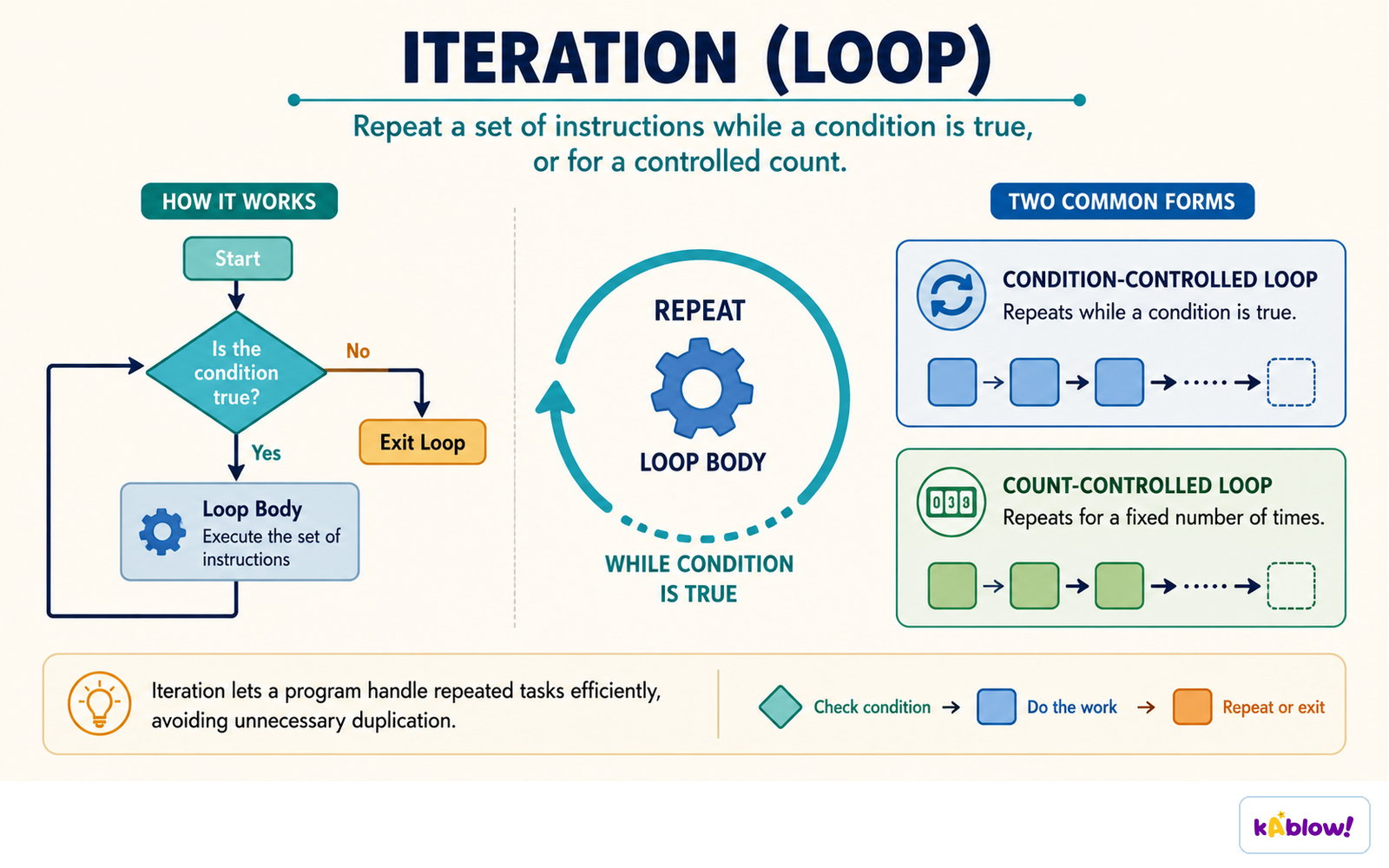
- Count-controlled loops repeat a fixed number of times using `FOR <id> ← <start> TO <end> [STEP <inc>]`.
- Condition-controlled loops repeat until a condition is met: `WHILE` (pre-condition) or `REPEAT...UNTIL` (post-condition).
- Nested iteration is a loop inside another loop, e.g., a FOR inside another FOR.
A loop repeats while a condition holds, or for a fixed number of repetitions.
Totalling & Counting
- Totalling adds up values in a loop: initialise total to 0, then update inside loop.
- Counting tracks occurrences: initialise count to 0, increment when condition met.
- Both are commonly used with loops to accumulate results.
String Handling
- Case conversion: `UCASE`/`LCASE` (pseudocode) or `.upper()`/`.lower()` (Python).
- Length: `LENGTH(string)` (pseudocode) or `len(string)` (Python).
- Substring: `SUBSTRING(string, start, length)` in pseudocode (start at 1); Python uses slicing `string[start:end]` (start at 0).
Arithmetic, Logical & Boolean Operators
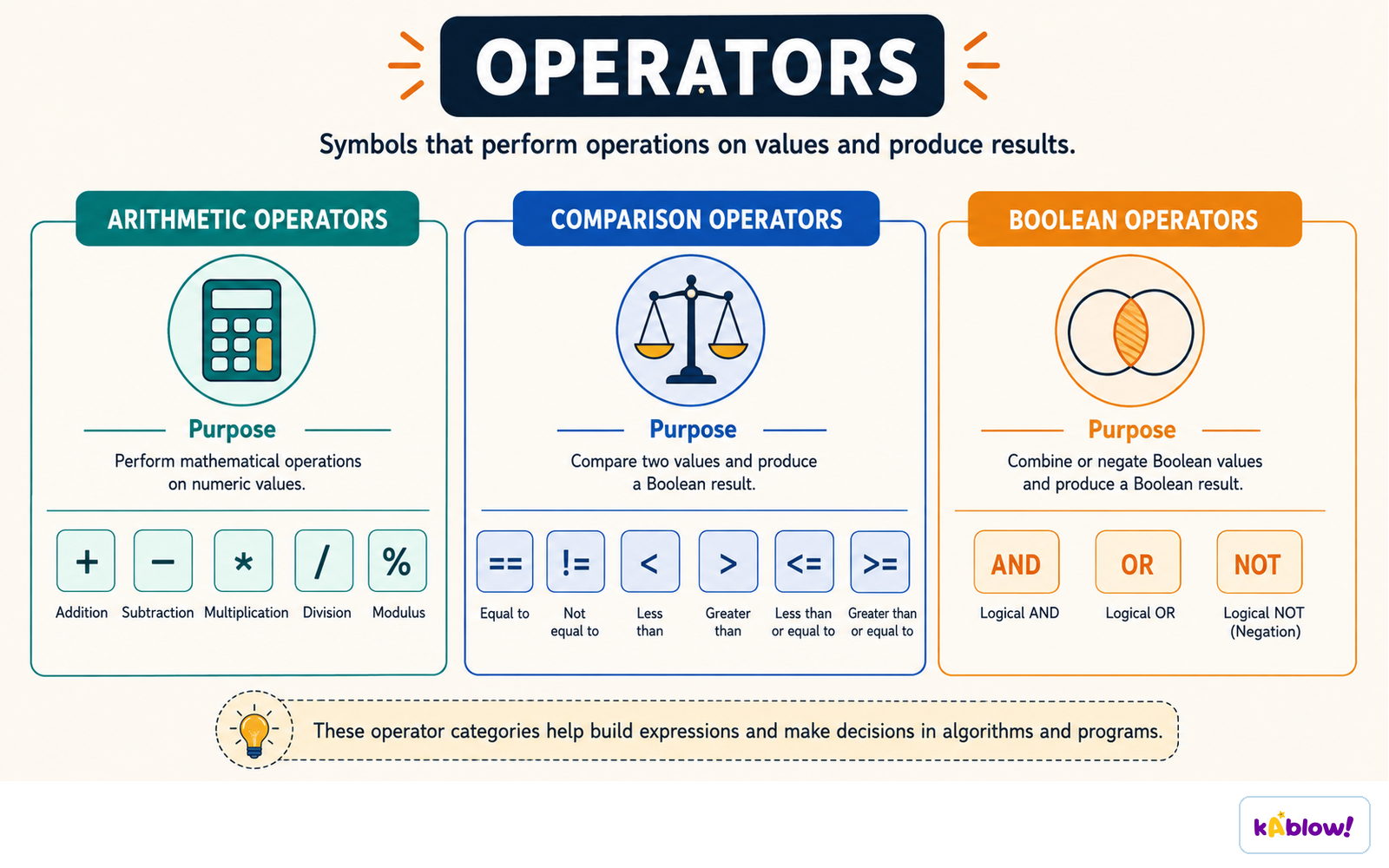
- Arithmetic operators: `+`, `-`, `×`, `/`, `MOD` (remainder), `DIV` (quotient), `^` (exponent).
- Logical operators compare values: `==`, `<>`, `<`, `≤`, `>`, `≥`.
- Boolean operators: `AND`, `OR`, `NOT` used to combine conditions.
Arithmetic operators compute values, comparison operators produce a Boolean, and Boolean operators combine them.
Procedures & Functions
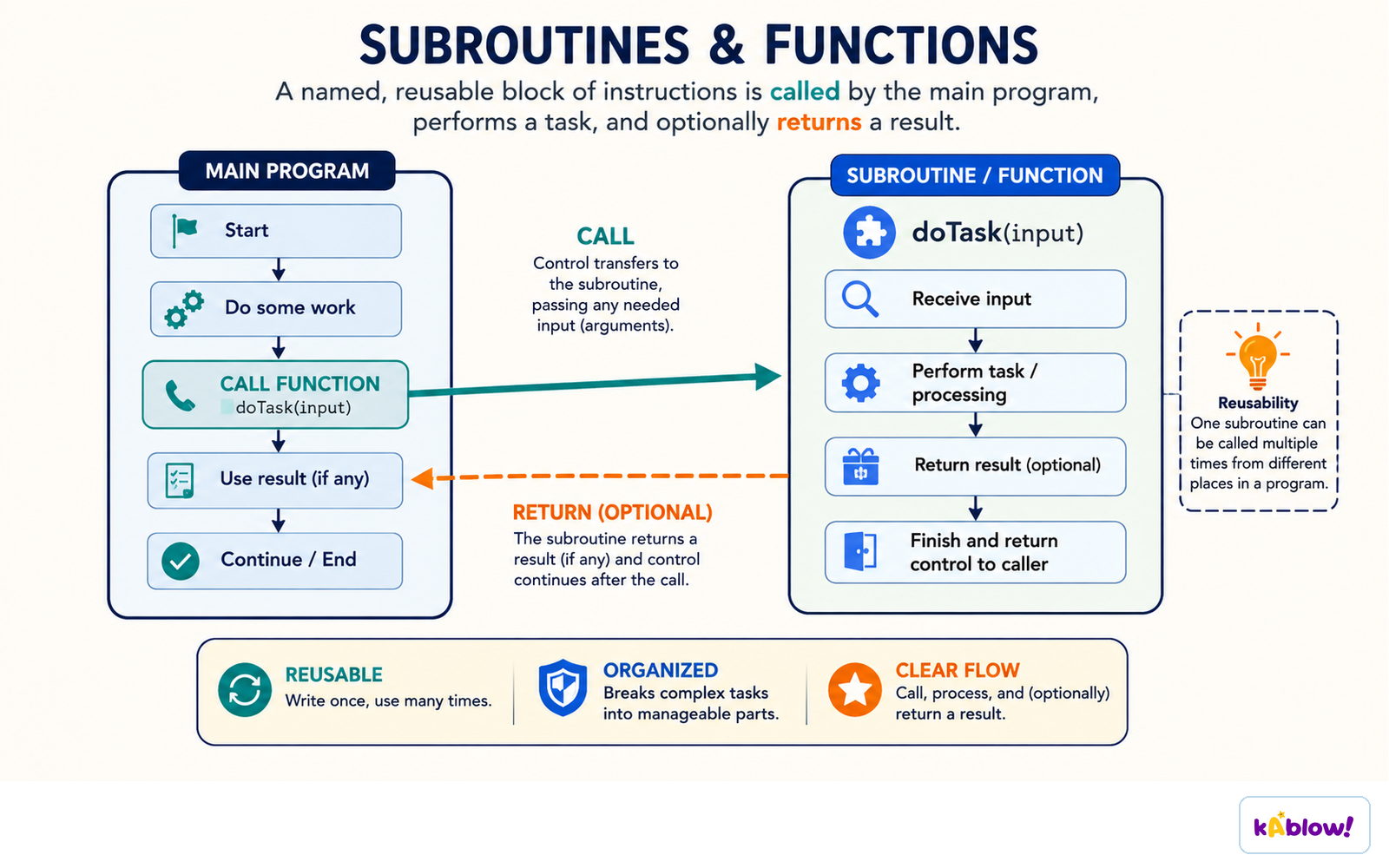
- Procedures do not return a value; defined with `PROCEDURE ... ENDPROCEDURE` and called with `CALL`.
- Functions return a value; defined with `FUNCTION ... RETURNS <type> ... ENDFUNCTION` and called in expressions.
- Parameters pass data into sub-programs; multiple parameters allowed.
- Sub-programs improve readability, maintainability, and avoid code duplication.
A subroutine is a named, reusable block: the main program calls it, it does its task, and it returns.
Local & Global Variables
- Local variables declared inside a sub-program; only accessible there; destroyed when the sub-program ends.
- Global variables declared at the outermost level; accessible from anywhere in the program.
- Use local variables to avoid unintended side-effects; global variables can be modified by any part of the program.
Library Routines
- Library routines are pre-written, reusable code (e.g., `RANDOM`, `ROUND`) that save time and are already tested.
- `RANDOM` generates random numbers; in pseudocode `RANDOM(lower, upper)`; in Python `import random; random.randint(a,b)`.
- `ROUND` rounds a number to a specified number of decimal places: `ROUND(value, places)`.
Maintaining Programs
- Use layout, indentation, comments, meaningful variable names, white space, and sub-programs to make code easy to maintain.
- Consistent use of these techniques improves readability and reduces errors when modifying code.
Slide
Sign up free to view the lesson slides
Step through every slide for this topic — plus flashcards and revision notes — with a free account.
Câu hỏi luyện tập
Xem trước miễn phí — 8 trên 54 câu hỏi. Đăng ký để xem tất cả.
1.Which of the following is the correct way to declare a variable in pseudocode?
Easy- ADECLARE Age : INTEGER
- BDECLARE Age = INTEGER
- CAge : INTEGER
- DINTEGER Age
2.Which data type would be most appropriate to store the value 'True'?
Easy- ABOOLEAN
- BSTRING
- CINTEGER
- DCHAR
3.What is the output of the following pseudocode? Total ← 0 FOR X ← 1 TO 3 Total ← Total + X NEXT X OUTPUT Total
Medium- A6
- B3
- C1
- D0
4.Which of the following correctly represents a condition-controlled loop in pseudocode?
Medium- AWHILE Colour ≠ 'Red' DO INPUT Colour ENDWHILE
- BFOR X ← 1 TO 10 OUTPUT X NEXT X
- CREPEAT INPUT Colour UNTIL Colour = 'Red'
- DIF Colour = 'Red' THEN OUTPUT 'Stop' ENDIF
5.What is the value of Result after executing the following pseudocode? Result ← 10 MOD 3
Easy- A1
- B3
- C0
- D10
6.Which of the following is a valid constant declaration in pseudocode?
Easy- ACONSTANT π ← 3.142
- BCONSTANT π = 3.142
- CDECLARE π : CONSTANT ← 3.142
- Dπ CONSTANT ← 3.142
7.What is the purpose of a procedure in programming?
Easy- ATo perform a task without returning a value
- BTo return a value
- CTo store data permanently
- DTo handle user input
8.Which of the following is the correct pseudocode to output the length of a string stored in variable Word?
Easy- AOUTPUT LENGTH(Word)
- BOUTPUT LEN(Word)
- COUTPUT Word.LENGTH
- DOUTPUT LENGTH Word
Unlock all 54 questions & more
Tạo tài khoản miễn phí để xem mọi câu hỏi, slide, thẻ ghi nhớ và ghi chú ôn tập cho chủ đề này.