Bearings Constructions And Scale Drawings
Học bằng cách chơi
Trả lời những câu hỏi này để kiếm năng lượng, rồi câu cá và khám phá. Không cần tài khoản.
Ghi chú bài học
Bearings
- Bearings are a way of describing an angle, commonly used in navigation.
- Three rules: measured from North, measured clockwise, written with 3 digits (e.g., 059°).
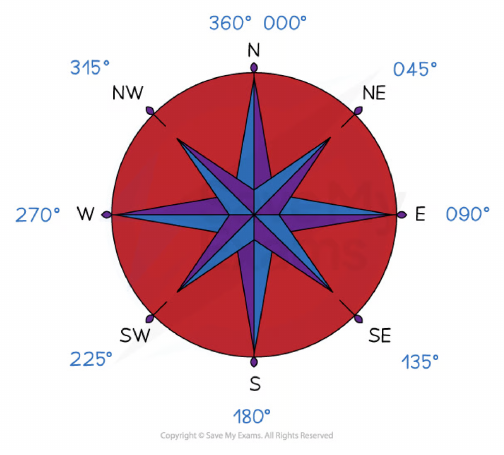
- Compass directions have standard bearings: N=000°, E=090°, S=180°, W=270°.
- To find bearing of B from A: start at A, draw North line, measure clockwise angle to B.
- If bearing of A from B is <180°, add 180° to get bearing of B from A; if >180°, subtract 180°.
- Always draw a clear diagram and label angles carefully.
Bearings of compass points
Scale
- Scale is a ratio comparing drawn size to real-life size (e.g., 1:50000).
- To find actual distance: measure on drawing, multiply by scale factor, convert units.
- To find drawing length: convert actual distance to same units, divide by scale factor.
- Common conversions: 1 km = 1000 m = 100000 cm.
- Always check if answer is sensible (e.g., actual distance > drawing distance).
Constructing Triangles (SSS)
- SSS triangle construction uses three given side lengths.
- Tools: pencil, ruler, compasses.
- Step 1: Draw the longest side as base using ruler.
- Step 2: Set compass to one side length, draw arc from one endpoint above base.
- Step 3: Set compass to third side length, draw arc from other endpoint to intersect first arc.
- Step 4: Draw lines from base endpoints to intersection point.
- Do not erase construction arcs – they show your method.
- Label vertices and side lengths as required.
Constructing triangle ABC
Scale Drawings
- Scale drawing uses a given scale to represent real objects or distances.
- Use ruler and protractor for accurate measurements and bearings.
- To mark a point given distance and bearing: draw North line, measure bearing clockwise, draw line to scale distance.
- For combined conditions (e.g., within distance range and bearing range), construct and shade the region.
- Always leave construction lines and arcs visible for marks.
Plotting a route by bearing and scale
Slide
Sign up free to view the lesson slides
Step through every slide for this topic — plus flashcards and revision notes — with a free account.
Câu hỏi luyện tập
Xem trước miễn phí — 8 trên 58 câu hỏi. Đăng ký để xem tất cả.
1.What are the three rules for bearings?
Easy- AMeasured from North, clockwise, written with three digits
- BMeasured from South, anticlockwise, written with three digits
- CMeasured from East, clockwise, written with two digits
- DMeasured from North, anticlockwise, written with three digits
2.The bearing of B from A is 105°. What is the bearing of A from B?
Medium- A285°
- B075°
- C255°
- D195°
3.A map has a scale of 1:50000. What does 1 cm on the map represent in real life?
Easy- A50000 cm
- B5000 cm
- C500 m
- D5 km
4.In a scale drawing, 1 cm represents 40 cm. If the window on the drawing is 3 cm long and 2 cm high, what are the actual dimensions?
Easy- A120 cm by 80 cm
- B40 cm by 30 cm
- C12 cm by 8 cm
- D160 cm by 120 cm
5.Using a ruler and compasses only, to construct a triangle with sides 5 cm, 7 cm and 9 cm, which side should you draw first?
Medium- AThe longest side (9 cm)
- BThe shortest side (5 cm)
- CAny side, it doesn't matter
- DThe side of length 7 cm
6.What is the compass direction for a bearing of 090°?
Easy- AEast
- BNorth
- CWest
- DSouth
7.The bearing of a lighthouse from a boat is 135°. What is the bearing of the boat from the lighthouse?
Medium- A315°
- B045°
- C225°
- D135°
8.On a map with scale 1:150000, the distance between two towns is 5.8 cm. What is the actual distance in km?
Medium- A8.7 km
- B87 km
- C0.87 km
- D870 km
Unlock all 58 questions, flashcards & more
Tạo tài khoản miễn phí để xem mọi câu hỏi, slide, thẻ ghi nhớ và ghi chú ôn tập cho chủ đề này.