Sequences
Học bằng cách chơi
Trả lời những câu hỏi này để kiếm năng lượng, rồi câu cá và khám phá. Không cần tài khoản.
Ghi chú bài học
Introduction to Sequences
- A sequence is an ordered set of numbers that follow a rule (e.g., 3, 6, 9, 12... rule: add 3).
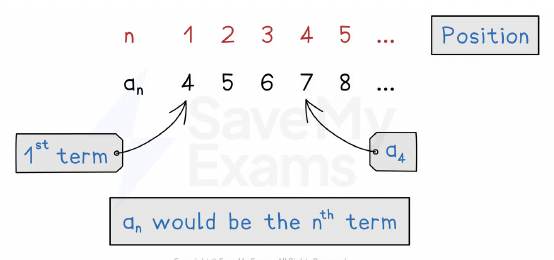
- Each number is a term; its position is given by n (n=1 is 1st term).
- A term-to-term rule tells how to get the next term (e.g., add 4 each time).
- A position-to-term rule (nth term formula) lets you find any term directly (e.g., 8n+2).
- To check if a value belongs to a sequence, set the nth term formula equal to the value and solve for n; if n is a whole number, it is a term.
Sequence position notation
Continuing Sequences
- Use first differences to spot patterns: e.g., 4,7,10,13 → differences +3, next term 16.
- If first differences change by a constant amount (second differences constant), the sequence is quadratic.
- If first differences double each time, the next difference is double the last.
- Be familiar with special sequences: square numbers (1,4,9,16...), cube numbers (1,8,27,64...), triangular numbers (1,3,6,10...).
Triangular numbers as dots

nth Terms of Linear Sequences
- A linear sequence (arithmetic) has a constant common difference d.
- The nth term formula is dn + b, where d is the common difference and b is the term before the 1st term (zero term).
- To find b, continue the sequence backwards by one term (subtract d from the 1st term).
- Example: 5,7,9,11 → d=2, b=3 → nth term = 2n+3.
Quadratic Sequences
- A quadratic sequence has an nth term involving n²; its second differences are constant.
- Compare to square numbers (n²): e.g., 6,9,14,21,30 → each term is 5 more than n² → nth term = n²+5.
- For simple quadratics an²+b, a = ½ × (second difference).
- Example: sequence 3,9,19,33,51 → second difference = 4 → a=2, then find b by comparing to 2n².
Cubic Sequences
- A cubic sequence has an nth term involving n³; its third differences are constant.
- Compare to cube numbers (n³): e.g., 2,9,28,65,126 → each term is 1 more than n³ → nth term = n³+1.
- For simple cubics an³+b, a = ⅙ × (third difference).
- Know cube numbers up to 5³=125 and 10³=1000.
Finding the nth Term: Worked Examples
- Linear: Find nth term of -7,-3,1,5,9 → d=4, b=-11 → nth term = 4n-11.
- Quadratic: Find nth term of 6,9,14,21,30 → second diff=2 → a=1 → compare to n² → nth term = n²+5.
- Cubic: Sequence 4,25,82,193,376 → third diff=18 → a=3 → compare to 3n³ → nth term = 3n³+1.
- Always check your formula by substituting n=1,2,3 to see if it matches the given terms.
Using nth Term to Find Terms and Check Membership
- To find a specific term, substitute n into the formula (e.g., 20th term of n²+5 = 400+5=405).
- To check if a number is in the sequence, set formula = number and solve for n; if n is a positive integer, it is a term.
- Example: Is 98 in sequence 8n+2? 8n+2=98 → n=12 → yes, 12th term.
- If n is not an integer (e.g., n=15.25), the number is not in the sequence.
Pattern Sequences (Exam Style)
- Many exam questions involve patterns of counters, lines, or squares; find the nth term for each quantity.
- Example: Pattern n has black counters = 2n+2, white counters = n².
- Use the nth term to check if a pattern can be made with given resources (e.g., 30 black, 140 white for Pattern 12).
- For linear patterns, the number of rows or houses can be found using the nth term formula.
Slide
Sign up free to view the lesson slides
Step through every slide for this topic — plus flashcards and revision notes — with a free account.
Câu hỏi luyện tập
Xem trước miễn phí — 8 trên 55 câu hỏi. Đăng ký để xem tất cả.
1.What is the next term in the sequence 18, 21, 26, 33, 42, ...?
Easy- A53
- B51
- C55
- D49
2.Find the next term in the sequence 18, 20, 24, 32, 48, ...
Medium- A80
- B64
- C56
- D72
3.The first four terms of a sequence are 17, 10, 3, -4. What is the next term?
Easy- A-11
- B-10
- C-12
- D-9
4.The nth term of a sequence is n3 - 5. What is the first term?
Easy- A-4
- B-3
- C0
- D1
5.The first four terms of a sequence are 29, 32, 35, 38. What is the next term?
Easy- A41
- B40
- C42
- D39
6.The first four terms of a sequence are 32, 27, 22, 17. What is the next term?
Easy- A12
- B13
- C11
- D10
7.The nth term of a sequence is n2 + 5. What is the second term?
Easy- A9
- B6
- C7
- D10
8.Find the next term in the sequence 12, 7, 2, -3, -8, ...
Easy- A-13
- B-12
- C-14
- D-11
Unlock all 55 questions, flashcards & more
Tạo tài khoản miễn phí để xem mọi câu hỏi, slide, thẻ ghi nhớ và ghi chú ôn tập cho chủ đề này.