Symmetry And Shapes
Học bằng cách chơi
Trả lời những câu hỏi này để kiếm năng lượng, rồi câu cá và khám phá. Không cần tài khoản.
Ghi chú bài học
Introduction to Lines & Angles
- A line is straight, one-dimensional, and extends forever; a line segment has a start and end point.
- Parallel lines never intersect and are marked with arrows; perpendicular lines intersect at right angles (90°).
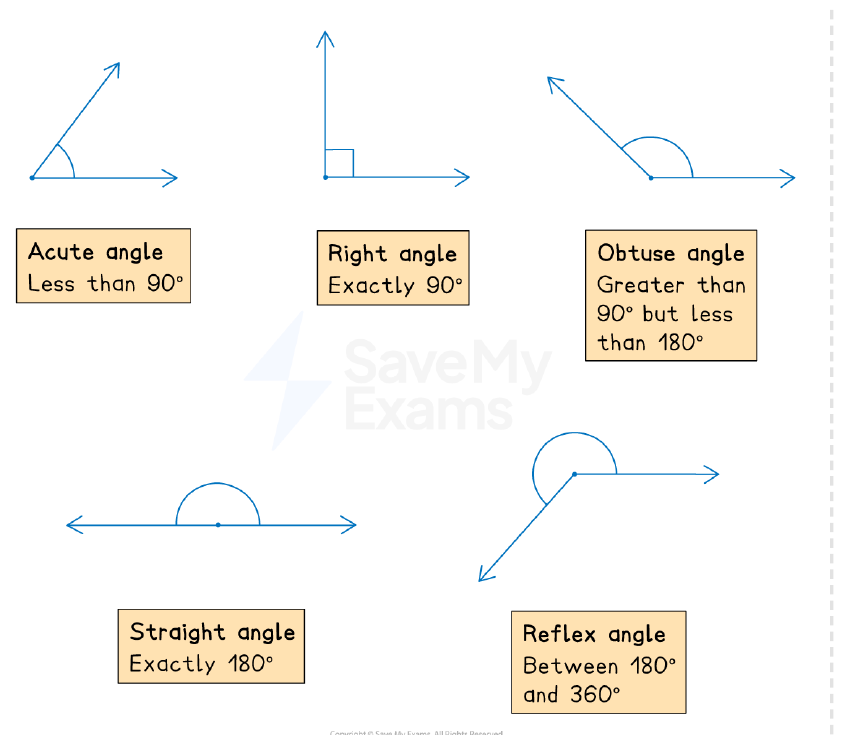
- Acute angle: less than 90°; right angle: exactly 90°; obtuse angle: greater than 90° but less than 180°.
- Straight angle: exactly 180°; reflex angle: greater than 180° but less than 360°.
- Angles at a point sum to 360°; angles on a straight line sum to 180°; angles that sum to 180° are supplementary.
Types of angles
Rotational Symmetry
- Rotational symmetry is the number of times a shape looks the same during a full 360° rotation; this number is the order of rotational symmetry.
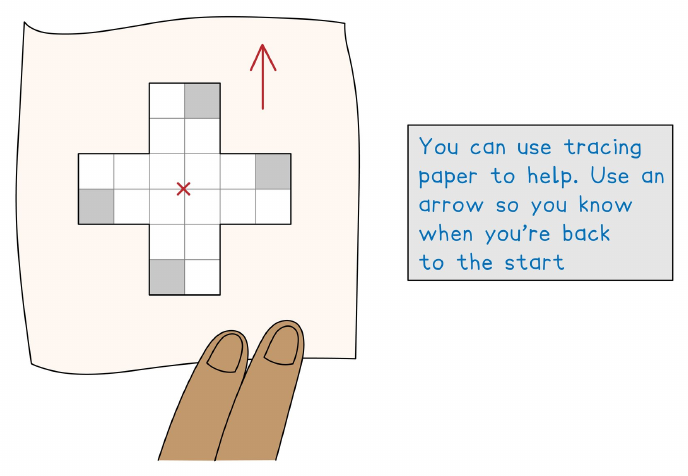
- Use tracing paper with an arrow to track orientation; returning to the start counts as 1, so order is at least 1.
- A shape with order 1 has no rotational symmetry (only looks the same at the start).
- A regular octagon has rotational symmetry of order 8; a regular pentagon has order 5.
Finding rotational symmetry with tracing paper
Lines of Symmetry
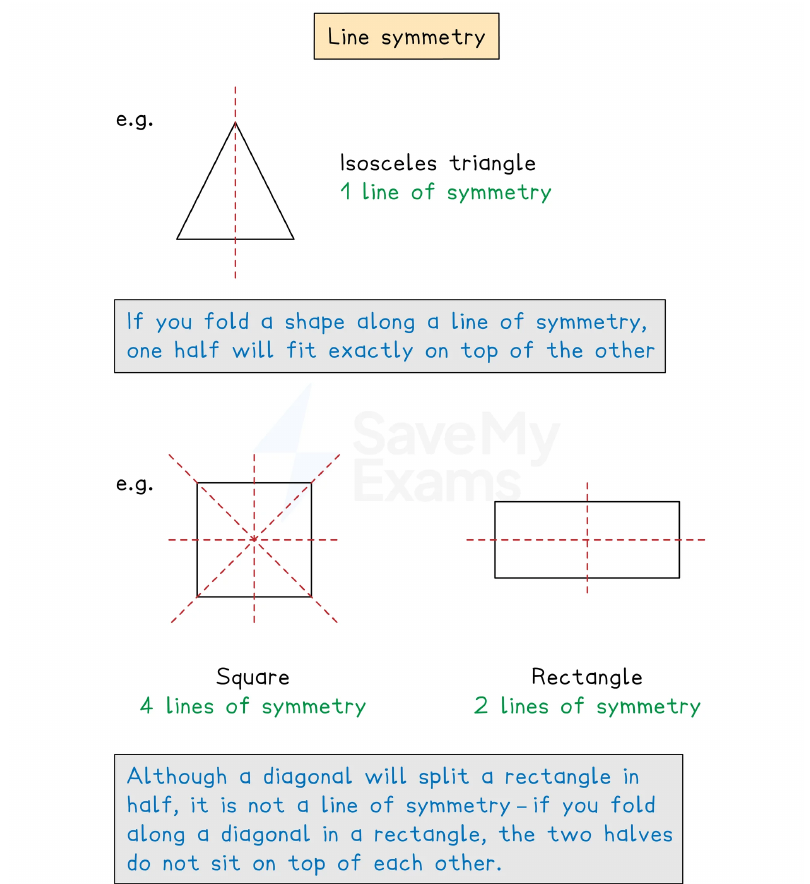
- A line of symmetry divides a shape into two mirror-image halves; folding along it makes the halves coincide.
- Some shapes have multiple lines of symmetry (e.g., square has 4, rectangle has 2).
- To complete a shape given a line of symmetry, reflect the given part across the line.
- Diagonal lines of symmetry require careful reflection; tracing paper can help.
Lines of symmetry
Properties of Polygons
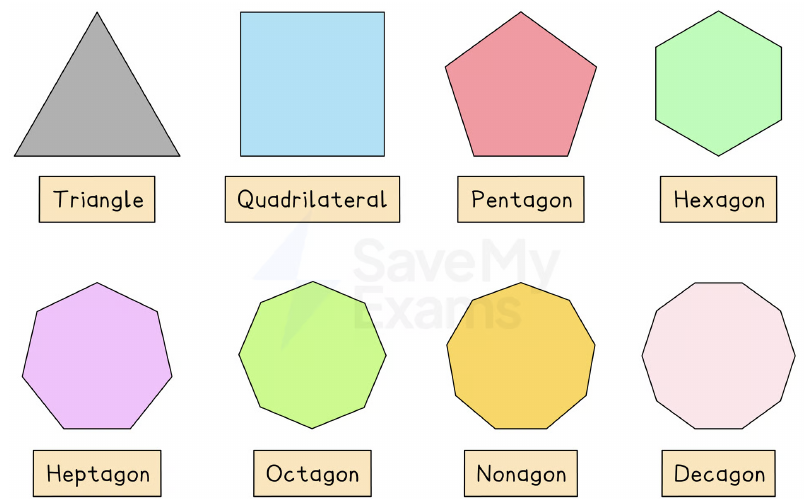
- Polygons are named by number of sides: triangle (3), quadrilateral (4), pentagon (5), hexagon (6), heptagon (7), octagon (8), nonagon (9), decagon (10).
- A regular polygon has all sides equal and all angles equal.
- Triangles: equilateral (3 equal sides/angles), isosceles (2 equal sides/angles), right-angled (one 90° angle), scalene (no equal sides).
- Quadrilaterals: square (4 equal sides, 4 right angles, 4 lines of symmetry, order 4 rotational symmetry).
- Rectangle: opposite sides equal, 4 right angles, 2 lines of symmetry, order 2 rotational symmetry.
- Parallelogram: opposite sides parallel and equal, opposite angles equal, no lines of symmetry, order 2 rotational symmetry.
- Rhombus: all sides equal, opposite sides parallel, opposite angles equal, 2 lines of symmetry, order 2 rotational symmetry.
- Trapezium: one pair of parallel sides; isosceles trapezium: non-parallel sides equal, 1 line of symmetry.
- Kite: two pairs of equal adjacent sides, one pair of equal opposite angles, 1 line of symmetry, order 1 rotational symmetry.
Named polygons
Properties of Circles
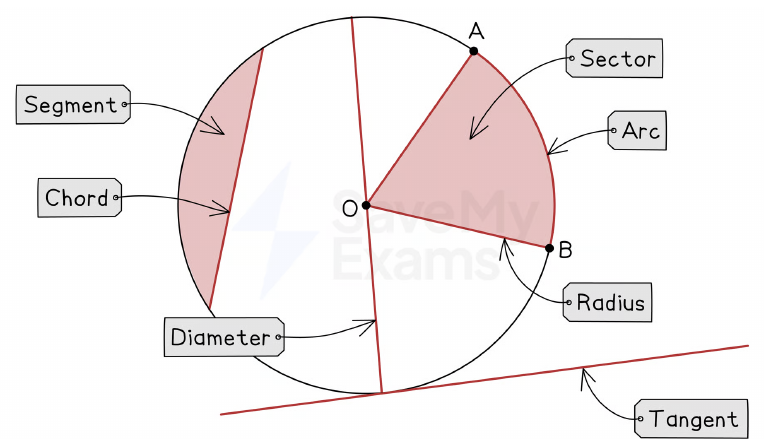
- Key terms: circumference (perimeter), diameter (line through centre, 2× radius), radius (centre to circumference).
- Chord: line joining two points on circumference; arc: part of circumference; sector: region between two radii and an arc.
- Segment: region between a chord and an arc; tangent: line touching circle at one point only.
- Diameter = 2 × radius; ratio circumference/diameter = π.
Parts of a circle
Properties of 3D Shapes
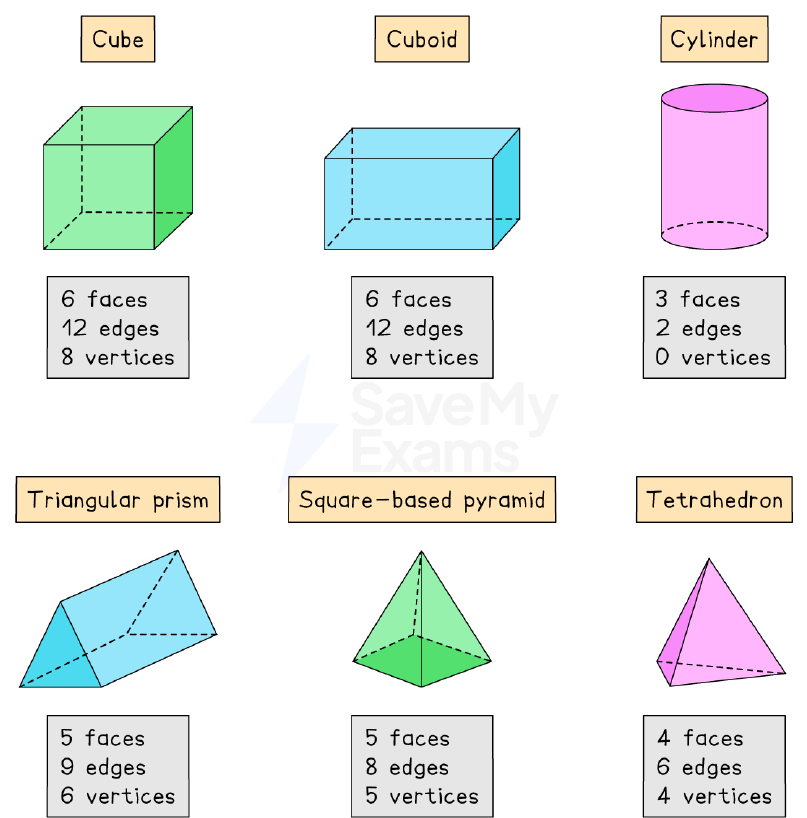
- A prism has the same cross-section throughout; examples: cube (square cross-section), cuboid (rectangle), triangular prism, cylinder (circle).
- A pyramid has a flat base and sloping sides meeting at an apex; square-based pyramid, tetrahedron (triangular-based pyramid), cone (circular base).
- Faces: flat surfaces; vertices: corners; edges: lines where faces meet.
- Cube: 6 square faces, 12 edges, 8 vertices. Cuboid: 6 rectangular faces, 12 edges, 8 vertices.
- Triangular prism: 2 triangular + 3 rectangular faces, 9 edges, 6 vertices. Square-based pyramid: 1 square + 4 triangular faces, 8 edges, 5 vertices.
- Cylinder: 2 circular + 1 curved face, 2 edges, 0 vertices. Sphere: 1 curved face, 0 edges, 0 vertices.
Properties of common 3D shapes
Nets of Solids
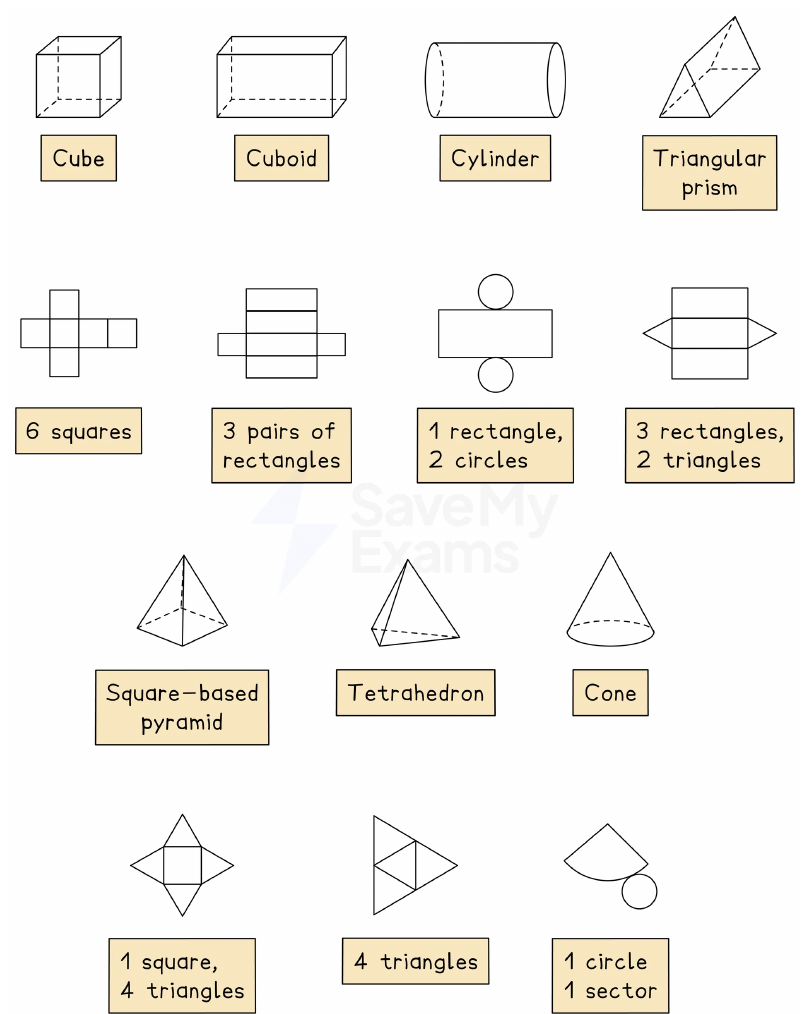
- A net is a 2D shape that can be folded to form a 3D solid; the area of the net equals the surface area of the solid.
- Net of a cube: 6 squares; there are 11 possible nets, the most common is a cross shape.
- Net of a cuboid: 6 rectangles in three pairs (opposite faces equal); 54 possible nets.
- Net of a cylinder: two circles (top and bottom) and a rectangle (curved surface); rectangle length = circumference of circle.
- Net of a square-based pyramid: one square and four congruent triangles.
Nets of common solids
Slide
Sign up free to view the lesson slides
Step through every slide for this topic — plus flashcards and revision notes — with a free account.
Câu hỏi luyện tập
Xem trước miễn phí — 8 trên 38 câu hỏi. Đăng ký để xem tất cả.
1.What is the order of rotational symmetry of a regular octagon?
Easy- A8
- B4
- C6
- D2
2.What is the mathematical name for a quadrilateral with exactly one pair of parallel sides?
Easy- ATrapezium
- BParallelogram
- CRhombus
- DKite
3.Write down the mathematical name for an angle which is less than 90°.
Easy- AAcute angle
- BObtuse angle
- CRight angle
- DReflex angle
4.How many lines of symmetry does a regular pentagon have?
Easy- A5
- B4
- C3
- D2
5.What is the order of rotational symmetry of a regular pentagon?
Easy- A5
- B4
- C3
- D2
6.Write down the mathematical name for a polygon with 5 sides.
Easy- APentagon
- BHexagon
- CHeptagon
- DOctagon
7.A quadrilateral has rotational symmetry of order 2 and exactly two lines of symmetry. What is its mathematical name?
Medium- ARectangle
- BKite
- CSquare
- DParallelogram
8.The diagram shows a circle with centre O and a chord AB. What is the mathematical name for line AB?
Medium- AChord
- BDiameter
- CRadius
- DTangent
Unlock all 38 questions, flashcards & more
Tạo tài khoản miễn phí để xem mọi câu hỏi, slide, thẻ ghi nhớ và ghi chú ôn tập cho chủ đề này.