Congruence And Similarity
Học bằng cách chơi
Trả lời những câu hỏi này để kiếm năng lượng, rồi câu cá và khám phá. Không cần tài khoản.
Ghi chú bài học
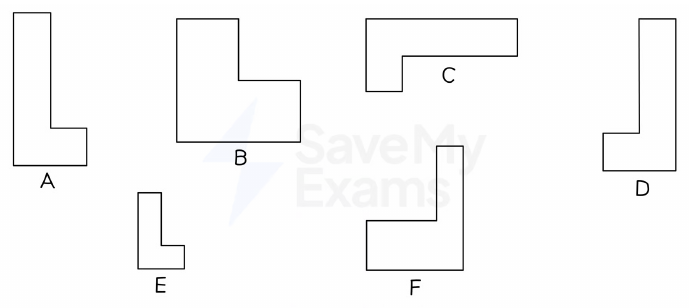
Congruence
- Two shapes are congruent if they are identical in shape and size.
- One shape may be a reflection, rotation, or translation of the other.
- If one shape is an enlargement of the other, they are not congruent.
- To prove congruence, show that corresponding sides are equal in length and corresponding angles are equal in size.
- Tracing paper can help check congruence if shapes are drawn to scale.
Congruent Shapes
Similarity
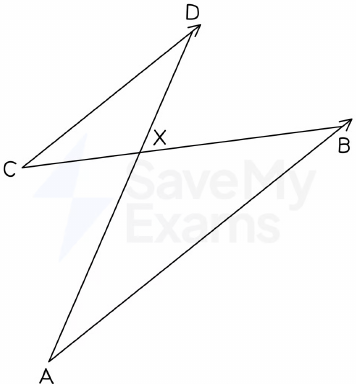
- Two shapes are similar if they have the same shape and their corresponding sides are in proportion.
- One shape is an enlargement of the other; similarity does not imply congruence.
- For triangles, prove similarity by showing corresponding angles are equal (e.g., using vertically opposite angles, alternate angles on parallel lines).
- For non-triangular shapes, show that all corresponding sides are in the same ratio (scale factor).
- If all angles are equal, the shapes are similar (but not necessarily congruent).
Similar Triangles in an Hourglass
Similar Lengths
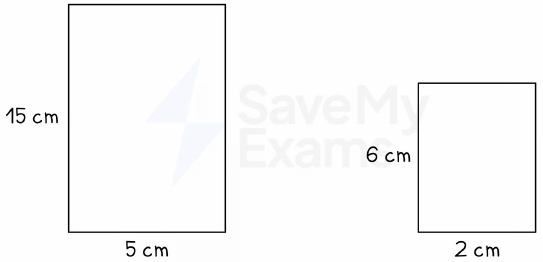
- Equivalent lengths on similar shapes are linked by a scale factor (k).
- If the second shape is larger, k > 1; if smaller, 0 < k < 1.
- To find k: divide a length on the second shape by the corresponding length on the first shape.
- To find a missing length: multiply the corresponding length by k (if going to larger) or divide by k (if going to smaller).
- Redraw overlapping similar shapes separately to avoid confusion.
Similar Rectangles
Similar Areas & Volumes
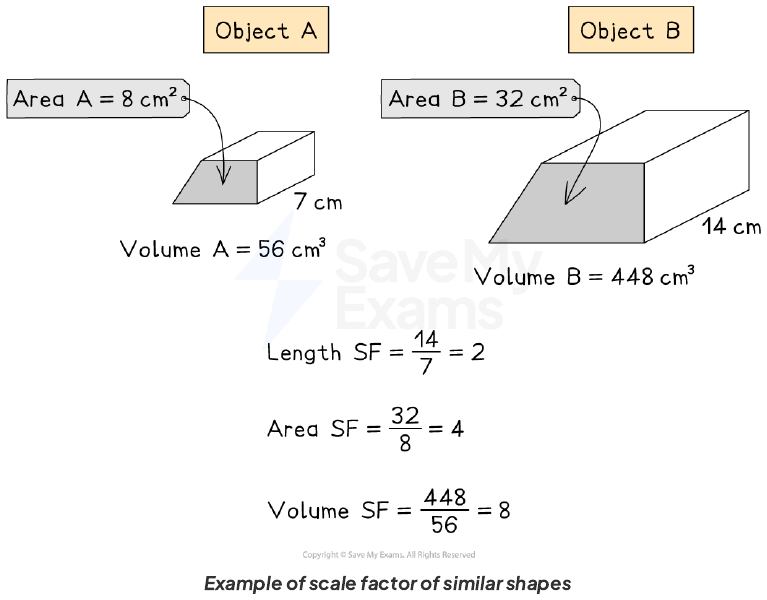
- If length scale factor = k, then area scale factor = k² and volume scale factor = k³.
- Given area scale factor, length scale factor = √(area SF); volume scale factor = (√(area SF))³.
- Given volume scale factor, length scale factor = ∛(volume SF); area scale factor = (∛(volume SF))².
- To find missing area or volume: identify known quantities, find the relevant scale factor, then multiply or divide accordingly.
- Always check whether the result should be larger or smaller than the given quantity.
Similar Solids: Length, Area and Volume Scale Factors
Worked Examples (Lengths)
- Example: Two similar rectangles have sides 6 cm and 3 cm. Scale factor = 6/3 = 2 (larger to smaller) or 3/6 = 0.5 (smaller to larger).
- To find missing side: if AD = 15 cm on larger, corresponding PS on smaller = 15 × 0.5 = 7.5 cm.
- Always identify corresponding sides correctly before applying scale factor.
Finding a Missing Length on a Similar Shape
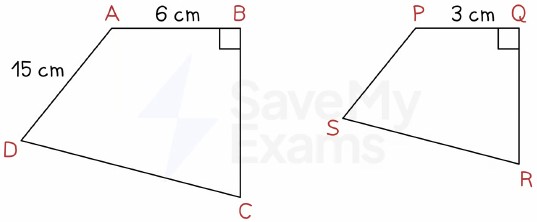
Worked Examples (Areas & Volumes)
- Example: Solid A volume 32 cm³, solid B volume 108 cm³. k³ = 108/32 = 27/8, so k = ∛(27/8) = 3/2.
- If height of A = 10 cm, height of B = 10 × (3/2) = 15 cm.
- For areas: if area scale factor = 4, then length scale factor = √4 = 2.
Slide
Sign up free to view the lesson slides
Step through every slide for this topic — plus flashcards and revision notes — with a free account.
Câu hỏi luyện tập
Xem trước miễn phí — 8 trên 44 câu hỏi. Đăng ký để xem tất cả.
1.Two shapes are congruent if they are identical in shape and size. Which of the following transformations does NOT change congruence?
Easy- AEnlargement
- BReflection
- CRotation
- DTranslation
2.Triangle ABC is similar to triangle PQR. AB = 6 cm, PQ = 9 cm. What is the length scale factor from triangle ABC to triangle PQR?
Easy- A1.5
- B0.666...
- C2
- D3
3.Two rectangles are similar. The smaller rectangle has width 4 cm and length 6 cm. The larger rectangle has width 10 cm. What is the length of the larger rectangle?
Easy- A15 cm
- B12 cm
- C20 cm
- D8 cm
4.Solid A and solid B are mathematically similar. The volume of solid A is 32 cm³ and the volume of solid B is 108 cm³. The height of solid A is 10 cm. Find the height of solid B.
Medium- A15 cm
- B20 cm
- C12 cm
- D18 cm
5.Two cones are mathematically similar. The total surface area of the smaller cone is 80 cm² and of the larger cone is 180 cm². The volume of the smaller cone is 168 cm³. Calculate the volume of the larger cone.
Hard- A567 cm³
- B378 cm³
- C756 cm³
- D283.5 cm³
6.A model of a car has a scale 1:20. The volume of the actual car is 12 m³. Find the volume of the model in cubic centimetres.
Medium- A1500 cm³
- B1500000 cm³
- C3000 cm³
- D600 cm³
7.Two mathematically similar containers have heights of 30 cm and 75 cm. The larger container has a capacity of 5.5 litres. Calculate the capacity of the smaller container in millilitres.
Medium- A352 ml
- B880 ml
- C220 ml
- D550 ml
8.Two containers are mathematically similar. The surface area of the larger container is 226 cm² and the surface area of the smaller container is 94 cm². The volume of the larger container is 680 cm³. Find the volume of the smaller container.
Hard- A183 cm³
- B150 cm³
- C200 cm³
- D250 cm³
Unlock all 44 questions & more
Tạo tài khoản miễn phí để xem mọi câu hỏi, slide, thẻ ghi nhớ và ghi chú ôn tập cho chủ đề này.