Functions
Học bằng cách chơi
Trả lời những câu hỏi này để kiếm năng lượng, rồi câu cá và khám phá. Không cần tài khoản.
Ghi chú bài học
Introduction to Functions
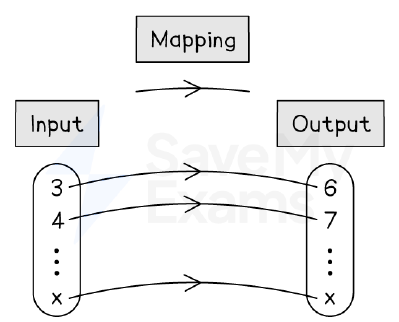
- A function is a mathematical 'machine' that takes an input and produces an output.
- Function notation: f(x) = ... means the function f with input x.
- Common letters for functions: f, g, h, j.
- To evaluate f(a), substitute a for x in the expression.
- If f(x) = output is known, solve f(x) = value to find the input x.
Mapping diagram for a function
Domain & Range
- The domain is the set of all possible inputs (x-values).
- The range is the set of all possible outputs (f(x)-values).
- Domain restrictions: avoid division by zero (e.g., x ≠ 0 for 1/x) and square roots of negatives (e.g., x ≥ 0 for √x).
- Range depends on domain; sketch the graph to help find the range.
- For a linear function f(x)=mx+c on a ≤ x ≤ b, the range is between f(a) and f(b) (order depends on gradient).
Composite Functions
- A composite function applies one function to the output of another.
- Notation: gf(x) means do f first, then g: gf(x) = g(f(x)).
- fg(x) means do g first, then f: fg(x) = f(g(x)).
- ff(x) or f²(x) means apply f twice.
- To evaluate numerically: work from the inside out.
Inverse Functions
- An inverse function reverses the original function; notation: f⁻¹(x).
- If f(a)=b, then f⁻¹(b)=a.
- To find f⁻¹(x) algebraically: write y = f(x), swap x and y, then solve for y.
- The composite of a function and its inverse cancels: ff⁻¹(x) = f⁻¹f(x) = x.
- Domain of f⁻¹ = range of f; range of f⁻¹ = domain of f.
Finding Inverse Functions
- Step 1: Write y = f(x).
- Step 2: Swap x and y to get x = f(y).
- Step 3: Rearrange to make y the subject.
- Step 4: Replace y with f⁻¹(x).
- Example: f(x)=2x+1 → f⁻¹(x) = (x-1)/2.
Domain and Range from Graphs
- The graph of y = f(x) shows domain on x-axis and range on y-axis.
- For f(x)=x², domain all real numbers, range f(x) ≥ 0.
- For f(x)=1/x, domain x≠0, range f(x)≠0.
- For f(x)=√x, domain x≥0, range f(x)≥0.
- Sketching helps visualise domain and range.
Graph of y = g(x) = 3x^2, domain x >= 0
Composite Functions Algebraically
- To find gf(x) algebraically, substitute f(x) into g.
- Example: f(x)=2x-1, g(x)=x² → gf(x) = (2x-1)².
- Simplify the resulting expression.
- Be careful with order: gf(x) ≠ fg(x) generally.
Inverse Functions and Solving Equations
- If f⁻¹(x)=c, then x = f(c) using cancellation.
- Example: f(x)=2x, solve f⁻¹(x)=5 → x = f(5)=10.
- This avoids finding f⁻¹ explicitly.
- Useful when inverse is difficult to find algebraically.
Slide
Sign up free to view the lesson slides
Step through every slide for this topic — plus flashcards and revision notes — with a free account.
Câu hỏi luyện tập
Xem trước miễn phí — 8 trên 64 câu hỏi. Đăng ký để xem tất cả.
1.A function is defined as f(x) = 3x - 5. What is the value of f(2)?
Easy- A1
- B6
- C-1
- D11
2.The domain of a function f(x) is the set of all possible inputs. Which of the following is the correct domain for f(x) = 1/x?
Easy- AAll real numbers
- Bx ≠ 0
- Cx > 0
- Dx ≥ 0
3.For the function f(x) = 2x + 1, what is the output when the input is -3?
Easy- A-5
- B5
- C-7
- D7
4.Given f(x) = 7 - 2x, find f(-3).
Easy- A13
- B1
- C-13
- D-1
5.The function f is defined by f(x) = 3x - 5. The domain of f is {-3, 0, 2}. What is the range of f?
Medium- A{-14, -5, 1}
- B{-4, -5, 1}
- C{-14, -5, 11}
- D{ -4, -5, 11}
6.Given f(x) = 2x2 and g(x) = 4x3, find fg(1).
Medium- A8
- B32
- C16
- D4
7.If f(x) = 7x - 4 and g(x) = 2x/(x-3), x ≠ 3, find fg(4).
Medium- A52
- B24
- C60
- D38
8.The function f is defined by f(x) = 2x - 7. The domain of f is {-2, 0, 5}. What is the range of f?
Medium- A{-11, -7, 3}
- B{-11, -7, 17}
- C{-3, -7, 3}
- D{-11, 7, 3}
Unlock all 64 questions & more
Tạo tài khoản miễn phí để xem mọi câu hỏi, slide, thẻ ghi nhớ và ghi chú ôn tập cho chủ đề này.