Percentages Toolkit
Học bằng cách chơi
Trả lời những câu hỏi này để kiếm năng lượng, rồi câu cá và khám phá. Không cần tài khoản.
Ghi chú bài học
Basic Percentages
- Percentage means 'out of 100' (e.g., 50% = 50/100).
- Convert a fraction to a percentage by finding an equivalent fraction with denominator 100, or by using a calculator: e.g., 234/650 = 0.36 = 36%.
- Key building blocks: 50% (halve), 25% (halve twice), 10% (divide by 10), 1% (divide by 100).
- Combine blocks: e.g., 20% = 10% × 2; 5% = 10% ÷ 2; 12% = 10% + 1% + 1%.
- With a calculator, use a multiplier (decimal equivalent): e.g., 12% of 650 = 0.12 × 650 = 78.
- To express one number as a percentage of another, write as a fraction then convert to decimal and multiply by 100.
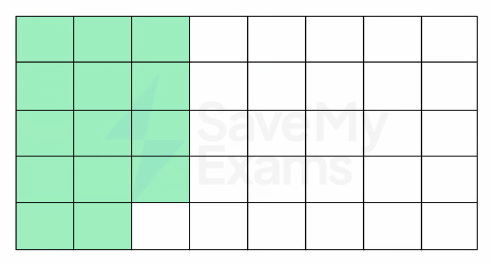
- Worked example: shade 35% of a 40-square grid — 10% = 4, so 30% = 12 and 5% = 2, total 14 squares shaded.
35% of a 40-square grid
Percentage Increases & Decreases
- To increase by a percentage, find the percentage of the original and add it on, or find (100 + x)% and use multiplier (1 + x/100).
- To decrease by a percentage, find the percentage and subtract, or find (100 - x)% and use multiplier (1 - x/100).
- For repeated percentage changes, multiply all multipliers together: e.g., increase by 10% (×1.10) then discount 15% (×0.85) gives combined multiplier 1.10 × 0.85 = 0.935.
- Percentage change = (after - before) / before × 100; positive = increase, negative = decrease.
- Percentage profit/loss = (selling price - cost price) / cost price × 100; positive = profit, negative = loss.
Reverse Percentages
- A reverse percentage question gives the value after a percentage change and asks for the original (before) value.
- Identify the multiplier p: for an increase of x%, p = 1 + x/100; for a decrease of x%, p = 1 - x/100.
- Use the equation: before × p = after, so before = after / p.
- Common mistake: a 10% increase followed by a 10% decrease does NOT return to the original (e.g., 100 → 110 → 99).
Slide
Sign up free to view the lesson slides
Step through every slide for this topic — plus flashcards and revision notes — with a free account.
Câu hỏi luyện tập
Xem trước miễn phí — 8 trên 53 câu hỏi. Đăng ký để xem tất cả.
1.What is 12% of 650?
Easy- A78
- B65
- C72
- D80
2.Write $1.92 as a percentage of $1.60.
Medium- A120%
- B83.3%
- C80%
- D125%
3.In a box of 80 glasses, 3 are broken. Work out the percentage of broken glasses.
Easy- A3.75%
- B2.5%
- C4%
- D3%
4.Work out 5% of $25.
Easy- A$1.25
- B$1.00
- C$1.50
- D$0.75
5.Work out $1.20 as a percentage of $16.
Medium- A7.5%
- B8%
- C6%
- D9%
6.67 of 645 parcels are damaged. Calculate the percentage of parcels that are damaged.
Medium- A10.4%
- B9.8%
- C11.2%
- D10.8%
7.Increase 42 by 16%.
Medium- A48.72
- B46.2
- C49.2
- D47.8
8.The surface area of France is 6.41 × 10⁵ km² and China is 9.60 × 10⁶ km². Find France's area as a percentage of China's.
Medium- A6.68%
- B7.5%
- C5.9%
- D8.1%
Unlock all 53 questions & more
Tạo tài khoản miễn phí để xem mọi câu hỏi, slide, thẻ ghi nhớ và ghi chú ôn tập cho chủ đề này.