Powers Roots And Standard Form
Học bằng cách chơi
Trả lời những câu hỏi này để kiếm năng lượng, rồi câu cá và khám phá. Không cần tài khoản.
Ghi chú bài học
Powers & Roots
- Powers (indices) show repeated multiplication: e.g., 6³ = 6 × 6 × 6.
- Any non-zero number to the power of 0 equals 1: 3⁰ = 1.
- Any number to the power of 1 equals itself: 3¹ = 3.
- Square roots reverse squaring; every positive number has two square roots (positive and negative). Notation √ refers to the positive root.
- Cube roots reverse cubing; each number has exactly one real cube root (∛).
- nth roots: if n is even, positive numbers have two real nth roots; negative numbers have none. If n is odd, every number has one real nth root.
- Reciprocal of a number is 1 divided by that number; written as index -1 (e.g., 5⁻¹ = 1/5).
Laws of Indices
- Multiplication: aᵐ × aⁿ = aᵐ⁺ⁿ (add powers).
- Division: aᵐ ÷ aⁿ = aᵐ⁻ⁿ (subtract powers).
- Power of a power: (aᵐ)ⁿ = aᵐⁿ (multiply powers).
- Negative power: a⁻ⁿ = 1/aⁿ (reciprocal).
- Fractional power: a1/n = ⁿ√a; am/n = (ⁿ√a)ᵐ = ⁿ√(aᵐ).
- Zero power: a⁰ = 1 (for a ≠ 0).
- Product and quotient rules: (ab)ⁿ = aⁿbⁿ; (a/b)ⁿ = aⁿ/bⁿ.
Converting to Standard Form
- Standard form: A × 10ⁿ, where 1 ≤ A < 10 and n is an integer.
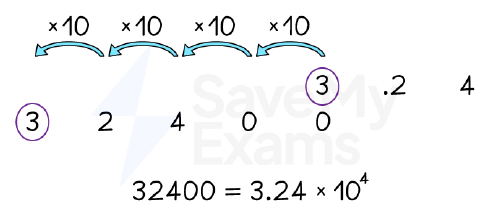
- For large numbers (≥10), n is positive: count how many places the decimal moves left. Example: 32400 = 3.24 × 10⁴.
- For small numbers (0 < number < 1), n is negative: count how many places the decimal moves right. Example: 0.0000324 = 3.24 × 10⁻⁵.
- To convert from standard form to ordinary number, move the decimal point n places (right if n>0, left if n<0).
Converting a large number to standard form
Operations with Standard Form
- Multiplication: multiply the A parts, add the powers of 10, then adjust to standard form. Example: (3×10²)×(4×10⁵)=12×10⁷=1.2×10⁸.
- Division: divide the A parts, subtract the powers of 10, then adjust. Example: (2×10⁻⁵)÷(8×10⁻³)=0.25×10⁻²=2.5×10⁻³.
- Addition/Subtraction (Method 1): convert both to ordinary numbers, add/subtract, then convert back to standard form.
- Addition/Subtraction (Method 2): rewrite numbers to have the same power of 10, add/subtract the A parts, then adjust. Efficient for large or negative exponents.
- On a calculator, use brackets and the ×10ˣ button to enter standard form numbers.
Common Mistakes & Tips
- Index laws only work with same base; e.g., 2³×5² cannot be simplified directly.
- A negative power means reciprocal, not a negative number: 2⁻⁴ = 1/16, not -16.
- When taking even roots of positive numbers, remember there are two roots (e.g., √25 = ±5), but the radical sign denotes the principal (positive) root.
- In standard form, A must be ≥1 and <10; if not, adjust by moving the decimal and changing the exponent accordingly.
Slide
Sign up free to view the lesson slides
Step through every slide for this topic — plus flashcards and revision notes — with a free account.
Câu hỏi luyện tập
Xem trước miễn phí — 8 trên 62 câu hỏi. Đăng ký để xem tất cả.
1.Write 510 100 000 in standard form.
Easy- A5.101 × 108
- B5.101 × 109
- C51.01 × 107
- D5.101 × 107
2.Write 0.00527 in standard form.
Easy- A5.27 × 10-3
- B5.27 × 10-4
- C5.27 × 103
- D52.7 × 10-4
3.Write 3.4 × 10⁻¹ as an ordinary number.
Easy- A0.34
- B34
- C3.4
- D0.034
4.Which of these numbers is the largest? 3.4 × 10⁻¹, 1.36 × 10⁶, 7.9 × 100, 2.4 × 10⁵, 5.21 × 10⁻³, 4.3 × 10⁻²
Easy- A1.36 × 106
- B2.4 × 105
- C7.9 × 100
- D3.4 × 10-1
5.Find the value of (2/5)2.
Easy- A4/25
- B2/25
- C4/5
- D2/5
6.Work out (5.2 × 10⁷) + (5.2 × 10⁶). Give your answer in standard form.
Medium- A5.72 × 107
- B5.2 × 107
- C5.72 × 106
- D1.04 × 108
7.Work out (9 × 10-4) × (3 × 107). Give your answer in standard form.
Medium- A2.7 × 104
- B2.7 × 103
- C2.7 × 105
- D27 × 103
8.Patrick says that 641/4 = 16 because 1/4 of 64 is 16. What is wrong with his reasoning?
Medium- A641/4 means the fourth root of 64, not 1/4 of 64
- B641/4 = 64 ÷ 4 = 16
- C641/4 = 64 × 1/4 = 16
- DNothing, Patrick is correct
Unlock all 62 questions & more
Tạo tài khoản miễn phí để xem mọi câu hỏi, slide, thẻ ghi nhớ và ghi chú ôn tập cho chủ đề này.