Electrical Quantities
Học bằng cách chơi
Trả lời những câu hỏi này để kiếm năng lượng, rồi câu cá và khám phá. Không cần tài khoản.
Ghi chú bài học
Electric Charge
- There are two types of electric charge: positive and negative.
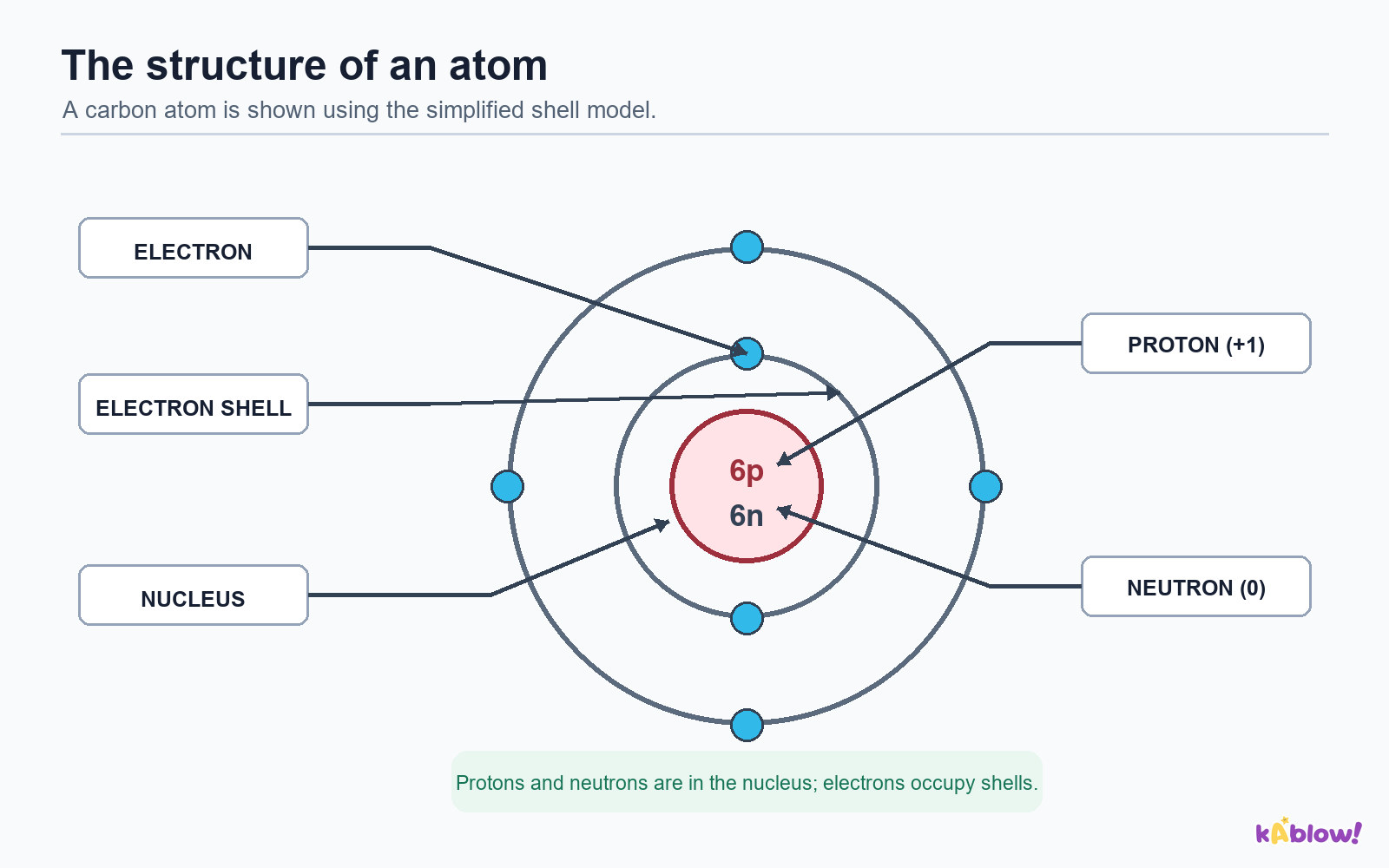
- Inside an atom, electrons are negatively charged, protons are positively charged, and neutrons are neutral.
- Atoms have equal numbers of protons and electrons, so overall they are neutral.
- Like charges repel, opposite charges attract.
- Electric charge is measured in coulombs (C) (Extended tier).
Structure of an atom showing protons, neutrons and electron shells.
Charging by Friction
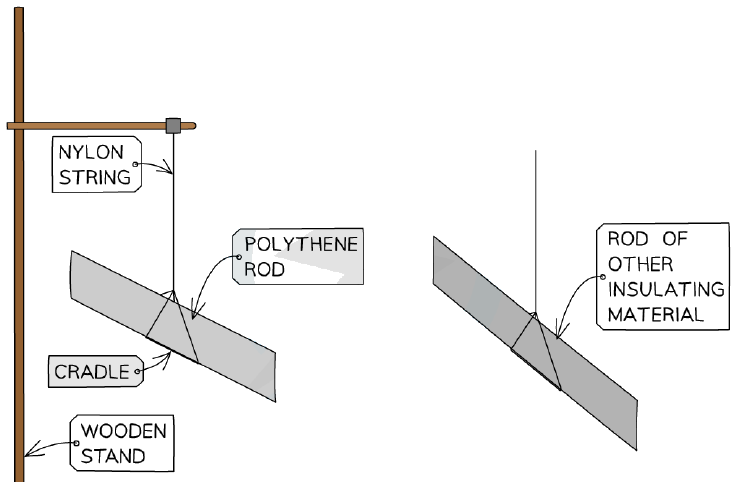
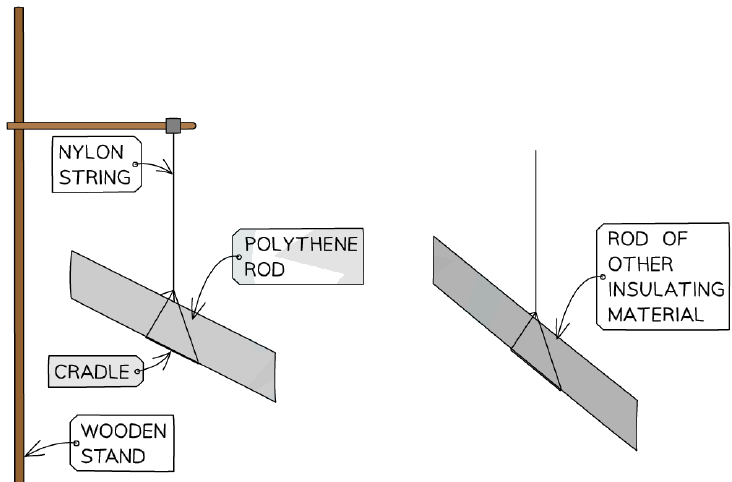
- Rubbing two insulating materials together transfers electrons from one to the other.
- The material that gains electrons becomes negatively charged; the material that loses electrons becomes positively charged.
- Example: rubbing a polythene rod with a cloth transfers electrons from the cloth to the rod → rod becomes negative, cloth becomes positive.
- Example: rubbing an acetate rod with a cloth transfers electrons from the rod to the cloth → rod becomes positive, cloth becomes negative.
- Only electrons move during charging by friction; protons do not move.
Apparatus for demonstrating charging by friction using a polythene rod and another insulating material.
Electric Fields (Extended Tier)
- An electric field is a region where a charge experiences a force.
- Field lines are directed from positive to negative charge.
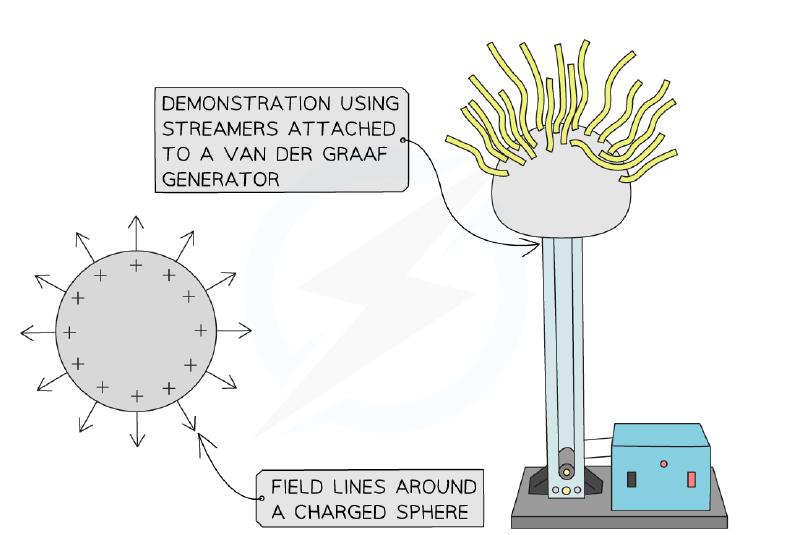
- Around a point charge, field lines are radial: outward for positive, inward for negative.
- Between two parallel plates, the field is uniform with parallel, equally spaced lines.
- Field lines are always perpendicular to the surface of a conductor.
Demonstration of a Van de Graaff generator with streamers and field lines around a charged sphere.
Conductors and Insulators
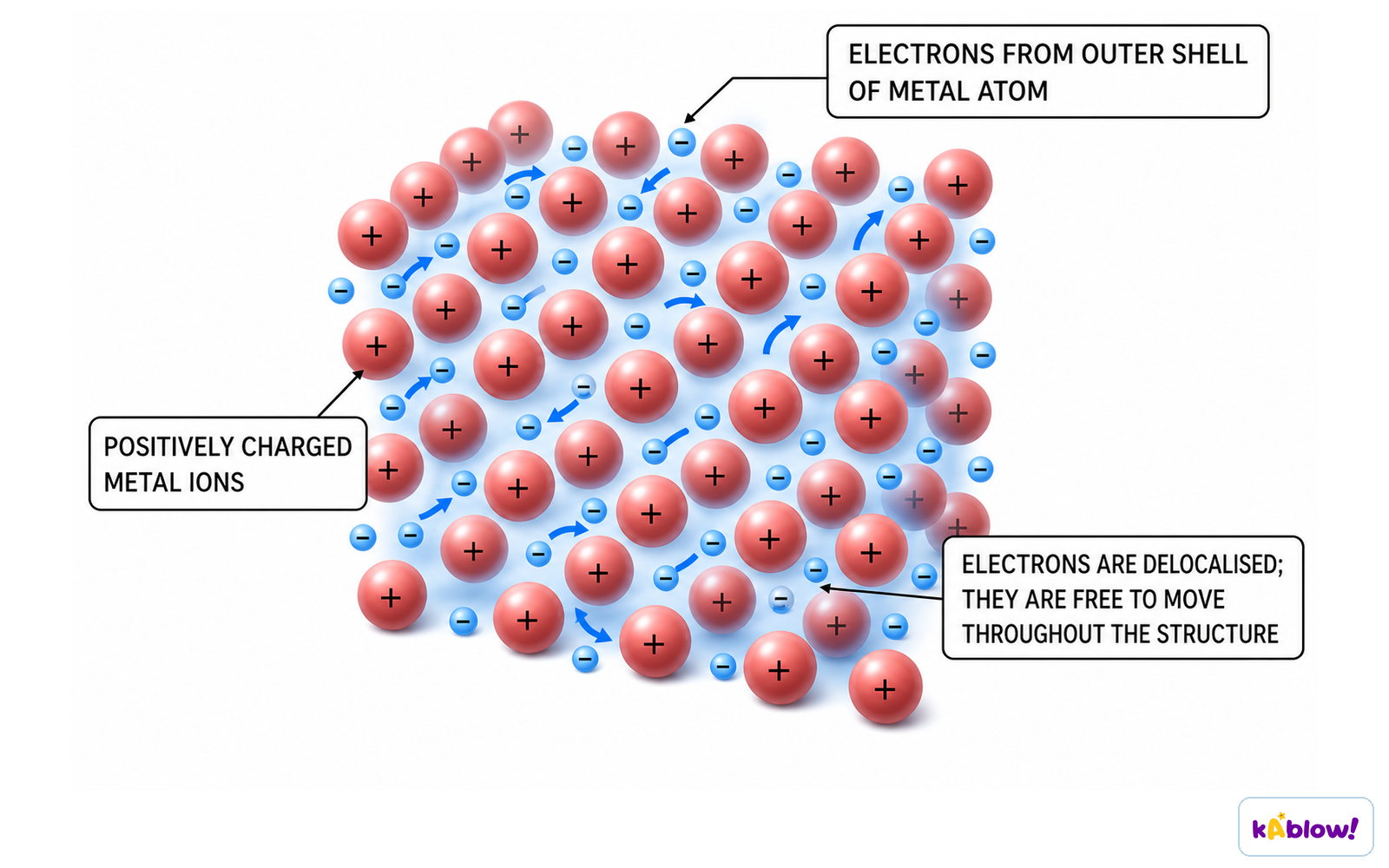
- Conductors (e.g., metals) allow charge to flow easily because they have delocalised electrons.
- Insulators (e.g., plastic, rubber, glass) have no free charges and do not allow charge to flow easily.
- A gold-leaf electroscope can test conductivity: a good conductor makes the leaf fall quickly; an insulator makes it fall slowly or not at all.
A diagram showing delocalised electrons in a metal conductor.
Current
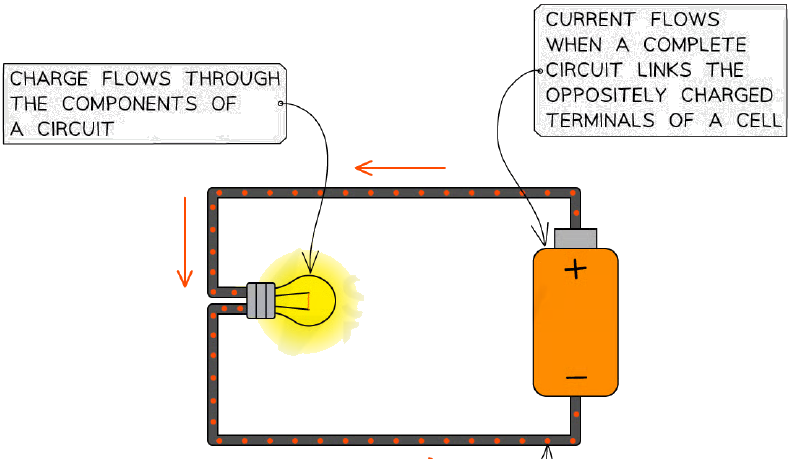
- Electric current is the rate of flow of charge.
- Current is measured in amperes (A) using an ammeter connected in series.
- Conventional current flows from positive to negative terminal (opposite to electron flow).
- Equation: I = \frac{Q}{t} , where Q is charge in coulombs, t is time in seconds (Extended tier).
- In metals, current is a flow of negatively charged electrons.
A simple circuit showing current flow from a cell through a light bulb.
Direct and Alternating Current
- Direct current (d.c.) flows in one direction only; produced by cells and batteries.
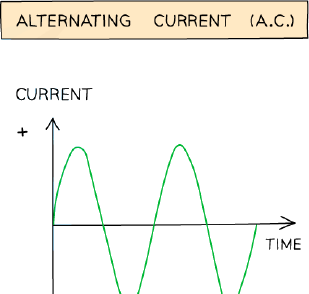
- Alternating current (a.c.) changes direction periodically; produced by mains electricity (UK: 230 V, 50 Hz).
- Graph of d.c. is a horizontal line; graph of a.c. is a sine wave.
Graph of alternating current
Electromotive Force and Potential Difference
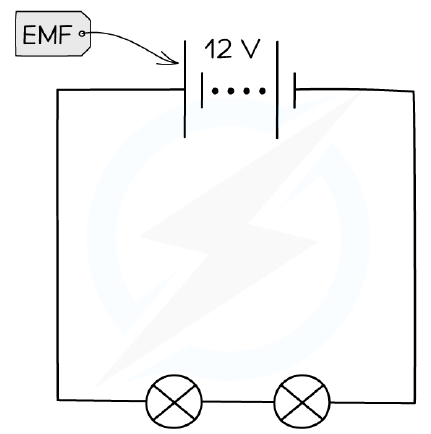
- Electromotive force (e.m.f.) is the energy supplied per unit charge by a source: E = \frac{W}{Q} (Extended tier).
- Potential difference (p.d.) is the energy transferred per unit charge across a component: V = \frac{W}{Q} .
- Both are measured in volts (V).
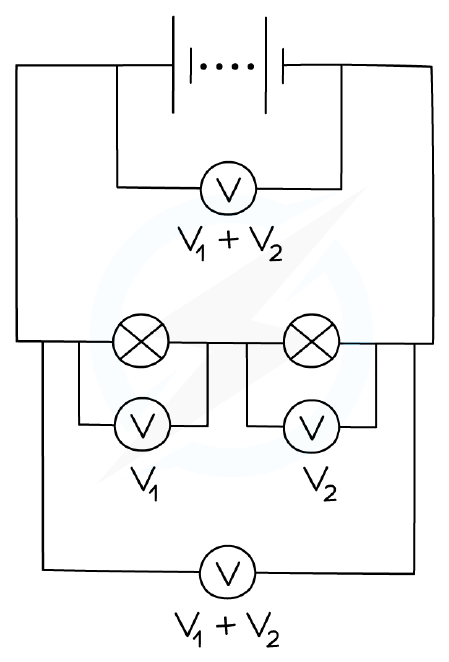
- Voltmeter is connected in parallel to measure p.d.
A simple circuit labelled with the e.m.f. of the power supply.
Resistance and Ohm's Law
- Resistance is the opposition to current; measured in ohms (Ω).
- Ohm's law: R = \frac{V}{I} .
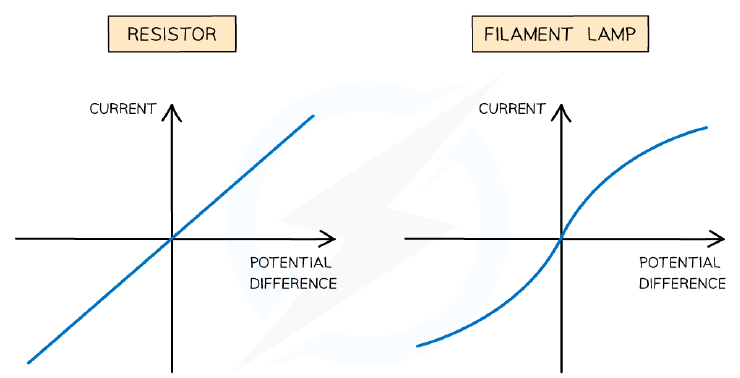
- For a fixed resistor at constant temperature, current is directly proportional to voltage (ohmic conductor).
- For a filament lamp, resistance increases with temperature (non-ohmic).
- A diode allows current in one direction only (forward bias).
Current-voltage graphs for a resistor and a filament lamp.
Resistance of a Wire
- Resistance is directly proportional to length: longer wire → higher resistance.
- Resistance is inversely proportional to cross-sectional area: thicker wire → lower resistance.
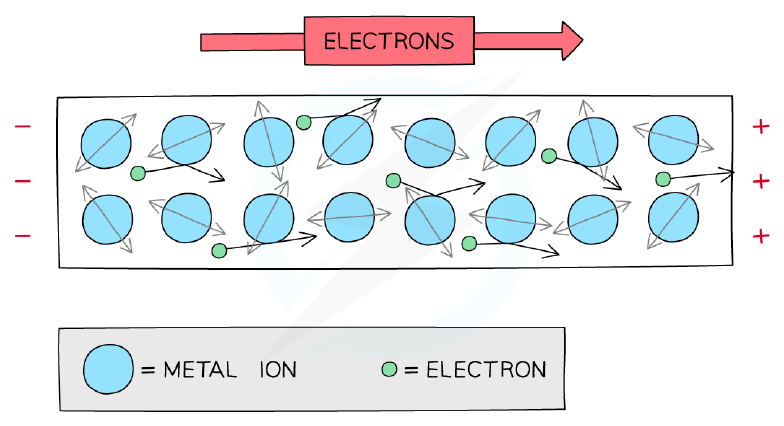
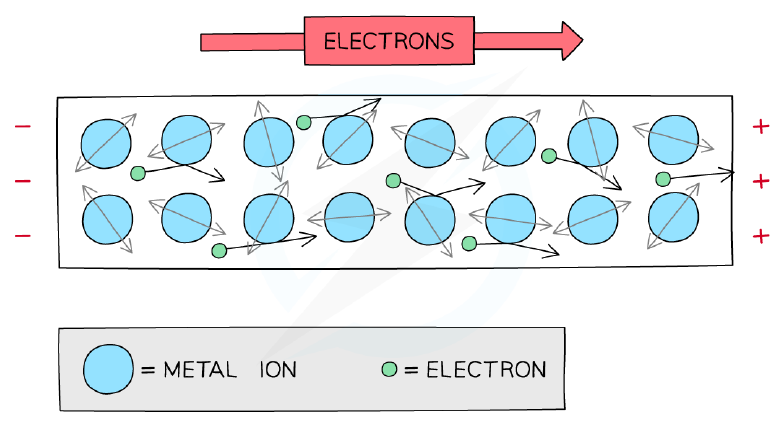
- Increasing temperature increases resistance due to more frequent collisions with vibrating metal ions.
Electrons moving through a material, colliding with atoms and increasing resistance.
Electrical Energy and Power
- Electrical power P = VI , measured in watts (W).
- Electrical energy E = VIt , measured in joules (J).
- Alternative: P = I2R and P = \frac{V2}{R} .
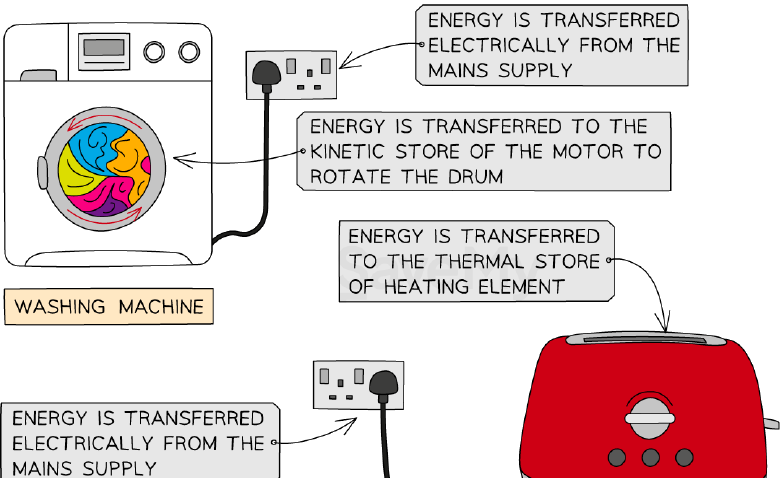
Energy transfer in a washing machine and a toaster
Slide
Sign up free to view the lesson slides
Step through every slide for this topic — plus flashcards and revision notes — with a free account.
Câu hỏi luyện tập
Xem trước miễn phí — 8 trên 46 câu hỏi. Đăng ký để xem tất cả.
1.A polythene rod is rubbed with a cloth and becomes negatively charged. This happens because
Easy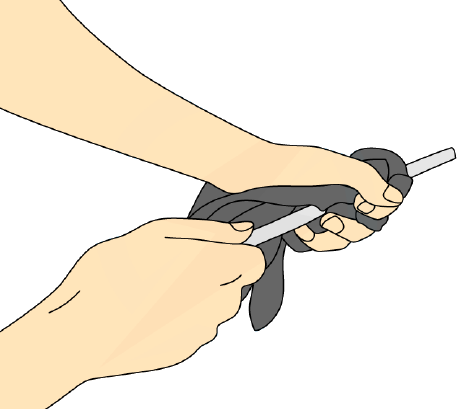
- Aelectrons move from the cloth to the rod
- Belectrons move from the rod to the cloth
- Cprotons move from the cloth to the rod
- Dprotons move from the rod to the cloth
2.Which of the following is a good conductor of electricity?
Easy- ARubber
- BPlastic
- CCopper
- DGlass
3.A lamp is rated at 12 V, 50 W. What is the current through the lamp when operating normally?
Medium- A0.24 A
- B4.17 A
- C600 A
- D38 A
4.The resistance of a wire is 10 Ω. What is the potential difference across the wire when a current of 0.5 A flows through it?
Easy- A0.05 V
- B5 V
- C20 V
- D10.5 V
5.A student connects a voltmeter to measure the potential difference across a lamp. How should the voltmeter be connected?
Easy- AIn series with the lamp
- BIn parallel with the lamp
- CIn series with the power supply
- DIn parallel with the power supply
6.Which graph shows the current-voltage characteristic of a filament lamp?
Medium- AA straight line through the origin
- BA curve that becomes less steep as voltage increases
- CA curve that becomes steeper as voltage increases
- DA horizontal line
7.A charge of 270 kC passes through a 12 V battery. How much electrical energy is transferred?
Medium- A22.5 J
- B3.24 × 106 J
- C3.24 × 103 J
- D2.25 × 104 J
8.Two identical resistors are connected in parallel. The total resistance is 2 Ω. What is the resistance of each resistor?
Medium- A1 Ω
- B2 Ω
- C4 Ω
- D0.5 Ω
Unlock all 46 questions & more
Tạo tài khoản miễn phí để xem mọi câu hỏi, slide, thẻ ghi nhớ và ghi chú ôn tập cho chủ đề này.