Energy, Work & Power
Học bằng cách chơi
Trả lời những câu hỏi này để kiếm năng lượng, rồi câu cá và khám phá. Không cần tài khoản.
Ghi chú bài học
Energy Stores & Transfers
- Energy is a property stored or transferred, measured in joules (J).
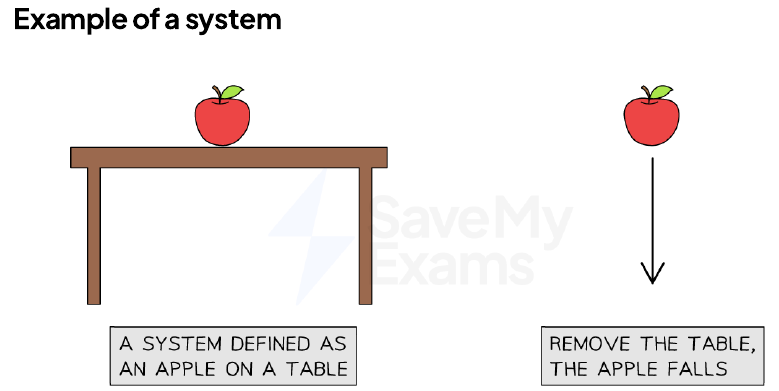
- A system is an object or group of objects; changes within a system involve energy transfer.
- Energy stores include: kinetic, gravitational potential, elastic, magnetic, electrostatic, chemical, nuclear, and thermal.
- Energy transfer pathways: mechanical (force), electrical (charge flow), heating (particle conduction), and radiation (electromagnetic waves).
- Example: a battery-powered torch transfers energy electrically from the chemical store of the battery to the thermal store of the bulb.
- Example: a falling object transfers energy mechanically from its gravitational potential store to its kinetic store.
Example of a system: an apple on a table
Kinetic Energy
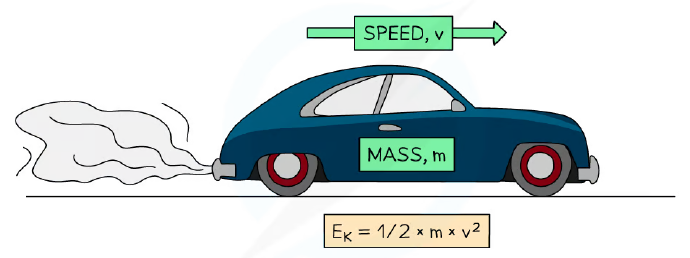
- Kinetic energy is the energy an object has due to its mass and speed: Ek = \frac{1}{2}mv2.
- Doubling mass doubles kinetic energy (directly proportional to mass).
- Doubling speed quadruples kinetic energy (proportional to speed squared).
- Energy is transferred to the kinetic store when an object speeds up, and away when it slows down.
A moving car has energy in its kinetic store
Gravitational Potential Energy
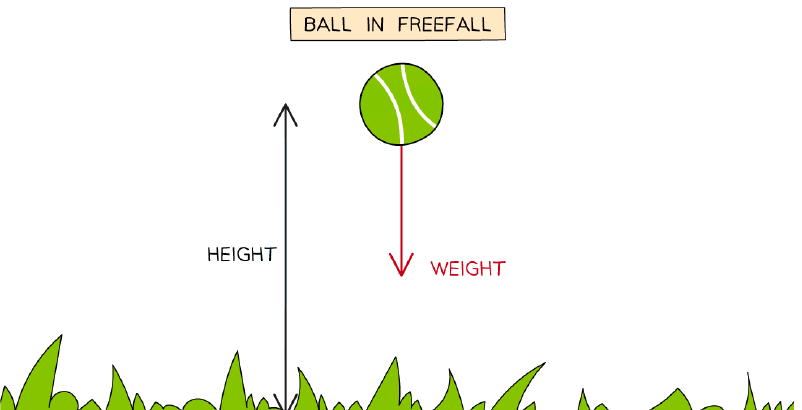
- Gravitational potential energy is the energy an object has due to its height in a gravitational field: \Delta Ep = mg\Delta h.
- Lifting an object transfers energy to its gravitational potential store; lowering transfers energy away.
- Work is done against the weight force to lift an object.
Ball in freefall illustrating height and weight
Conservation of Energy
- Principle of conservation of energy: energy cannot be created or destroyed, only transferred between stores.
- For a closed system, total energy remains constant: total energy in = total energy out.
- Energy can be dissipated (spread out) to the surroundings, often as wasted energy.
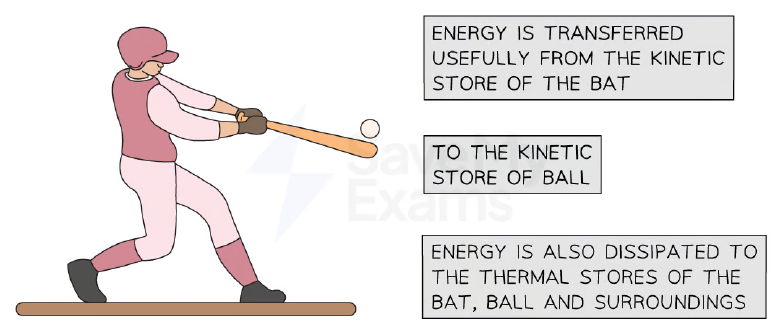
- Example: a bat hitting a ball transfers kinetic energy to the ball (useful) and to thermal stores (wasted).
- Energy flow diagrams show stores and transfers; Sankey diagrams show proportions of useful and wasted energy.
The principle of conservation of energy applied to a bat hitting a ball
Work Done
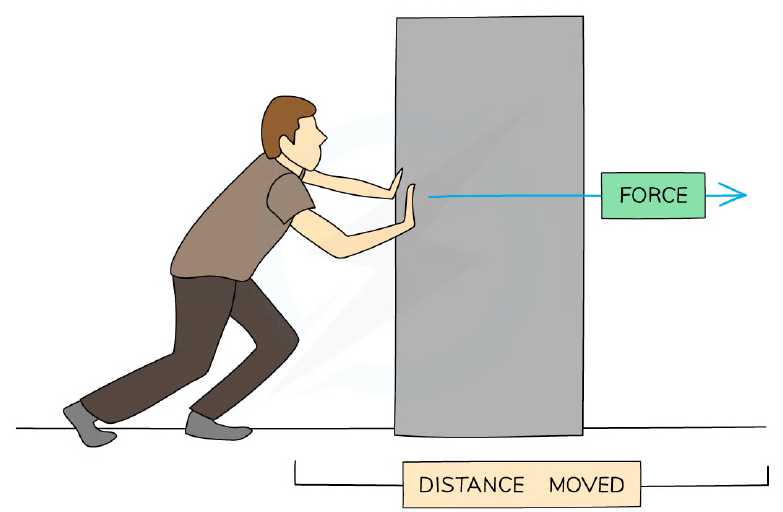
- Work done occurs when a force moves an object over a distance: W = Fd.
- Work done equals energy transferred: 1 N m = 1 J.
- If no movement occurs, no work is done.
- Example: a force of 500 N over 23 m does 11 500 J of work.
Work is done when a force is used to move an object over a distance
Power
- Power is the rate of work done or energy transferred: P = \frac{W}{t} = \frac{\Delta E}{t}.
- Unit of power is the watt (W): 1 W = 1 J/s.
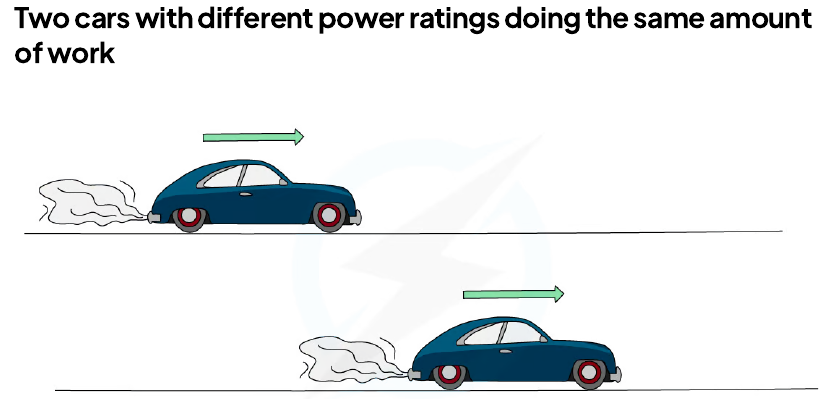
- A more powerful machine does the same work in less time.
- Example: a 2000 W iron used for 5 minutes transfers 600 000 J of energy.
Two cars with different power ratings doing the same amount of work
Efficiency
- Efficiency is the ratio of useful output to total input (energy or power): \text{efficiency} = \frac{\text{useful output}}{\text{total input}} \times 100\%.
- High efficiency means most energy is used usefully; low efficiency means much is wasted.
- Efficiency has no units; can be expressed as a decimal or percentage.
- Example: a motor with 35% efficiency lifting a 7.2 kg load 5.0 m in 3 s has a power input of 336 W.
Sankey diagram: a modern energy-efficient light bulb
Slide
Sign up free to view the lesson slides
Step through every slide for this topic — plus flashcards and revision notes — with a free account.
Câu hỏi luyện tập
Xem trước miễn phí — 8 trên 55 câu hỏi. Đăng ký để xem tất cả.
1.What is the unit of energy?
Easy- AJoule
- BNewton
- CWatt
- DMetre
2.Which of the following is an energy store?
Easy- AElectrical
- BKinetic
- CMechanical
- DHeating
3.The principle of conservation of energy states that energy cannot be created or destroyed. It can only be:
Easy- Atransferred from one store to another
- Bincreased or decreased
- Cchanged into mass
- Dstored as heat
4.Work done is equal to:
Easy- Aenergy transferred
- Bpower
- Cforce
- Ddistance
5.A car of mass 1000 kg is moving at 20 m/s. What is its kinetic energy?
Medium- A200 000 J
- B10 000 J
- C400 000 J
- D20 000 J
6.Which of the following correctly describes the energy transfer when a ball is thrown upwards?
Easy- AKinetic to gravitational potential
- BGravitational potential to kinetic
- CChemical to kinetic
- DNuclear to thermal
7.A force of 50 N moves an object 2 m in the direction of the force. How much work is done?
Easy- A100 J
- B25 J
- C52 J
- D48 J
8.Which of the following is an energy transfer pathway?
Easy- AThermal
- BMechanical
- CKinetic
- DChemical
Unlock all 55 questions & more
Tạo tài khoản miễn phí để xem mọi câu hỏi, slide, thẻ ghi nhớ và ghi chú ôn tập cho chủ đề này.