Sound
Học bằng cách chơi
Trả lời những câu hỏi này để kiếm năng lượng, rồi câu cá và khám phá. Không cần tài khoản.
Ghi chú bài học
Sound Waves
- Sound waves are longitudinal waves produced by vibrating sources.
- They require a medium (solid, liquid, gas) to travel; cannot travel through a vacuum.
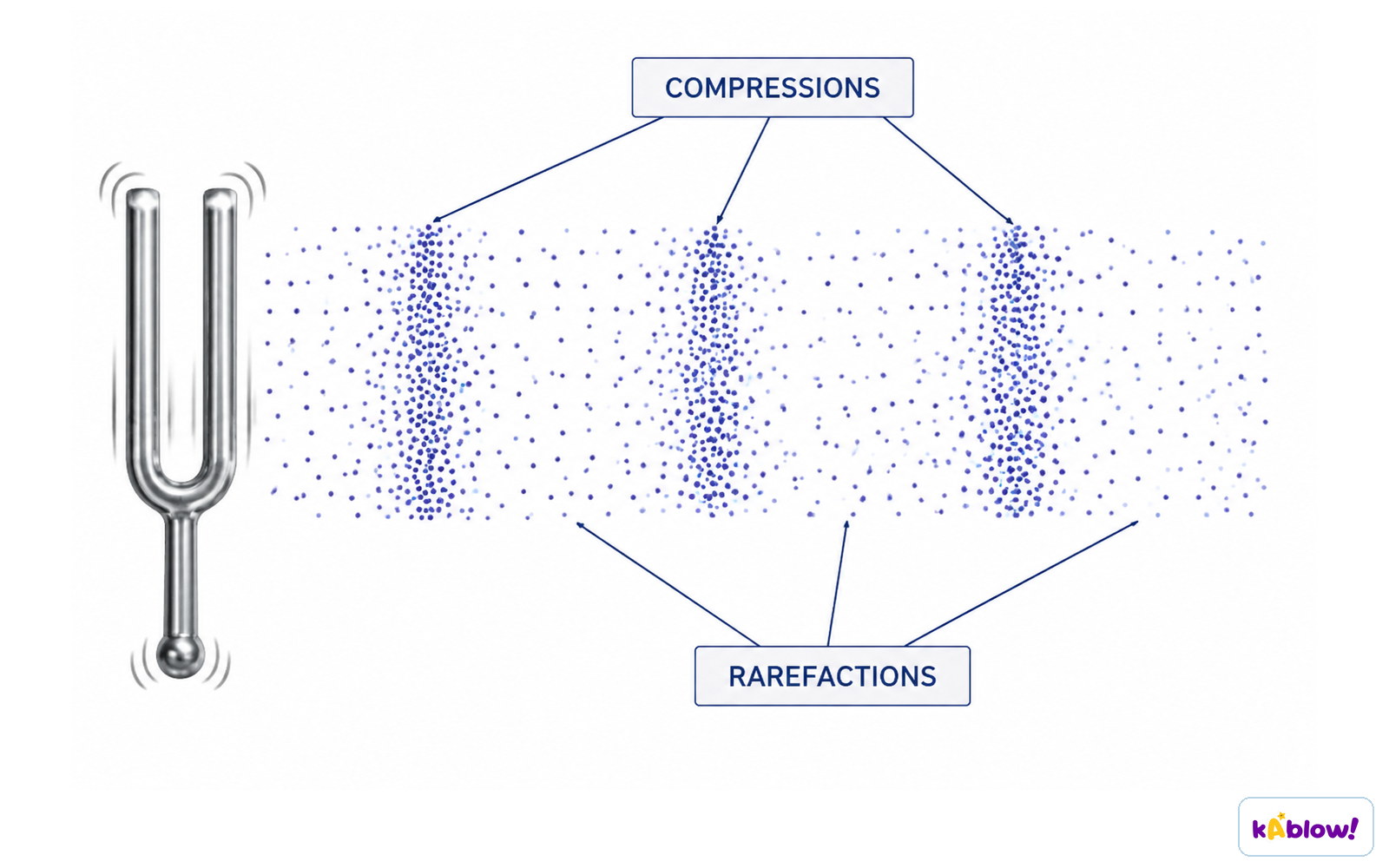
- Longitudinal waves consist of compressions (regions of higher density) and rarefactions (regions of lower density).
- Sound is a pressure wave; compressions and rarefactions cause pressure variations.
- When sound hits a solid, the pressure variations cause the solid to vibrate in sync with the wave.
A diagram illustrating compressions and rarefactions in a sound wave generated by a vibrating solid.
Measuring the Speed of Sound
- Speed of sound in air: 330–350 m/s (increases with temperature).
- Sound travels fastest in solids (~5000 m/s), slower in liquids (~1500 m/s), slowest in gases.
- Experiment 1 (two-point method): Measure distance (e.g., 100 m) and time (stopwatch) between a sound source and observer. Speed = distance / time.
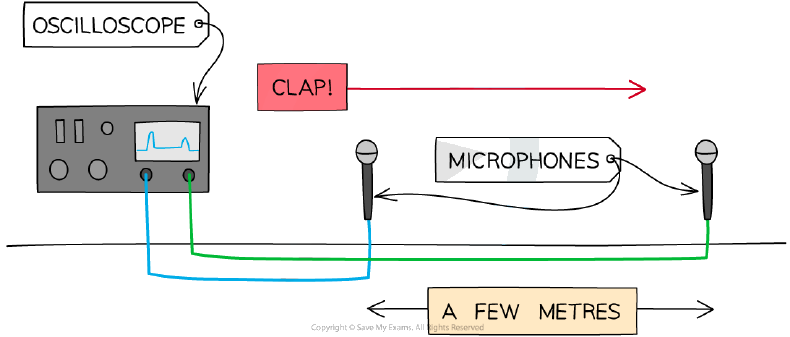
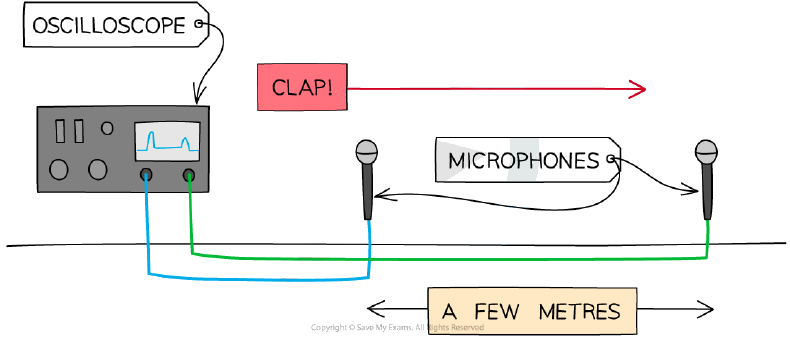
- Experiment 2 (oscilloscope method): Two microphones connected to an oscilloscope, distance ~2 m. Clap near first mic; oscilloscope measures time difference. More accurate than stopwatch.
- Accuracy: Experiment 2 is more accurate because timing is automatic; Experiment 1 suffers from human reaction time (~0.2 s error).
- Use repeat readings and larger distances to reduce random errors.
Experiment setup for measuring the speed of sound using two microphones and an oscilloscope.
Effects of Sound Waves
- Pitch depends on frequency: high frequency → high pitch; low frequency → low pitch.
- Loudness depends on amplitude: large amplitude → loud sound; small amplitude → quiet sound.
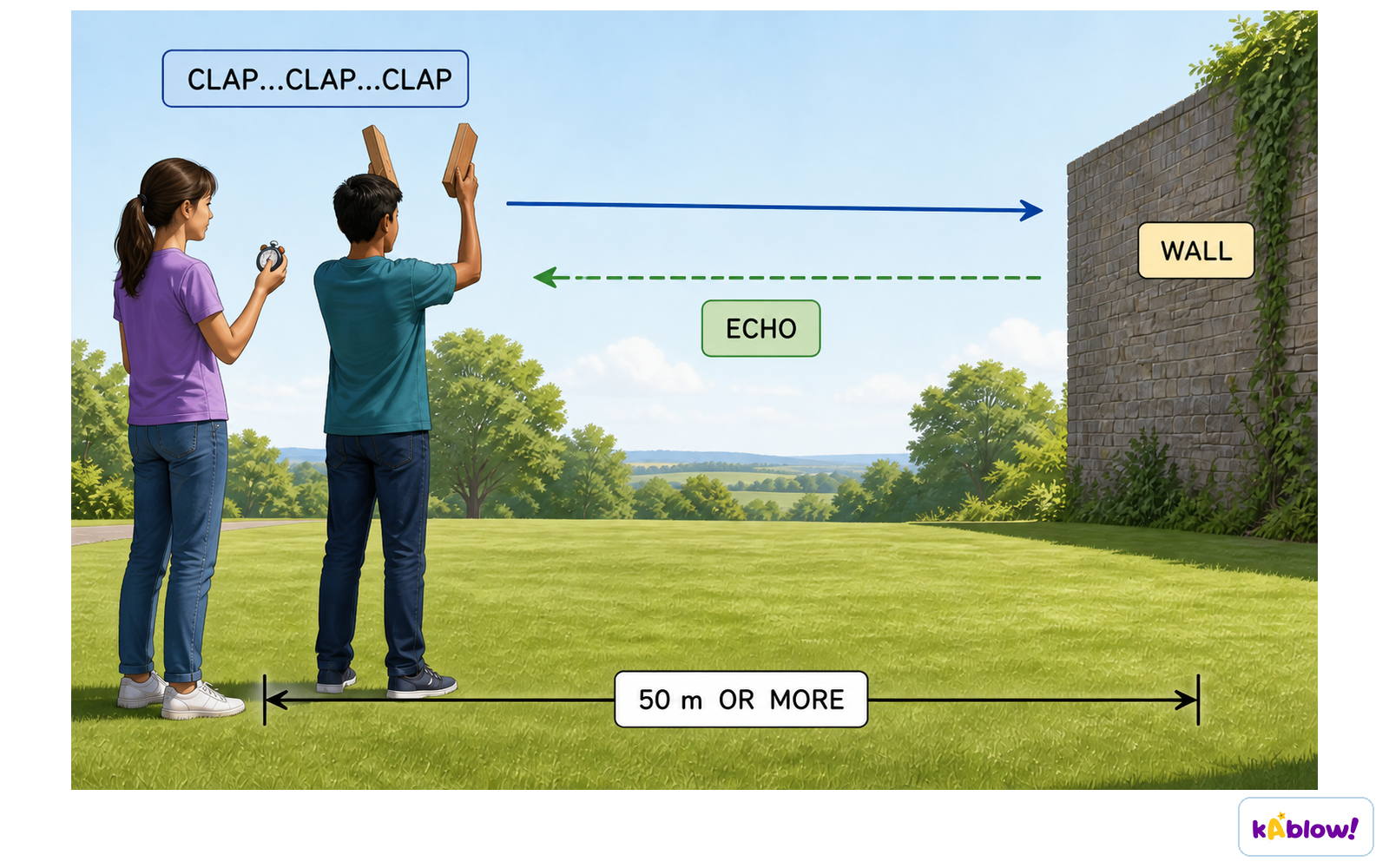
- Echoes are reflections of sound waves off hard, flat surfaces.
- Distance to reflecting surface: distance = ½ × speed × time (time is total for sound to travel to surface and back).
A person clapping to create an echo off a wall, while another person times the event.
Ultrasound
- Human hearing range: 20 Hz – 20,000 Hz (20 kHz).
- Ultrasound is sound with frequency above 20 kHz.
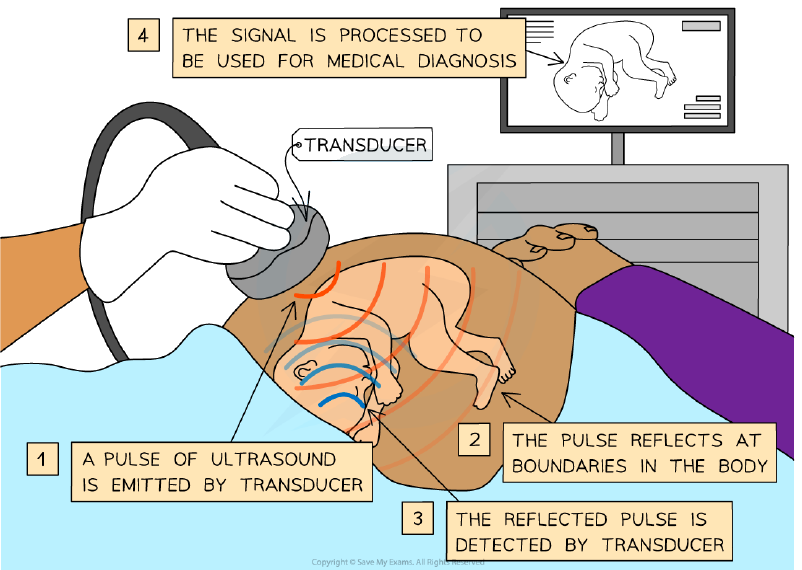
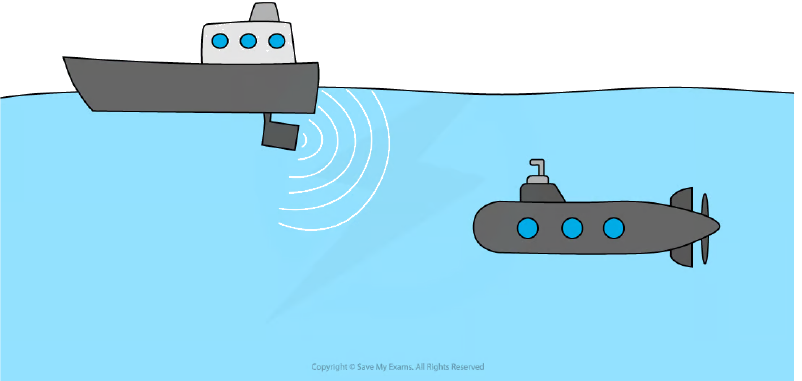
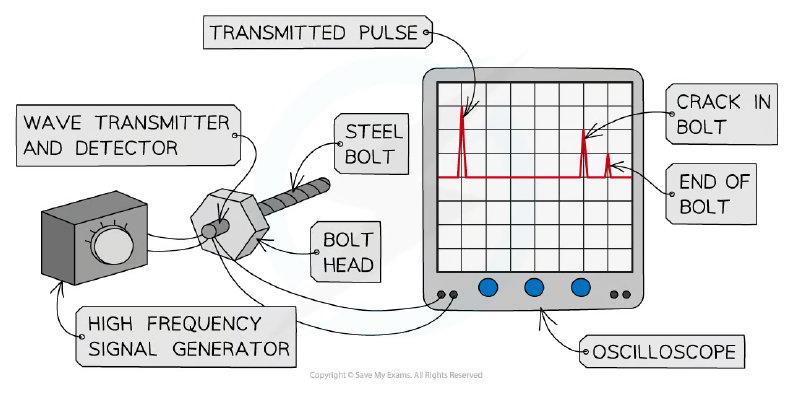
- Ultrasound is partially reflected at boundaries between different media.
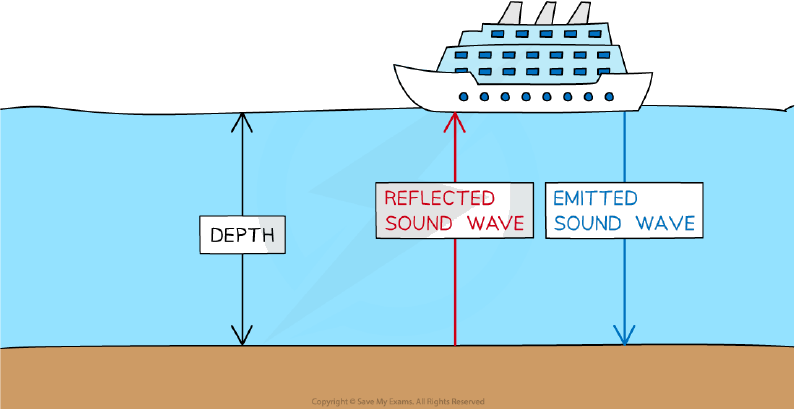
- Uses: medical scanning (foetus, soft tissues), non-destructive testing (detecting cracks in metal), sonar (depth measurement).
- Depth calculation: depth = ½ × speed × time (same as echo formula).
- Ultrasound is non-invasive and considered harmless.
Medical scanning using ultrasound
Slide
Sign up free to view the lesson slides
Step through every slide for this topic — plus flashcards and revision notes — with a free account.
Câu hỏi luyện tập
Xem trước miễn phí — 8 trên 48 câu hỏi. Đăng ký để xem tất cả.
1.Which of the following frequency ranges is completely audible by a human with average hearing?
Easy- A200 Hz to 200 kHz
- B5 Hz to 50 kHz
- C50 Hz to 5 kHz
- D50 kHz to 50 MHz
2.A tuba player plays a loud note on her tuba. She then plays a quiet note of the same pitch. Which property of the sound wave she produced has changed?
Easy- AFrequency
- BWavelength
- CAmplitude
- DSpeed
3.A high frequency note is played on a violin. The violinist then reduces the frequency of the note. What change in the note do the audience hear?
Easy- APitch increases
- BPitch decreases
- CVolume increases
- DVolume decreases
4.Sound wave W has amplitude A and frequency f. Sound wave X is louder and lower in pitch than sound wave W. What can be said about the amplitude and frequency of sound wave X?
Easy- AAmplitude higher than A, frequency higher than f
- BAmplitude higher than A, frequency lower than f
- CAmplitude lower than A, frequency higher than f
- DAmplitude lower than A, frequency lower than f
5.Which of the following is not a use of ultrasound?
Easy- AScanning a fetus during pregnancy
- BNon-destructive testing of materials such as to find leaks in copper pipes
- CMapping with sonar
- DIdentifying broken bones
6.When objects vibrate, they produce sound waves. An object in a room vibrates. However, a person in that same room does not hear anything. Why not?
Easy- AThe room contains no air.
- BThe sound waves are travelling too fast.
- CThe amplitude of the sound waves is too great.
- DThe frequency of the sound waves is too great.
7.After a lockdown drill, the management notes the siren is too quiet and its pitch is too low. They ask the company to make the alarm louder and give it a higher pitch. What effect does this have on the resulting sound wave?
Easy- AIt has a larger amplitude and a lower frequency.
- BIt has a larger frequency and a lower amplitude.
- CIt has a smaller frequency and a larger amplitude.
- DIt has a larger frequency and a larger amplitude.
8.A teacher uses a signal generator connected to a speaker to make sounds of different frequencies. Which frequency can be heard by a student?
Easy- A10 Hz
- B30 kHz
- C440 Hz
- D120 kHz
Unlock all 48 questions & more
Tạo tài khoản miễn phí để xem mọi câu hỏi, slide, thẻ ghi nhớ và ghi chú ôn tập cho chủ đề này.