Iteration: repeating instructions with loops
Học bằng cách chơi
Trả lời những câu hỏi này để kiếm năng lượng, rồi câu cá và khám phá. Không cần tài khoản.
Ghi chú bài học
What is Iteration?
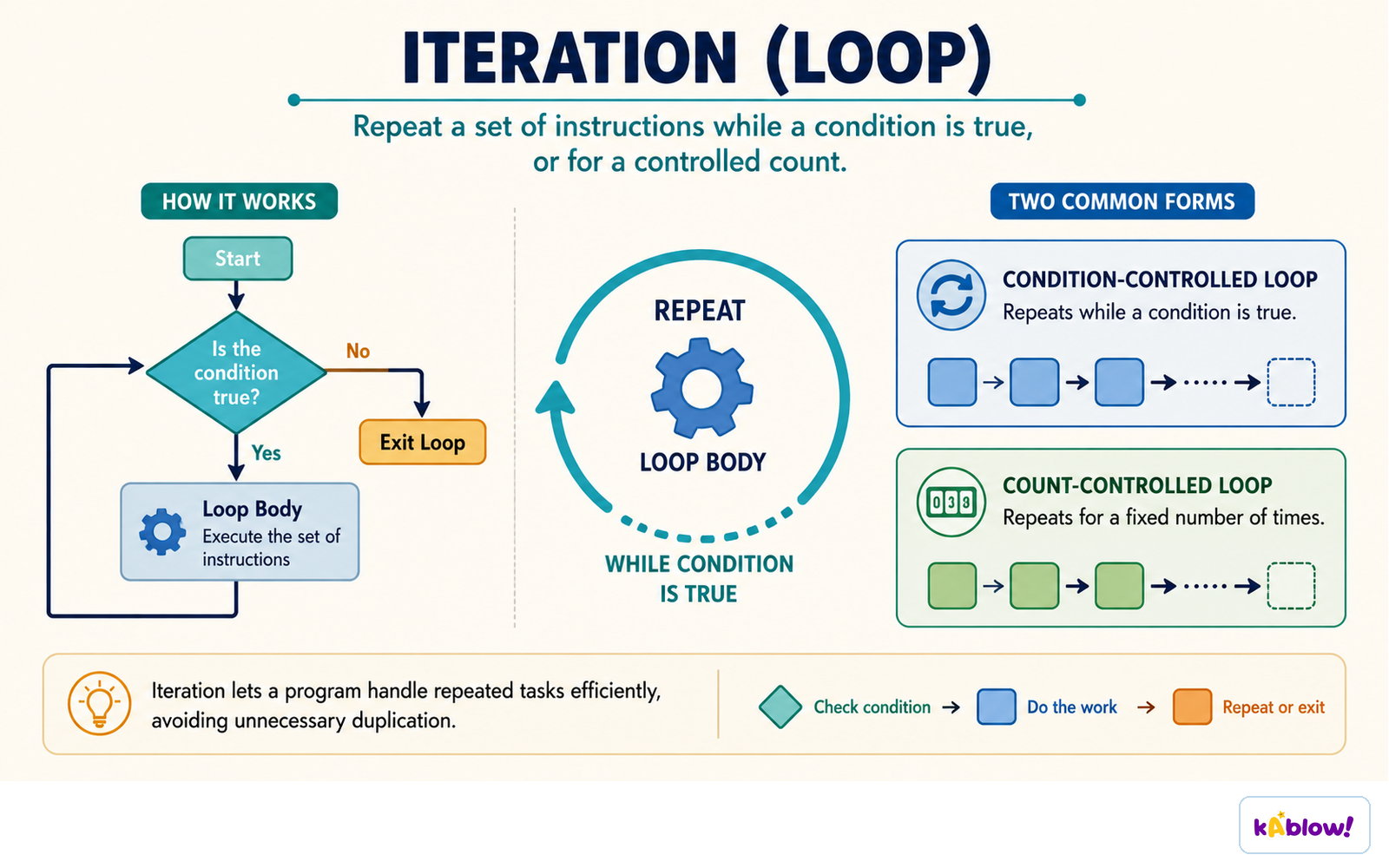
- Iteration means repeating a set of instructions (a block of code) more than once.
- It is one of the three basic building blocks of programming, alongside sequence (doing things in order) and selection (making choices).
- Loops let you write the same code once and run it many times, saving time and reducing errors.
- Each repetition of the loop is called an iteration.
A loop repeats while a condition holds, or for a fixed number of repetitions.
Count-Controlled Loops (for loops)
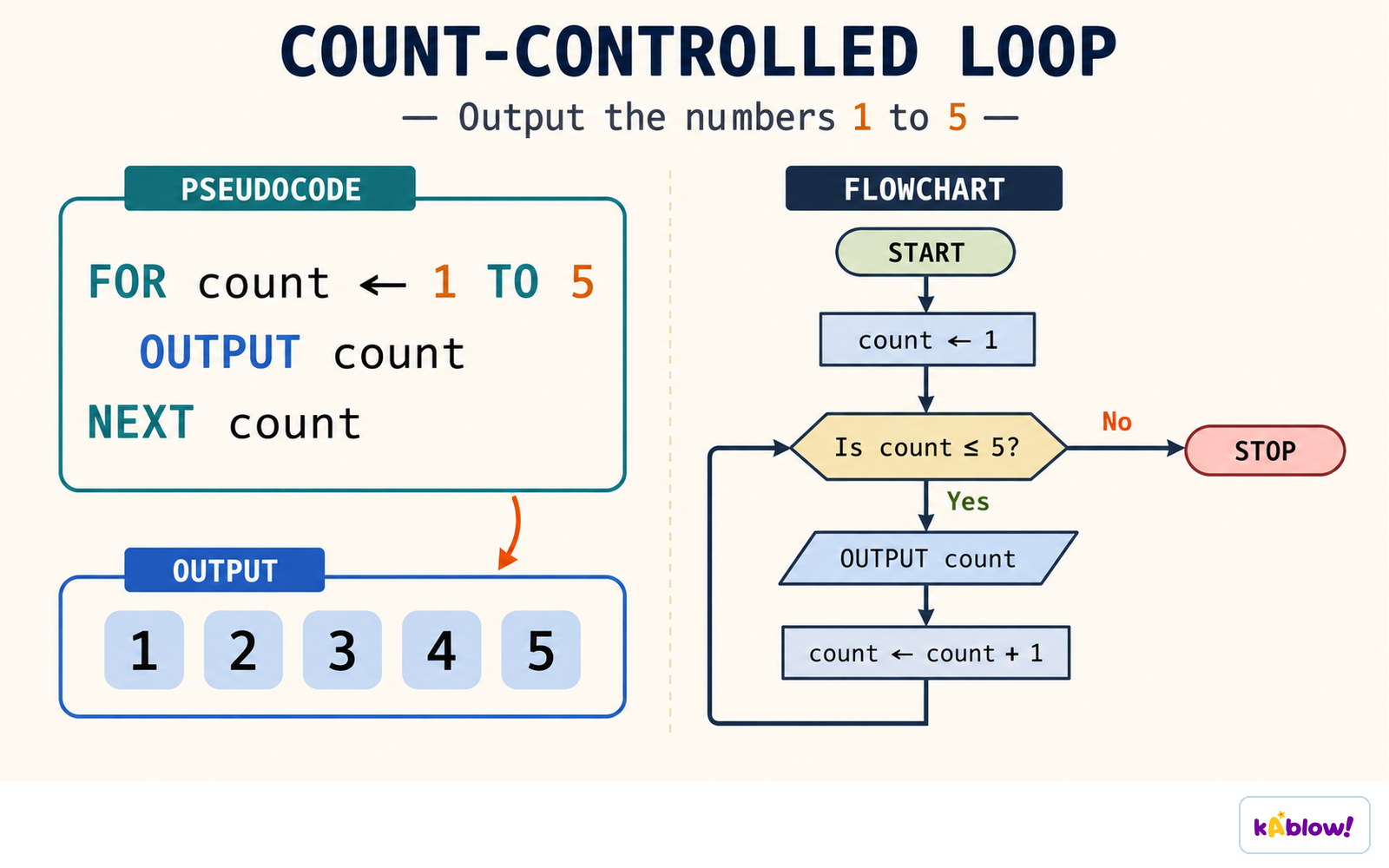
- A count-controlled loop (often a for loop) repeats a fixed number of times.
- It uses a loop variable (also called a counter) that changes each time the loop runs.
- The loop variable often starts at a value, continues while a condition is true, and increases or decreases by a step.
- Example: `for i in range(5):` runs the indented code 5 times, with `i` taking values 0, 1, 2, 3, 4.
- Use a for loop when you know exactly how many times you want to repeat.
A count-controlled loop runs a fixed number of times, here outputting the numbers 1 to 5.
Condition-Controlled Loops (while loops)
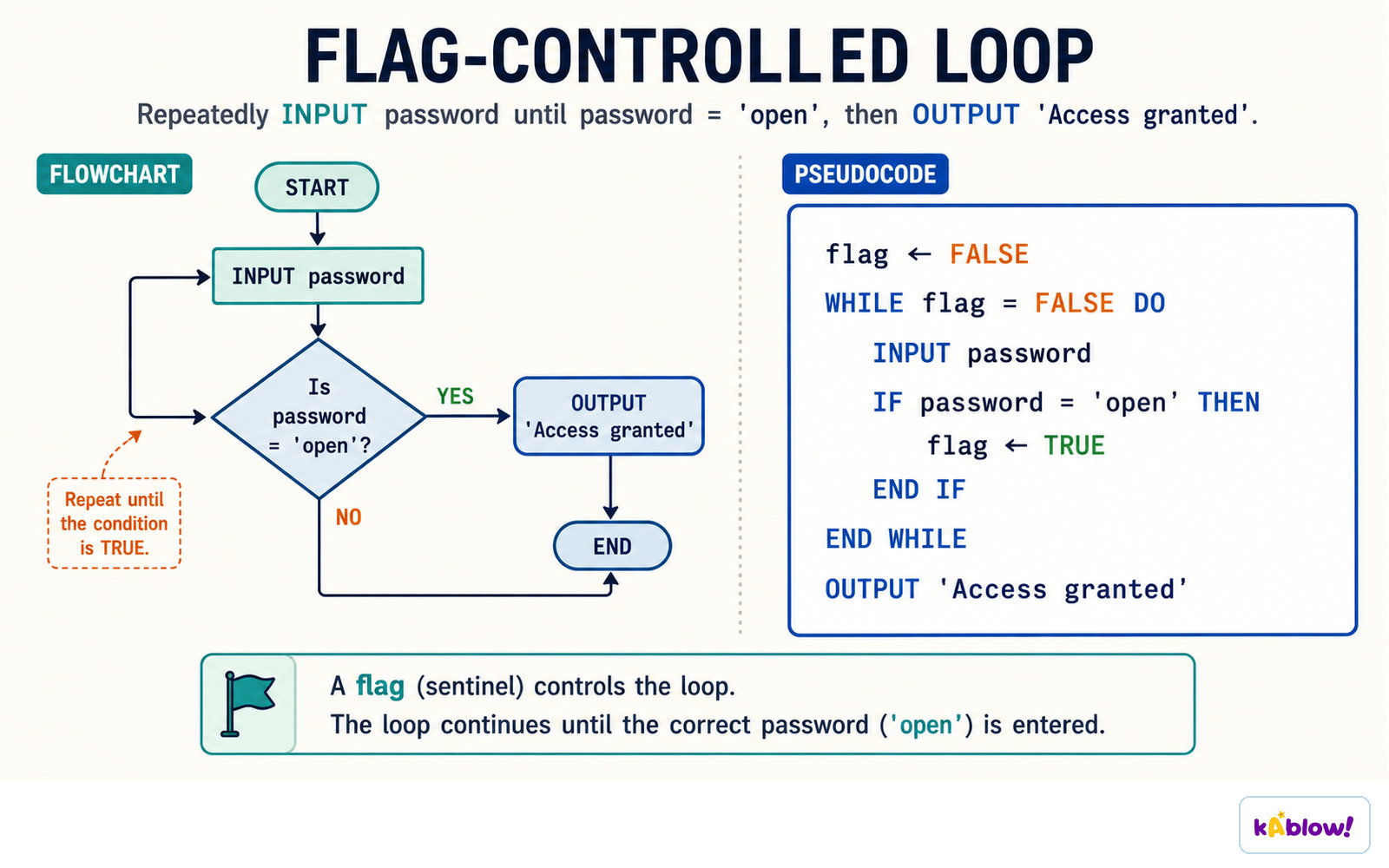
- A condition-controlled loop (often a while loop) repeats as long as a condition is true.
- The condition is checked before each repetition; if it is false at the start, the loop body never runs.
- Example: `while x < 10:` repeats until `x` becomes 10 or more.
- Use a while loop when you do not know in advance how many times the loop will run.
- The loop must eventually make the condition false, or it will run forever.
A flag controls the loop: it keeps asking until the correct password is entered.
Loop Variables and Updating
- The loop variable is a variable that changes each iteration, often used to control the loop or to track progress.
- In a for loop, the loop variable is automatically updated by the loop.
- In a while loop, you must update the variable yourself inside the loop body.
- Common update: `counter = counter + 1` (or `counter += 1`) to increase the counter by 1.
- The loop variable can be used inside the loop, for example to calculate sums or to index into a list.
Infinite Loops and How to Avoid Them
- An infinite loop is a loop that never ends because the condition never becomes false.
- Infinite loops can freeze a program or cause it to run forever.
- To avoid them, make sure the condition can become false (e.g., update the loop variable).
- Check that the loop variable moves towards the stopping condition (e.g., increases if the condition is `<`).
- Test your loop with small values to see if it behaves as expected.
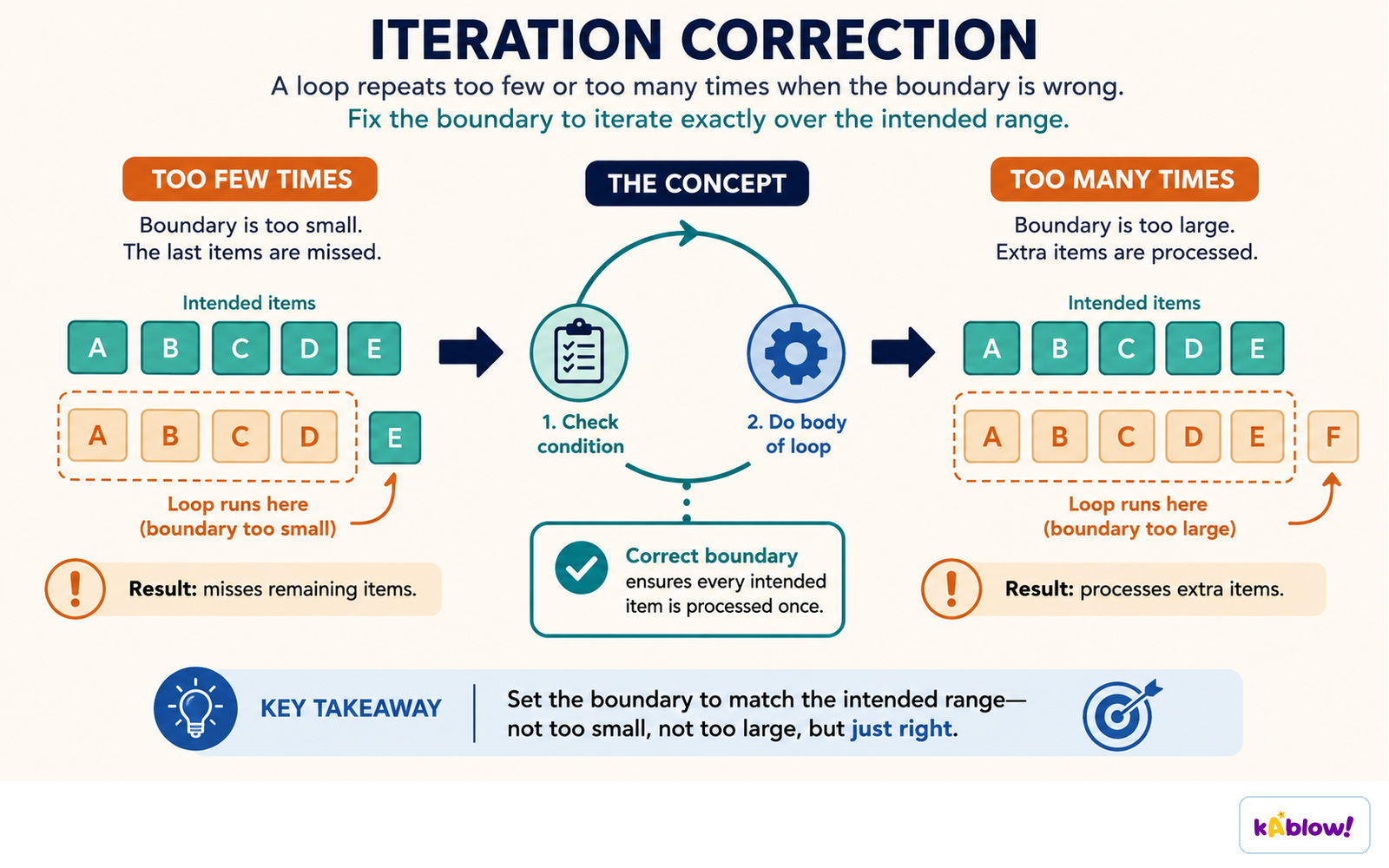
A loop boundary that is too small misses the last item; one that is too large processes extra items.
Choosing the Right Loop
- Use a for loop when the number of repetitions is known in advance (e.g., repeat 10 times, or iterate over a list).
- Use a while loop when the number of repetitions depends on a condition that may change (e.g., keep asking until the user enters a valid answer).
- For loops are often clearer and less error-prone for fixed counts.
- While loops are more flexible for unknown numbers of repetitions.
- Sometimes a for loop can be written as a while loop, and vice versa, but one is usually more natural.
Combining Loops with Selection
- You can put an if statement inside a loop to make decisions during each iteration.
- This lets you process each item differently based on its value.
- Example: `for num in numbers: if num % 2 == 0: print(num)` prints only even numbers.
- You can also put a loop inside an if statement, or nest loops inside loops (nested loops).
- Combining loops and selection allows you to solve complex problems like searching, counting, and filtering.
Common Loop Patterns
- Counting: use a loop to count how many times something happens.
- Summing: accumulate a total by adding each value in a loop.
- Searching: loop through items to find a specific one.
- Input validation: use a while loop to keep asking for input until it is valid.
- Nested loops: a loop inside another loop, often used for grids or tables.
Key Terminology
- Iteration: one repetition of a loop.
- Loop body: the block of code that is repeated.
- Loop condition: the boolean expression that controls a while loop.
- Loop variable: the variable that changes each iteration.
- Infinite loop: a loop that never terminates.
Slide
Sign up free to view the lesson slides
Step through every slide for this topic — plus flashcards and revision notes — with a free account.
Câu hỏi luyện tập
Xem trước miễn phí — 8 trên 61 câu hỏi. Đăng ký để xem tất cả.
1.What is the term for the control flow that repeats a block of instructions a set number of times?
Easy- Acount-controlled loop
- Bcondition-controlled loop
- Cinfinite loop
- Dselection
2.A 'while' loop is an example of a count-controlled loop.
EasyTrue or false?
3.Which of the following is a typical use of a count-controlled (for) loop?
Easy- ARepeating until the user enters 'quit'
- BPrinting numbers 1 to 10
- CChecking a password until correct
- DWaiting for a button press
4.What is the main danger of a condition-controlled loop if the condition never becomes false?
Easy- AIt runs too slowly
- BIt becomes an infinite loop
- CIt skips the block
- DIt uses too much memory
5.Which of the following are examples of iteration? (Select all that apply)
Easy- Afor loop
- Bwhile loop
- Cif statement
- Drepeat-until loop
6.In a 'for' loop, the loop variable automatically increases (or decreases) each time the loop runs.
EasyTrue or false?
7.Which loop would be most appropriate to keep asking for a password until the correct one is entered?
Medium- Afor loop
- Bwhile loop
- Crepeat-until loop
- Dboth while and repeat-until
8.What is the value of 'total' after this code runs? total = 0; for i in range(1, 4): total = total + i
Medium- A3
- B6
- C10
- D4
Unlock all 61 questions, flashcards & more
Tạo tài khoản miễn phí để xem mọi câu hỏi, slide, thẻ ghi nhớ và ghi chú ôn tập cho chủ đề này.