Procedures, functions and modular programs
Học bằng cách chơi
Trả lời những câu hỏi này để kiếm năng lượng, rồi câu cá và khám phá. Không cần tài khoản.
Ghi chú bài học
What are procedures and functions?
- A procedure is a named block of code that performs a specific task but does not return a value.
- A function is a named block of code that performs a task and returns a value to the caller.
- Both are examples of callable units – pieces of code that can be invoked (called) multiple times.
- They allow you to decompose a large, complicated problem into smaller, manageable chunks.
- Each chunk can be given a meaningful name, making the code easier to read and understand.
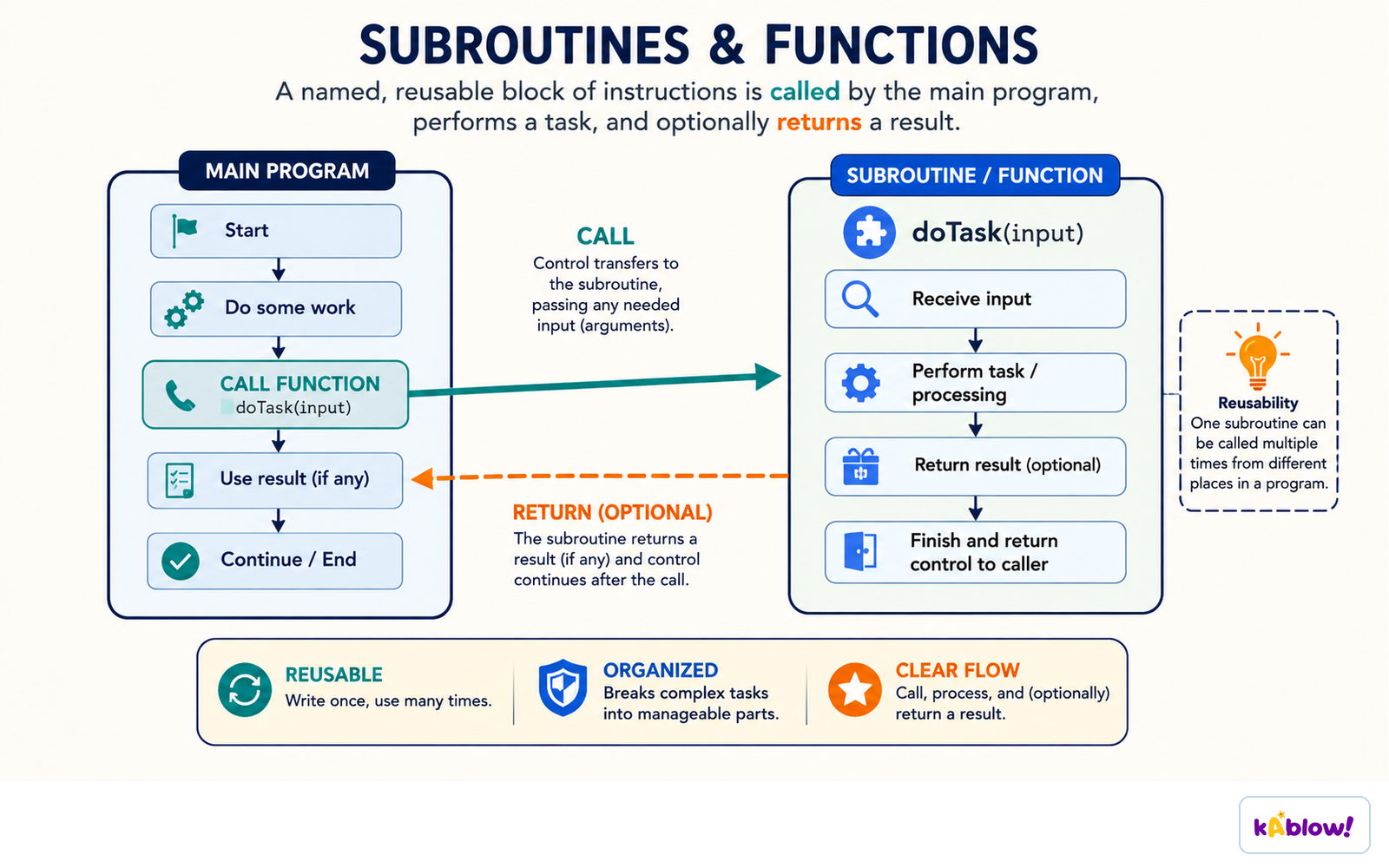
A subroutine is a named, reusable block: the main program calls it, it does its task, and it returns.
Why use modular programs?
- Modularity makes programs easier to build, test, and debug because each part can be developed and checked separately.
- Code can be reused – write a procedure once and call it many times, avoiding duplication.
- It reduces the cognitive load – you don't have to hold the whole program in your head at once.
- It improves quality and reliability – well-tested modules are less likely to contain errors.
- It makes maintenance easier – you can change one module without affecting others.
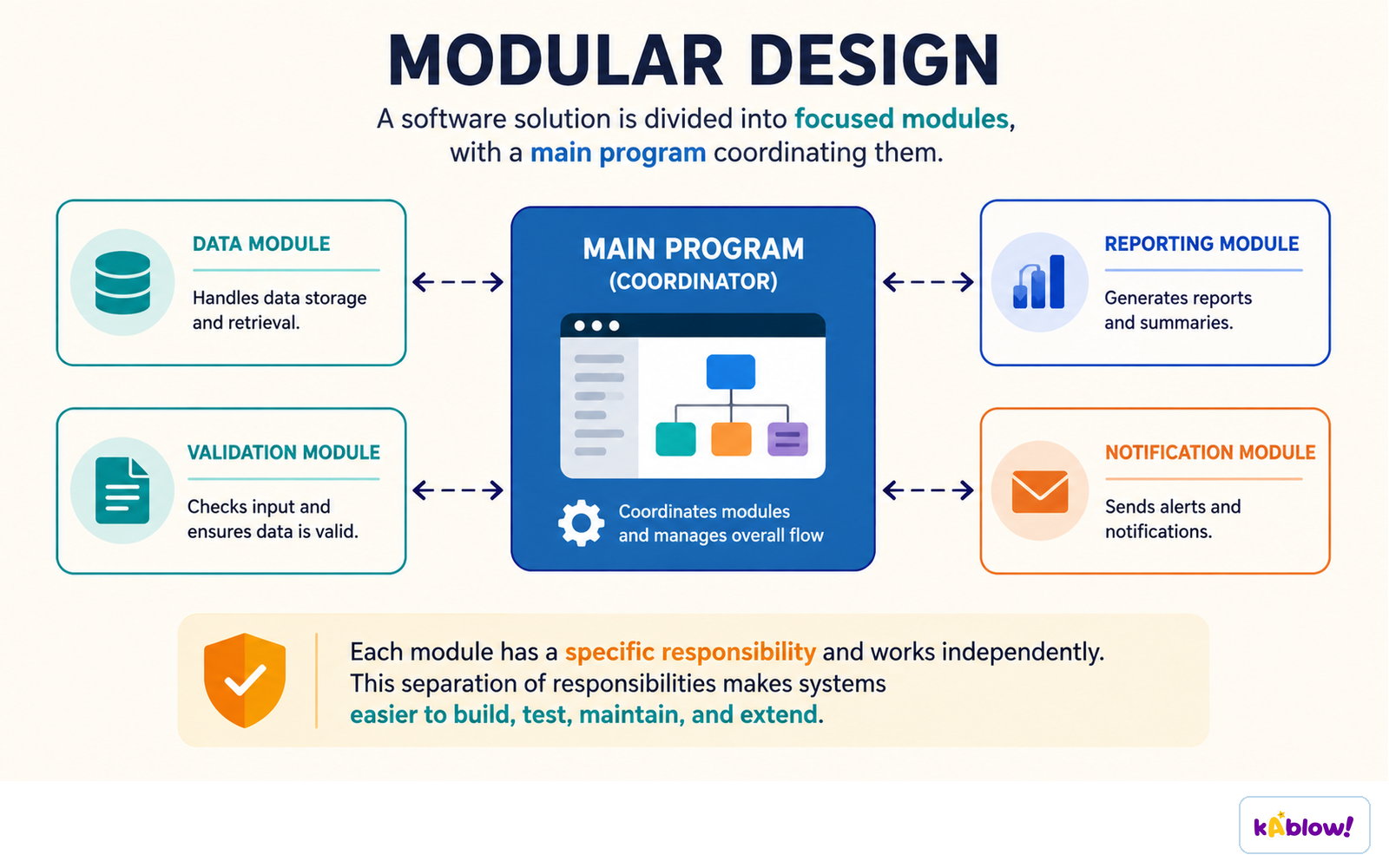
A solution split into focused modules, each with one responsibility, coordinated by a main program.
Defining and calling procedures
- To define a procedure, you give it a name and a block of code that runs when it is called.
- To call a procedure, you write its name followed by parentheses (e.g., `drawSquare()`).
- A procedure can be called multiple times from different parts of the program.
- Procedures can take parameters – values passed into the procedure to make it more flexible.
- Example: `drawSquare(size)` uses the `size` parameter to draw a square of that size.
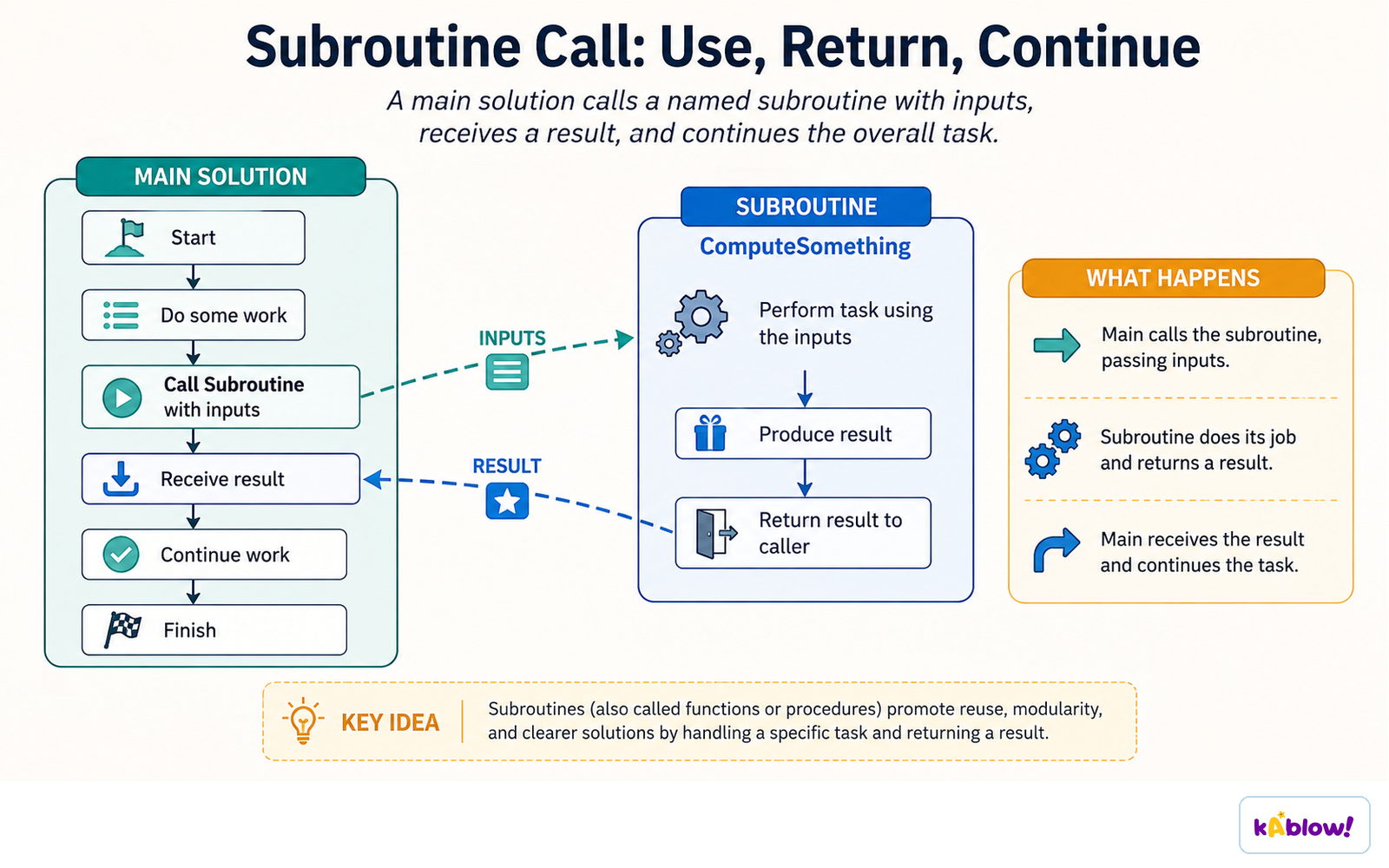
The main solution calls a subroutine with inputs, receives a result, and continues its own task.
Parameters and arguments
- Parameters are the variables listed in the procedure/function definition.
- Arguments are the actual values passed when you call the procedure/function.
- Parameters allow the same code to work with different data each time it is called.
- Example: `calculateArea(length, width)` – `length` and `width` are parameters; `calculateArea(5, 3)` passes arguments 5 and 3.
- Some languages allow default parameters – if you don't pass an argument, a default value is used.
Return values
- A function returns a value using a `return` statement.
- The returned value can be assigned to a variable or used in an expression.
- Example: `result = add(2, 3)` – the function `add` returns 5, which is stored in `result`.
- Procedures do not return a value; they just perform an action.
- In some languages, a procedure without a `return` still returns `None` or `null` implicitly.
Scope of variables
- Variables defined inside a procedure/function are local – they can only be used within that block.
- Variables defined outside all procedures are global – they can be accessed anywhere in the program.
- Local variables are created when the procedure is called and destroyed when it ends.
- Using local variables helps avoid naming conflicts and makes code more self-contained.
- Global variables can be changed from anywhere, which can lead to bugs – use them sparingly.
Procedures vs functions – key differences
- Procedures perform a task but do not return a value; functions return a value.
- In some languages (e.g., Python), procedures are just functions that don't have a `return` statement.
- In others (e.g., C), all callable units are called functions, even if they return nothing (void).
- Some languages use the term method for functions defined inside classes (object-oriented programming).
- The choice of terminology depends on the programming language you are using.
Examples in Python
- Procedure example: `def greet(name): print('Hello', name)` – it prints but returns nothing.
- Function example: `def add(a, b): return a + b` – it returns the sum.
- Calling a procedure: `greet('Alice')` – prints 'Hello Alice'.
- Calling a function: `result = add(3, 4)` – result becomes 7.
- You can use functions inside expressions: `print(add(1, 2)×3)` prints 9.
Testing and debugging modular programs
- Because each module is small, you can test it independently before integrating it into the whole program.
- Debugging is easier – you know which module contains the error.
- You can write test cases for each function to check it works correctly.
- Modularity supports teamwork – different people can work on different modules simultaneously.
- It also allows you to reuse tested modules in other programs.
History (brief)
- The concept of subroutines was developed in the 1940s, with early contributions by Alan Turing, John Mauchly, and Kay McNulty.
- Maurice Wilkes, David Wheeler, and Stanley Gill are credited with the formal invention of the closed subroutine.
- Early computers often used a call sequence – a series of instructions – to call subroutines.
- The return address (where to continue after the subroutine) was stored in various ways, often on a stack.
- Modern languages provide built-in support for procedures and functions, making them easy to use.
Slide
Sign up free to view the lesson slides
Step through every slide for this topic — plus flashcards and revision notes — with a free account.
Câu hỏi luyện tập
Xem trước miễn phí — 8 trên 57 câu hỏi. Đăng ký để xem tất cả.
1.What is a procedure in programming?
Easy- AA named block of code that performs a specific task
- BA type of variable that stores multiple values
- CA loop that repeats a block of code
- DA data structure for storing numbers
2.Which of the following is the main difference between a function and a procedure in languages like COBOL and BASIC?
Easy- AFunctions return a value, procedures do not
- BProcedures return a value, functions do not
- CFunctions can be called multiple times, procedures only once
- DProcedures are used for calculations, functions for output
3.A procedure can be called multiple times from different parts of a program.
EasyTrue or false?
4.Which of the following are benefits of using procedures and functions in programming? (Select all that apply)
Easy- AThey make programs easier to debug
- BThey allow code to be reused
- CThey make programs run faster
- DThey make programs easier to understand
5.In the context of modular programming, what is a parameter?
Medium- AA value that is passed into a procedure or function when it is called
- BA value that is returned from a procedure or function
- CA variable that is used only inside a procedure
- DA type of loop used to repeat a block of code
6.In some programming languages, the term 'method' is used to refer to a function that is defined inside a class.
MediumTrue or false?
7.Match the programming term to its correct description.
Medium- Function
- Procedure
- Method
- A callable unit that returns a value
- A callable unit that does not return a value
- A function defined inside a class
8.Put the steps of using a procedure in a program in the correct order.
Medium- Define the procedure
- Call the procedure
- Execute the code inside the procedure
- Return to the point after the call
Unlock all 57 questions, flashcards & more
Tạo tài khoản miễn phí để xem mọi câu hỏi, slide, thẻ ghi nhớ và ghi chú ôn tập cho chủ đề này.