Fertilisation and seed formation
Học bằng cách chơi
Trả lời những câu hỏi này để kiếm năng lượng, rồi câu cá và khám phá. Không cần tài khoản.
Ghi chú bài học
Pollination and Fertilisation
- Fertilisation occurs after successful pollination.
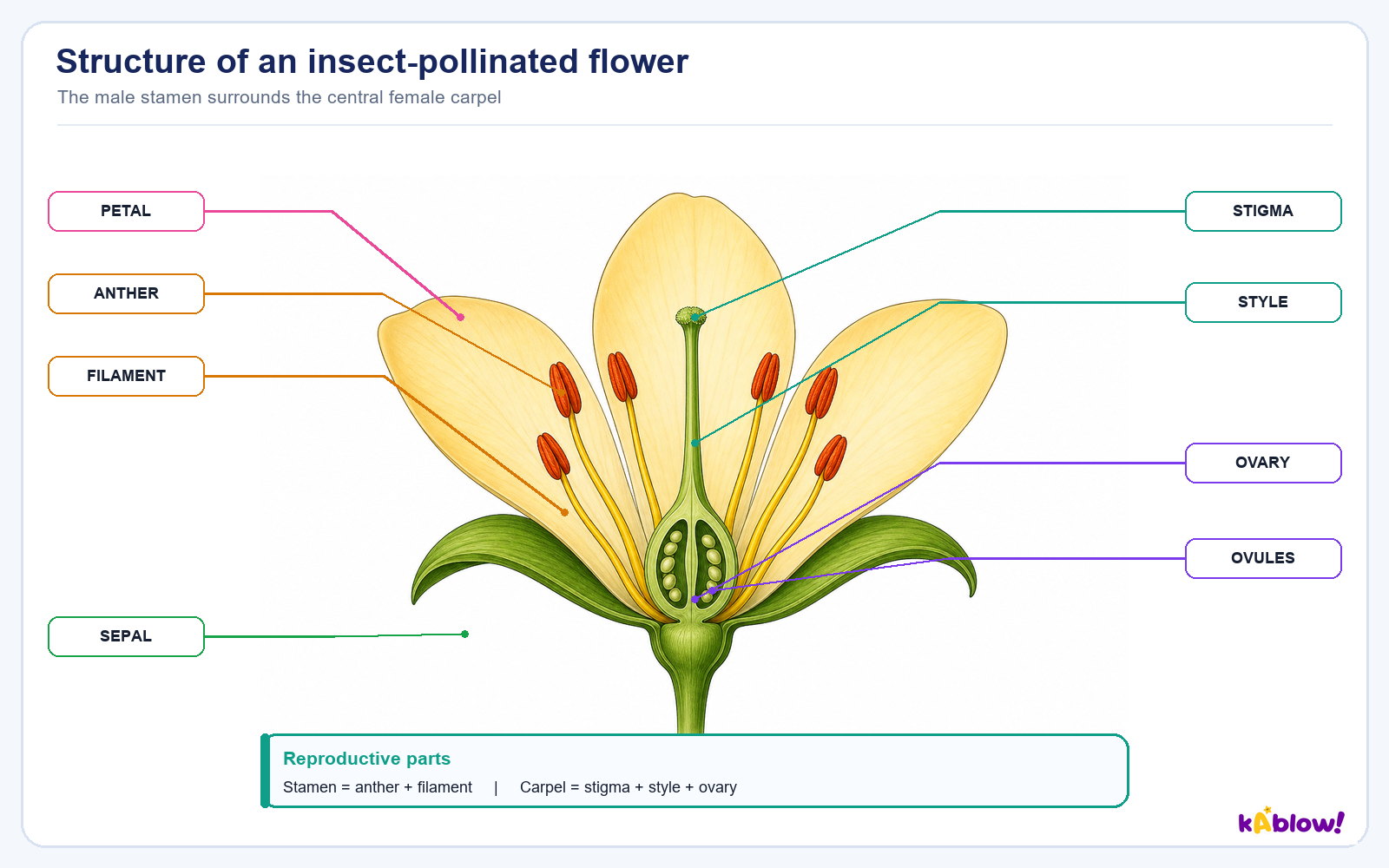
- Pollination is when pollen from the stamen (male part) reaches the carpel (female part) of a flower.
- After landing on a stigma, a pollen grain germinates and grows a pollen tube down the style to the ovary.
- The male sex cell nucleus moves through the pollen tube and joins with the ovule nucleus – this joining is fertilisation.
The parts of a flower, the reproductive organ of a plant.
Seed Formation
- The fertilised ovule becomes a seed.
- Each seed contains an embryo plant and a food store to nourish it.
- The seed is protected by a seed coat.
Fruit Formation
- As seeds develop, the ovary transforms into a fruit.
- The fruit protects the seeds and helps in their dispersal.
- Fruits include berries, nuts, and pods.
Importance of Insect Pollinators
- Many crops (fruits, vegetables, nuts) depend on insect pollination by bees, butterflies, and beetles.
- Pollinators transfer pollen between flowers, enabling seed and fruit production.
- Without insect pollination, crop yields would decrease, reducing food availability and increasing prices.
- This affects global food security – the quantity and diversity of food.
Slide
Sign up free to view the lesson slides
Step through every slide for this topic — plus flashcards and revision notes — with a free account.
Câu hỏi luyện tập
Xem trước miễn phí — 8 trên 58 câu hỏi. Đăng ký để xem tất cả.
1.Which of the following is the male part of a flower?
Easy- AStamen
- BCarpel
- COvary
- DStigma
2.Fertilisation in plants occurs when which two nuclei join?
Easy- AMale sex cell nucleus and ovule nucleus
- BPollen nucleus and stigma nucleus
- CSperm nucleus and egg nucleus
- DMale nucleus and female nucleus
3.Which part of the flower develops into a fruit after fertilisation?
Easy- AOvary
- BOvule
- CStigma
- DStyle
4.What is the role of the pollen tube in plant fertilisation?
Easy- AIt transports the male sex cell to the ovule
- BIt produces pollen grains
- CIt receives pollen from the anther
- DIt becomes the seed coat
5.Which of the following is NOT a part of a seed?
Easy- AAnther
- BEmbryo plant
- CFood store
- DSeed coat
6.If bee populations decline significantly, what is the most likely effect on crop yields?
Medium- ACrop yields would decrease
- BCrop yields would increase
- CCrop yields would stay the same
- DCrop yields would become more variable
7.The anther and filament are parts of which flower structure?
Easy- AStamen
- BCarpel
- CPetal
- DSepal
8.What is the function of the seed coat?
Easy- ATo protect the seed
- BTo provide food for the embryo
- CTo attract pollinators
- DTo help in seed dispersal
Unlock all 58 questions, flashcards & more
Tạo tài khoản miễn phí để xem mọi câu hỏi, slide, thẻ ghi nhớ và ghi chú ôn tập cho chủ đề này.