Food tests
Học bằng cách chơi
Trả lời những câu hỏi này để kiếm năng lượng, rồi câu cá và khám phá. Không cần tài khoản.
Ghi chú bài học
Introduction to Food Tests
- Food tests are used to identify the presence of specific nutrients in food samples.
- Different chemical reagents produce characteristic colour changes when they react with particular nutrients.
- The four main nutrients tested are protein, sugar, starch, and lipids.
Food tests identify starch, reducing sugars, protein and lipids through characteristic colour changes or a cloudy emulsion.
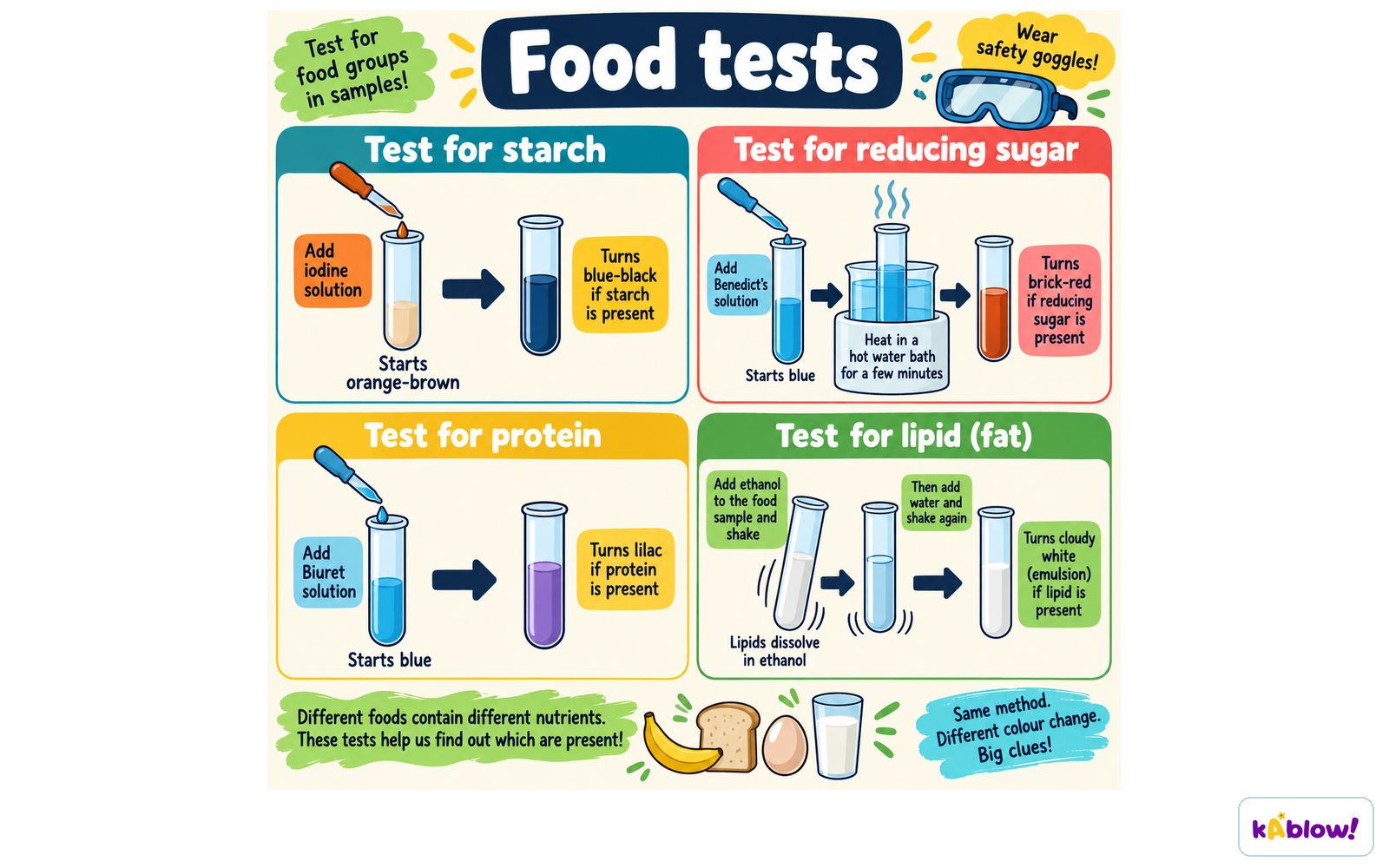
Testing for Protein (Biuret Test)
- Use Biuret solution (blue in colour).
- Add a few drops of Biuret solution to a food sample in a test tube.
- If protein is present, the solution turns purple.
- If no protein is present, the solution remains blue.
- Foods high in protein include meat, fish, eggs, cheese, milk, and nuts.
Testing for Sugar (Benedict's Test)
- Use Benedict's solution (blue).
- Add Benedict's solution to the food sample and heat in a water bath for a few minutes.
- If sugar is present, the solution changes colour: green → yellow → orange → red (depending on concentration).
- No colour change (remains blue) indicates no sugar.
- Foods high in sugar include fizzy drinks, fruit juices, sweets, and cakes.
Testing for Starch (Iodine Test)
- Use iodine solution (yellow/brown).
- Add a few drops of iodine solution to the food sample.
- If starch is present, the solution turns blue/black.
- No colour change (remains yellow/brown) indicates no starch.
- Foods high in starch include bread, pasta, potatoes, and rice.
Testing for Lipids (Ethanol Emulsion Test)
- Use ethanol (alcohol).
- Add ethanol to the food sample and shake, then pour into water.
- If lipids are present, the mixture turns cloudy/milky white.
- No cloudiness indicates no lipids.
- Foods high in lipids include oil, cheese, butter, and some meats.
Summary of Colour Changes
- Protein → Biuret: blue to purple.
- Sugar → Benedict's: blue to green/yellow/orange/red (after heating).
- Starch → Iodine: yellow/brown to blue/black.
- Lipids → Ethanol: clear to cloudy white.
Positive food tests: Biuret turns lilac, heated Benedict’s can turn brick-red, iodine turns blue-black, and the ethanol emulsion test turns cloudy white.
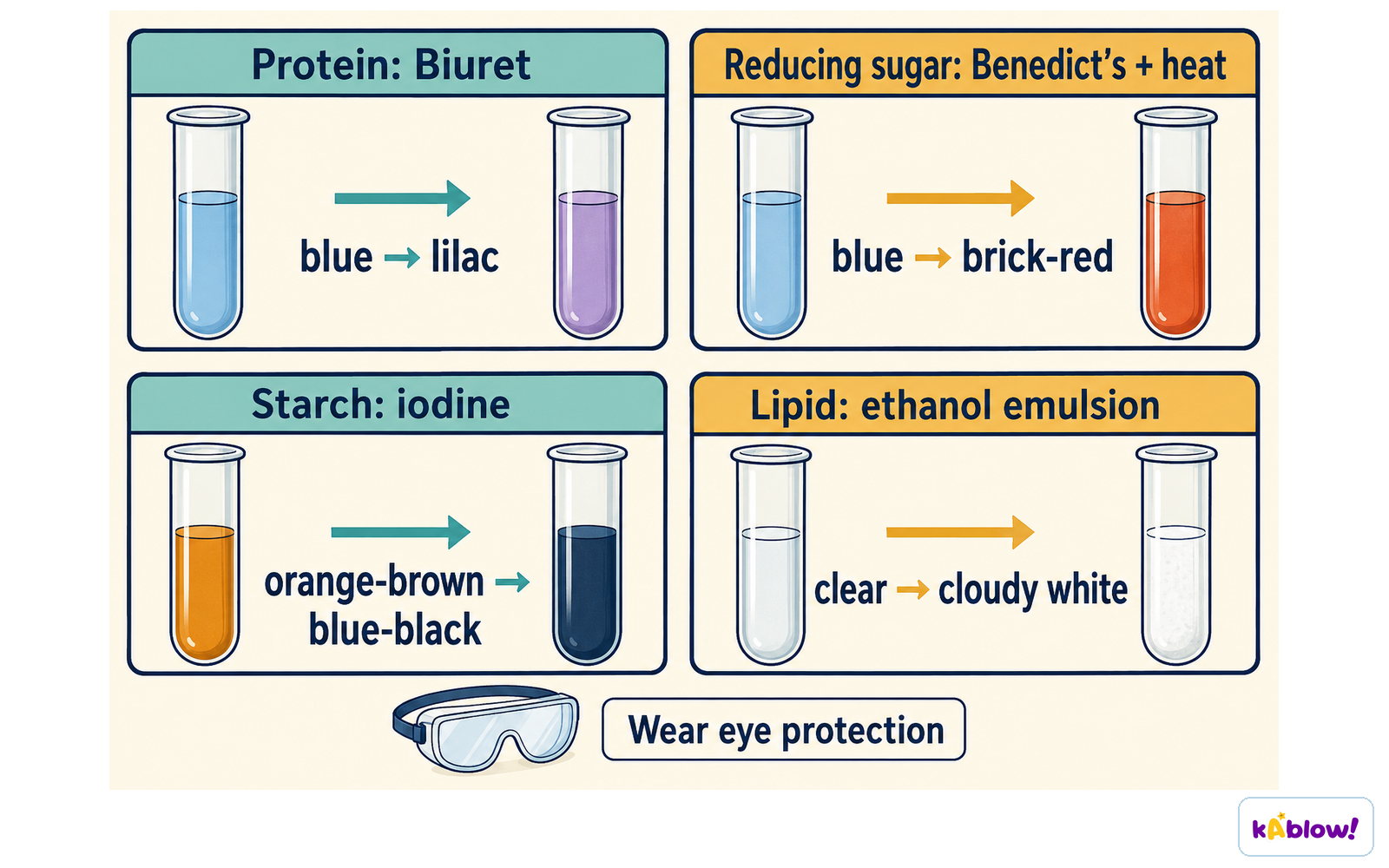
Biuret test: blue reagent gives a lilac-purple result when protein is present.
Benedict's test: heat the food sample and reagent in a water bath; orange is a positive result.
Iodine test: orange-brown iodine turns blue-black when starch is present.
Emulsion test: add ethanol, then water; a milky white emulsion shows lipids are present.
Slide
Sign up free to view the lesson slides
Step through every slide for this topic — plus flashcards and revision notes — with a free account.
Câu hỏi luyện tập
Xem trước miễn phí — 8 trên 65 câu hỏi. Đăng ký để xem tất cả.
1.Which food contains a lot of lipids?
Easy- ABread
- BApple
- CButter
- DRice
2.Which food contains a lot of protein?
Easy- APasta
- BEggs
- COrange juice
- DPotato
3.Which food contains a lot of sugars?
Easy- ABread
- BCheese
- CFruit juice
- DButter
4.Which food contains a lot of carbohydrates?
Easy- AMeat
- BFish
- CBread
- DEggs
5.An investigation is carried out to determine if a food sample contains sugars. Which test should be used and what colour change indicates sugar is present?
Medium- ABiuret test; blue to purple
- BBenedict's test; blue to green/yellow/orange/red
- CIodine test; yellow/brown to blue/black
- DEthanol test; colourless to cloudy white
6.An investigation is carried out to determine if a food sample contains lipids. Which test should be used and what colour change indicates lipids are present?
Medium- ABiuret test; blue to purple
- BBenedict's test; blue to red
- CIodine test; yellow/brown to blue/black
- DEthanol test; colourless to cloudy white
7.An investigation is carried out to determine if a food sample contains protein. Which test should be used and what colour change indicates protein is present?
Medium- ABiuret test; blue to purple
- BBenedict's test; blue to red
- CIodine test; yellow/brown to blue/black
- DEthanol test; colourless to cloudy white
8.Iodine solution is dropped onto a slice of bread. What will be observed and why?
Medium- AThe iodine turns blue/black because bread contains starch.
- BThe iodine turns purple because bread contains protein.
- CThe iodine turns red because bread contains sugar.
- DThe iodine remains yellow/brown because bread contains lipids.
Unlock all 65 questions, flashcards & more
Tạo tài khoản miễn phí để xem mọi câu hỏi, slide, thẻ ghi nhớ và ghi chú ôn tập cho chủ đề này.