Gas exchange in plants
Học bằng cách chơi
Trả lời những câu hỏi này để kiếm năng lượng, rồi câu cá và khám phá. Không cần tài khoản.
Ghi chú bài học
Overview of Gas Exchange in Plants
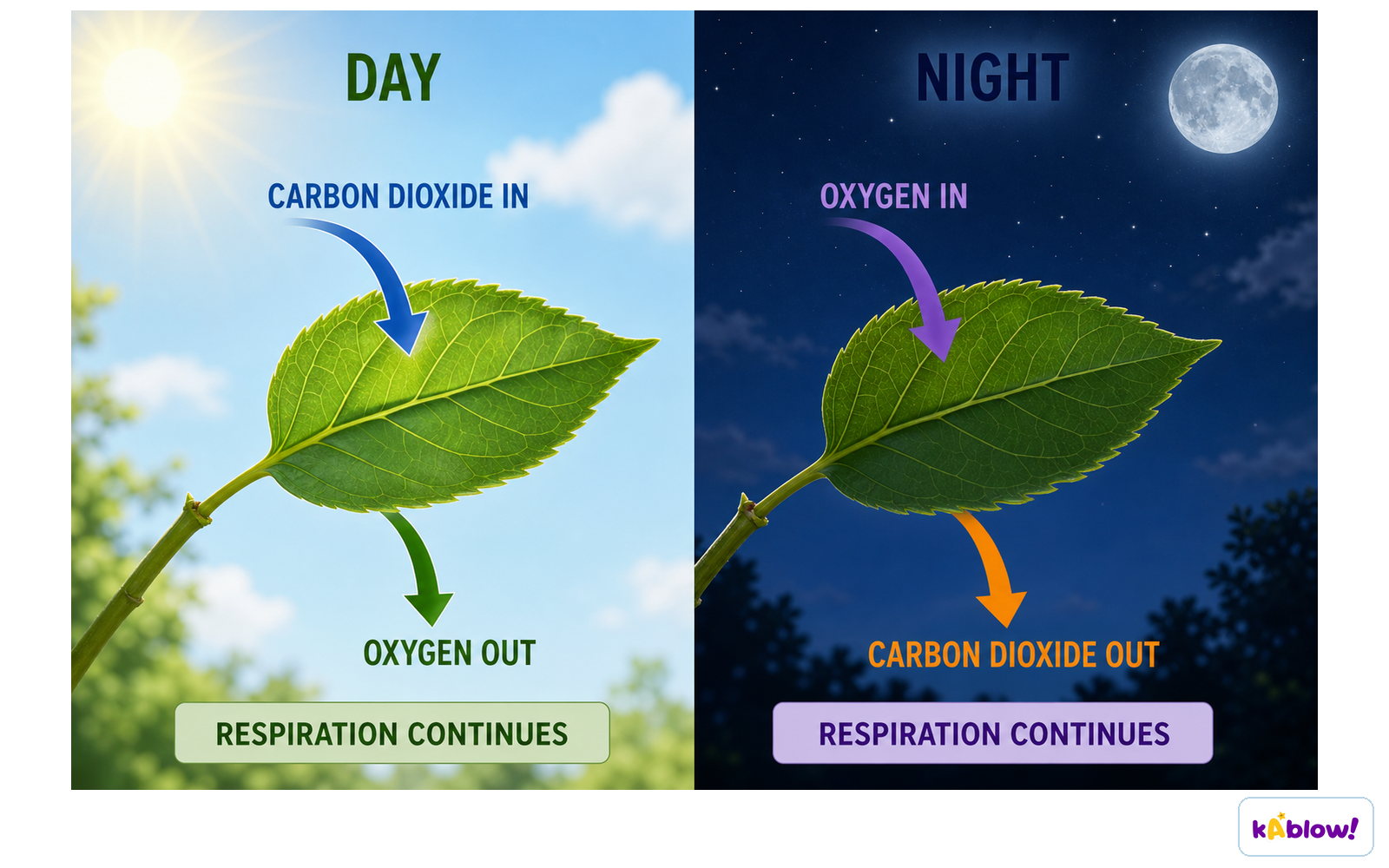
- Plants exchange gases with the environment to survive.
- Photosynthesis: takes in carbon dioxide and releases oxygen.
- Respiration: takes in oxygen and releases carbon dioxide.
- The leaf is the main organ for gas exchange.
In daylight, net carbon dioxide enters and oxygen leaves; at night, net oxygen enters and carbon dioxide leaves.
Stomata
- Stomata are small openings mainly on the underside of leaves.
- Each stoma is surrounded by two guard cells that control its opening and closing.
- When open, carbon dioxide enters and oxygen and water vapour exit.
- Stomata allow gas exchange while regulating water loss.
Guard Cells
- Guard cells swell and open stomata when the plant has plenty of water.
- When water is scarce, guard cells shrink and close stomata to prevent water loss.
- They control the balance between gas exchange and water conservation.
Spongy Mesophyll
- The spongy mesophyll layer has loosely arranged cells with air spaces.
- Air spaces facilitate the movement of gases through the leaf.
- Carbon dioxide diffuses through air spaces to reach palisade cells for photosynthesis.
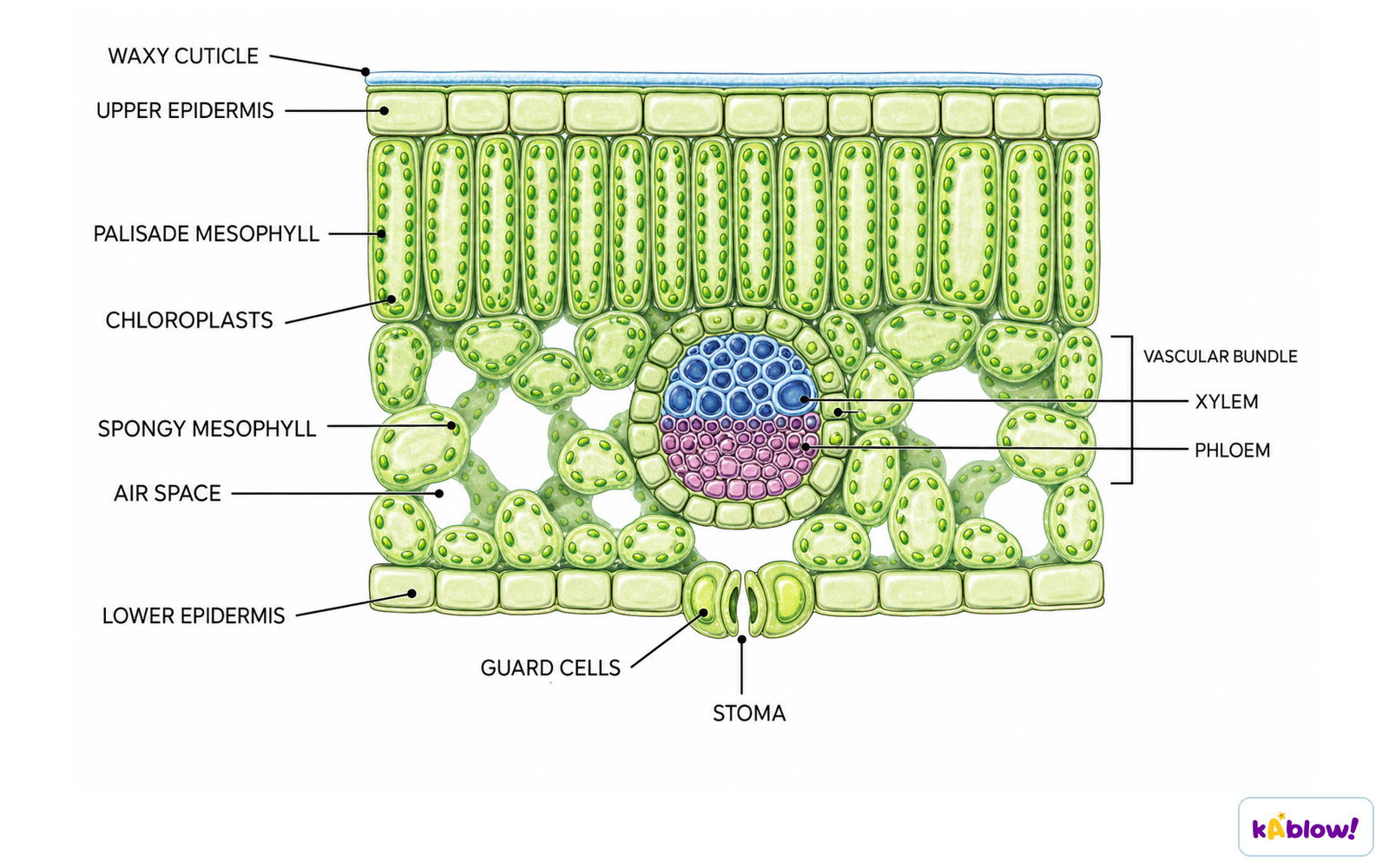
A dicotyledonous leaf cross-section showing epidermal layers, mesophyll, air spaces, a vascular bundle, chloroplasts and guard cells.
Palisade Mesophyll
- The palisade mesophyll layer consists of tightly packed cells.
- These cells are rich in chloroplasts, the site of photosynthesis.
- The arrangement maximises light absorption for photosynthesis.
Waxy Cuticle
- The waxy cuticle is a thin, protective layer covering the leaf surface.
- It prevents excessive water loss by reducing evaporation.
- It allows light to penetrate for photosynthesis.
Cross-section of a leaf showing cuticle, epidermis, palisade and spongy mesophyll, air spaces, stoma and guard cells.
Slide
Sign up free to view the lesson slides
Step through every slide for this topic — plus flashcards and revision notes — with a free account.
Câu hỏi luyện tập
Xem trước miễn phí — 8 trên 57 câu hỏi. Đăng ký để xem tất cả.
1.Where are stomata mainly located on a leaf?
Easy- AUnderside of the leaf
- BUpper side of the leaf
- CBoth sides equally
- DOnly on the leaf edges
2.Which cells control the opening and closing of stomata?
Easy- AGuard cells
- BPalisade cells
- CSpongy mesophyll cells
- DEpidermal cells
3.During photosynthesis, plants take in which gas?
Easy- ACarbon dioxide
- BOxygen
- CNitrogen
- DWater vapour
4.Which layer of the leaf contains loosely arranged cells with air spaces?
Easy- ASpongy mesophyll
- BPalisade mesophyll
- CWaxy cuticle
- DEpidermis
5.What is the main function of the waxy cuticle on a leaf?
Easy- APrevent excessive water loss
- BAbsorb carbon dioxide
- CCarry out photosynthesis
- DOpen and close stomata
6.When water is scarce, what happens to the stomata?
Easy- AThey close to prevent water loss
- BThey open wider to absorb more carbon dioxide
- CThey remain unchanged
- DThey move to the upper leaf surface
7.Which statement about gas exchange in plants is correct?
Medium- APlants take in oxygen and release carbon dioxide only during respiration
- BPlants take in carbon dioxide and release oxygen only during photosynthesis
- CPlants take in oxygen and release carbon dioxide only during photosynthesis
- DPlants take in carbon dioxide and release oxygen only during respiration
8.Why are palisade mesophyll cells well suited for photosynthesis?
Medium- AThey are tightly packed and rich in chloroplasts
- BThey contain large air spaces
- CThey are located on the leaf underside
- DThey have a waxy coating
Unlock all 57 questions, flashcards & more
Tạo tài khoản miễn phí để xem mọi câu hỏi, slide, thẻ ghi nhớ và ghi chú ôn tập cho chủ đề này.