Life processes and unicellular organisms
Học bằng cách chơi
Trả lời những câu hỏi này để kiếm năng lượng, rồi câu cá và khám phá. Không cần tài khoản.
Ghi chú bài học
Life Processes (MRS GREN)
- All living organisms perform seven life processes, remembered by the acronym MRS GREN.
- Movement: All living things move; plants grow towards light, animals move to find food or escape danger.
- Respiration: A chemical reaction that releases energy stored in glucose.
- Sensitivity: Living things sense changes in their environment and respond (e.g., humans feel heat, plants grow towards light).
- Growth: Organisms increase in size; unicellular organisms grow by increasing cell size, multicellular by producing more cells.
- Reproduction: The process of producing offspring.
- Excretion: The removal of waste products from the body.
- Nutrition: Plants photosynthesise; animals eat plants or other animals.
Unicellular Organisms
- Unicellular organisms are living organisms made of just one cell.
- Despite their small size, they perform all seven life processes.
- Examples include bacteria, euglena, amoebas, and yeast (a fungus).
Bacteria
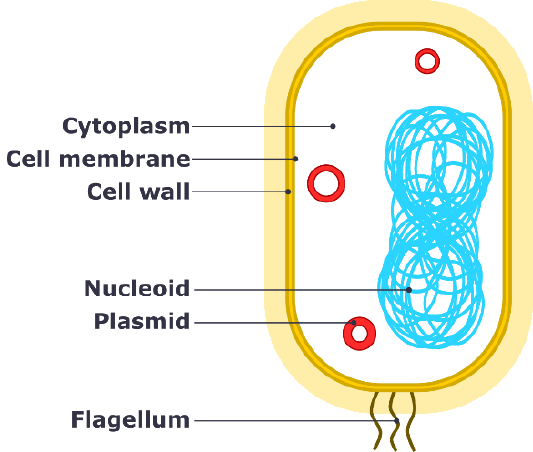
- Bacteria are some of the most common and diverse unicellular organisms.
- They do not have a nucleus; genetic material is located in the nucleoid and plasmids.
- Some bacteria have a long tail called a flagellum for movement.
- Bacteria have a cell wall, cell membrane, and ribosomes.
Structure of a bacterium
Euglena
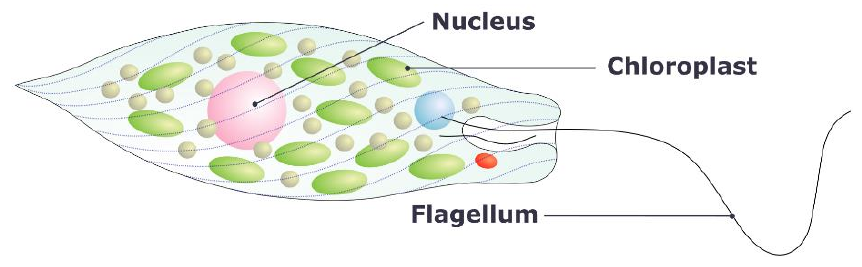
- Euglena is a unicellular organism found in water.
- It has a flagellum to help it swim.
- It contains chloroplasts for photosynthesis.
Structure of Euglena
Other Unicellular Organisms
- Amoebas are unicellular organisms that move and feed using pseudopods.
- Yeast is a unicellular fungus used in baking and brewing.
Slide
Sign up free to view the lesson slides
Step through every slide for this topic — plus flashcards and revision notes — with a free account.
Câu hỏi luyện tập
Xem trước miễn phí — 8 trên 26 câu hỏi. Đăng ký để xem tất cả.
1.How many life processes do all living organisms perform?
Easy- ASeven
- BFive
- CSix
- DEight
2.Which of the following is NOT a life process?
Easy- APhotosynthesis
- BRespiration
- CExcretion
- DSensitivity
3.Which statement about unicellular organisms is correct?
Easy- AThey are made of one cell and perform all life processes.
- BThey are made of many cells and perform only some life processes.
- CThey are made of one cell and perform only some life processes.
- DThey are made of many cells and perform all life processes.
4.Which of the following is an example of a unicellular organism?
Easy- ABacterium
- BHuman
- COak tree
- DMushroom
5.Bacteria do not have a nucleus. Where is their genetic material located?
Easy- AIn the nucleoid and plasmids
- BIn the nucleus
- CIn the cytoplasm
- DIn the cell wall
6.What is the function of the flagellum in some bacteria?
Easy- AMovement
- BRespiration
- CReproduction
- DNutrition
7.Euglena is a unicellular organism that can photosynthesise. Which organelle allows it to do this?
Easy- AChloroplast
- BMitochondrion
- CNucleus
- DFlagellum
8.A student observes a unicellular organism under a microscope. It has a flagellum and chloroplasts. Which organism is it most likely to be?
Medium- AEuglena
- BAmoeba
- CYeast
- DBacterium
Unlock all 26 questions, flashcards & more
Tạo tài khoản miễn phí để xem mọi câu hỏi, slide, thẻ ghi nhớ và ghi chú ôn tập cho chủ đề này.