Changes of state
Học bằng cách chơi
Trả lời những câu hỏi này để kiếm năng lượng, rồi câu cá và khám phá. Không cần tài khoản.
Ghi chú bài học
Conservation of Mass
- During a state change, the number of particles stays the same.
- The mass before a state change equals the mass after – this is conservation of mass.
- No particles are lost or gained; only their arrangement and energy change.
Particle Model of Solids
- Particles are held together in a regular pattern.
- They vibrate around fixed positions.
- Heating increases vibrations until the melting point is reached.
- Example: melting point of water is 0°C.
Melting (Solid → Liquid)
- At the melting point, temperature stays constant while melting occurs.
- Particles break free from fixed positions but remain in contact.
- Once fully melted, particles can move past each other (liquid state).
Boiling (Liquid → Gas)
- Heating a liquid makes particles move faster until the boiling point.
- At boiling point, particles gain enough energy to separate from each other.
- Gas particles are far apart and move quickly in random directions.
- Example: boiling point of water is 100°C.
Condensation (Gas → Liquid)
- Cooling a gas to its boiling point causes it to condense into a liquid.
- Particles lose energy and come closer together.
Freezing (Liquid → Solid)
- Cooling a liquid to its melting point causes it to freeze into a solid.
- Particles become fixed in a regular pattern.
Sublimation and Deposition
- Sublimation: solid changes directly into a gas (e.g., dry ice).
- Deposition: gas changes directly into a solid (e.g., frost formation).
Summary of State Changes
- Solid → Liquid: melting
- Liquid → Gas: boiling/evaporation
- Gas → Liquid: condensation
- Liquid → Solid: freezing
- Solid → Gas: sublimation
- Gas → Solid: deposition
Heating drives melting, boiling, evaporation and sublimation; cooling reverses them through freezing, condensation and deposition.
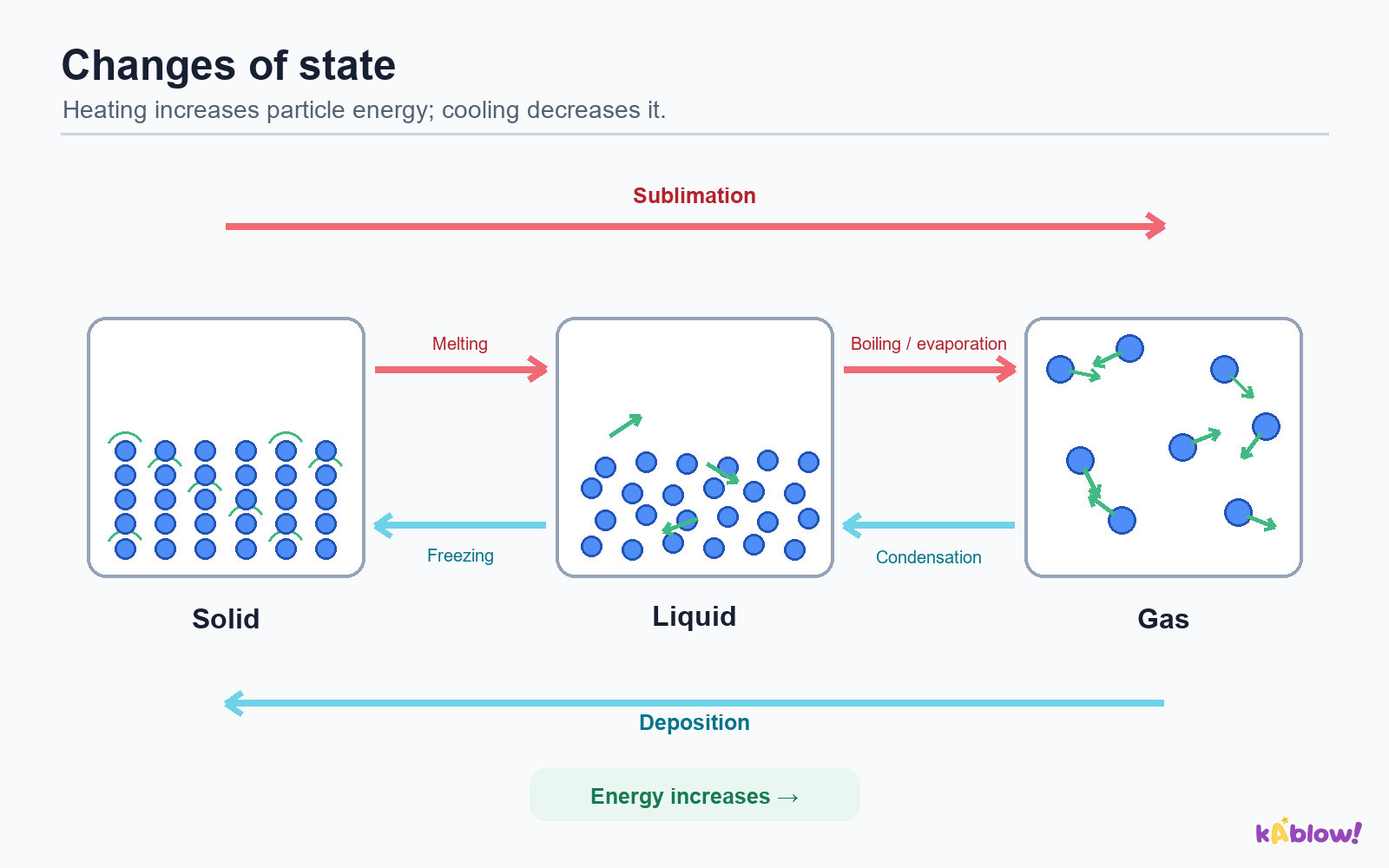
Particle arrangements in the three states
Slide
Sign up free to view the lesson slides
Step through every slide for this topic — plus flashcards and revision notes — with a free account.
Câu hỏi luyện tập
Xem trước miễn phí — 8 trên 40 câu hỏi. Đăng ký để xem tất cả.
1.What is meant by the conservation of mass during a change of state?
Easy- AThe total number of particles remains the same, so mass does not change.
- BMass is lost when a solid melts.
- CMass is gained when a gas condenses.
- DThe mass changes but the number of particles stays the same.
2.What is the name of the change of state from solid to liquid?
Easy- AMelting
- BFreezing
- CCondensation
- DSublimation
3.What is the name of the change of state from gas to liquid?
Easy- ACondensation
- BEvaporation
- CDeposition
- DFreezing
4.What is the name of the change of state from liquid to gas?
Easy- ABoiling
- BMelting
- CCondensation
- DSublimation
5.What is the name of the change of state from gas to solid?
Easy- ADeposition
- BSublimation
- CCondensation
- DFreezing
6.What is the name of the change of state from solid to gas?
Easy- ASublimation
- BDeposition
- CMelting
- DEvaporation
7.What is the name of the change of state from liquid to solid?
Easy- AFreezing
- BMelting
- CCondensation
- DDeposition
8.What is the melting point of water?
Easy- A0°C
- B100°C
- C-10°C
- D50°C
Unlock all 40 questions, flashcards & more
Tạo tài khoản miễn phí để xem mọi câu hỏi, slide, thẻ ghi nhớ và ghi chú ôn tập cho chủ đề này.